Author: admin

  • Geoengineering for global warming: Increasing aerosols in atmosphere would make sky whiter

    ScienceDaily: Earth Science News


    Catching solar particles infiltrating Earth’s atmosphere

    Posted: 31 May 2012 05:09 PM PDT

    On May 17, 2012, an M-class flare exploded from the sun. They caused a shower of particles to cascade down toward Earth’s surface. The shower created what’s called a ground level enhancement (GLE).

    Chemical substitution: On early Earth, iron may have performed magnesium’s RNA folding job

    Posted: 31 May 2012 05:09 PM PDT

    Researchers have used experiments and numerical calculations to show that iron, in the absence of oxygen, can substitute for magnesium in RNA binding, folding and catalysis. The findings suggest that three billion years ago, on the early Earth, iron did the chemical work now done by magnesium.

    Geoengineering for global warming: Increasing aerosols in atmosphere would make sky whiter

    Posted: 31 May 2012 08:26 AM PDT

    One idea for fighting global warming is to increase the amount of aerosols in the atmosphere, scattering incoming solar energy away from Earth’s surface. But scientists theorize that this solar geoengineering could have a side effect of whitening the sky during the day. New research indicates that blocking 2 percent of the sun’s light would make the sky three-to-five times brighter, as well as whiter.

    ‘Like a jet through solid rock:’ Volcanic arc fed by rapid fluid pulses

    Posted: 31 May 2012 07:19 AM PDT

    The depths of Earth are anything but peaceful: large quantities of liquids carve their way through the rock as fluids, causing magma to form. Scientists have now shown that the fluids flow a lot faster through solid rock than previously assumed.

    Potentially civilization-ending super-eruptions may have surprisingly short fuses

    Posted: 30 May 2012 02:20 PM PDT

    Super-eruptions are potentially civilization-ending events and new research suggests that they may have surprisingly short fuses.

    Landslides linked to plate tectonics create the steepest mountain terrain

    Posted: 30 May 2012 12:20 PM PDT

    New research shows some of the steepest mountain slopes in the world got that way because of the interplay between terrain uplift associated with plate tectonics and powerful streams cutting into hillsides, leading to large landslides.

    Why Earth is not an ice ball: Possible explanation for faint young sun paradox

    Posted: 30 May 2012 12:20 PM PDT

    More than 2 billion years ago, a much fainter sun should have left the Earth as an orbiting ice ball. Why we avoided the deep freeze is a question that has puzzled scientists, but one astronomer might have an answer.

    Arctic bacteria help in the search to find life on Jupiter’s moon Europa

    Posted: 30 May 2012 07:04 AM PDT

    In a fjord in Canada, scientists have found a landscape similar to one of Jupiter’s icy moons: Europa. It consists of a frozen and sulfurous environment, where sulfur associated with Arctic bacteria offer clues for the upcoming missions in the search for traces of life on Europa.
    You are subscribed to email updates from ScienceDaily: Earth Science News
    To stop receiving these emails, you may unsubscribe now.
    Email delivery powered by Google
    Google Inc., 20 West Kinzie, Chicago IL USA 60610
  • Switching to a green economy could mean millions of jobs, says UN

    Switching to a green economy could mean millions of jobs, says UN

    United Nations Environment Programme says global move to low-carbon economy means millions could be lifted from poverty

    • guardian.co.uk, Thursday 31 May 2012 14.57 BST
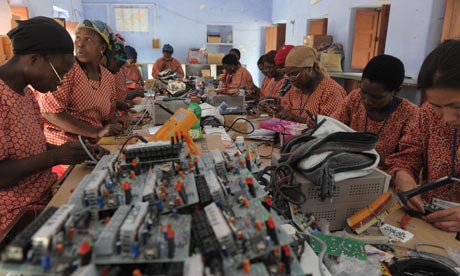
    • Green jobs : African women learn about circuit boards for solar lights at the Barefoot College India

      Women learning how to integrate circuit boards for solar lights in the Indian state of Rajasthan. Photograph: Roberto Schmidt/AFP/Getty Images

      Tens of millions of new jobs can be created around the world in the next two decades if green policies are put in place to switch the high-carbon economy to low-carbon, the UN has said.

      Between 15m and 60m additional jobs are likely, according to a new report from the United Nations Environment Programme (Unep). These are net gains in employment for the world economy, taking into account any job losses in high-carbon industries that fail to transform.

      Achim Steiner, executive director of Unep, said: “The findings underline that [the green economy] can include millions more people in terms of overcoming poverty and delivering improved livelihoods for this and future generations. It is a positive message of opportunity in a troubled world of challenges.”

      As well as generating net new gains in the number of jobs, the switch to a green economy could help to lift millions of people out of poverty.

      In the US, there are now about three million “green jobs“, in sectors such as wind power and energy efficiency, the study found. In the UK, the number is close to one million and has been one of the few areas of the economy that has been creating jobs. There are about 500,000 people working in green jobs in Spain. In the developing world, too, the number is growing rapidly – about 7% of people employed in Brazil, amounting to three million people, are now in the green economy.

      However, realising the full potential of green jobs depends on countries taking action to develop the green economy and bringing in policies that will foster investment, according to the report.

      Juan Somavia, director general of the International Labour Organisation, which was co-author of the report, said: “The current development model has proven to be inefficient and unsustainable, not only for the environment, but for economies and societies as well. We urgently need to move to a sustainable development path with a coherent set of policies, with people and the planet at the centre.”

      He rebuffed claims that greening industry would lead to job losses, because of the changes to some traditional industries such as fossil fuel extraction. He said: “Environmental sustainability is not a job killer, as it is sometimes claimed. On the contrary, if properly managed, it can lead to more and better jobs, poverty reduction and social inclusion.”

      Some areas are more vulnerable to losses – global fishing fleets, for instance, will probably have to be reduced if overfishing is to be tackled, and fishermen will have to be found new employment. But the report found that long-term sustainable management could avoid job losses. For instance, an estimated one million people in Asia may have lost jobs in forestry because of poor resource management, which could have been largely avoided with better policies and enforcement.

      Jobs easily identified as “green” – workers in renewable energy, for instance, maintaining forests or installing insulation – are not the only ones to be touched by the shift to a more environmentally sustainable economy. At least half of the global workforce will be affected in some way by 2030, the study found. This will stretch from people whose industrial processes are overhauled to cut greenhouse gases, to farmers who change their methods to be more environmentally friendly, and workers in the construction industry who begin to install new greener materials.

      Some of the sectors identified in the report as being most affected by the changes include: agriculture, forestry, fishing, energy, resource-intensive manufacturing, recycling, building and transport.

      Women could benefit – if the shift is managed properly it could provide them with better access to jobs and higher incomes.

      The study, Working towards sustainable development: opportunities for decent work and social inclusion in a green economy, has been timed to be published ahead of World Environment Day next week, and to inform discussions at the landmark Rio+20 environmental conference, where nations will attempt to work on a new set of targets and agreements to help halt environmental degradation around the world.

  • The energy bill is misleading, manipulative and destructive

    The energy bill is misleading, manipulative and destructive

    Ed Davey has manipulated quotes to support the bill and a clause has been inserted to allow any coal plant to be built

    Energy Minister Charles Hendry sits on Ed Davey

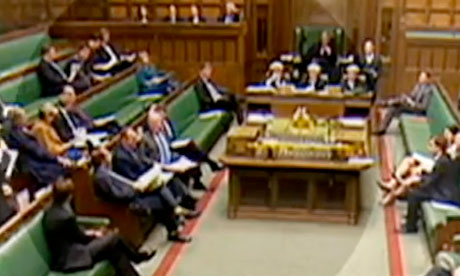
    The energy minister Charles Hendry has sat physically on Ed Davey. Photograph: ITV News

    My conversation with Ed Davey began badly. Two weeks ago the Liberal Democrat secretary of state rang me to explain that his energy bill would be the best legislation drafted since the 10 commandments. It happened that earlier that day, Ed Davey’s deputy, the Conservative energy minister Charles Hendry, whom it would be inaccurate to describe as petite, had delivered a statement to the House of Commons, after which he had tried to reverse into his seat. But he missed, and instead sat on the secretary of state. I told Davey that I hoped he had recovered, and that it seemed to me symbolic of the Lib Dems’ role in the coalition.

    To say that he took this in the wrong spirit is to state the case mildly. He insisted that it is “inaccurate and unwarranted to suggest that the Liberal Democrats are being sat on by the Conservatives”. Ten minutes later, halfway through a long and riveting disquisition on “feed-in tariffs with contracts for difference”, he suddenly and unexpectedly returned to the theme, hotly insisting that his role in government proved that the Liberal Democrats were not in any sense or any manner being sat on. That clears it up then.

    Our relationship is about to deteriorate further, as I will use this article to accuse Davey of some of the lowest and most deceitful tactics in the politician’s armoury.

    On Tuesday, the Guardian published a letter from Davey, in which he claimed that I mistake his “short-term methods” (approving more gas and coal plants) for his “long-term goals” (stopping climate change). It’s easy to mix them up, isn’t it? Approving more gas and coal plants looks so much like stopping climate change that I’m sure he can understand my confusion.

    But the question it raises is what he means by “short-term”. As I explained in my column this week, his energy bill allows gas plants to produce more carbon dioxide than they do today, until 2045. It imposes no restrictions at all on coal plants, as long as they undertake that one day in the indeterminate future they will “demonstrate” that carbon capture and storage equipment could reduce an unspecified quantity of their emissions. So the short term, in Davey’s view, expires at some time between 2045 and the end of the solar system.

    Even at the beginning of this expiry period, the battle to prevent escalating climate change will be all over bar the shouting. Davey’s “transitional” technologies, gas and coal (which are transitional in the sense that chocolate fudge cake is a transition to a low-calorie diet), will knacker his supposed long-term goals many years before the “short term” comes to an end.

    He then went on to claim that “the Committee on Climate Change [the government’s climate advisers] says our approach “could be compatible with power sector decarbonisation required to meet carbon budgets – provided we reform the electricity market to secure low-carbon investment.”

    So this is the first of the deceptions of which I will accuse him: one of the most blatant cases of selective quotation I have yet encountered. Here is what the Committee on Climate Change actually said:

    “The approach set out in the announcement could be compatible with power sector decarbonisation required to meet carbon budgets, but also carries the risk that there will be too much gas-fired generation instead of low-carbon investment.”

    As the blog CarbonBrief points out,

    “Presumably the second half of the last sentence wasn’t quite so useful to Davey’s point, so he left it off.”

    The committee also pointed out that:

    “It is important that a clear decarbonisation objective is set for [Davey’s electricity market reform], and that a process is put in place to ensure that this objective is achieved.”

    The energy bill singularly fails to deliver either the objective or the process. Davey’s attempt to claim the committee’s endorsement is manipulative and misleading.

    After I wrote my column, Alex Marshall from trade magazine the Ends report got in touch to point out that I had missed something. Buried in the outer reaches of the known world (annex D of the bill) is a single sentence, which allows ministers to rip up any conditions for the construction and operation of new coal plants in this country.

    Admittedly, these conditions are so feeble as to be effectively useless. Coal plants can be built as long as:

    “Carbon capture and storage technology is or is to be, or has been, used in commercial electricity generation for the purposes of or in connection with a CCS demonstration project.”

    No figure is mentioned and – if you read it carefully – you will see that nothing actually needs to have been done: they will be approved if they undertake that CCS “is to be” demonstrated at some point in the future. “Demonstrated” does not mean that it has to continue to work, less still that it has to apply to any more than a small fraction of the emissions the plant produces.

    But the little sentence in annex D appears to grant Davey and his successors a licence to cancel even this condition:

    “Exceptions: power to make exceptions to maintain energy security.”

    Given that the bill is pitched partly as an attempt to maintain energy security, this appears to allow the government to approve any coal plant it chooses, whether or not it will one day be fitted with carbon capture and storage equipment.

    So Davey, I don’t know whether you have been sat on by the Conservatives, except in the literal sense. But I do know that both your bill and the claims you have made about it are as misleading, as manipulative and as destructive as anything this government has yet done. And that is saying quite a lot.

  • Secrets of Volcano Lightning Probed During Alaska Eruption

    Secrets of Volcano Lightning Probed During Alaska Eruption
    Our Amazing Planet
    Lightning is often seen crackling in the plumes of explosive volcanic eruptions, such as thatof the Icelandic volcano Eyjafjallajökull. However, active volcanoes are often quite remote from civilization and their outbursts are sudden and unpredictable,
    See all stories on this topic »
    Super Volcanoes Form Super Fast
    Discovery News
    Earlier estimates thought that it could take 100000 to 300000 years for the magma pools that erupt into super-volcanoes to form, so no one was particularly worried about a super-eruption in the near future. But a new study by Vanderbilt University
    See all stories on this topic »
    The planet’s largest volcanoes may have taken as little as a few hundred years
    BBC News
    It was thought supervolcanoes took 200000 years to develop but it’s now believed it happens much faster. Researchers at a 760000 year old supervolcano site in California found that the magma pool beneath it erupted a few hundred years after forming.
    See all stories on this topic »

    BBC News
    Iceland’s volcanoes could power UK homes
    Energy Live News
    UK households could get their electricity supplied from Iceland’s volcanoes following an agreement signed yesterday between the two countries. This follows Energy Minister Charles Hendry’s visit to a power station in Iceland’s south west region earlier
    See all stories on this topic »
    The global economy is sitting on a volcano. What happens next?
    FM blog (blog)
    Why do people choose to live on a dangerous explosive volcano? People are too comfortable to move, and it pays to live there. The soil is often rich. Some volcanoes have rich mineral deposits or tourism. And they probably will get lucky,
    See all stories on this topic »

    FM blog (blog)
    UK and Iceland sign Volcano deal
    reNews Europe
    The UK has signed a memorandum of understanding with Iceland to pave the way for sourcing geothermal power from the islands volcanoes. The agreement was signed by UK energy minister Charles Hendry and his Icelandic counterpart Oddný G. Harðardóttir.
    See all stories on this topic »

    reNews Europe
    UK eyes geothermal energy from volcanoes
    UPI.com
    REYKJAVíK, Iceland, May 31 (UPI) — The British government said it signed a deal aimed at getting electricity supplied through geothermal energy derived from Icelandic volcanoes. British Minister of State for Energy Charles Hendry signed a memorandum
    See all stories on this topic »
  • Abbott’s conscientious objection will deliver Greens more power

    Abbott’s conscientious objection will deliver Greens more power

    3

    TODAY, a number of NSW Coalition MPs will vote in favour of a motion from Greens’ MP Cate Faehrmann that supports gay marriage.

    They will do this because, as conservatives, they believe in marriage.

    They believe marriage will strengthen same-sex relationships and bring families closer together, while marriage itself will benefit from same-sex couples who want to uphold its traditional values.

    They will also vote in favour of protections for religious ministers in any amendment to the federal Marriage Act, following a sensible amendment to the motion from Nationals MP Trevor Khan.

    The reason they are free to act on their conservative principles is Premier Barry O’Farrell is sticking to Coalition tradition and granting a free vote.

    This means today’s vote will make history for being the first time Coalition MPs will vote for same-sex marriage.

    This will send a strong message to Canberra that conservative politicians support equality because of their conservative principles and should be able to act on these principles when voting. Unlike Premier O’Farrell, Opposition Leader Tony Abbott is still denying a free vote at the federal level. This is despite the very clear message from recent opinion polls that the Coalition will suffer electorally if Tony Abbott keeps refusing Coalition MPs and senators the right to vote according to their conscience.

    Abbott’s stance is the first time ever that the federal Coalition will be denied a free vote when the ALP has one. His rationale is that he made a promise at the last election not to support reform. But no promise was made that he would break Coalition tradition and deny a free vote, and polling proves voters know this.

    Last weekend a Galaxy poll showed 77 per cent of Coalition voters want the Coalition to have a conscience vote on the issue. Another recent Galaxy poll showed 73 per cent of voters believe the Coalition’s tradition of allowing a conscience vote on such issues is what should guide Coalition policy, not Abbott’s personal views or undertakings.

    The same poll showed 61 per cent of Australians want same-sex marriage in this term of government, not sometime down the track. Is this feeling strong enough to count at the ballot box? Bob Katter thinks so. During a discussion with Kevin Rudd at the Sydney Writers’ Festival, Katter conceded his Australia Party lost 7 per cent of its first-preference votes because of the anti-gay marriage ad campaign it ran.

    Growing support for marriage equality also suggests Abbott’s stance will be a liability for the Coalition. The overwhelming response to recent parliamentary inquiries into marriage equality showed Australians are more highly motivated than ever to support the issue.

    A senate inquiry received an unprecedented 44,000 submissions in favour of marriage equality and a house of representatives inquiry received 177,000 positive responses. This makes legislation to allow same-sex marriages the most popular in our parliament’s history.

    What this means for Abbott is clear – his hardline stance will guarantee the Greens will have the balance of power in the senate after the next election.

    Thanks to Julia Gillard’s continued and clear opposition to equality, the protest vote against Abbott will go straight to Christine Milne.

    O’Farrell understands that allowing some MPs to vote for marriage equality proves that the Coalition is a “broad church”.

    Abbott doesn’t get this, but he will at the next election if he doesn’t change his mind. His stubbornness will make life very difficult for inner-city Liberals such as Kelly O’Dwyer, Malcolm Turnbull and Teresa Gambaro, whose polling shows support for marriage equality running as high as 75 per cent.

    Unless Abbott allows a free vote the issue will plague these and other Liberals throughout the next election. It will be raised at every public meeting they attend. It will distract them from the issues they want to focus on. It will be used to criticise the Coalition for being out of step with the strong support for marriage equality among young Australians.

    Today, the NSW parliament is set to send a strong message of hope to gay and lesbian Australians. By denying the federal Coalition a free vote, Tony Abbott is sending the Greens a message of hope that they will have the balance of power after the next election.

    Alex Greenwich is convenor of Australian Marriage Equality

    1 comment on this story

  • Burke laments parliamentary behaviour


    Burke laments parliamentary behaviour

    Updated: 09:35, Friday June 1, 2012

    Burke laments parliamentary behaviour

    The MP presiding over the proceedings of federal parliament has never seen it as bad as it is now and has blamed the hung parliament for the level of personal attacks.

    Deputy Speaker Anna Burke, who is sitting in the chair vacated by Speaker Peter Slipper until he’s cleared of criminal allegations and a civil claim, has been responsible for keeping order in a ‘pretty brutal’ House of Representatives.

    Ms Burke says the mood of parliament has reached a level of intensity and personal vitriol she hasn’t seen during her 14 years in the lower house.

    She’s told ABC Radio a couple of times during the week she’s wanted to hurl some abuse as well but she can’t do that anymore.