Author: admin

  • Winds of change blow through China as spending on renewable energy soars

    Winds of change blow through China as spending on renewable energy soars

    World’s biggest polluter spends £4bn a year on wind and solar power generation in single region as it aims to cut fossil fuel use

    • guardian.co.uk, Monday 19 March 2012 19.31 GMT
    • Article history
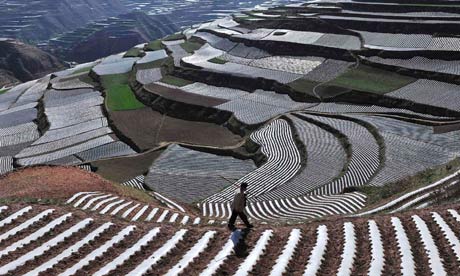
    • A farmer walks past a terrace of dang shen, a traditional Chinese medicine, in Gansu province

      A farmer walks past a terrace of dang shen, a traditional medicine, in Gansu – a region being transformed by spending on renewables. Photograph: Sheng Li/Reuters

      The remote, wind-blasted desert of northwestern Gansu could be the most unloved, environmentally abused corner of China. It is home to the country’s first oilfield and several of the coalmines and steel factories that have contributed to China’s notoriety as the planet’s biggest polluter and carbon dioxide emitter.

      But in the past few years, the landscape has started to undergo a transformation as Gansu has moved to the frontline of government efforts to reinvent China’s economy with a massive investment in renewable energy.

      The change is evident soon after driving across the plains from Jiuquan, an ancient garrison town on the Silk Road that is now a base for more than 50 energy companies.

      Wind turbines, which were almost unknown five years ago, stretch into the distance, competing only with far mountains and new pylons for space on the horizon. Jiuquan alone now has the capacity to generate 6GW of wind energy – roughly equivalent to that of the whole UK. The plan is to more than triple that by 2015, when this area could become the biggest windfarm in the world.

      This is the other side of China’s development. Although it is the world’s biggest CO2 emitter and notorious for building the equivalent of a 400MW coal-fired power station every three days, it is also erecting 36 wind turbines a day and building a robust new electricity grid to send this power thousands of miles across the country from the deserts of the west to the cities of the east.

      It is part of a long-term plan to supply 15% of the country’s energy from renewable sources by 2020. Most of that will come from nuclear and hydropower, but the government is also tapping the wind and solar potential of the deserts, mountain plateaus and coastlines.

      The scale of investment has led to hopes that China may emerge as the world’s first green superpower. This is premature. Breakneck economic growth has left much of the country enshrouded in a murky grey smog. But the environmental crisis is so bad that it is a driver for change.

      Carbon dioxide emissions have more than doubled in the past 10 years, taking China past the US as the world’s No 1 source of greenhouse gases. Dirty smokestacks and illegal discharge pipes contribute to the hundreds of thousands of annual premature deaths from pollution related diseases. Environment ministry statistics suggest that 40% of river water can make you sick.

      Four in five major cities are unlikely to reach the government’s relatively low standards for air quality. Biodiversity is declining, while consumer demand is rising for ever more rare – and expensive – flora, fauna and minerals. More than two dozen areas have been declared “resource depleted”. Droughts are becoming more prolonged and more widespread.

      If environmental damage were fully factored into the state’s account books, China’s economic growth rate would probably be halved, Wang Yuqing – the former deputy director of the state environmental protection ministry – warned this week. He estimated environmental damage last year at about 2.5tn yuan (£250bn), or 5-6% of China’s GDP.

      Government plans to tackle these problems include increasingly ambitious pollution controls, afforestation targets and hydroengineering projects, But the focus of its efforts is the attempted switch from coal to renewable energy.

      The campaign faces economic and technical obstacles. Coal and gas are far cheaper and abundant, which means it will be many years before China’s emissions start to fall.

      But Jiuquan’s planners say their region is testimony to how quick change can come when staple fossil fuels run out. The output of the first local oilfields, which opened in Yumen county in 1939, has fallen by two-thirds since the 80s. New fields are being explored, but officials say the era of “peak oil” in Jiuquan has already passed.

      “This was the cradle of the Chinese oil industry,” said Wu Shengxue, director of Jiuquan’s reform and development department. “But we realise that fossil fuel supplies are limited. They will run out one day. So we need to find other forms of energy. Jiuquan is leading the move to renewable energy in China.”

      Investments in wind and solar are now more than 40bn yuan a year in the region, he said, compared to about 1bn yuan for oil and coal combined.

      The flood of money is transforming this previously poor area. Average urban incomes – once among China’s lowest – have almost tripled since 2000 and are forecast to be higher than the national average by 2015.

      Other regions are following. National planners have earmarked seven regions for huge wind projects, each at least 10GW in size. The state grid has struggled to keep up. Two years ago, almost a third of the turbines were wastefully unconnected.

      This has prompted unflattering comparisons with the Great Leap Forward of the late 50s, when Mao Zedong urged China’s population to ramp up agricultural and steel production to unrealistic levels with disastrous consequences.

      There are echoes of that era in a banner on the street in Yumen New Town, which reads: “Make an effort to develop the economy in a fast leap!”

      Market forces are a secondary consideration. The state grid is legally obliged to pay 0.54 yuan per kilowatt hour (kWh) of wind energy, even though it could get the same amount of coal-fired power for 0.3 yuan.

      The director of the town’s energy department said the fact that the government controls prices rather than the market was good for the development of wind power.

      Yumen used to be known as Oil City but people are now being moved from the old oilfields to a new town in half-completed tower blocks closer to the windfarms.

      “Most people left because business was bad. The environment is much better here,” said Dong Suqin, 66, who relocated three years ago.

      Business is also more promising. By 2020 Jiuquan plans to increase wind power generation sixfold to 40GW. Wu predicts even faster growth between 2020 and 2030, when solar power starts to take off: “That’s when the technology will have matured and the generating costs will be lower. By 2030, I think China will get half its energy from renewable resources and Jiuquan will be famous around the world. People here are going to be rich.”

      His optimism is shared in Dunhuang, a city of ancient Buddhist grottoes and ultramodern solar farms where China’s first 10MW demonstration photovoltaic plant waits to be connected to the state grid.

      “We showed it can be done – this is very significant,” said Song Rongwu, assistant manager at the state development and investment corporation (SDIC) facility. “Ten years from now, I believe every home in Dunhuang will be powered by clean energy. The Gobi desert will be filled with blue photovoltaic panels. It will be a beautiful sight.”

      That is by no mean certain. King Coal’s rule looks stronger than ever. This year, China will – for the first time – account for half the coal burned globally, according to Yang Fuqiang of the World Resources Institute. Last year, this dirtiest of fuels increased its share of national energy supply to above 72%. Meanwhile hydropower declined because of drought, and the wind industry had a year of consolidation.

      Yang says incentives to boost the supply of clean energy are no longer enough. He wants the government to curb demand for fossil fuels by making them more expensive: “We need a cap on coal to send a strong signal to investors – ‘Don’t put your money in coal. Move to cleaner energy.’ ”

      Environmentalists see glimmers of hope in places such as Jiuquan that this might one day change. But the pace is still too slow and there is too much focus on engineering projects in the desert and not enough on consumption habits in cities.

      “We cannot yet say China has finished industrialisation and the dirty phase is finished. This will last quite some time,” said Li Bo of Friends of Nature, China’s first green NGO. “We cannot rely solely on new technology to clean up our environment. We need to talk more about social responsibility and eco-civilisation.”

      Additional research by Cecily Huang

  • Water users vent their concerns in Forbes

    It must be recognised that future droughts will occur. We must not be lulled into a false sense of security.

    Water users vent their concerns in Forbes

    Posted March 20, 2012 08:02:07

    Loading…

    Map DataMap data ©2012 GBRMPA, Google, Whereis(R), Sensis Pty LtdTerms of Use
    Map Data
    Map data ©2012 GBRMPA, Google, Whereis(R), Sensis Pty Ltd
    Map data ©2012 GBRMPA, Google, Whereis(R), Sensis Pty Ltd
    Map
    Map
    Satellite

    Map: Forbes 2871

    The Murray Darling Basin Authority is being urged to use the recent flooding to reassess decisions made during the drought.

    About 20 people attended a community meeting in Forbes yesterday to discuss the impact of the draft plan on the Lachlan Valley.

    No further buybacks are planned for the river, but some irrigators are still concerned about the social and economic impacts.

    Local farmer Rawson Leach says now the river and storages are full, it is a perfect time to rethink decisions made when the situation was more desperate.

    “Nature has given us a great gift in that it’s provided ample water over the last two years to just take a deep breath and readjust their time frames so that some of the rushed decisions that have been thrown up at us two years ago can have plenty of time to work,” he said.

    “Once some of these business and some of the decisions are made, there will be no going back.”

    The chief executive of the MDBA, Rhondda Dickson, says the recent flooding will help make the transition to the proposed new system easier.

    She says it is important to remember the plan will be in place long after the waters have receded.

    “The sort of changes we’re proposing aren’t just for the next two years or the next period of time or even five to ten years,” she said.

    “What we’re looking at is really quite a significant rebalancing of the systems so in the estimates we’ve identified of how much water needs to be recovered for the environment, we’ve looked at the last droughts and floods of the last 114 years.”

    The MDBA has also been told the Lachlan Valley is suffering while the draft plan is developed.

    Mr Leach says the uncertainty around the plan has made some landholders nervous about spending money on their properties.

    “People extrapolate out consequences that may not occur, but where there’s uncertainty there’s always going to be a reluctance to invest or to continue maintenance all those sort of things.

    “You know, it’s once there’s doubt, it’s like the share market.

    “Once there’s doubt there’s always that unknown factor.”

    Ms Dickson says it is important the issues around the plan are dealt with quickly.

    She says there are a range of ways to provide certainty.

    “One is to finalise and settle on a plan that is reasonably well accepted.

    “We know we’re never going to have a plan that everyone’s going to want to have because everyone’s views are so different, but one that is reasonably accepted by all governments and that they can focus on, the implementation, and that the implementation will include them.”

    Topics:environment, rivers, murray-darling-basin, water, water-management, water-supply, irrigation, forbes-2871

  • 2010 Haiti quake possible start of new cycle of seismic activity

    ScienceDaily: Earthquakes News


    2010 Haiti quake possible start of new cycle of seismic activity

    Posted: 26 Jan 2012 12:21 PM PST

    The January 2010 quake that destroyed much of Port-au-Prince may have marked the start of a new cycle of active seismicity, putting Haiti and the Dominican Republic at high risk of future devastating earthquakes.
    You are subscribed to email updates from ScienceDaily: Earthquake News
    To stop receiving these emails, you may unsubscribe now.
    Email delivery powered by Google
    Google Inc., 20 West Kinzie, Chicago IL USA 60610
  • ‘Gravity is climate’: 10 years of climate research satellites GRACE

    ScienceDaily: Severe Weather News


    ‘Gravity is climate’: 10 years of climate research satellites GRACE

    Posted: 16 Mar 2012 04:53 PM PDT

    For the first time, the melting of glaciers in Greenland can now be measured with high accuracy from space. A new sharp image also renders the spatial distribution of the glacial melt more precisely.

    Better models needed to track atmospheric pollution’s impact on health, climate

    Posted: 19 Feb 2012 11:32 AM PST

    The past decade has witnessed a significant growth in Asian air pollution, causing a great concern for air quality and climate. If government policymakers hope to contain the problem, they will need increased research and better computer models of black carbon and other aerosol pollutants, also known as atmospheric brown cloud.

    Birds in uncertain climates are more likely to stray from their mates

    Posted: 16 Feb 2012 03:54 PM PST

    Married people may pledge to stay faithful through good times and bad, but birds sing a different tune — when weather is severe or uncertain, birds are more likely to stray from their mates, says a new study.
    You are subscribed to email updates from ScienceDaily: Severe Weather News
    To stop receiving these emails, you may unsubscribe now.
    Email delivery powered by Google
    Google Inc., 20 West Kinzie, Chicago IL USA 60610
  • Preparing for the flood: Visualisations help communities plan for sea level rise

    ScienceDaily: Oceanography News


    ‘Gravity is climate’: 10 years of climate research satellites GRACE

    Posted: 16 Mar 2012 04:53 PM PDT

    For the first time, the melting of glaciers in Greenland can now be measured with high accuracy from space. A new sharp image also renders the spatial distribution of the glacial melt more precisely.

    Overfishing leaves swaths of Mediterranean barren

    Posted: 01 Mar 2012 03:09 PM PST

    Centuries of overexploitation of fish and other marine resources — as well as invasion of fish from the Red Sea — have turned some formerly healthy ecosystems of the Mediterranean Sea into barren places, an unprecedented study of the Mediterranean concludes.

    Preparing for the flood: Visualizations help communities plan for sea-level rise

    Posted: 20 Feb 2012 06:08 AM PST

    Researchers have produced computer visualizations of rising sea levels in a low-lying coastal municipality, illustrating ways to adapt to climate change impacts such as flooding and storms surges.
    You are subscribed to email updates from ScienceDaily: Oceanography News
    To stop receiving these emails, you may unsubscribe now.
    Email delivery powered by Google
    Google Inc., 20 West Kinzie, Chicago IL USA 60610
  • Volcano Threats

    News 3 new results for volcanoes
    UK adds solar storms, volcanoes to national threat list
    CTV.ca
    AP In this photo, smoke plumes from the Grimsvotn volcano, which lies under the Vatnajokull glacier, about 120 miles, (200 kilometers) east of the capital, Rejkjavik, Iceland. (AP / Jon Gustafsson) LONDON — Britain has added volcanoes and solar storms
    See all stories on this topic »

    CTV.ca
    Britain adds volcanoes, solar storms to floods and terrorism on national risk
    Washington Post
    LONDON — Britain has added volcanoes and solar storms to floods, flu and terrorism on a list of threats to national security. The highest-priority risks to Britain are pandemic influenza, coastal flooding, terrorist attacks and — a new addition
    See all stories on this topic »
    Scientists find chain of islands more than 65 million years old
    Jamaica Observer
    She is currently said to reside in the craters of the Kilauea volcano on the big island; but that’s just the newest of the eight main islands in the chain. Though humans were not around to record her relocations, she must have previously lived on Maui,
    See all stories on this topic »


    Tip: Use site restrict in your query to search within a site (site:nytimes.com or site:.edu). Learn more.

    Delete this alert.
    Create another alert.