Author: admin

  • Nuclear alerts.

    News 8 new results for DANGER TO US NUCLEAR PLANTS
    Fukushima one year on: Clean up efforts slowly gaining a toe hold as public
    Bellona
    “First of all the accident reminded us about the real danger with nuclear reactors – that the unthinkable can and will happen. The accident also shows that even in as technologically advanced a country as Japan, there were several flaws in everything
    See all stories on this topic »
    52 of 54 Nuclear Reactors Shut Down in Japan
    Care2.com
    52 of the 54 nuclear reactors in Japan are currently offline for a variety of reasons. Mainly the disaster at Fukushima, which occured one year ago on March 8, is driving an anti-nuclear sentiment and an interest in other energy sources,
    See all stories on this topic »

    Care2.com
    TV ad campaign opposes proposed Iowa nuclear plant
    CBS News
    A narrator starts in: “One year ago Japan was rocked by nuclear disaster proving that nuclear energy is dangerous and costly …” referring to the Fukushima Dai-ichi plant, where a tsunami knocked out power to the plant. The ad also expresses concerns
    See all stories on this topic »
    Large Solar Storm Could Damage Nuclear Plants says NRC
    Nuclear Street – Nuclear Power Portal (blog)
    Since 2004, the issue has been on the federal agenda ever since a congressional-appointed expert panel warned of possible catastrophic consequences to plants by geomagnetic currents, reported the New York Times. The threat was deemed “High Impact,
    See all stories on this topic »
    Nuclear waste Leave well alone
    The Economist
    OF ALL THE difficulties nuclear power is heir to, that of waste has most fired the public imagination. Building power plants that last a century is one thing; creating waste that will be dangerous for 100 times as long is another.
    See all stories on this topic »

    The Economist
    Fukushima mothers, kids speak of health concerns at NY event
    Mainichi Daily News
    house in Koriyama city is located 58 kilometers from the disaster—-stricken Fukushima Daiichi nuclear power plant, said she is very worried about the effect of radiation on children after seeing many Internet postings about its potential danger.
    See all stories on this topic »

    Mainichi Daily News
    Vt. Yankee is giving back
    Barre Montpelier Times Argus
    Prior to having its license renewed last year by the NRC, Vermont Yankee had to undergo one of the most rigorous safety inspections any US nuclear plant ever has to ensure it is operating as safely as possible and not impacting the surrounding
    See all stories on this topic »
    UK nuclear sites at risk of flooding, report shows
    Business Green
    Closed and running reactors at Dungeness, Kent, are also classed as currently at high risk. Another of the sites at risk is Hinkley Point in Somerset, where the first of the new nuclear stations is planned and where there are reactors in operation and
    See all stories on this topic »


    Tip: Use quotes (“like this”) around a set of words in your query to match them exactly. Learn more.

    Delete this alert.
    Create another alert.
    Manage your alerts.

  • Five grotty train stations set for sale to the private sector

    Five grotty train stations set for sale to the private sector

    4

    FIVE of Sydney’s overcrowded and grubby train stations could be handed over to the private sector for redevelopment.

    The state government is considering a radical proposal to “bundle” five CBD train stations and release them as a series of public-private partnerships for an overhaul.

    Commuters would benefit from redesigned and modern stations, attractive shopping precincts and affordable apartments, Infrastructure Partnerships Australia (IPA) said.

    The overhaul would include the five stations on the City Circle Loop – Redfern, Central, Town Hall, Martin Place and Circular Quay.

    IPA, the peak lobby group representing the infrastructure private sector, has submitted the radical plan to the Legislative Assembly committee’s inquiry into the utilisation of rail corridors.

    The inquiry was set up late last year to examine the use of air space above and around the rail corridor in the greater metropolitan area of Sydney, including the Hunter region and in the Illawarra.

    The five train, bus and ferry interchanges present an “opportunity for joint development” because they have high passenger frequency and are in key locations, IPA said.

    “This high level of patronage means the station concourse, airspace and adjacent land – if planned for, designed and delivered in a suitable way – is a potentially valuable commercial real estate holding for the government,” the report states.

    “Many of these stations are in a poor condition, with a sub-optimal legacy design and have not experienced wholesale renovation for many decades.”

    The private sector is in a position to invest in the proposal, IPA said. “The renovation of these five stations could be bundled as public- private partnerships, in which the private sector would finance train station redesign and renovation.

    “A joint development of the high-traffic CBD stations under this model would allow for the redevelopment of Sydney’s legacy CBD rail stations at substantially lower cost to the taxpayer while simultaneously delivering world-class facilities to rail commuters.

    “The redevelopment would also deliver high-value retail real estate in the CBD.”

    It was time to replace the “crappy old cafes, bottle shops and newsagents” with quality retail precincts, IPA chief executive Brendan Lyon said.

    “When you think about global cities and their transport interchanges, they have done a lot more with their major CBD transport hubs than Sydney has.”

    Transport Minister Gladys Berejiklian said the proposal would be considered.

    “The masterplan is looking at capacity and demand issues around the whole of the transport network, including the CBD railway lines and stations,” Ms Berejiklian said.


    49 comments on this story

  • Oil Price Daily News Update

    Oil Price Daily News Update


    Iran Looking to Resume Talks Over its Nuclear Program

    Posted: 07 Mar 2012 04:42 PM PST

    Iran has finally offered to resume talks about its nuclear program. The five permanent members of the UN Security Council; the US, Russia, China, France, and Britain, along with Germany, have accepted a proposal from Iran that talks be resumed. The time and place have not yet been settled. The Iranian Nuclear negotiator, Said Jalili, announced in a letter, dated February, that Tehran was ready to resume the talks at the earliest possible moment, so long as it would be allowed to continue with its peaceful atomic energy program. The EU foreign policy…

    Read more…

    Iraq Oil Outlook Overly Ambitious

    Posted: 07 Mar 2012 03:51 PM PST

    A delegation from the International Energy Agency spent two days in Baghdad speaking with high-ranking officials in preparation for an end-of-year report on the country’s oil sector. By some estimates, Iraq could hold some of the largest oil reserves in the world and an international auction for oil and natural gas blocks is planned for May. Without a hydrocarbon law, and considering the fractured political system, the IEA’s report may be more about political obstacles than oil potential, however. Baghdad announced triumphantly this week that…

    Read more…

    Chinese Govt. to Clean the Capital’s Air – Everyone Else – Good Luck

    Posted: 07 Mar 2012 03:46 PM PST

    One of the most striking social phenomena of industrializing societies is that, when the nation’s economy begins to improve, those on the land increasingly move to the cities for greater economic opportunities. To give but one example – in 1960, the population of Istanbul had an estimated population of 1,738 ,000. Today? More than 12 million. Between 1960 and 2000, the population of Istanbul surged  443.8 percent. With such population explosions comes an unprecedented demand for increased services, which municipal authorities scramble…

    Read more…

    US East Coast Faces Severe Oil Shortages and High Prices as Refineries Close

    Posted: 07 Mar 2012 03:41 PM PST

    It has been six weeks since we last discussed the problems that could be in store for the U.S.’s East Coast due to closing of refineries in the Philadelphia area. Last week, the U.S. Department of Energy issued a second, more detailed report on what could happen to the availability of oil and prices in the event the third and largest of the three Philadelphia refineries in question be forced to close down this coming July. In contrast with most DoE reports, this one contains a clear, unambiguous warning that there likely will be serious troubles…

    Read more…

    Bolivia’s Natural Gas Reserves Now on Political Firing Line

    Posted: 07 Mar 2012 03:39 PM PST

    First, the good news. Bolivia has South America’s second largest proven natural gas reserve, totaling approximately 24 trillion cubic feet (tcf), according to the U.S. Geological Survey. Of this, 85 percent is located in the Tarija region. Bolivia is on schedule to produce 52 million cubic meters of natural gas per day beginning in April, according to Bolivia’s state-owned oil and natural gas company Yacimientos Petrolíferos Fiscales Bolivianos SA (Bolivian Oil Company, or YPFB). YPFB-Andina CEO Jorge Ortiz said that the San Antonio…

    Read more…

    The Chevy Volt was Doomed to Fail from the Start

    Posted: 07 Mar 2012 03:36 PM PST

    The news out of Detroit had all the feel of a wake.  GM announced that it was suspending production of the Chevy Volt idling its Hamtramck factory where the electric car is made from March 19 to April 23 is “to match production with demand”.  The 1300 workers get laid off, but because of contract terms most still get paid. It may seem like a wake but the patient is not yet declared officially dead—-but with sales at a miserable 7,671 vehicles in 2011 against a target of 10,000.  With Volt sales of 1,626 cars in…

    Read more…

    Pilot Lights, What a Waste of Energy!

    Posted: 07 Mar 2012 03:33 PM PST

    My personal journey into home energy reduction began with taking stock of past energy use as reported on my utility bills. I quickly migrated toward reading the meters directly to gauge the impact of particular activities. What I learned from our gas meter shocked me, and ultimately led to our single-biggest energy-saving behavioural shift. I’ve already ruined any hope of suspense in the title of the post, but just how bad does something have to be before I’ll resort to a word like “evil?” And how bad are your own demons?…

    Read more…

    New Nano-Scale Silver Tree Could Revolutionise Solar Power

    Posted: 07 Mar 2012 03:19 PM PST

    Electricity from solar power is produced via photovoltaic cells in solar panels, or mirrors reflecting the suns energy onto giant solar towers. But a team of researchers at the University of California, known as the Davis team, have just developed a revolutionary approach to solar energy that could well be the next big thing. A tree made from nano-scale silver filaments. The scientists based their design on a tree due to the vast surface area that its leaves provide for absorbing sunlight in relation to the small support structure of the trunk…

    Read more…

    Chevron’s Nigerian Rig Fire Finally Goes Out on its Own

    Posted: 07 Mar 2012 03:18 PM PST

    The fire has finally gone out at Chevron’s Funiwa natural gas rig off the coast of Nigeria. It started back in January when equipment failure caused an explosion that is thought to have killed two contractors working on the well at the time. The fire was proving difficult to control and a relief well drilled to try and stop the flow of gas to the Funiwa rig had been unsuccessful. Chevron Corp released a statement declaring that the raging fire had gone out by itself. “The site of the Funiwa 1A natural gas well offshore Nigeria ceased…

    Read more…

    US Plastic Industry Set to Grow with $30 Billion Investment in New Factories

    Posted: 07 Mar 2012 03:15 PM PST

    We often think of oil and gas being used to provide fuel for power plants in order to create electricity, or to create petrol and diesel for running vehicles; but oil and gas are also vital for other products such as producing plastics. Due to the shale gas boom natural gas prices in the US are the lowest in the world, outside of the Middle East. Chevron Phillips Chemical Co., a new joint venture company created between Chevron Corp and ConocoPhillips, believes that the plastic industry could invest $30 billion into constructing factories within…

    Read more…

    You are subscribed to email updates from OilPrice.com Daily News Update
    To stop receiving these emails, you may unsubscribe now.
    Email delivery powered by Google
    Google Inc., 20 West Kinzie, Chicago IL USA 60610
    Reply
    Forward
  • Should floods force a rethink

    La-nena? Climate change!!! Severe weather events are happening all over the world.

    Neville Gillmore

    Should floods force a rethink?

    March 6, 2012

    There are times that cause you to take a reality check on Australia’s overriding view of bricks and mortar as investments.

    As brown swirling flood waters force thousands of people from their homes in NSW and northern Victoria this week, the images of rivers breaking their banks and gushing through gardens and into homes are enough to make you cry.

    When one devastated homeowner declared on national television that he “wasn’t going through this again”, his pain was raw for all to see.

    Advertisement: Story continues below http://ad-apac.doubleclick.net/adi/onl.smh.real/domain/blogs;blogname=talkingproperty;cat=domain;cat1=blogs;ctype=article;pos=3;sz=300×250;tile=3;ord=3.5524455E7?” width=’300′ height=’250′ scrolling=”no” marginheight=”0″ marginwidth=”0″ allowtransparency=”true” frameborder=”0″>

    Imagine being forced to grab a few precious belongings and leave your home to the will of nature.

    Yes, it’s only brick and mortar, and not lives, but for many people – if not almost everyone – a home is part of what defines you. It’s full of memories. And most poignantly, brimming with dreams of times ahead.

    A spokeswoman for the Bureau of Meteorology says the recent high rainfall is a result of La Niña and is not necessarily related to longer-term climate change.

    Nevertheless, given that this week’s widespread flooding follows last year’s wave of floods, cyclones and bushfires, the question facing many Australians is whether this is situation normal, and if so, do we need to adapt our style of housing, or the infrastructure around it?

    In a speech given by Insurance Australia Group chief executive Mike Wilkins late last year, he called on governments to learn the lessons from our recent experience to make our communities safer.

    “If we don’t take action, we’re doomed to repeat this cycle of destruction, devastation, slow rebuild and lost productivity over and over again into the future,” Wilkins told the American Chamber of Commerce in December.

    “In recent times we’ve seen significant new areas of land being opened up for development in the rapidly growing areas around the north west of Sydney. Much of this region is located on the Nepean floodplain and has historically been subject to severe flooding.

    “We believe the planning authorities responsible for releasing these areas of land must ensure mitigation work is conducted prior to any new building, so it is not subject to flood if the outskirts of Sydney experience a wet summer similar to Queensland’s.”

    Wilkins also highlighted the tragic Queensland floods of last summer.

    “[They] were not the first times that many of the areas around Brisbane, Ipswich, Toowoomba and Emerald had been severely flooded. It will also not be the last time. In these areas, it is not a question of if; it’s a question of when the next flood will come.

    “Notwithstanding this inevitable pattern, plenty of development – homes, sheds, businesses, even infrastructure like substations – was allowed to spring up in areas of unacceptable risk around Brisbane and Ipswich over the intervening drier years.”

    Wilkins said it was irresponsible to rebuild in a way that “ignores clear historical records”. “We do a great disservice and potential harm to our community if we grow apathetic in our approach to rebuilding,” he said.

    Wilkins put forward a number of solutions, which are listed verbatim below:

    • Increasing the woefully inadequate level of investment in mitigation infrastructure.
 Protective works could include barrages for unusual tides, levee banks, sea walls, properly maintained fire breaks and access trails, improved drainage and dams.
    • Planning authorities must be a lot tougher and more transparent about their planning and zoning decisions. Development simply shouldn’t be allowed in areas of unacceptable danger.
    • Strengthened building standards will ensure we are adequately prepared for changing risks.

    “The improvement to building codes in cyclone-prone areas in north Queensland following Tropical Cyclone Larry meant that – notwithstanding its enormous size and destructive wind speeds – the level of damage incurred during Tropical Cyclone Yasi … was surprisingly low,” Wilkins argued.

    Do you think we will face more extreme weather events? And if so, does Australia need to make changes to how and where we build homes?

  • Science daily: Earth Science News

    ScienceDaily: Earth Science News


    NASA sees second biggest flare of the solar cycle

    Posted: 07 Mar 2012 03:51 PM PST

    The leading edge of the first of two major coronal mass ejections will reach Earth at about 1:25 AM EST on the morning of March 8 (plus or minus 7 hours). Such a CME could result in a severe geomagnetic storm, causing aurora at low latitudes, with possible disruption to high frequency radio communication, global positioning systems (GPS), and power grids.

    Oceans acidifying faster today than in past 300 million years

    Posted: 07 Mar 2012 11:54 AM PST

    The oceans may be acidifying faster today than they did in the last 300 million years, according to scientists.

    When it comes to creating wetlands, Mother Nature is in charge

    Posted: 07 Mar 2012 06:38 AM PST

    Fifteen years of studying two experimental wetlands has convinced experts that turning the reins over to Mother Nature makes the most sense when it comes to this area of ecological restoration.
    You are subscribed to email updates from ScienceDaily: Earth Science News
    To stop receiving these emails, you may unsubscribe now.
    Email delivery powered by Google
    Google Inc., 20 West Kinzie, Chicago IL USA 60610
  • Why the energy industry is so invested in climate change denial

    Why the energy industry is so invested in climate change denial

    The world most’s profitable companies are valued by their carbon reserves – never mind the resulting ruin to the planet

    • The earth seen from space, 4 January 2012, by Nasa

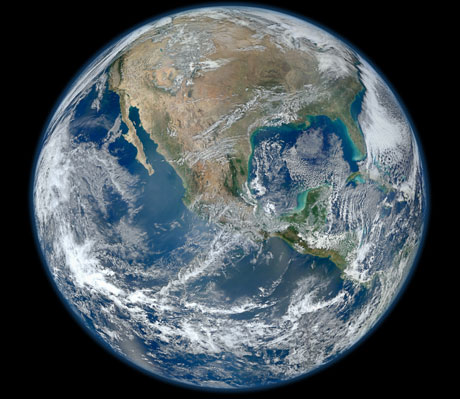
      The Americas, seen from space on 4 January 2012. Photograph: Nasa Goddard Photo

      If we could see the world with a particularly illuminating set of spectacles, one of its most prominent features at the moment would be a giant carbon bubble, whose bursting someday will make the housing bubble of 2007 look like a lark. As yet – as we shall see – it’s unfortunately largely invisible to us.

      In compensation, though, we have some truly beautiful images made possible by new technology. Last month, for instance, Nasa updated the most iconic photograph in our civilization’s gallery: “Blue Marble”, originally taken from Apollo 17 in 1972. The spectacular new high-def image shows a picture of the Americas on 4 January, a good day for snapping photos because there weren’t many clouds.

      It was also a good day because of the striking way it could demonstrate to us just how much the planet has changed in 40 years. As Jeff Masters, the web’s most widely read meteorologist, explains:

      “The US and Canada are virtually snow-free and cloud-free, which is extremely rare for a January day. The lack of snow in the mountains of the western US is particularly unusual. I doubt one could find a January day this cloud-free with so little snow on the ground throughout the entire satellite record, going back to the early 1960s.”

      In fact, it’s likely that the week that photo was taken will prove “the driest first week in recorded US history”. Indeed, it followed on 2011, which showed the greatest weather extremes in our history – 56% of the country was either in drought or flood, which was no surprise since “climate change science predicts wet areas will tend to get wetter and dry areas will tend to get drier.” Indeed, the nation suffered 14 weather disasters, each causing $1bn or more in damage last year. (The old record was nine.) Masters again: “Watching the weather over the past two years has been like watching a famous baseball hitter on steroids.”

      In the face of such data – statistics that you can duplicate for almost every region of the planet – you’d think we’d already be in an all-out effort to do something about climate change. Instead, we’re witnessing an all-out effort to … deny there’s a problem.

      Our GOP presidential candidates are working hard to make sure no one thinks they’d appease chemistry and physics. At the last Republican debate in Florida, Rick Santorum insisted that he should be the nominee because he’d caught on earlier than Newt or Mitt to the global warming “hoax”.

      Most of the media pays remarkably little attention to what’s happening. Coverage of global warming has dipped 40% over the last two years. When, say, there’s a rare outbreak of January tornadoes, TV anchors politely discuss “extreme weather,” but climate change is the disaster that dare not speak its name.

      And when they do break their silence, some of our elite organs are happy to indulge in outright denial. Last month, for instance, the Wall Street Journal published an op-ed by “16 scientists and engineers” headlined “No Need to Panic About Global Warming”. The article was easily debunked. It was nothing but a mash-up of long-since-disproved arguments by people who turned out mostly not to be climate scientists at all, quoting other scientists who immediately said their actual work showed just the opposite.

      It’s no secret where this denialism comes from: the fossil fuel industry pays for it. (Of the 16 authors of the Journal article, for instance, five had had ties to Exxon.) Writers from Ross Gelbspan to Naomi Oreskes have made this case with such overwhelming power that no one even really tries denying it any more. The open question is why the industry persists in denial in the face of an endless body of fact showing climate change is the greatest danger we’ve ever faced.

      Why doesn’t it fold, the way the tobacco industry eventually did? Why doesn’t it invest its riches in things like solar panels and so profit handsomely from the next generation of energy?

      The answer is more interesting than you might think.

      Part of it’s simple enough: the giant energy companies are making so much money right now that they can’t stop gorging themselves. ExxonMobil, year after year, pulls in more money than any company in history. Chevron’s not far behind. Everyone in the business is swimming in money.

      Still, they could theoretically invest all that cash in new clean technology or research and development for the same. As it happens, though, they’ve got a deeper problem, one that’s become clear only in the last few years. Put briefly: their value is largely based on fossil-fuel reserves that won’t be burned if we ever take global warming seriously.

      When I talked about a carbon bubble at the beginning of this essay, this is what I meant. Here are some of the relevant numbers, courtesy of the Capital Institute: we’re already seeing widespread climate disruption, but if we want to avoid utter, civilization-shaking disaster, many scientists have pointed to a two-degree rise in global temperatures as the most we could possibly deal with.

      If we spew 565 gigatons more carbon into the atmosphere, we’ll quite possibly go right past that reddest of red lines. But the oil companies, private and state-owned, have current reserves on the books equivalent to 2,795 gigatons – five times more than we can ever safely burn. It has to stay in the ground.

      Put another way, in ecological terms, it would be extremely prudent to write off $20tn-worth of those reserves. In economic terms, of course, it would be a disaster, first and foremost for shareholders and executives of companies like ExxonMobil (and people in places like Venezuela).

      If you run an oil company, this sort of write-off is the disastrous future staring you in the face as soon as climate change is taken as seriously as it should be, and that’s far scarier than drought and flood. It’s why you’ll do anything – including fund an endless campaigns of lies – to avoid coming to terms with its reality. So, instead, we simply charge ahead. To take just one example, last month, the boss of the US Chamber of Commerce, Thomas Donohue, called for burning all the country’s newly discovered coal, gas, and oil – believed to be 1,800 gigatons-worth of carbon from our nation alone.

      What he and the rest of the energy-industrial elite are denying, in other words, is that the business models at the center of our economy are in the deepest possible conflict with physics and chemistry. The carbon bubble that looms over our world needs to be deflated soon. As with our fiscal crisis, failure to do so will cause enormous pain – pain, in fact, almost beyond imagining. After all, if you think banks are too big to fail, consider the climate as a whole and imagine the nature of the bailout that would face us when that bubble finally bursts.

      Unfortunately, it won’t burst by itself – not in time, anyway. The fossil-fuel companies, with their heavily-funded denialism and their record campaign contributions, have been able to keep at bay even the tamest efforts at reining in carbon emissions. With each passing day, they’re leveraging us deeper into an unpayable carbon debt – and with each passing day, they’re raking in unimaginable returns. ExxonMobil last week reported its 2011 profits at $41bn, the second highest of all time. Do you wonder who owns the record? That would be ExxonMobil, in 2008, at $45bn.

      Telling the truth about climate change would require pulling away the biggest punchbowl in history, right when the party is in full swing. That’s why the fight is so pitched. That’s why those of us battling for the future need to raise our game.

      And it’s why that view from the satellites, however beautiful from a distance, is likely to become ever harder to recognize as our home planet.