Author: admin

  • SA bottle recycling deposit to rise to 20c

    Driving bottles across the border into South Australia for recycling is about to get more lucrative – if you can avoid getting caught, reports The Australian Financial Review (27/10/2006, p.3).

    Deposit to rise to 20c: The state government is proposing to lift the 5c recycling deposit to as much as 20c a bottle.

    $4000 fine for bringing from interstate: But it wants to impose a $4000 fine for recyclers who bring bottles from interstate to claim refunds.

    Interstate importation causing concern: The manager of industry sustainability at the SA Environment Protection Authority, Tom Whitworth, said the practice of bringing empty containers into SA for refunds was causing concern for the 118 collection depots and manufacturers.

    Large quantities being brought in: The SA government has admitted that "large quantities" of empty containers were being brought from other states to claim the 5c refund.

    Hope that fines and declarations will stop the practice: They hope to thwart the practice through the fines and by giving recycling depots powers to seek declarations that containers brought in for refunds were bought in SA.

    The Australian Financial Review, 27/10/2006, p.3

    Source: Erisk Net  
  • Thieves siphon off 27,000-litre water tanks

    Water and water carrier equipment have been stolen in southern NSW, as the worsening drought drives people to despair. Water carters have been flooded with work, with delivery backlogs of up to a week and new customers turned away, reported The Canberra Times (25/10/2006, p.4).

    Tanks, dams not safe: Goulburn police had received half a dozen reports of 27,000-litre water tanks being siphoned off by thieves. Water theft had also been reported in Yass, Bungendore and Tarago. At a property in Bungendore, a farmer told police his dam level had dropped by 30cm and there were vehicle tyre marks nearby.

    Carters’ equipment targeted: Sutton water carter James Bingley recently had his standpipe – a device used in water collection, stolen out of the back of his truck. A replacement cost him $1300. Mr Bingley said the drought was placing strain on the region’s water carrier and he was running four days behind.

    Carters at fever pitch: One of the region’s biggest water suppliers, AAA All Areas Water Carrying, has three water carriers working from dawn to dusk and some through the night. One day last week, the company fielded 52 phone calls in the space of three and a half hours.

    The Canberra Times, 25/10/2006, p.4

    Source: Erisk Net  

  • The 120-M.P.H. Electric Car

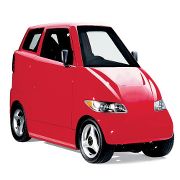
    electric carThis is the electric car that can accelerate from zero to 60 mph in 4.0 seconds to a top speed of 120 mph in one gear with no shifting thanks to its two electric motors – smaller versions of the same kind found in diesel-electric locomotives – that combine to produce over 1,000 lbf ft. of torque.

    No wider than most motorcycles at 39", it can fit in a 6′ half-lane with more clearance than a semi-truck in a full 12′ freeway lane, enabling you to negotiate traffic congestion where lane splitting is permitted. Its small size eliminates the need for parallel parking as it can park perpendicular to a curb without the need for a full space.

    The driver and passenger sit in tandem front and back seats that use four-point pilot seat belts with iner tia reels, similar to harnesses found in race cars, yet are easy to use. The cars chassis is made of stainless steel, and the chrome moly roll cage meets Sports Car Club of America racing standards for safety. The body panels are made of carbon fiber, Kevlar, and fiberglass, and its side impact bars offer four times the protection found in typical SUVs.

    The cars unique stability is derived from its low center of gravity, created by 1,100 lbs. of batteries under the floor, giving it a rollover threshold equivalent to a 5-star National Highway Traffic Safety Administration rating found in the lowest-slung sports cars. It has front and rear disc brakes and coil-over shock absorbers. The car generates no emissions and operates from a set of lead-acid batteries that can recharge using any service up to 50 amps, providing enough power for a range of 40-80 miles, up to four times the average commute in the U.S.8 1/2 L x 39 W x 60 H. (3,000 lbs.)

    It is available in a variety of colors and cost USD $108,000.00.

  • Global warming

    The average surface temperature of earth has increased more than 1 degree Fahrenheit since 1900 and the rate of warming has been nearly three times the century-long average since 1970. Almost all experts studying the recent climate history of the earth agree now that human activities, mainly the release of heat-trapping gases from smokestacks, tailpipes, and burning forests, are probably the dominant force driving the trend. The gases add to the planet’s natural greenhouse effect, allowing sunlight in, but preventing some of the resulting heat from radiating back to space. Drawing on research on past climate shifts, observations of current conditions, and computer simulations, many climate experts say that without big curbs in greenhouse gas emissions, the 21st century could see temperatures rise 3 to 8 degrees, weather patterns sharply shift, ice sheets shrink and seas rise several feet.

    book coverTHE NORTH POLE WAS HERE
    PUZZLES AND PERILS AT THE TOP OF THE WORLD
    By Andrew C. Revkin

    New York Times reporter, Andrew Revkin leads readers through the mysterious history of arctic exploration. He follows oceanographers, peers into the mysteries of climate modeling and global warming, and ultimately shows how the fate of the pole will affect us all.

    Ages 10 and up
    A New York Times Book / KINGFISHER
    128 pages, hardcover.
    Publication: April 2006
    ISBN : 0-7534-5993-0
    Price : USD$15.95

    For more information to purchase, click here  

  • Canberra flags shift on emissions

    Many options: There are many options to "price" carbon.

    Carbon tax ruled out: There is a carbon tax – which the Government has ruled out.

    Emissions trading getting mixed messages: There are emissions trading schemes, in which greenhouse gas emissions are capped and companies trade permits among themselves. The Government is sending mixed messages about whether it would accept emissions trading.

    Sequestration: Another option that would put a price on pollution is to make companies increasingly bear the costs of their emissions, by requiring investment and use of technology to make coal clean, or to capture emissions and bury them.

    Howard moving because voters alarmed: Greg Bourne had a long career as a petroleum executive for BP before joining environmental group WWF Australia as chief executive. Bourne says Howard is moving with alacrity on global warming because voters are genuinely alarmed at the doomsday scenarios.

    Business prepared to pay for its pollution: Australia will remain critically dependent on coal. Bourne says business is prepared to pick up at least some of the tab for its pollution, and is already "shadow pricing" – in plain terms, factoring the cost of a pollution price into its operations.

    Predicts "modest" carbon price: His prediction is the Government will unveil a "modest" carbon price, signal that it will take effect from a certain date, and call for submissions from business about the best way to design the system.

    Business willing to accept emissions trading: Business was also signalling that it is prepared to cop a global system of emissions trading.

  • Pareidolia

    pareidolia (payr.eye.DOH.lee.uh) n. The erroneous or fanciful perception of a pattern or meaning in something that is actually ambiguous or random.
    —pareidolic adj.

    So, says WordSpy. http://www.wordspy.com/words/pareidolia.asp

    “Not so fast”, says Jim Nutter of the NSW Northern Rivers.

     There is no doubt that we perceive patterns, or significance, in ambiguous, random phenomena. In fact, the whole of human knowledge is built on patterns that we have perceived in random phenomena. It is not just a human characteristic either. When animals hunt, they deduce the presence of their next meal in the movement of grass, or rustling in leaves.

    In fact, we train our perception to give significance to some patterns and not others. The notion that some patterns are meaningful and others erroneous, or fanciful is an arbitary construct that we place on our perception to make sense of it.

    Starting with the Barrow Point rock carvings, which he discovered and reported to the Australian Museum in the sixties, Jim has photographed a wide range of ambiguos and random phenomena which are clearly identifiable as human faces. He observes that once we begin to notice these seemingly coincidental “faces in the clouds” that the world becomes charged with meaning and significance, rather as it must have seemed to stone age people.

     He encourages you to submit your photographs of images of things that are not “really” there to compile a stock of photos of this phenomena.

    The kangaroo in the fig tree was shot by Peter King and published in the Echo newspaper. The face in the rock is from Jim’s collection. You will have to email your photos to us for the moment, while we work out how to use our image file upload thingy.