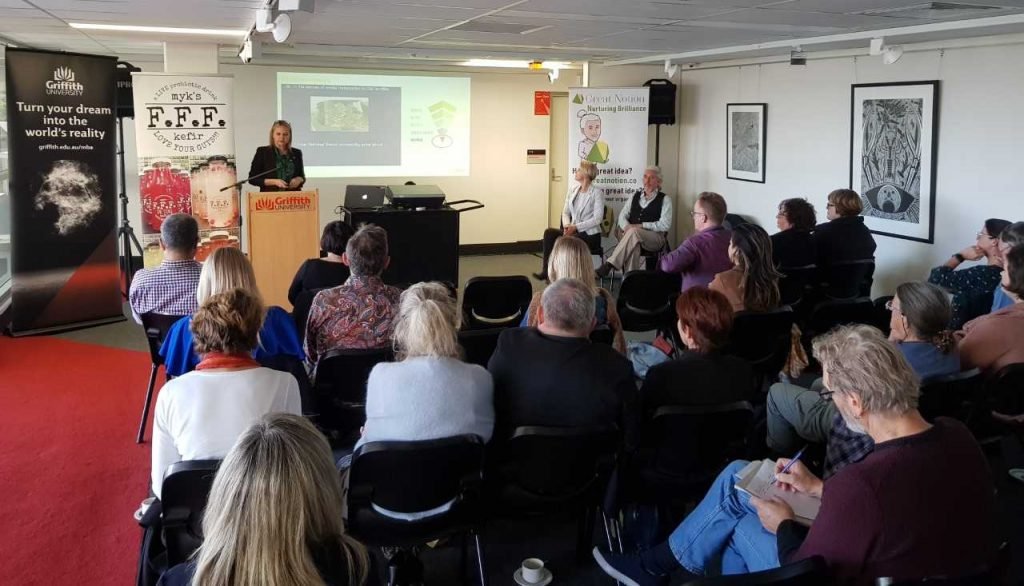
Over fifty delegates kicked off a lively discussion about the role of the Circular Economy for small business at Griffith University, Southbank, yesterday, Thursday, 30th May.
The Queensland Small Business Week Event #QSBW had businesses grilling government, academics and practitioners about tools to implement the strategies discussed, government support for innovation and long term impacts on the economy.
Liesl Hull from Suez presented examples of practitioner success
Geoff Ebbs of Great Notion hosted a panel with Dr Robert Hales, Director of Griffith’s Centre for Sustainable Enterprise and Marjon Wind, of CE Labs and BMI. Speakers inlcuded Syliva Garner from Queensland Department of Environment and Science, Petra Perolini of the Queensland College of Art and Liesl Hull from waste conglomerate Suez.
Griffith University will launch a course for business leaders in July, in the same timeline CE Labs will announce the outcome of the 3 month process they launched in February and Great Notion will begin a roadshow through business networks and chambers of commerce.
Wages growth, inflation, interest rates and unemployment are
at all-time lows. Traditional economic models are not working. How can small
business thrive in a low-growth economy?
Many small business owners find it unhelpful to engage with
macro-economic policy. It seems largely irrelevant to our frame of operation. Throughout
the rise and fall of empire, fashions in economic theory and the fickle passions
of rulers, taverns and cafes, bakers and tailors, butchers and milliners have flourished.
Small businesses dominated the main thoroughfares and side streets of the capitals
of every civilisation.
People need to eat, to dress, to trade regardless of the forces
shaping the geopolitics of the day. Every army has its camp followers;
providing the services soldiers demand, at a price.
Of course, retail markets flourish in wealthy, successful
empires and struggle when an empire is on its knees. The recent economic crisis
in Greece was marked by the absence of advertising in the streets and the threadbare
nature of famous retail strips. Similarly, the depression years in Australia
and the US showed a dramatic shrinkage in retail activity. Nevertheless, some
businesses survived the tough times, building their brands and brand loyalty or
simply eking out an existence in their community.
We face an era where globalisation and online trading have
undermined many of the roles filled traditionally by small business. Trade is
booming, but many small businesses are not. On top of that, we now face challenges
to the geopolitical framework, the availability and price of resources and the
natural environment that supports and nourishes us.
How best to prepare for this apparently perfect storm?
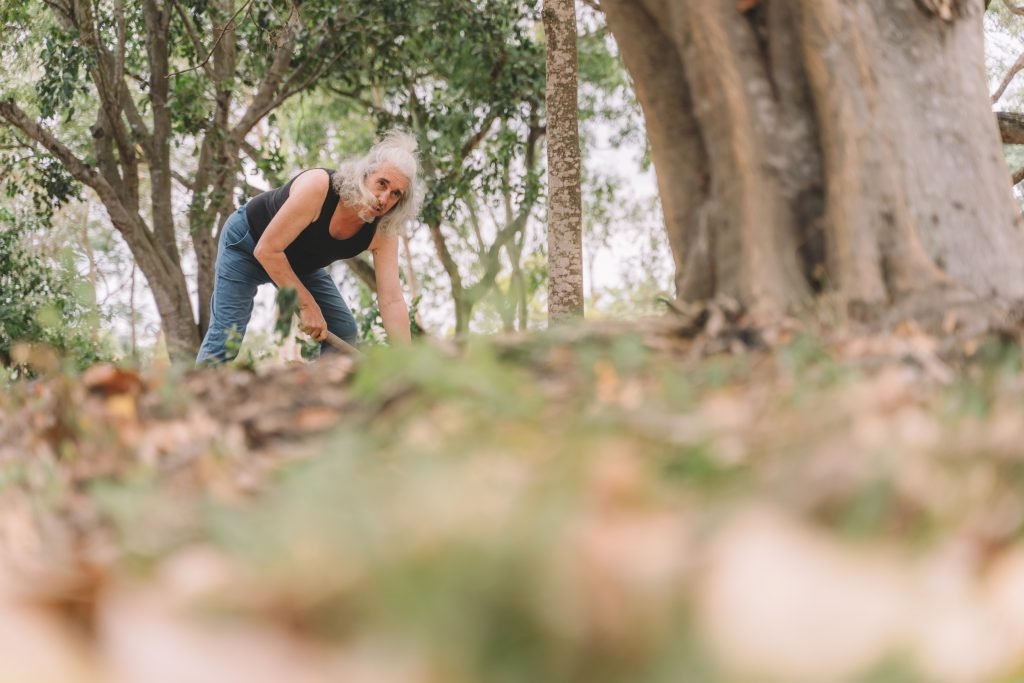
Digging in the leaf litter to gather nutrients might turn up truffles
Is zero-waste enough?
The notion of the Circular Economy is that we can no longer
continue the extractive practices of the linear economy; harvesting resources,
extracting the most profitable elements and throwing the remainder away. We
need to emulate ecosystems, ensuring that what we don’t use ourselves is taken
advantage of by another member of the eco-system. A rainforest throws nothing
away, clean water flows down its rivers, to be returned by the water cycle. It
is a net producer of oxygen and consumes only sunshine. Everything else cycles
around within the closed ecosystem.
Implicit in our adoption of this model is the twin notions
that the planetary systems that support us can only provide a finite amount of
resources and survive a certain level of contamination. To preserve the supportive
capacity of those systems, we must limit the extraction of raw materials and
the production of waste.
Therefore, the primary focus of the current wave of Circular
Economy practitioners is, justifiably, the elimination of waste through re-use,
reduction and recycling.
There is an underlying problem, though, that this focus does
not capture. That problem is our addiction to growth.
The challenge of growth
Put simply, the challenge of continuous growth is that we
live on a finite planet and, at some point, we reach the limit of the planet to
support us and so must stop population and consumption growth. This was succinctly
framed by Malthus in the eighteenth century when he compared human populations
to rabbits on a desert island, and the cycles of population boom and bust that
characterise them. His concluding observation was that only some moral
imperative could prevent humans from facing the same fate.
David Suzuki recently reframed the problem using a test-tube
of nutrients and a population of bacteria that is analysed further under the mathematics
of growth. “Eventually, the bacteria will consume 100% of the resources in the
test-tube” he notes.
The ability of technology to solve any shortages that arose over
the intervening centuries discredited Malthus so completely, that scientists (such
as the Club of Rome, writing in the sixties that humanity faced major challenges
by the mid-twenty first century) have been largely ignored as alarmist. Indeed,
it is a defining characteristic of many contemporary, populist movements around
the world that they accuse globalist governments of threatening the rights of
ordinary people to consume whatever they want in the name of fictional crises that
have been produced simply to scare us into submission. The rhetoric pits
personal freedoms against a mythical global good.
At the heart of this hubris is our conviction that we have
conquered nature; we confront global collapse as interplanetary gods waving our
magical trident to perform geo-engineering on Earth or providing an escape to
Mars. This is the type of desperation that led the Easter Islanders to
construct huge stone statues in a vain attempt to survive without fresh water.
As a civilisation we can only survive if those of us who can
see the big picture, can provide a clear portrait of a radically changed
economic system with a complete understanding of what this change means for
ordinary people.
The development of tools for small business to thrive in a
circular economy is one step in that larger process.
Our dependence on growth
In 2008 I interviewed Dick Smith about his attempts to run
Australian Geographic as a non-growth company and Dick Smith Foods as a bulwark
against the damage globalisation might be doing to Australia’s food
sovereignty.
Among the difficulties he faced at Australian Geographic were
rising costs of both overheads and supplies, staff expectations for advancement
and the ongoing need for capital investment. Ultimately he sold Australian Geographic
as a going concern and the business model reverted to a traditional membership
publishing one.
He also conceded defeat of the mission for Dick Smith Foods when
the Green family sold their quite sizable food processing business to American
interests.
“I remain a capitalist,” he told me, “No other system has
provided so much advantage for so many people, but I am not sure how we can
avoid its cycles of boom and bust.”
Given such a long period of economic growth, the scale of an
imminent downturn is somewhat frightening.
To date, we have assumed an underlying growth in the economy
to meet many of our expectations that life will improve over time. It is
important to analyse those expectations so that we can better prepare to deal
with the changes we face.
The mathematics of growth
Earlier I asserted that the traditional 25 year mortgage is
based on a three percent inflation rate. That is because an annual three
percent increase results in a doubling of the value of your asset every 25 years.
A ten percent increase doubles the value every seven years. This is the basis
of exponential growth. A small increase in the rate of growth, reduces the time
it takes to double the value of the asset.
It takes 25 years to double something that increases at 3% a year, only 10 years to double something increasing at 7%
David Suzuki uses this to demonstrate the impact of exponential growth in his famous test tube example. You take a test tube full of a nutrient solution and you add a bacteria that reproduces every second, consuming some nutrients to do so. The population of bacteria doubles each second. At the beginning the test tube is full of nutrients and has one bacterium. At some point, the end of growth (E), the test tube is empty of nutrients and so the population of bacteria cannot grow and will collapse. One second before that (E-1), the test tube will be half full of nutrients and will have half the possible maximum number of bacteria (E-1=50%). Five seconds before the end of growth (E-5) the number of bacteria will be 3% of the theoretical maximum. Do the maths: 50, 25, 12.5, 6.25, 3.125. (E-5=3%)
He puts it this way, “At 3% of the theoretical maximum, most
of the bacteria will be blissfully unaware that they are about to go extinct.
There is 97% of room for growth and plenty of nutrients. Nothing’s wrong, they
will say.”
He makes the point that with the human population doubling every 25 years and many resources already in short supply, most scientists concur that we are in the final moments of a major collapse. “We are currently much closer than the five second point of the test tube example.”
He extends the analogy. “Let us say that a few brilliant
bacteria in the test tube have explored the world around them and found three
more nutrient laden test tubes nearby. Imagine that they decide to use some of
the diminishing resources to go to Mars. Those three test tubes could expand
the life of the colony by two seconds! This is not a new beginning, it is just
a slight delay of the end.”
The point is that despite our individual and systemic dependence on continous growth, it is not sustainable. We cannot afford it because it leads directly to a collapse of the systems on which we depend.
As a result, we cannot assume a background of growth as the basis of our future planning.
The instinctive mantra of political parties that their role
is to nurture and manage economic growth is a convenient fiction in the face of
a radical and unpalatable truth. It is one of the reasons we no longer trust
them. We know the premise rings hollow.
The role of debt
There is a very simple reason that governments and opposition
parties continually talk about economic growth as the central plank in a capitalist
democracy. That is, the financial system depends on it.
It is impossible to make a profit by lending money to
someone unless they pay you interest. For the borrower to justify those
interest payments they must be making more money from their commercial activity
than the money costs them.
If you borrow a million dollars to buy a home in Sydney you
will pay, over 25 years, another million in interest. If the house has not
doubled in value by the time you have paid it off, you have lost money on the
deal.
This simple arithmetic is the basis of our housing market,
the 25 year loan and the preferred CPI increase of 3%. If inflation sits at 3%
then home owners can afford to buy houses, rents are about half the cost of
having a mortgage but someone paying off a mortgage pulls in front after 25
years, because they can now live in their property rent free.
That model has been seriously disrupted over the last two
decades.
The same logic applies to commercial lending, the share
market and international currency exchanges. Without continuous growth, the
debt model collapses and so does our current financial system.
In the light of this it is interesting to consider that
charging interest on loans was once illegal in Christian Europe (it was known
as the crime of Ursury) and remains banned in Islam. The rise of commerce and
the collapse of the Church in the face of the industrial revolution has
radically changed our thinking about the role of debt.
Is degrowth possible?
There are plenty of organisations promoting the virtues of
reducing our footprint: Fly less, buy less, use less, apply thrift, declutter,
destress, spend nothing …. All of this is a retailer’s nightmare.
The driving logic of these campaigns is compelling.
Consumption is not happiness, the ecosystem that nurtures us is overloaded, we
have to reduce our footprint to survive. It is not a question of whether we can
implement degrowth, it is a matter of how we survive in the face of a collapse
in growth. Degrowth now, is simply an insurance policy against future systemic
failure.
How on earth is this view compatible with Thriving in a
Circular Economy?
The simple answer is to look at a natural ecosystem like a
rainforest.
Overall the forest only consumes sunlight, it captures
rainwater and releases clean fresh water into the streams that run out of it.
It produces oxygen and consumes carbon from the atmosphere. Other than that, it
is a closed system.
But it grows.
It thrives.
It teems with life.
See the article Unpacking the Circular Economy for a detailed analysis about how linear systems within an ecosystem contribute to a circular economy. Ultimately, each of us can grow as we need to, but somehow we have to particpate in the overall ecosystem.
We cannot grow exponentially. We cannot grow at the expense of future generations. But we can grow vigorously, as long as we are part of an ecosystem and ensure that our waste is someone else’s food.
The limits of growth are simply that we cannot grow by exploiting
the major resources and throwing the rest away – unless we have an army of
parasites, camp followers and dung beetles. Most importantly, those dung
beetles, camp followers and parasites must thrive as well. There cannot be a
pile of poison at the end of the line which no-one can touch, be accountable
for or live with.
That is the condition of entry into the circular economy.
So, the tools of survival?
Small business has a head start.
It is a member of its community. Its stakeholders are
generally its staff and customers. If remote financial markets are stakeholders
then it is not, for the purposes of this treatise, a small business. Using
those stakeholders to build a community network allows the business owner to go
beyond profit. Instead of measuring success by how much money you can siphon
from the business, start measuring how much good will you have built in your
community. It is that good will that will see you through the next depression.
The Koch brothers built a fossil fuel empire that has funded
the conservative political movement in the US on the basis that Good Profit is
generated by harnessing the goodwill of stakeholders, not by extracting money from
them. While I have differences of opinion with them on what constitutes the
moral good, I have no disagreement on the application of a moral framework to
business. It is essential.
Building a community network is the way to amplify the
influence and reach of your business and the perceived value of your brand.
Build your community and they will help you build the business, regardless what
happens in the macro-economic and geo-political climate.
Secondly, there are a range of very simple management tools
that allow you to differentiate between building a sustainable business and
participating in the illusion of continuous economic growth.
Some of them are simple, ancient adages. Cash is king,
neither a lender nor a borrower be, a stitch in time saves nine.
Behind each of these straightforward observations are
centuries of wisdom. By applying the management tools that flow from these
simple pearls, you can avoid the crippling bondage of debt, disposable income,
built in obsolescence and churn.
You can build a sustainable business that embeds your
contribution to the community in the value that you provide to the community.
This is the ultimate contribution to the world you live in, and unlike your
bank balance, you can take it with you.
Globalisation, online competition, energy prices, low economic growth: we are all aware of the challenges.
Small business has a natural advantage, however. We are embedded in our community and have the opportunity to build and reinforce our networks of stake holders.
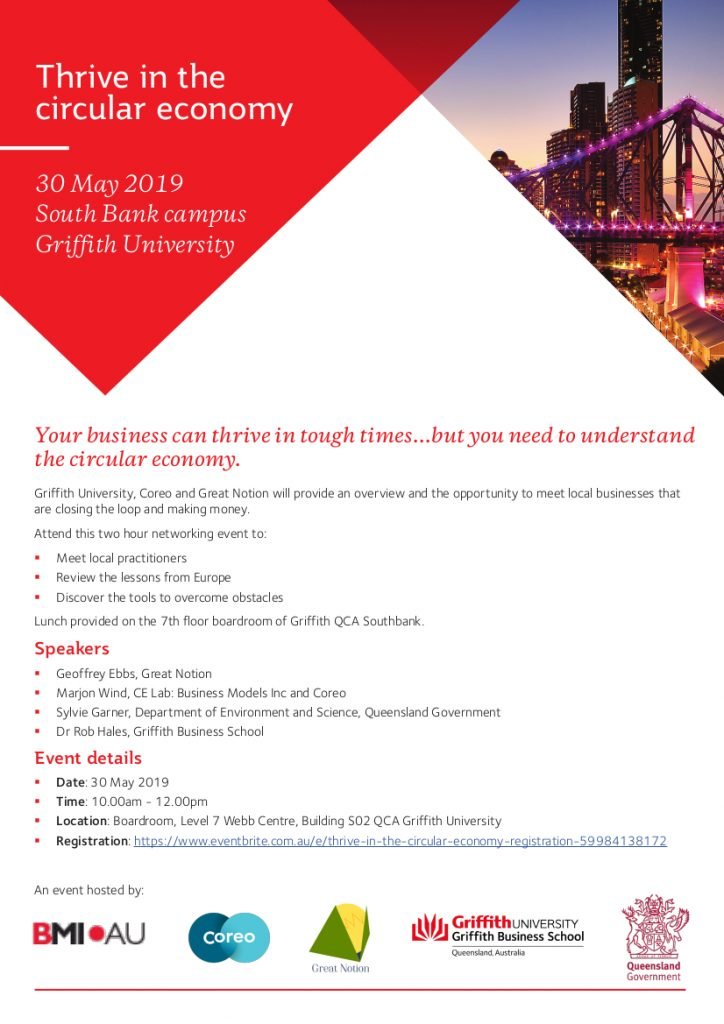
Great Notion, Griffith University and the Circular Economy Labs have put together a networking opportunity and lunch at Soutbank during Small Business Week to discuss the role of small business in the circular economy.
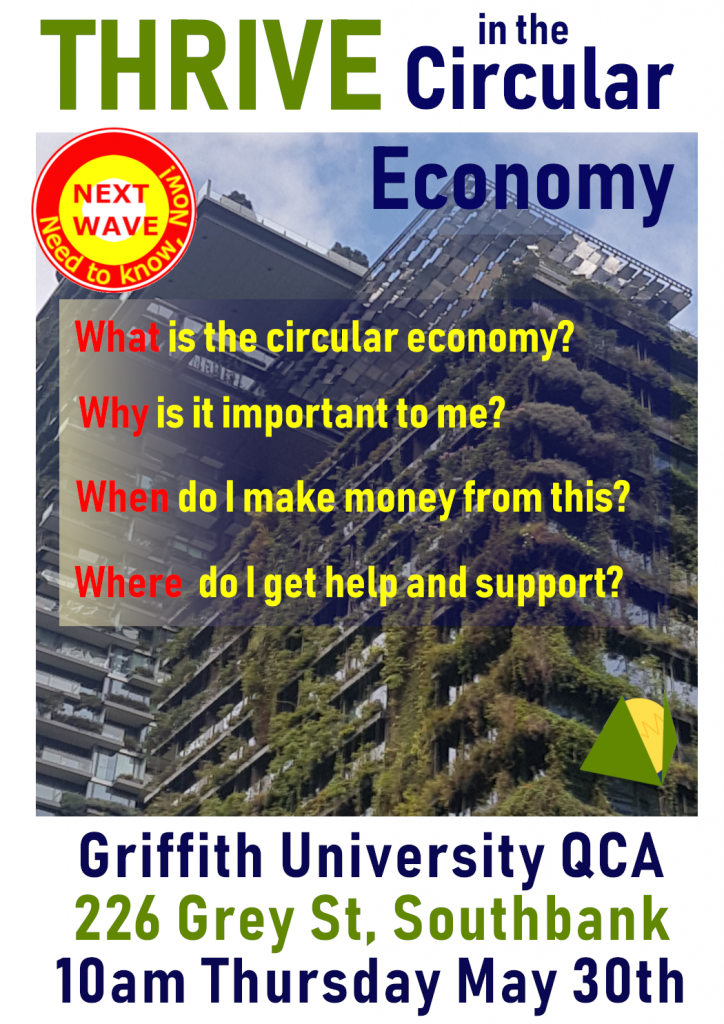
Come to the Executive Boardroom on the 7th floor of QCA at 226 Grey St for a two hour session starting at 10am on Thursday 30th May. Thrive in the circular economy will give small business the chance to discuss the opportunities with the Queensland Government, the Circular Economy Labs and local practitioners.
Hosted by Great Notion and Griffith University, this is a unique opportunity to talk to the practitioners and the people who are testing the business models and training the practitioners.
The notion of values being core to business success is not restricted to the profit-for-purpose sector, impact investing or philanthropic work.
Apple is widely held to be a world leading example of market domination through value identification
Brand strategy approaches like Simon Senik’s Why, the Business Model Canvas, or the currently fashionable disrupt to succeed approach are all based on identifying the value that you offer to your customer and placing that value at the core of your business. All refer to Apple as a leading example of this thinking.
Even traditional sales and branding approaches, though, depended on the identification of your Unique Value Proposition (UVP)
We do not have to assert any new world view
to assign an important role to your values as a business owner or director of
an organization.
The importance of value to a brand is that
it overcomes price, convenience and other considerations that undermine profit.
If we appeal to the values that we have in common with our customers they will
reward us with their dollars.
Values, then are the core of a brand and
the basis of your message, raison d’etre and brand.
But wait, there’s more.
At the heart of the logic about brand value
is the recognition that our values tie us together. It is our values that make
us feel to be part of something.
In his best-selling book Good Profit, Charles G Koch – yes he is one of those Koch brothers – writes “What I consider to be good profit comes from creating superior value for our customers while consuming fewer resources and acting lawfully and with integrity. Good profit comes from making a contribution in society.”
We can complement our drive for profit,
then, with a drive for values. In fact, we can release our profit to harness
our values to create that network of stakeholders with common values that in
turn will future proof our business by creating a community of values that
supports our business.
It seems like heresy to put something other
than profit at the heart of our business strategy.
After all, business cannot survive without
profit. If you are running an organization that is not balancing its books,
that is losing money, then you will have to close the doors and you will lose
everything you have built.
Profit is absolutely essential to success
in business.
The key, though, is that profit is
necessary, but it is not sufficient.
I can make a profit by bullying people to
give me money, I can make a profit by stealing, I can make a profit by selling
the river running through my city, the clouds above or the trees in the local
park, but none of these business models are sustainable. Eventually, the
stakeholders whose resources I am appropriating will find some-way to stop me
from profiting from taking their stuff.
It is only when we contribute value to our
stakeholders that they support us.
By overtly declaring that value, and
working with our stakeholders to build and protect that value we can future
proof our businesses.
A community with common values collects and nurtures value within the community
The advantage that nearly all small
business has over its larger competitors is that it is already part of a
community. The fact that you work in an area where your customers know you is
your secret weapon, a starting point that cannot be replicated by the world’s
biggest corporations, by global trade agreements or by unsympathetic
governments.
You can release your profits to invest in
nurturing secret advantages like that and build the stakeholder community that
will future proof your business, simply by identifying the values that you have
in common.
Values and identity politics.
There is one potential danger in the focus
on values and building communities with like values and that is the sense of
tribal belonging that it creates.
It is this tribal urge at the heart of
values that has made religion and other belief systems such a powerful tool in
imperial conquest. You do not need such a huge army to force distant
populations to pay taxes if they believe in the values that you offer them.
I am an unlikely person to be quoting Charles
G Koch, because the values that drive the Koch brothers enormous coal business,
their funding of climate denial media and the support of conservative politicians
and their politics of fear are the same values that he considers to be the
basis of Good Profit. I have been selective in my use of his quotes to show
that the application of values to business is not a partisan view. He is
selective of the philosophers that he quotes in his identification that
Economic Freedom is the most important freedom of all and the moral duty of government.
We promote our values, then, at the risk of
fanning the flames of tribalism. Identifying our values identifies groups of
people who will support us come hell or high water. If we work together to
support each other, we weave a community that is self-reinforcing and resists
outside attempts to break it up.
The relationship between values and the circular economy is that those communities will then find ways to close the loop, keep value in the community and reduce the wastage of energy, resources and value from the community. But that is the topic of the next article.
Attendees to Small Business Week on Southbank are invited to
discover the opportunities presented by the Circular Economy at Griffith
University, Southbank at 10am on May 30.
Circular Economy opportunities in Australia alone represent billions
of dollars of dormant value that can be released by Small and Medium
Enterprises focused on the sector. “Many companies assume that the Circular
Economy is specifically focused on waste,” said lead strategist for Great
Notion, Geoff Ebbs, “The truth is that it is focused on wasted value.”
Business owners and managers attending the workshop at QCA
Grey St South Bank will be brought up to speed on strategies, tools and
opportunities to engage with the Circular Economy.
Dr Rob Hales, Director of Griffith Sustainability will launch a short course in the Circular Economy aimed directly at small business.
The course has been developed in conjunction with CELabs, a
Circular Economy laboratory funded by the Qld Government to engage 65 corporates
in building a template for the Circular Economy that will be presented at the inaugural
Circular Economy Conference in Finland in June.
Marjon Wind of the CELab will outline the project in detail.
Free tickets are available to attend the event, information packs and vouchers to hands-on workshops are available for $125.