Author: Neville

  • First Global Maps from Orbiting Carbon Observatory

    First Global Maps from Orbiting Carbon Observatory

    Dec. 19, 2014: The first global maps of atmospheric carbon dioxide from NASA’s new Orbiting Carbon Observatory-2 mission show elevated carbon dioxide concentrations across the Southern Hemisphere from springtime biomass burning and hint at potential surprises to come.

    At a media briefing  at the American Geophysical Union meeting in San Francisco, scientists from NASA’s Jet Propulsion Laboratory, Pasadena, California; Colorado State University (CSU), Fort Collins; and the California Institute of Technology, Pasadena, presented the maps of carbon dioxide and a related phenomenon known as solar-induced chlorophyll fluorescence and discussed their potential implications.

    splash

    Global atmospheric carbon dioxide concentrations from Oct. 1 through Nov. 11, as recorded by NASA’s Orbiting Carbon Observatory-2. Carbon dioxide concentrations are highest above northern Australia, southern Africa and eastern Brazil. Image Credit: NASA/JPL-Caltech

    A global map covering Oct. 1 through Nov. 17 shows elevated carbon dioxide concentrations in the atmosphere above northern Australia, southern Africa and eastern Brazil.

    “Preliminary analysis shows these signals are largely driven by the seasonal burning of savannas and forests,” said OCO-2 Deputy Project Scientist Annmarie Eldering, of JPL. The team is comparing these measurements with data from other satellites to clarify how much of the observed concentration is likely due to biomass burning.

    The time period covered by the new maps is spring in the Southern Hemisphere, when agricultural fires and land clearing are widespread. The impact of these activities on global carbon dioxide has not been well quantified. As OCO-2 acquires more data, Eldering said, its Southern Hemisphere measurements could lead to an improved understanding of the relative importance in these regions of photosynthesis in tropical plants, which removes carbon dioxide from the atmosphere, and biomass burning, which releases carbon dioxide to the atmosphere.

    The early OCO-2 data hint at some potential surprises to come. “The agreement between OCO-2 and models based on existing carbon dioxide data is remarkably good, but there are some interesting differences,” said Christopher O’Dell, an assistant professor at CSU and member of OCO-2’s science team. “Some of the differences may be due to systematic errors in our measurements, and we are currently in the process of nailing these down. But some of the differences are likely due to gaps in our current knowledge of carbon sources in certain regions — gaps that OCO-2 will help fill in.”

    splash

    This map shows solar-induced fluorescence, a plant process that occurs during photosynthesis, from Aug. through Oct. 2014 as measured by NASA’s Orbiting Carbon Observatory-2. This period is springtime in the Southern Hemisphere and fall in the Northern Hemisphere. Image Credit: NASA/JPL-Caltech

    Carbon dioxide in the atmosphere has no distinguishing features to show what its source was. Elevated carbon dioxide over a region could have a natural cause — for example, a drought that reduces plant growth — or a human cause. At today’s briefing, JPL scientist Christian Frankenberg introduced a map using a new type of data analysis from OCO-2 that can help scientists distinguish the gas’s natural sources.

    Through photosynthesis, plants remove carbon dioxide from the air and use sunlight to synthesize the carbon into food. Plants end up re-emitting about one percent of the sunlight at longer wavelengths. Using one of OCO-2’s three spectrometer instruments, scientists can measure the re-emitted light, known as solar-induced chlorophyll fluorescence (SIF). This measurement complements OCO-2’s carbon dioxide data with information on when and where plants are drawing carbon from the atmosphere.

    Auroras Underfoot (signup)

    “Where OCO-2 really excels is the sheer amount of data being collected within a day, about one million measurements across a narrow swath,” Frankenberg said. “For fluorescence, this enables us, for the first time, to look at features on the five- to 10-kilometer scale on a daily basis.” SIF can be measured even through moderately thick clouds, so it will be especially useful in understanding regions like the Amazon where cloud cover thwarts most spaceborne observations.

    The changes in atmospheric carbon dioxide that OCO-2 seeks to measure are so small that the mission must take unusual precautions to ensure the instrument is free of errors. For that reason, the spacecraft was designed so that it can make an extra maneuver. In addition to gathering a straight line of data like a lawnmower swath, the instrument can point at a single target on the ground for a total of seven minutes as it passes overhead. That requires the spacecraft to turn sideways and make a half cartwheel to keep the target in its sights.

    The targets OCO-2 uses are stations in the Total Carbon Column Observing Network (TCCON), a collaborative effort of multiple international institutions. TCCON has been collecting carbon dioxide data for about five years, and its measurements are fully calibrated and extremely accurate. At the same time that OCO-2 targets a TCCON site, a ground-based instrument at the site makes the same measurement. The extent to which the two measurements agree indicates how well calibrated the OCO-2 sensors are.

    Additional maps released today showed the results of these targeting maneuvers over two TCCON sites in California and one in Australia. “Early results are very promising,” said Paul Wennberg, a professor at Caltech and head of the TCCON network. “Over the next few months, the team will refine the OCO-2 data, and we anticipate that these comparisons will continue to improve.”

    Credits and more information:

    Production editor: Dr. Tony Phillips | Credit: Science@NASA

    To learn more about OCO-2, visit: http://oco2.jpl.nasa.gov/

    Caltech manages JPL for NASA.

    NASA monitors Earth’s vital signs from land, air and space with a fleet of satellites and ambitious airborne and ground-based observation campaigns. NASA develops new ways to observe and study Earth’s interconnected natural systems with long-term data records and computer analysis tools to better see how our planet is changing. The agency shares this unique knowledge with the global community and works with institutions in the United States and around the world that contribute to understanding and protecting our home planet.

    For more information about NASA’s Earth science activities this year, see: http://www.nasa.gov/earthrightnow

  • The John James Newsletter 37

    le desktop notifications for Gmail.   Learn more  Hide


    More


    Web Clip

    101 Cookbooks – Winter Shandy Punch – 2 days ago

    The John James Newsletter 37

    Inbox x

    John James

    5:47 AM (2 hours ago)
    to John

    The John James Newsletter 37

    20 December 2014. 

    May your Christmas be happy and your friendships stronger to deal with the difficult times that lie ahead. The love that waits around us will sustain our hopes, if only we let it. 

    Russian businessman:

    Naturally, the task is simple – we need to drop the ruble to the minimum and then buy all that we can, giving away the dollars that are no longer needed and not guaranteed by anything. This will help concentrate all the rubles inside the country where we can assign their price independently. There will be a short-term increase in prices and a reduction in living standards, but – like an incision by a surgeon – it will be a little painful at first, but then you will be healthy and strong for the rest of your life.

    Full scale of plastic in the world’s oceans revealed for first time 

    Over five trillion pieces of plastic are floating in our oceans, largely deriving from food and drink packaging and clothing. While spread out around the globe, much of this rubbish accumulates in five large ocean gyres, which are circular currents that churn up plastics in a set area. Each of the major oceans have plastic-filled gyres, including the well-known ‘great Pacific garbage patch’ that covers an area roughly equivalent to Texas.

    http://www.theguardian.com/environment/2014/dec/10/full-scale-plastic-worlds-oceans-revealed-first-time-pollution?CMP=ema_632

    Is Ukraine Preparing for a Nuclear False Flag to Frame Russia? 

    Russia’s State Advisor, Director of The Institute of Problems of Globalization, Doctor of Economics, author Mikhail Delyagin tells Anton Chelyshev on Komsomolskaya Pravda radio that Ukraine is preparing a new large-scale anti-Russian provocation

    http://fortruss.blogspot.mx/2014/12/is-ukraine-preparing-for-nuclear-false.html

    The Peshawar School massacre: A failure to understand

    The problem with the public perception of the war in Pakistan is that we see only part of it: we see the heartrending images from Peshawar and elsewhere where terrorists have struck. But there is a war that we do not see in the tribal north.

    http://maryamsakeenah.blogspot.com.au/

    The small and surprisingly dangerous detail the police track about you

    The crackdown on protestors in Ferguson, Missouri showed the extent to which advanced military weapons and equipment, designed for the battlefield, are making their way to small-town police departments across the US. The same thing is happening with surveillance equipment that is enabling the police to gather vast quantities of sensitive information about each and every one of us in a way that was never previously possible.

    http://www.ted.com/talks/catherine_crump_the_small_and_surprisingly_dangerous_detail_the_police_track_about_you/transcript?language=en

    Russia and Turkey’s Gas Deal

    This is a long but comprehensive analysis of the fluctuating politics and strategies of gas supply to Europe. it is worth every minute you spend reading it.

    Joaquin Flores is an American expat living in Belgrade, and a full-time analyst at the Center for Syncretic Studies, a public geostrategic think-tank. His expertise encompasses Eastern Europe, Eurasia with a proficiency in Middle East affairs. Flores is particularly adept at analyzing the psychology of the propaganda wars.

    http://syncreticstudies.com/2014/12/11/russia-and-turkeys-gas-deal-can-save-europe-and-the-world/

    Did anyone notice that Australia now has a carbon trading scheme?

    Senator Nick Xenophon has brought back a carbon trading scheme to Australia by inserting a ‘Safeguard Mechanism’ into the Direct Action legislation. This creates the framework for a market based methods to arrive at a price for carbon. Conceptually any company who currently emits more than 100,000 tonnes of CO2 annually will be required from 1 July 2016 to keep their emissions below a predetermined baseline level or face penalties.

    http://reneweconomy.com.au/2014/anyone-notice-australia-now-carbon-trading-scheme-87832

    The Media Is Focusing On the WRONG Senate Torture Report

    Torture is only good at one thing: eliciting false confessions. Bush-era torture techniques, we now know, were cold-bloodedly modeled after methods used by Chinese Communists to extract confessions from captured US servicemen that they could then use for propaganda during the Korean War. So the latest revelations actually makes sense: The White House started pushing the use of torture when officials in 2002 were desperately trying to tie Iraq to the 9/11 attacks in order to strengthen their public case for invading a country that had nothing to do with 9/11 at all.

    http://www.washingtonsblog.com/2014/12/doesnt-mainstream-media-discuss-torture-issue.html

    Guess which currency has stronger fundamentals— the dollar or… ruble?

    If you listen to conventional financial news, they’ll all tell you that you’d have to be insane to own anything in Russia right now—stocks, bonds, currency, etc. They’ll tell you that the ruble is in freefall, and that the dollar is the place to be.

    http://www.sovereignman.com/trends/surprise-guess-which-currency-has-stronger-fundamentals-the-dollar-or-ruble-15765/

    Going to the dogs

    Multi-billion dollar lending to Ukraine by the International Monetary Fund (IMF) and World Bank has stopped amid growing doubts among country board directors at the two international organizations that the Ukrainian Government can meet repayment commitments and loan covenants for 2015, or deliver on reform promises and budget financing targets tabled in Kiev this week.

    http://johnhelmer.net/?p=12395

    Your Ancestors, Your Fate

    To a striking extent, your overall life chances can be predicted not just from your parents’ status but also from your great-great-great-grandparents’. We estimate that 50 to 60 percent of variation in overall status is determined by lineage. The fortunes of high-status families inexorably fall, and those of low-status families rise, toward the average — what social scientists call “regression to the mean” — but the process can take 10 to 15 generations (300 to 450 years). This is longer than most social scientists have estimated in the past.

    http://opinionator.blogs.nytimes.com/2014/02/21/your-fate-thank-your-ancestors/?_r=0

    A Tale of Two Girls: Malala and Nabeela

    Whilst Ms Yousafzai was receiving her Nobel Prize, my attention was drawn towards the case of another young girl from Pakistan: Nabeela Rahman. Much like Malala, Nabeela too recently travelled to the West with an altogether different purpose.

    http://www.informationclearinghouse.info/article40492.htm

    The last great extinction a double-whammer

    Scientists have long believed that heavy dust from an asteroid impact blocked out the sun, setting off a disastrous chain of events that led to the extinction of the dinosaurs. But now researchers have found more evidence that major volcanic eruption began 250,000 years before the impact and continued afterwards. “We’re talking about something similar to what’s happening today: lots of carbon dioxide being emitted into the atmosphere very rapidly. Ultimately that leads to ocean acidification, killing a significant portion of plankton — the base of the food chain. If you wipe them out, then you’d have catastrophic effects.”

    http://www.dailymail.co.uk/sciencetech/article-2871421/Were-dinosaurs-killed-one-two-punch-Dates-suggest-volcanic-eruption-took-place-deadly-asteroid-strike.html

  • Thank you Australian Labor Party

    3 of 3
    Web Clip
    Reuters: Oddly EnoughTennessee police looking for Christmas tree thief1 day ago

    Thank you

    Inbox
    x

    Skye Laris via sendgrid.info 

    1:39 PM (2 hours ago)

    to me
    Neville,
    2014 has been a big year for Labor.

    Since the last election, the Abbott Government has tried some foul things: $100,000 degrees, a GP Tax, cuts to health and education; the list goes on.

    Yet despite what they’ve tried, our community has worked together to stand up against Abbott’s unfair budget.

    Without your help, we couldn’t have helped to block $100,000 degrees, protect the Racial Discrimination Act, and uphold the World Heritage Listing for Tassie’s forests.

    Thanks to your work more and more people know that Abbott’s budget is just rotten, and we’re only convincing more people every day.

    So thank you.

    We’ve made a short video reflecting on the year, take a look:

    Video_thumbnail.jpg

    Together we’ve been able to make a difference, so thanks again.

    Have a safe summer,

    Skye, Riley, Ross and Alice
    Labor’s Digital Campaigns Team

  • Together, we’ve changed minds The Australian Institute

    The conversation has been marked as not important.
    1 of 3
    Web Clip

    Together, we’ve changed minds

    Inbox
    x

    The Australia Institute <mail@tai.org.au> Unsubscribe

    2:34 PM (1 hour ago)

    to me
    The Australia Institute

    Dear Neville —

     2014: we changed minds

    By any measure, it’s been a big year for The Australia Institute. As the government sought to make sweeping changes, we worked with politicians across party lines to safeguard important policies and to shape public and parliamentary debates. Here are some of our highlights from 2014.

    We worked to protect the RET
    We helped secure the support of the Palmer United Party, Senator Ricky Muir, and in turn a majority of the senate, to protect the Renewable Energy Target, the Australian Renewable Energy Agency, the Clean Energy Finance Corporation, and the Climate Change Authority. By protecting the RET and these leading climate agencies, the senate safeguarded more than $11 billion worth of government investment in renewable and clean energy, and up to an additional $35 billion worth of investment in clean energy, leveraged from the private sector. In June, Clive Palmer and former Liberal leader, John Hewson, launched our report Fighting Dirty on Clean Energy.

    We revealed billions in subsidies for mining
    We challenged the idea that mining is good for humanity and generated enormous political attention about the downsides of coal and coal seam gas through 2014, continuously enraging the industry. Our report Mining the age of entitlement revealed for the first time the extraordinary extent of state government subsidies to the mining industry – $17.6 billion per year!

    We made superannuation exciting
    Our ground-breaking work on superannuation tax concessions is leading an unstoppable public discussion for tax inequality reform. Just this week, the OECD echoed our findings that Australia’s superannuation tax concessions, which are set to reach $50.7 billion by 2016-17, are overly-generous and unsustainable. Even the Murray Review, led by former Commonwealth Bank boss and the inaugural Chair of the Future Fund, David Murray, has called for action in this area.

    We reframed the divestment debate and backlash
    In October, when the government lashed out at the Australian National University’s decision to divest from seven mining companies, we enlisted your help to publish an open letter of support to the ANU in the Canberra Times and the Australian Financial Review. The letter defended the ANU’s right to divest on social and environmental grounds, and was signed by dozens of investors, senior business representatives and other high-profile Australians including Malcolm Fraser and John Hewson. A further 10,000 people signed our online petition!

    After the open letters, IPA, CISjournalists and column writers had to work “of course institutions have the right to sell shares whenever they want” into their attacks on ANU. Even former Treasurer Peter Costello was forced to concede “it’s no big deal to sell a stock.”

    We revealed millions in subsidies for Tasmania’s logging industry
    Our work on forestry has played a key role in overcoming the common misconception that the Tasmanian logging industry is a big employer, and in highlighting that the state government is overcharging electricity consumers while paying subsidies to Forestry Tasmania. We helped position forestry subsidies as a key issue in the Tasmanian state election. Without that work, there is no way the Tasmanian Liberal Opposition would have promised an end to forestry subsidies – a promise they must now deliver on in Government.

    We eroded the ‘budget emergency’ 
    We busted myths about the government’s ‘budget emergency’, and helped lead the effort to block $12 billion worth of Federal Budget funding cuts. We audited the auditors following the National Commission of Audit, revealing that their report was deeply flawed.

    To all of our supporters, we thank you for coming on the journey with us. All in all, it’s been a great year, and we look forward to getting stuck right in again in 2015!

    Wishing you a safe and happy holiday season, and all the best for the New Year.

    The TAI team

    TAI in the media

    We’ve had a lot of fun getting our faces on TV and our ideas in print throughout the year, sharing research and contributing a unique perspective on the politics of the day.

    From Richard’s fortnightly columns in The Canberra Times and the Australian Financial Review, to Ben’s regular spots on Sky News and The Drum, and everything in between – the Australia Institute clocked up an average of more than 200 media mentions a week in 2014!

    The sixth annual Go Home on Time Day made a massive splash in media and highlighted our research, which finds Australians contribute a cumulative $110 billion worth of unpaid overtime every year!

    We appeared on The Project not once, not twice but 14 times, and we made the front page of The Saturday Paper. We challenged the mining industry and its advocates at every opportunity. Even Alan Jones paid us some credit, agreeing that the privately-owned Galilee mine should not be propped up with public funding (we didn’t see that one coming!)

    You can’t reframe a debate unless you’re in the debate – and the Australia Institute is always in the debate.

    Coming in early 2015: safeguarding QLD against corruption

    Join former NSW ICAC Commissioner, David Ipp, and a host of legal transparency experts this February for Accountability and the Law: Safeguarding QLD against Corruption. This special election-eve conference will examine why Queensland needs protection from corruption in politics and industry like never before.

    For more info and to reserve your place, visit http://www.accountabilityconferenceqld.com.

    Supported by The Australia Institute.

    Give the gift of ideas this Christmas

    Weekly updates from TAI
  • Progress towards our goal – solving climate change Citizens Climate Lobby

    3 of 3
    Web Clip

    Progress towards our goal – solving climate change

    Inbox
    x

    Lynate Pettengill – Citizens’ Climate Education Corp <Lynate_Pettengill_Citizens_Clima@mail.vresp.com> Unsubscribe

    10:47 AM (24 minutes ago)

    to me

    CCEC_CCL_banner
    Dear Neville,

    As you know CCL is working tirelessly to build the political will for our Carbon Fee and Dividend proposal. What you may not know is how well things are going!

    We now have approximately 55 senators and 188 representatives our volunteers rank as favorably inclined towards our legislation, which puts us close to the 60 votes we need in the Senate and 218 we need in the House. And our number of volunteers is doubling, sometimes tripling, each year.

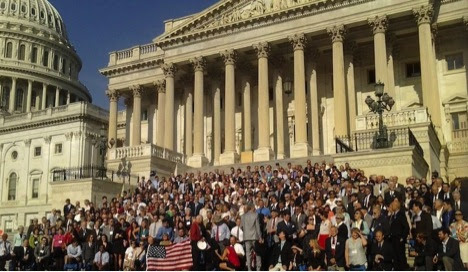
    We had over 600 volunteer lobbyists in Washington, DC this June, and our total membership is now more than 11,000. By our June 2015 International Conference, we hope to have more than 15,000 supporters with 1,000 or more of us coming to DC to meet with our members of Congress.

    With that many volunteers, and so many members of Congress already on board, it feels like we’re getting close to passing carbon fee and dividend legislation!

    DC_Photo 2

    The more volunteers we have, the quicker we’ll get legislation passed. So we need to keep growing, and we need to keep providing quality support to our ever-expanding cadre of awesome volunteers.

    In order to provide this support, we’re now raising $500,000 to meet the remainder of our $1.5 million budget for the year. These funds are used to support our group leaders and volunteers in the field, as well as provide educational conferences in Washington, DC and each CCL region, more briefings of the REMI report, cover costs like our offices in Coronado, CA and DC, our well-used conference line, the website, our social media presence, international outreach and support, and CCL group starts across the U.S.

    How can we reach this $500,000 goal? Simple: One donation at a time! Your donation will be tax-deductible because it will fund our educational outreach to and support of our volunteers.

    Please give as generously as you can today to help us solve global warming.

    We can do this! We can raise $500,000! We can solve global warming!

    Thank you for your generous participation.

    In Joy and Gratitude, Lynate

    Lynate Pettengill
    Development Director
    Citizens’ Climate Education Corp.

    P.S. We started this campaign in October and are already halfway to our $500,000 goal thanks to donations from people like you!

  • Now’s our moment FAIR AGENDA

    2 of 3
    Web Clip

    Now’s our moment

    Inbox
    x

    Bec, Fair Agenda <info@fairagenda.org>

    10:47 AM (20 minutes ago)

    to me
    Fair Agenda
    Neville,

    Late last night news broke that Tony Abbott is “taking the weekend” to consider a cabinet reshuffle.1 You and thousands of Fair Agenda members have already reminded him, in his own words, that there are plenty of talented female coalition MPs “knocking on the door” – but the late breaking articles don’t mention any women under consideration.

    Right now is our moment to break down that door. But it has to be today.

    Here’s what it will take to put fair representation on the PM’s agenda this weekend:

    1. More voices joining the call: Can you share our petition on facebook and tag five friends asking them to sign? We’ll deliver the messages to the Prime Minister today, and invite local media to hear about the fast growing campaign, so he won’t be able to miss it.
    2. Taking the message directly the the Prime Minister: if enough of us tweet and comment on his facebook page, the staff monitoring social will have to alert Mr Abbott to the calls for more women in Cabinet.
    3. Make sure the media ask him about it: political staff know there’s nothing like the Friday afternoon press inquiry to get the whole office jumping, so let’s go where the journalists are:

    Unsure of what to say? Don’t worry – we’ve plenty of suggestions to get you started, just click here for some ideas. The important thing is that everywhere the Prime Minister goes today he’s being asked about women in Cabinet.

    Could there a be a better time when the Prime Minister himself has called out sexism in the Liberal party2 and we know he plans to reshuffle the cabinet?

    We’re all busy this time of year – but if you can take just a few minutes to do these three things, we can change the course of the PM’s busy day, and make it about fair representation in our Government.

    Thanks for all that you do!

    Bec and Renee for Fair Agenda
    -References-

    1. Prime Minister Tony Abbott to spend weekend pondering front bench reshuffle, Sydney Morning Herald, 18 December 2014.
    2. Peta Credlin critics are sexist, Tony Abbott claims during TV slap down, Sydney Morning Herald, 12 December 2014.

    Fair Agenda
    http://www.fairagenda.org/

    Fair Agenda · Australia
    This email was sent to nevilleg729@gmail.com. To stop receiving emails, click here.
    You can also keep up with Fair Agenda on Twitter or Facebook.

    Created with NationBuilder, the essential toolkit for leaders.