Author: Neville

  • Carbon capture and storage — reality or still a dream?

    Australia
    16 October 2014, 6.27am AEDT

    Carbon capture and storage — reality or still a dream?

    To have any chance of avoiding dangerous climate change we’ll have to reduce the carbon emissions from our energy sectors — currently the largest human source of greenhouse gas emissions globally. And…

    Could carbon capture and storage be the way to clean up coal power stations, such as this one in Australia’s Latrobe Valley? Monash University/Flickr, CC BY-NC

    To have any chance of avoiding dangerous climate change we’ll have to reduce the carbon emissions from our energy sectors — currently the largest human source of greenhouse gas emissions globally. And we’ll have to do it quickly.

    Renewable energy is one solution. But given ongoing debate about supplying enough energy for a growing population, and replacing old fossil fuel energy generators, options such as carbon capture and storage have been hailed as another.

    Recently the largest carbon capture and storage program yet began operation at SaskPower’s Boundary Dam project in Saskatchewan, Canada. The project retrofitted a 138 megawatt coal power station into a 110 megawatt station, and is expected to capture 90% of the carbon emissions produced through burning the coal.

    Carbon capture and storage, or CCS, gained attention as far back as 1995, when the Intergovernmental Panel on Climate Change speculated that yet-to-be-developed CCS technology might be applied to large fossil fuel generators.

    The Canadian project demonstrates that the technology can be used, but we now know it comes at considerable cost, and may not even reduce overall carbon emissions.

    Many of these issues have been presented in a CCS Information Paper by Beyond Zero Emissions, of which I am the CEO.

    Why CCS?

    The rationales supporting CCS include the technical, economic and political obstacles in the transition to a zero carbon energy system such as one reliant on renewable energy.

    From a physical construction point of view, replacement of existing emission intensive generation capacity, on top of the additional capacity required in developing economies, is a daunting prospect. Particularly when considering the ever tightening time-frame for change for preventing dangerous climate change.

    How CCS works LeJean Hardin and Jamie Payne derivative work: Jarl Arntzen/Wikimedia Commons, CC BY-SA
    Click to enlarge

    In addition, a political minefield awaits the regulated obsolescence of a large utility asset portfolio of mixed public and private shareholders as greenhouse gas emissions cease to be ignored.

    It’s no wonder that the possibility to adapt these assets to operate without emitting carbon dioxide invites temptation — a circuit breaker of sorts.

    CCS doesn’t work if you’re digging up more fossil fuels

    The Canadian CCS project will use the captured carbon to help extract crude oil. This is partly to offset the cost of capturing carbon, but what does it mean for carbon emissions?

    The CO2 injected into oil-bearing rock mixes with the oil and allows that oil (now mixed with CO2) to move to the surface, via wells, for recovery.

    After separating the CO2 from the recovered oil, CO2 (valued by the industry between US$25-$40 per tonne) is cycled back into the ground again and again.

    Ultimately some CO2 will remain permanently stored. But CO2 enhanced oil recovery can produce between 0.2 and 1.1 tonnes of oil for every tonne of CO2 permanently stored (see also here and here).

    Nearly all of the oil will be burned to produce 0.6 to 3.4 tonnes of CO2. Therefore, the ratio of CO2 stored to CO2 released due to oil burning ranges from 0.6-to-1 to 3.4-to-1. That’s either slightly climate-positive (with an overall storing of carbon) or very climate-damaging (with carbon released overall).

    In order to maximise profit, oil producers will inevitably target the most climate-damaging reservoirs where the greatest amount of oil can be recovered by using the least amount of CO2.

    On top of emissions from oil, in North America where most of the new CO2 injection activities are planned, any CO2 permanently stored is not expected to be monitored and verified. No legal mechanisms have been established. So in this case the permanent storage of any CO2 should be considered incidental.

    High cost — for what gain?

    So why use CO2 to retrieve oil at all? One reason is to offset to considerable costs of retrofitting the coal power station, and countering the 21% drop in power output.

    The essential goal behind CCS is to preserve capital assets while transitioning to zero carbon emissions. But this argument doesn’t hold up under scrutiny.

    We can de-carbonise electricity by replacing fossil fuel power with renewable, or retrofitting fossil fuel power with CCS, or a mix of both. But no matter which path we choose, it will come at the expense of emissions-intensive power generators, and then passed on to society.

    This can come through devalued share holder capital from closing power stations early, or through additional investment for CCS.

    In the case of the latter, the capital returns of fossil fuel generators renewed by CCS would be clipped by a wholesale electricity market in which renewable generation is already proving competitive. Any room in the wholesale market for price increases would be borne by electricity customers.

    Additional investment not generating additional revenue dilutes returns, effectively consuming the pre-existing capital. Any shareholder of a company experiencing an unproductive equity raising is aware of this reality. The only capital preserved therefore would be the balance of existing and new capital – if any.

    The Canadian CCS project is the first chance to test this point. A reported CA$1.35 billion (AU$1.56bn) including a CA$240 million government grant has been invested to retrofit the coal power station with CCS — converting 139 megawatts to 110 megawatts.

    Compare this with the recent sale of the NSW owned MacGen to AGL — 4,640 megawatts for the sum of AU$1.5 billion. Clearly any attempt to refit Macquarie Generation with CCS would prove far more costly than foregoing such a sale value.

    It is clear that it would be less costly to simply replace emission intensive generators — a cost that would be offset by avoided future fuel expenditure.

    More cost and less abatement

    Quite aside from greenhouse gas emissions which CCS seeks to resolve, other problems remain with the continued use of fossil fuels.

    Mine site land-use conflict with agricultural production and protected areas of bio-diversity, fire risk of exposed flammable material, combustion waste solids and other pollutants not addressed by carbon capture, as well as water intensity of thermally inefficient generators to name but a few.

    It must be questioned why infrastructure which entails such significant external costs would be adhered to so determinedly, even if CCS could be proved as a slightly commercial proposition.

    When it’s clear that CCS is not even close to a commercial prospect and when net CO2 emissions may actually increase when combined with oil recovery we must accept reality and swiftly move on to proven and affordable solutions to reducing carbon emissions such as renewable energy, energy efficiency and reforestation to name but a few.

  • Solar energy that doesn’t block the view

    ScienceDaily: Your source for the latest research news
    Featured Research
    from universities, journals, and other organizations
    Solar energy that doesn’t block the view
    Date:
    August 19, 2014
    Source:
    Michigan State University
    Summary:
    Researchers have developed a new type of solar concentrator that when placed over a window creates solar energy while allowing people to actually see through the window. It is called a transparent luminescent solar concentrator and can be used on buildings, cell phones and any other device that has a flat, clear surface.
    Share This

    Email to a friend
    Facebook
    Twitter
    LinkedIn
    Google+
    Print this page

    Solar power with a view: MSU doctoral student Yimu Zhao holds up a transparent luminescent solar concentrator module.
    Credit: Yimu Zhao
    [Click to enlarge image]

    A team of researchers at Michigan State University has developed a new type of solar concentrator that when placed over a window creates solar energy while allowing people to actually see through the window.

    It is called a transparent luminescent solar concentrator and can be used on buildings, cell phones and any other device that has a clear surface.

    And, according to Richard Lunt of MSU’s College of Engineering, the key word is “transparent.”

    Research in the production of energy from solar cells placed around luminescent plastic-like materials is not new. These past efforts, however, have yielded poor results — the energy production was inefficient and the materials were highly colored.

    “No one wants to sit behind colored glass,” said Lunt, an assistant professor of chemical engineering and materials science. “It makes for a very colorful environment, like working in a disco. We take an approach where we actually make the luminescent active layer itself transparent.”

    The solar harvesting system uses small organic molecules developed by Lunt and his team to absorb specific nonvisible wavelengths of sunlight.

    “We can tune these materials to pick up just the ultraviolet and the near infrared wavelengths that then ‘glow’ at another wavelength in the infrared,” he said.

    The “glowing” infrared light is guided to the edge of the plastic where it is converted to electricity by thin strips of photovoltaic solar cells.

    “Because the materials do not absorb or emit light in the visible spectrum, they look exceptionally transparent to the human eye,” Lunt said.

    One of the benefits of this new development is its flexibility. While the technology is at an early stage, it has the potential to be scaled to commercial or industrial applications with an affordable cost.

    “It opens a lot of area to deploy solar energy in a non-intrusive way,” Lunt said. “It can be used on tall buildings with lots of windows or any kind of mobile device that demands high aesthetic quality like a phone or e-reader. Ultimately we want to make solar harvesting surfaces that you do not even know are there.”

    Lunt said more work is needed in order to improve its energy-producing efficiency. Currently it is able to produce a solar conversion efficiency close to 1 percent, but noted they aim to reach efficiencies beyond 5 percent when fully optimized. The best colored LSC has an efficiency of around 7 percent.

    The research was featured on the cover of a recent issue of the journal Advanced Optical Materials.

  • Report: Fossil fuel companies found paying lip service to climate risks 41 14 2

    Report: Fossil fuel companies found paying lip service to climate risks

     41  14 2

     1

    • October 16, 2014 • Comments (0)

    fossil fuel companies

    Coal, oil and gas companies almost universally recognise the risks climate change poses to their businesses, yet just 7% are integrating these threats into their spending choices.

    That’s the latest warning of UK think-tank the Carbon Tracker Initiative, as new analysis -– in partnership with CDP and Ceres  – shows that many companies are simply paying “lip service” to climate risk.

    The research examined the answers of 81 coal, oil and gas companies who took part in a survey by CDP – including some of the world’s largest fossil fuels companies such as BP, Statoil, ExxonMobil, Chevron, BHP Billton and Rio Tinto.

    Of the companies asked, 86% said they consider climate change a physical risk for their business, while 99% thought climate-related regulation, including carbon taxes or cap and trade schemes, to be risk to their operations.

    Yet just 7% of companies provide evidence that they were adequately integrating this risk into their spending assessments – showing these companies are “failing to connect the dots”.

    Last week, Bank of England governor Mark Carney became the latest figure to warn that companies risk being left with a product they can not sell as the world takes action to tackle climate change.

    He warned a World Bank seminar “the vast majority of reserves are unburnable”.

    It is widely accepted that to keep global warming below 2°C, the vast majority of fossil fuels will have to be left in the ground.

    Mark Campanale, Founder and Executive Director of the Carbon Tracker Initiative warned companies must do more to disclose the threat this places on their businesses.

    With the IEA forecasting that $23 trillion will be invested in expanding the fossil fuel sector up to 2035, putting this amount of capital at risk doesn’t leave much room for complacency in how climate risks are disclosed.

    Four out of five of the companies show no evidence of analysing how different temperature increases could impact their business, while around 10% of the oil and gas companies, and just one coal company, stress-test projects against the internationally agreed goal of limiting warming to 2°C.

    Just two of the 32 coal companies who responded to the report survey accept this limit agreed on by governments.

    And while 25 companies “acknowledge climate change”, only five of these went on to “acknowledge that climate change requires emissions reductions”.

    With the survey sample representing the “best in class” sample – the 24% of fossil fuels companies that received and responded to CDPs 2014 climate change questionnaire – these figures are particularly worrying.

    The failure of these companies to disclose how they plan to deal with the transition to a low carbon economy or international climate legislation may affect their business model should sound a warning bell to investors, warn the researchers.

    Mindy Lubber, president of the sustainable advocacy group Ceres said:

    The report highlights the vast gulf between what investors are looking for and what energy companies are not providing in regards to financial risks from high carbon, high cost fossil fuels projects. Investors should step up their calls to companies to better explain these huge expenditures.

    Carbon Tracker Initiative is calling on financial regulators and standard setting bodies to increase their scrutiny of fossil fuel companies and ensure they build “climate literate” capital markets.

    – See more at: http://tcktcktck.org/2014/10/report-fossil-fuel-companies-found-paying-lip-service-climate-risks/64803#sthash.VE6ODlYl.5l9IerJG.dpuf

  • Governments to discuss opportunities to reduce non-CO2 greenhouse gases

    Hero Background

    UN Climate Change NEWSROOM

    READ MORE
  • Live: Pacific Warriors to face off with coal ship

    1 of 5
    Ad850% + Investment Returnsthe-best-investments-today.com – Invest In Alternative Investments. Huge Profits. Free Top-Pick Guide!

    Live: Pacific Warriors to face off with coal ship

    Inbox
    x

    Aaron Packard – 350.org <aaron@350.org> Unsubscribe

    11:16 AM (4 hours ago)

    to me

    After months of preparation and planning, 30 Pacific Climate Warriors just launched their traditional canoes into the water in Newcastle. They are paddling into the oncoming path of coal ships in an attempt to shut down the world’s largest coal port for a day.

    You can follow the action on our live blog right now!

    As the Pacific Warriors arrived in Australia, news came from back home that king tides fueled by rising sea levels had wreaked havoc on a number of Pacific Islands. Homes flooded, crops lost and critical infrastructure damaged. This was a timely reminder of what living with climate change is like for the Pacific Islands and why they have come to Australia to fight back against the fossil fuel industry.

    But as the warriors stand up to the industry we need your support. They know they cannot win this fight alone.

    Show the Pacific Warriors that they are not out there alone. Share your support and spread their story by taking a photo with your message to the Climate Warriors and posting it to social media using the hashtag #StandUpForThePacific. Need some inspiration? Click here for more information.

    We want to flood social media with messages of support for the Warriors so their message is impossible to ignore. Click here to learn more about how you can show your support for the Pacific Warriors.

    This is a big day. It is a day where the Pacific stands up against the destruction of the fossil fuel industry.

    Please stand with us.

    Regards,
    Aaron Packard on behalf of the 350.org team

    PS: Hear first hand from the Warriors next week in your local city. Click here to register today: www.350.org.au/warriorstory

    1 of 5
    Ad850% + Investment Returnsthe-best-investments-today.com – Invest In Alternative Investments. Huge Profits. Free Top-Pick Guide!

    Live: Pacific Warriors to face off with coal ship

    Inbox
    x

    Aaron Packard – 350.org <aaron@350.org> Unsubscribe

    11:16 AM (4 hours ago)

    to me

    After months of preparation and planning, 30 Pacific Climate Warriors just launched their traditional canoes into the water in Newcastle. They are paddling into the oncoming path of coal ships in an attempt to shut down the world’s largest coal port for a day.

    You can follow the action on our live blog right now!

    As the Pacific Warriors arrived in Australia, news came from back home that king tides fueled by rising sea levels had wreaked havoc on a number of Pacific Islands. Homes flooded, crops lost and critical infrastructure damaged. This was a timely reminder of what living with climate change is like for the Pacific Islands and why they have come to Australia to fight back against the fossil fuel industry.

    But as the warriors stand up to the industry we need your support. They know they cannot win this fight alone.

    Show the Pacific Warriors that they are not out there alone. Share your support and spread their story by taking a photo with your message to the Climate Warriors and posting it to social media using the hashtag #StandUpForThePacific. Need some inspiration? Click here for more information.

    We want to flood social media with messages of support for the Warriors so their message is impossible to ignore. Click here to learn more about how you can show your support for the Pacific Warriors.

    This is a big day. It is a day where the Pacific stands up against the destruction of the fossil fuel industry.

    Please stand with us.

    Regards,
    Aaron Packard on behalf of the 350.org team

    PS: Hear first hand from the Warriors next week in your local city. Click here to register today: www.350.org.au/warriorstory

  • A Tax Cheat is a THIEF (HOCKEY)

    1 of 9
    AdI want to retire abroadwww.escapologist.com.au – Now you can live in luxury for less These 3 countries are safe & cheap

    ‘A tax cheat is a thief’ – Joe Hockey

    Inbox
    x

    Lily – GetUp!

    12:39 PM (2 hours ago)

    to me
    Dear NEVILLE,

    Corporate tax dodging is costing Australian taxpayers billions of dollars — money that could be funding our hospitals, universities and social safety net.

    In a matter of days, more than 40,000 of us signed a petition asking Joe Hockey to ensure corporate tax dodgers pay their fair share of tax — and the pressure is working.

    The Treasurer is now talking tough on corporate tax dodging, saying ‘a tax cheat is a thief’ and making commitments to crack down on global tax evasion.1 But meanwhile, he’s slashed the ATO budget, hamstringing their ability to go after the worst corporate tax cheats.

    So to turn tough talk into action, Government MPs and senators need to know that reports of corporate tax dodging have really touched a nerve with their voters. Together, let’s deliver the message: talk is cheap — we want action.

    Click here to email your Government MP or Senator and ask for real action to ensure that big business pays their fair share of tax

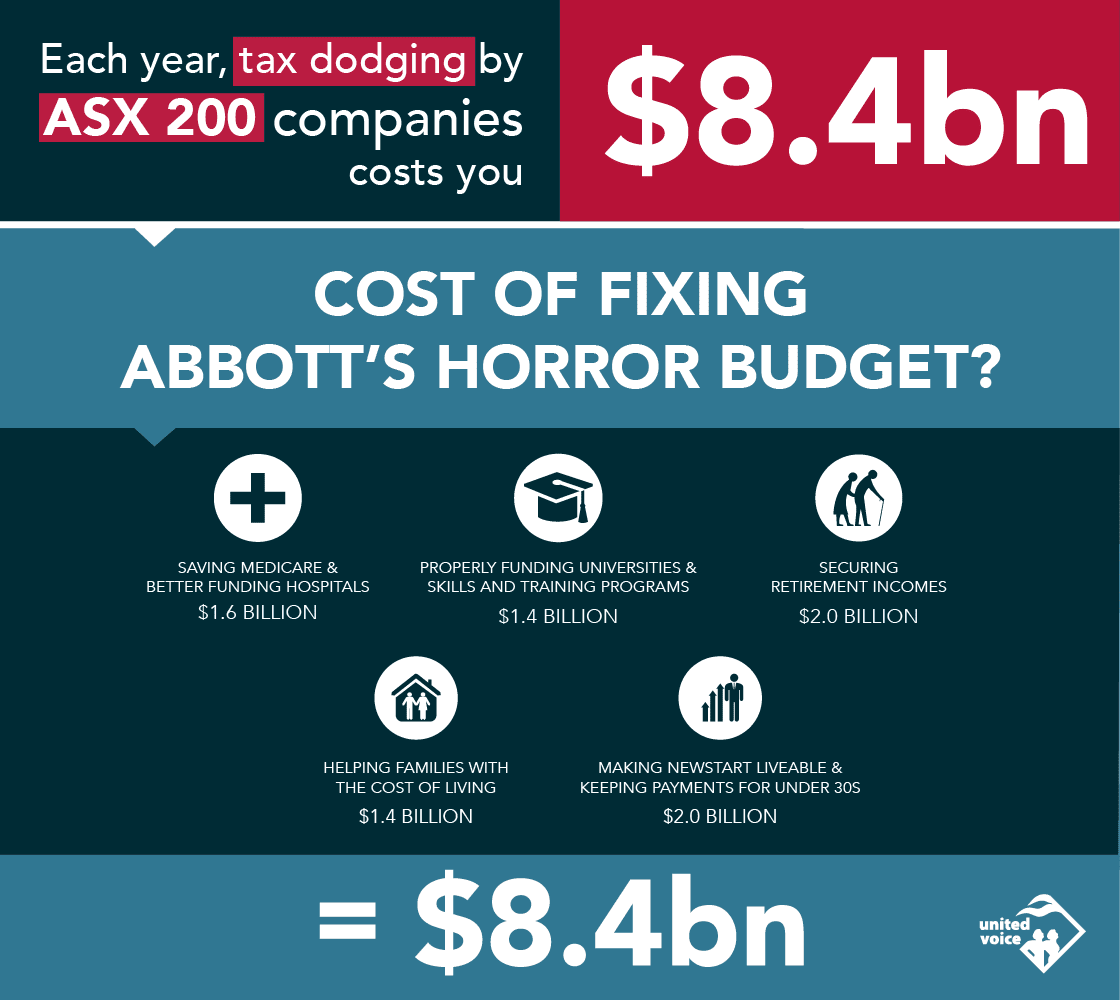
    An estimated 2.5 milllion Australians are now living below the poverty line at the very time the Abbott Government is asking the poorest Aussie households to contribute $1.1 billion more than the wealthy.2 And according to a report by the Tax Justice Network and United Voice, the top 200 ASX companies are paying billions less than they should be, parking some of their profits in offshore tax havens.3

    It’s disgraceful. That’s why Australians are up in arms over the failure of big business to pay their fare share, while we’re asked to bear the budget pain. So this is exactly the right time to put pressure on our politicians to take a tougher stance on tax dodging by big business.

    While Mr Hockey’s crack down rhetoric is a great start, his actions leave a lot to be desired. The Government just cut $189 million from the Australian Taxation Office — the very body that polices tax compliance. They’ve also left open loopholes that could have delivered $1.1 billion more to the national coffers.4

    Actions speak louder than words, and picking up the phone to call an MP’s office is an incredibly effective way of putting pressure on our decision makers. Click here to call your Liberal MP or Senator and ask them what actions — not words — they’re going to take to crack down on corporate tax dodgers: www.getup.org.au/corporate-tax-call

    It’s only fair that big businesses making massive profits pay their fair share, just like the rest of us. If they don’t, we’re the ones who end up footing the bill.

    Thank you for all that you do,
    Lily, Mark, Nat and Georgina, for the GetUp team

    PS — This image from our friends at United Voice shows who picks up the bill when our government fails to crack down on big business tax dodgers: our schools, communities and hospitals. Take the time now to tell your MP to spend more time cracking down on big business tax dodgers, instead of squeezing out budget savings from the poor, the sick and our seniors.

    image

    [1]’The Path to Brisbane — Setting up the G20 to make a difference’, The Hon Joe Hockey MP, 8 October 2014.
    [2]’Poverty in Australia Report’, Australian Council of Social Services, October 2014. ‘Poorest families pay most in budget’, Sydney Morning Herald, 22 May 2014.
    [3]’Who Pays for Our Commonwealth? Tax Practices of the ASX 200′, United Voice and the Tax Justice Network, October 2014.
    [4]’Corporate tax avoidance costs Australian business’, Sydney Morning Herald, 30 September 2014.