–
 AdSolar Hot Water System – www.gosolarnewcastle.com.au – Quality Product Backed By 15 Yrs Warranty.250/315/400L Tank Sizes.
|
Daily update: Why rooftop solar makes networks such a hard sell

|
||||||||||||||||||||||||||||||||||||||||
–
|
AdSolar Hot Water System – www.gosolarnewcastle.com.au – Quality Product Backed By 15 Yrs Warranty.250/315/400L Tank Sizes.
|
Daily update: Why rooftop solar makes networks such a hard sell
|
||||||||||||||||||||||||||||||||||||||||
ADVERTISEMENT
Despite all the metals and raw materials that go into making solar cells and wind turbines, these sources of low-carbon renewable electrify will have a low climate and environmental impact through 2050
October 8, 2014 |By Bobby Magill and Climate Central
Wind farms are a major part of global renewable energy buildout by 2050.
Credit: Lollie-Pop/flickr
A lot of metals go into making solar cells and wind turbines, raw materials such as copper, iron, rare earth metals such as indium and others and that involve a lot of greenhouse gases and other pollution when they’re mined and processed to make parts for renewable power generators.
So just how green are these sources of low-carbon renewable electricity? Pretty green, it turns out.
Rolling out wind and solar power projects across the globe through 2050 will probably have a very low climate and environmental impact and even reduce air pollution despite the need for extracting pollution-intensive raw materials for those wind, solar and hydropower projects, according to new research published Monday.
As part of the new Norwegian University of Science and Technology study, researchers conducted the first-ever lifecycle analysis of a wide-scale global rollout of new wind, hydro and solar power plants, asking whether shifting from coal and natural gas power generation to renewables would increase or decrease certain types of pollution.
Generally, there isn’t much known about the environmental and climate costs of a global shift from fossil fuels to renewables and how that shift affects pollution from producing raw materials used in solar panels and wind turbine blades such as copper, concrete, aluminum, indium and other materials, according to the study.
Wind turbines require up to 14 times the iron needed for fossil fuel power generation, and solar photovoltaics require up to 40 times the copper than traditional coal, oil or natural gas-fired power plants, according to the study.
But over time, the environmental impact of extracting those raw materials declines, pollution decreases and the total quantity of those materials likely needed for renewables is a fraction of the volume of those materials being mined today, the study says.
The researchers assumed that solar, wind and hydropower will make up 39 percent of total global power production in 2050, up from 16.5 percent in 2010, requiring 1.5 gigatons of bulk raw materials for construction.
“I was surprised that all the pollution went down for renewables,” the study’s lead author, Edgar Hertwich, an energy and process engineering professor at the Norwegian University of Science and Technology, told Climate Central. “I expected some of the toxics might be rising because of the materials used. Metal ores contain a lot of heavy metals. I expected that to be significant. I was really surprised it didn’t show up.”
When compared to coal-fired power plants, renewables come out on top because wind and solar power generation requires no additional raw material over the lifespan of the turbine or solar panel. Coal-fired plants, on the other hand, require continued mining of coal, he said.
The study, published Monday in the journal Proceedings of the National Academy of Sciences, concludes that new renewable power installations would increase the demand for iron and steel by 10 percent by 2050, and the copper that would be needed for photovoltaic systems are equivalent to two years of current global copper production.
“The amount of material having to move for coal is more than metal moved for renewables,” he said.
Even when solar and wind power generators need to be rebuilt, raw materials can be recycled from older power generators, he said.
Displacing fossil fuels with renewables could reduce global greenhouse gas emissions by 62 percent below a scenario that assumes global energy consumption would continue on its current trajectory, with coal power generation possibly increasing 149 percent over 2007 levels, according to the study. The research also shows that freshwater pollution could be reduced by half and particulate matter in the air reduced by 40 percent.
“This study helps further verify the benefits and necessity of renewable technologies for meeting long-term greenhouse gas mitigation goals,” said Christine Shearer, postdoctoral scholar of earth system science at the University of California-Irvine, whose recent research suggests that reliance on natural gas for power generation impedes the development of renewables.
“We know that no energy source is benign,” she said. “Each one will have an impact on the environment and resources, especially when scaled up. Hertwich and his colleagues have done a real service by quantifying these life cycle effects and showing the benefits of renewable energies not only for the climate, but also air and water, with a manageable amount of resources.”
You May Also Like:
Three Decades Until Carbon Budget Is Eaten Through
Drought Dries Up California Hydropower
Oceans Getting Hotter Than Anybody Realized
Climate Fueled Some of 2013’s Most Extreme Events
This article is reproduced with permission from Climate Central. The article was first published on October 7, 2014.
 Joel Aschbrenner, jaschbrenn@dmreg.com
 James Hansen’s pitch for reducing the greenhouse gases that cause climate change is boiled down to some basic numbers:
A fee of $10 per ton of carbon dioxide, increasing $10 each year, would reduce carbon dioxide emissions by 33 percent in a decade.
While such a carbon tax remains a third-rail issue politically, Hansen, an Iowa native and former director of NASA’s Goddard Institute for Space Studies, says it’s the best way to slow rising sea levels, superstorms and other catastrophes caused by climate change.
“In reality, we’re headed down a path that is certain disaster if we stay on that path,” he told Register editors and writers Wednesday.

Hansen said a carbon tax could be an economic development tool. Under the plan he advocates, every dollar raised would be distributed equally to legal U.S. residents. Hansen said it would raise the price of a gallon of gas by about $1, but would return about $2,000 annually to every resident.
He said the U.S. should lead on the issue. The first country to adopt a carbon tax will reap the benefits of owning new green technologies born out of incentives for reducing emissions, he said.
“It’s a tragedy if we don’t do it, because the solution is not that painful,” he said.
Hansen is speaking on climate change this afternoon at the Heartland Global Health Consortium at Drake University and at 7 p.m. in the main lounge of the Iowa Memorial Union in Iowa City.
An early messenger, Hansen has been sounding alarm bells about the dangers of climate change since the 1980s, when he first testified before Congress. Today, he directs the climate science program at Columbia University’s Earth Institute, where he is working on a paper called “Ice melt, sea level rise and superstorms.”
Hansen said increasing temperatures will speed the melting of the planet’s ice caps, raising sea levels and making coastal cities uninhabitable. But it’s not just the coasts. Studies show a rise in global temperature of 3 degrees Celsius, which he said would happen by 2050 on the current trajectory, would reduce harvests in the U.S. corn belt by 46 percent, he said.
“We’re already pushing beyond the safe level,” he said. “We need to reduce carbon emissions as rapidly as is practical, and that’s what putting an honest price on carbon will do.”
What is practical, though, is a matter of debate. Opponents of a carbon tax say it would hamstring the economy, increasing the price of goods via higher fuel costs. Others say it would be fruitless for the United States to impose a carbon tax if the developing world continues to burn fossil fuels at an increasing rate.
|
AdCommercial Solar Power – www.naturalsolar.com.au – 12 Year Installation Warranty Commercial Solar Experts Free Quote
|
Daily update: Regulator warns consumers could flee the grid
|
||||||||||||||||||||||||||||||||||||||||
#renewables: affordable and achievable with today’s technologies: http://bit.ly/1CiMurC
 | By By SETH BORENSTEIN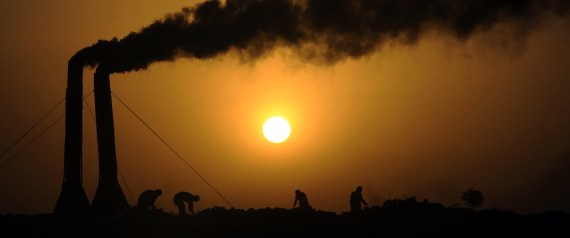
WASHINGTON (AP) — People are changing Earth so much, warming and polluting it, that many scientists are turning to a new way to describe the time we live in. They’re calling it the Anthropocene — the age of humans.
Though most non-experts don’t realize it, science calls the past 12,000 years the Holocene, Greek for “entirely recent.” But the way humans and their industries are altering the planet, especially its climate, has caused an increasing number of scientists to use the word Anthropocene to better describe when and where we are.
“We’re changing the Earth. There is no question about that, I’ve seen it from space,” said eight-time spacewalking astronaut John Grunsfeld, now associate administrator for science at NASA. He said that when he looked down from orbit, there was no place he could see on the planet that didn’t have the mark of man. So he uses the term Anthropocene, he said, “because we’re intelligent enough to recognize it.”
Grunsfeld was in the audience of a “Living in the Anthropocene” symposium put on last week by the Smithsonian. Meanwhile, the American Association for the Advancement of Science is displaying an art exhibit, “Fossils of the Anthropocene.” More than 500 scientific studies have been published this year referring to the current time period as the Anthropocene.
And on Friday the Anthropocene Working Group ramps up its efforts to change the era’s name with a meeting at a Berlin museum. The movement was jump-started and the name coined by Nobel laureate Paul Crutzen in 2000, according to Australian National University scientist Will Steffen.
Geologists often mark new scientific time periods with what they call a golden spike — really more of a bronze disk in the rock layer somewhere that physically points out where one scientific time period ends and another begins, said Harvard University’s Andrew Knoll, who supports the idea because “humans have become a geologic force on the planet. The age we are living now in is really distinct.”
But instead of a golden spike in rock, “it’s going to be a layer of plastic that covers the planet, if not a layer of (heat-trapping) carbon,” said W. John Kress, acting undersecretary of science for the Smithsonian. Kress said the Smithsonian is embracing the term because “for us it kind of combines the scientific and the cultural in one word.”
It’s an ugly word, one many people don’t understand, and it’s even hard to pronounce, Kress admitted. (It’s AN’-thruh-poh-seen.) That’s why when he opened the Smithsonian’s symposium, he said, “We are living in the Anthropocene,” then quickly added, “the age of humans.”
“Never in its 4.6 billion-year-old history has the Earth been so affected by one species as it is being affected now by humans,” Kress said.
Steffen, one of the main leaders of the Anthropocene movement, said in an email that the age of humans is more than just climate change. It includes ozone loss, disruption of nitrogen and phosphorous cycles that are causing dead zones, changes in water, acidification of the ocean, endocrine disruptors and deforestation.
Steffen said there’s no scientific consensus for the term Anthropocene yet, but he sees support growing. To become official it has to be approved by the International Union of Geological Sciences’ Commission on Stratigraphy.
That process is detailed and slow, said Harvard’s Kroll, who spearheaded the last successful effort to add a new time period — the little known Ediacaran period, about 600 million years ago. It took him 15 years.
The head of that deciding committee, Stan Finney at California State University at Long Beach, said in an interview that he is often called “the biggest critic” of the Anthropocene term. He said while there’s no doubt humans are dramatically changing the planet, creating a new geologic time period requires detailed scientific records, mostly based on what is in rocks.
Supporters also don’t agree on when the Anthropocene starts. Suggestions include the start of farming, industrialization and the use of the atomic bomb.
The Geological Society of America hasn’t taken up the term yet, but may soon start paying attention to the concept, said society president Hap McSween of the University of Tennessee.
“I actually think it’s a great idea,” McSween said. “Humans are profoundly affecting the environment, probably as much as natural events have in the past. And when effects become profound enough, we draw a new boundary and make it a period. … It’s a good way to point out the environmental havoc that humans are causing.”
___
Online:
Geologic time scale: http://www.ucmp.berkeley.edu/help/timeform.php
Anthropocene Working Group: http://quaternary.stratigraphy.org/workinggroups/anthropocene/
Smithsonian Living in the Anthropocene symposium: http://www.si.edu/consortia/anthropocene2014
___
Seth Borenstein can be followed at http://twitter.com/borenbears