

Author: Neville

  • Antarctic ice melts causing shift in Earth’s gravity

    Antarctic ice melts causing shift in Earth’s gravity

    By Karla Lant     Oct 2, 2014 in Science

    The effects of climate change are now so profound that gravity itself is changing. The European Space Agency (ESA) announced Friday that Antarctica has lost enough ice in only three years to cause a shift in the Earth’s gravitational pull.

    The effects of climate change are now so profound that gravity itself is changing. The European Space Agency (ESA) announced Friday that Antarctica has lost enough ice in only three years to cause a shift in the Earth’s gravitational pull.

    “The loss of ice from West Antarctica between 2009 and 2012 caused a dip in the gravity field over the region,” writes the ESA. “And, between 2011 and 2014, Antarctica as a whole has been shrinking in volume by 125 cubic kilometers a year.”

    The ESA’s Gravity field and steady-state Ocean Circulation Explorer Satellite (GOCE), launched in 2009, measured these changes. You can see a video that visualizes them here.

    While in some senses this doesn’t seem like a major impact, it is highly significant as part of the overall havoc being wreaked by climate change. Earlier this year a completely different team of researchers from NASA and the University of California, Irvine (UC Irvine) announced that multiple major glaciers in West Antarctica have begun an “unstoppable collapse” and have “passed the point of no return”:

    “This sector will be a major contributor to sea level rise in the decades and centuries to come,” writes glaciologist and lead author Eric Rignot of UC Irvine and NASA’s Jet Propulsion Laboratory (JPL). “A conservative estimate is it could take several centuries for all of the ice to flow into the sea.”

    So these are events that are too far gone to stop, and the best case scenario is that as a result global sea levels will rise by several meters over the next few hundred years — not a long time.

    And what about the gravity issue? Most of us learned about Newtonian physics in basic high school courses. These courses told us that gravity is a constant, but this isn’t completely accurate; it actually varies slightly based on your location on the planet and the density of whatever is underneath you, rock, groundwater, ocean currents, or ice. Other factors impact gravity too, and ESA launched GOCE to measure variations in gravity and observe what causes them.

    In the time GOCE has been operating ESA has reported that gravity changes over time. For example, gravity “scars” left by earthquakes such as the 2011 Japanese earthquake vary slightly over time. This is how ESA got the results about Antarctica’s melting ice and gravity dipping.

    The GOCE satellite takes high-resolution measurements of the gravitational field and scientists combine those with results from Grace, another satellite mission. Grace, operated by the U.S. and Germany, provides lower resolution gravity analysis. The combined results allow ESA experts to see the clearest gravitational changes, and other satellites provide melt maps. CryoSat, for example, shows an increase in ice loss from West Antarctica of at least three times since only 2009. Greenland and Antarctica together now lose approximately 500 cubic kilometers of ice annually; that’s a Manhattan-sized iceberg three-and-a-half miles thick.

  • The 5&5 Tony Burke

    2 of 7
    AdI want to retire abroadwww.escapologist.com.au – Now you can live in luxury for less These 3 countries are safe & cheap
    2 of 7
    AdI want to retire abroadwww.escapologist.com.au – Now you can live in luxury for less These 3 countries are safe & cheap

    The 5&5

    Inbox
    x

    Tony Burke via sendgrid.info 

    8:07 AM (44 minutes ago)

    to me
    .

    Neville —
    Let’s get straight into it. Here’s the #5and5.

    BEST:

    1. It’s not every week you save the pension. Your campaign with Bill Shorten and Jenny Macklin secured an essential victory for Australian pensioners this week by forcing the Government to back down on its planned cuts to the age pension and increase in the retirement age to 70. This is only round one – they’ve already said they’ll try to cut it again. Your help is going to be needed right up to election day.
    2. There’s been some divisive language carelessly thrown around lately. On Thursday Bill made it clear that Labor stands for a united and cohesive Australia that embraces respect and rejects racism, hatred and bigotry. Check out Bill’s great speech here.
    3. Also on Thursday Labor MPs added their voices to Bill’s to show that Labor stands united on supporting cultural respect and community harmony. This is about common decency to our fellow Australians. You can watch some great moments from these speeches here.
    4. The Country Caucus, which is chaired by Joel Fitzgibbon, hammered the Government for neglecting rural and regional Australia. The representation these MPs provide for the bush is relentless and leaves the National Party as nothing more than Libs in hats.
    5. Talk about getting a message out! Last week I posted a video about Christopher Pyne’s higher education cuts after he said that Labor can’t be heard (you can watch it here if you haven’t seen it already). Well, thanks to you we have been heard. The video has been shared by more than 10,000 of you and has reached nearly one million people.

    WORST:

    1. Around the same time Tony Abbott was preparing to fly to New York last week, 120 world leaders were meeting for the United Nations climate change summit to tackle climate change. It’s a shame Tony Abbott wasn’t one of them. How can we have meaningful action on climate change if our PM won’t even show up.
    2. More than 3,000 people have died from Ebola in West Africa so far. The United Nations, Médecins Sans Frontières and even President Barack Obama have called on nations to offer personnel and technical support to stop its deadly spread. At the UN the Australian Government co-sponsored a resolution calling on countries to send people to help, only to then refuse to support Australians who want to offer their expertise.
    3. For a period of about four hours on Thursday afternoon it looked like Australia was going to have segregation in the public galleries in Parliament House. The latest reports suggest this now won’t go ahead. Nonetheless, it was a disappointing moment for our Parliament.
    4. “Look there’s your dole, go home eat Cheezels, get on the Xbox.” That’s how Liberal MP Ewan Jones defended the Government’s decision to leave people under 30 with nothing to live on for six months. Later that day he tried to deny the Government even had this policy. Sounds like Ewan would be more useful on an X-Box than as an MP.
    5. On Monday Bronwyn Bishop suspended her 200th Labor member of Parliament. To put this into perspective, at this rate the Speaker is on track to hit 600 suspensions this term, which will account for around one third of all suspensions since Federation. I’ll let you make your own judgments on that.

    Song of the week is The Beatles with When I’m Sixty Four, which is dedicated to Kevin Andrews’ attempt to change the chorus to When I’m Seventy.

    Inbox
    x

    Tony Burke via sendgrid.info 

    8:07 AM (44 minutes ago)

    to me
    .

    Neville —
    Let’s get straight into it. Here’s the #5and5.

    BEST:

    1. It’s not every week you save the pension. Your campaign with Bill Shorten and Jenny Macklin secured an essential victory for Australian pensioners this week by forcing the Government to back down on its planned cuts to the age pension and increase in the retirement age to 70. This is only round one – they’ve already said they’ll try to cut it again. Your help is going to be needed right up to election day.
    2. There’s been some divisive language carelessly thrown around lately. On Thursday Bill made it clear that Labor stands for a united and cohesive Australia that embraces respect and rejects racism, hatred and bigotry. Check out Bill’s great speech here.
    3. Also on Thursday Labor MPs added their voices to Bill’s to show that Labor stands united on supporting cultural respect and community harmony. This is about common decency to our fellow Australians. You can watch some great moments from these speeches here.
    4. The Country Caucus, which is chaired by Joel Fitzgibbon, hammered the Government for neglecting rural and regional Australia. The representation these MPs provide for the bush is relentless and leaves the National Party as nothing more than Libs in hats.
    5. Talk about getting a message out! Last week I posted a video about Christopher Pyne’s higher education cuts after he said that Labor can’t be heard (you can watch it here if you haven’t seen it already). Well, thanks to you we have been heard. The video has been shared by more than 10,000 of you and has reached nearly one million people.

    WORST:

    1. Around the same time Tony Abbott was preparing to fly to New York last week, 120 world leaders were meeting for the United Nations climate change summit to tackle climate change. It’s a shame Tony Abbott wasn’t one of them. How can we have meaningful action on climate change if our PM won’t even show up.
    2. More than 3,000 people have died from Ebola in West Africa so far. The United Nations, Médecins Sans Frontières and even President Barack Obama have called on nations to offer personnel and technical support to stop its deadly spread. At the UN the Australian Government co-sponsored a resolution calling on countries to send people to help, only to then refuse to support Australians who want to offer their expertise.
    3. For a period of about four hours on Thursday afternoon it looked like Australia was going to have segregation in the public galleries in Parliament House. The latest reports suggest this now won’t go ahead. Nonetheless, it was a disappointing moment for our Parliament.
    4. “Look there’s your dole, go home eat Cheezels, get on the Xbox.” That’s how Liberal MP Ewan Jones defended the Government’s decision to leave people under 30 with nothing to live on for six months. Later that day he tried to deny the Government even had this policy. Sounds like Ewan would be more useful on an X-Box than as an MP.
    5. On Monday Bronwyn Bishop suspended her 200th Labor member of Parliament. To put this into perspective, at this rate the Speaker is on track to hit 600 suspensions this term, which will account for around one third of all suspensions since Federation. I’ll let you make your own judgments on that.

    Song of the week is The Beatles with When I’m Sixty Four, which is dedicated to Kevin Andrews’ attempt to change the chorus to When I’m Seventy.

  • The Kink in the Human Brain – monbiot.com

    e to enable desktop notifications for Gmail.   Learn more  Hide
    1 of 3
    AdRetiring overseas is easywww.escapologist.com.au – Three English speaking countries where you can live well for less

    The Kink in the Human Brain – monbiot.com

    Inbox
    x

    George Monbiot news@monbiot.com via google.com 

    5:04 PM (5 minutes ago)

    to me

    The Kink in the Human Brain – monbiot.com


    The Kink in the Human Brain

    Posted: 02 Oct 2014 02:41 AM PDT

    Pointless, joyless consumption is destroying our world of wonders.

    By George Monbiot, published in the Guardian 2nd October 2014

    This is a moment at which anyone with the capacity for reflection should stop and wonder what we are doing.

    If the news that in the past 40 years the world has lost over 50% its vertebrate wildlife (mammals, birds, reptiles, amphibians and fish) fails to tell us that there is something wrong with the way we live, it’s hard to imagine what could. Who believes that a social and economic system which has this effect is a healthy one? Who, contemplating this loss, could call it progress?

    In fairness to the modern era, this is an extension of a trend that has lasted some two million years. The loss of much of the African megafauna – sabretooths and false sabretooths, giant hyaenas and amphicyonids (bear dogs), several species of elephant – coincided with the switch towards meat eating by hominims (ancestral humans). It’s hard to see what else could have been responsible for the peculiar pattern of extinction then.

    As we spread into other continents, their megafaunas almost immediately collapsed. Perhaps the most reliable way of dating the first arrival of people anywhere is the sudden loss of large animals. The habitats we see as pristine – the Amazon rainforest or coral reefs for example – are in fact almost empty: they have lost most of the great beasts that used to inhabit them, which drove crucial natural processes.

    Since then we have worked our way down the foodchain, rubbing out smaller predators, medium-sized herbivores, and now, through both habitat destruction and hunting, wildlife across all classes and positions in the foodweb. There seems to be some kink in the human brain that prevents us from stopping, that drives us to carry on taking and competing and destroying, even when there is no need to do so.

    But what we see now is something new: a speed of destruction that exceeds even that of the first settlement of the Americas, 14,000 years ago, when an entire hemisphere’s ecology was transformed through a firestorm of extinction within a few dozen generations, in which the majority of large vertebrate species disappeared.

    Many people blame this process on human population growth, and there’s no doubt that it has been a factor. But two other trends have developed even faster and further. The first is the rise in consumption; the second is amplification by technology. Every year, new pesticides, new fishing technologies, new mining methods, new techniques for processing trees are developed. We are waging an increasingly asymmetric war against the living world.

    But why are we at war? In the rich nations, which commission much of this destruction through imports, most of our consumption has nothing to do with meeting human needs.

    This is what hits me harder than anything: the disproportion between what we lose and what we gain. Economic growth in a country whose primary and secondary needs have already been met means developing ever more useless stuff to meet ever fainter desires.

    For example, a vague desire to amuse friends and colleagues (especially through the Secret Santa nonsense) commissions the consumption of thousands of tonnes of metal and plastic, often confected into complex electronic novelties: toys for adults. They might provoke a snigger or two, then they are dumped in a cupboard. After a few weeks, scarcely used, they find their way into landfill.

    In a society bombarded by advertising and driven by the growth imperative, pleasure is reduced to hedonism and hedonism is reduced to consumption. We use consumption as a cure for boredom, to fill the void that an affectless, grasping, atomised culture creates, to brighten the grey world we have created.

    We care ever less for the possessions we buy, and dispose of them ever more quickly. Yet the extraction of the raw materials required to produce them, the pollution commissioned in their manufacturing, the infrastructure and noise and burning of fuel needed to transport them are trashing a natural world infinitely more fascinating and intricate than the stuff we produce. The loss of wildlife is a loss of wonder and enchantment, of the magic with which the living world infects our lives.

    Perhaps it is misleading to suggest that “we” are doing all this. It’s being done not only by us but to us. One of the remarkable characteristics of recent growth in the rich world is how few people benefit. Almost all the gains go to a tiny number of people: one study suggests that the richest 1% in the United States capture 93% of the increase in incomes that growth delivers. Even with growth rates of 2 or 3% or more, working conditions for most people continue to deteriorate, as we find ourselves on short contracts, without full employment rights, without the security or the choice or the pensions their parents enjoyed.

    Working hours rise, wages stagnate or fall, tasks become duller, more stressful and harder to fulfill, emails and texts and endless demands clatter inside our heads, shutting down the ability to think, corners are cut, services deteriorate, housing becomes almost impossible to afford, there’s ever less money for essential public services. What and whom is this growth for?

    It’s for the people who run or own the banks, the hedge funds, the mining companies, the advertising firms, the lobbying companies, the weapons manufacturers, the buy-to-let portfolios, the office blocks, the country estates, the offshore accounts. The rest of us are induced to regard it as necessary and desirable through a system of marketing and framing so intensive and all-pervasive that it amounts to brainwashing.

    A system that makes us less happy, less secure, that narrows and impoverishes our lives, is presented as the only possible answer to our problems. There is no alternative – we must keep marching over the cliff. Anyone who challenges it is either ignored or excoriated.

    And the beneficiaries? Well they are also the biggest consumers, using their spectacular wealth to exert impacts thousands of times greater than most people achieve. Much of the natural world is destroyed so that the very rich can fit their yachts with mahogany, eat bluefin tuna sushi, scatter ground rhino horn over their food, land their private jets on airfields carved from rare grasslands, burn in one day as much fossil fuel as the average global citizen uses in a year.

    Thus the Great Global Polishing proceeds, wearing down the knap of the Earth, rubbing out all that is distinctive and peculiar, in human culture as well as nature, reducing us to replaceable automata within a homogenous global workforce, inexorably transforming the riches of the natural world into a featureless monoculture.

    Is this not the point at which we shout stop? At which we use the extraordinary learning and expertise we have developed to change the way we organise ourselves, to contest and reverse the trends that have governed our relationship with the living planet for the past two million years, and that are now destroying its remaining features at astonishing speed? Is this not the point at which we challenge the inevitability of endless growth on a finite planet? If not now, when?

    www.monbiot.com

  • Daily update: Citigroup sees solar + battery storage “socket” parity within years

    enable desktop notifications for Gmail.   Learn more  Hide
    4 of 8
    Ad$8890 10kw solar systemswww.dollarsolar.com.au – $4590 for a 5kw solar power system $2990 3kw solar power system

    Daily update: Citigroup sees solar + battery storage “socket” parity within years

    Inbox
    x

    Renew Economy editor@reneweconomy.com.au via mail215.atl21.rsgsv.net 

    1:30 PM (3 hours ago)

    to me
    Citi sees solar+battery storage “socket” parity within years; How energy storage will accelerate decline of fossil fuels; 1/3 solar systems in Qld get little or no tariff; Indian supreme court rebuffs coal lobby arguments; Is wearable tech the next frontier of energy savings?; How ‘wind turbine deafness’ got so wrong, so quick; and Japan focuses on zero-energy buildings.
    Is this email not displaying correctly?
    View it in your browser.
    RenewEconomy Daily News
    The Parkinson Report
    Investment bank Citigroup says the return on investment for solar plus storage by 2020 will beat the payback from solar now. That means socket parity in some countries by 2020, and in utility scale grid in large parts of the world by 2030. Fossil fuel generators and utiliy business models will be terminally challenged.
    Citigroup analysis says energy storage will have profound impact on fossil fuels such as coal, oil, gas. It’s good news for renewables though.
    Nearly one third of households in Queensland get paid little or nothing for exports to the grid. Despite this, 63,000 households added solar in last year.
    Decision by Supreme Court of India to cancel 214 coal allocations made between 1993 – 2010 was a stunning rebuff to legal arguments from Indian coal lobby.
    How the Apple Watch could live up to its promise.
    Latest cycle of “wind turbines make you sick/deaf/whatever has been instantaneously debunked by the scientist who wrote research.
    Japan is aggressively pushing forward with renewable power options.
  • It. Is. Working. get up

    2 of 4
    Ad850% + Investment Returnsprivate-client-investments.com – High Yield Recession Proof Products -Minimal Risk- Special Tax Credits!

    It. Is. Working.

    Inbox
    x

    Mark – GetUp!

    1:26 PM (3 hours ago)

    to me
    Dear NEVILLE,

    It. Is. Working.

    In major headlines yesterday, the Abbott Government is capitulating on billions in cruel cuts to Newstart and social services.1 That’s after GetUp members stepped up with donations to unmissable billboards, holding key senators to their budget promises.

    Now with the Government’s budget strategy in disarray, we’ve got the chance to stop their plans to deregulate university fees too — preventing sickening fee hikes that would deny opportunities to many and shackle others to a lifetime of debt.

    So, we’re partnering with teachers and students on a new TV ad campaign, grounded in the messaging that tested best with swing voters. Then we’re running the ad in areas guaranteed to grab the attention of the key crossbench senators with the power to stop the Government’s plans — because that’s what’s working.

    Critical Senate hearings on uni fee deregulation start next week, so we need to lock in our ad placements now. Check out the ad and chip in to get it in front of key swing voters when it counts.

    Click here to see the ad

    According to recent research, many Australians still don’t know about the proposed university fee deregulation — but when they do hear about it, they’re not happy. That’s where we come in.

    The research shows that for key swing voters the prospect of degree costs skyrocketing to $100,000+ sets off absolute alarm bells. Especially offensive is the idea that money, not hard work, will get you a place at university, and that student debts will take a lifetime to pay off.

    To drive these cut-through messages home, we’re launching an ad with our friends at the National Tertiary Education Union and the National Union of Students that shows what getting into university would become under deregulation: an all-out bidding war. Can you help get it on the air, so we can raise alarm bells with key swing voters, as their senators decide the fate of these bills?

    Yes, I’ll chip in

    Cutting back on higher education in a knowledge-based global economy is a recipe for disaster, especially when a study released this week revealed that Australia is getting huge public returns on its education spending — amongst the highest of any OECD country.2

    University deregulation won’t just hurt students, it will create a drag on our whole economy, by undermining our clever country and creating a generation awash in debt. Let’s be clever ourselves, by getting this new uni fee auction TV ad on the air to the right people at the right time.

    https://www.getup.org.au/at-what-price3

    Thanks for all you make possible,
    Mark and Nat, for the GetUp team

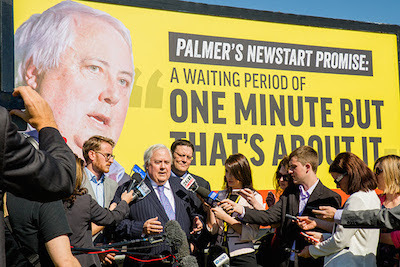
    PS – Just weeks ago, more than 1,400 GetUp members chipped in to get billboards in front of Clive Palmer and PUP senators, to hold them to their budget promises at the critical moment. And it bloody well worked! Below is a picture of Mr Palmer and Senator Glenn Lazarus literally standing in front of their Newstart promise — writ large by GetUp members — as they announced they would not do a deal with the Government. Now to get this uni fees ad on the air at this decision moment for crossbench senators, we need to raise the bar even higher. Click here to chip in!

    PPS – Coming up on the 16 October is the Student’s National Day of Action. Students, teachers, alumni, and parents will be mobilising on campuses across the country, the last hoorah before semester ends. Find out about events happening near you on the National Union of Students website.

    References:
    [1] “Federal Government to introduce new split welfare bill to House of Representative with Labor’s backing”, ABC News, 2 October 2014
    [2] “Australian universities climb Times world rankings, while US and UK lose ground”, Sydney Morning Herald, 2 October 2014


    GetUp is an independent, not-for-profit community campaigning gr

  • The 10 stuff-ups we all make when interpreting research

    Australia
    3 October 2014, 6.20am AEST

    The 10 stuff-ups we all make when interpreting research

    UNDERSTANDING RESEARCH: What do we actually mean by research and how does it help inform our understanding of things? Understanding what’s being said in any new research can be challenging and there are…

    Oh no – not that mistake again. Flickr/Alex Proimos, CC BY-NC

    UNDERSTANDING RESEARCH: What do we actually mean by research and how does it help inform our understanding of things? Understanding what’s being said in any new research can be challenging and there are some common mistakes that people make.

    Have you ever tried to interpret some new research to work out what the study means in the grand scheme of things?

    Well maybe you’re smart and didn’t make any mistakes – but more likely you’re like most humans and accidentally made one of these 10 stuff ups.

    1. Wait! That’s just one study!

    You wouldn’t judge all old men based on just Rolf Harris or Nelson Mandela. And so neither should you judge any topic based on just one study.

    If you do it deliberately, it’s cherry-picking. If you do it by accident, it’s an example of the exception fallacy.

    The well-worn and thoroughly discredited case of the measles, mumps and rubella (MMR) vaccine causing autism serves as a great example of both of these.

    People who blindly accepted Andrew Wakefield’s (now retracted) study – when all the other evidence was to the contrary – fell afoul of the exception fallacy. People who selectively used it to oppose vaccination were cherry-picking.

    2. Significant doesn’t mean important

    Some effects might well be statistically significant, but so tiny as to be useless in practice.

    You know what they say about statistics? Flickr/Frits Ahlefeldt-Laurvig, CC BY-ND
    Click to enlarge

    Associations (like correlations) are great for falling foul of this, especially when studies have huge number of participants. Basically, if you have large numbers of participants in a study, significant associations tend to be plentiful, but not necessarily meaningful.

    One example can be seen in a study of 22,000 people that found a significant (p<0.00001) association between people taking aspirin and a reduction in heart attacks, but the size of the result was miniscule.

    The difference in the likelihood of heart attacks between those taking aspirin every day and those who weren’t was less than 1%. At this effect size – and considering the possible costs associated with taking aspirin – it is dubious whether it is worth taking at all.

    3. And effect size doesn’t mean useful

    We might have a treatment that lowers our risk of a condition by 50%. But if the risk of having that condition was already vanishingly low (say a lifetime risk of 0.002%), then reducing that might be a little pointless.

    We can flip this around and use what is called Number Needed to Treat (NNT).

    In normal conditions if two random people out of 100,000 would get that condition during their lifetime, you’d need all 100,000 to take the treatment to reduce that number to one.

    4. Are you judging the extremes by the majority?

    Biology and medical research are great for reminding us that not all trends are linear.

    We all know that people with very high salt intakes have a greater risk of cardio-vascular disease than people with a moderate salt intake.

    Too much or too little salt – which as worse? Flickr/JD Hancock, CC BY
    Click to enlarge

    But hey – people with a very low salt intake may also have a high risk of cardio-vascular disease too.

    The graph is U shaped, not just a line going straight up. The people at each end of the graph are probably doing different things.

    5. Did you maybe even want to find that effect?

    Even without trying, we notice and give more credence to information that agrees with views we already hold. We are attuned to seeing and accepting things that confirm what we already know, think and believe.

    There are numerous example of this confirmation bias but studies such as this reveal how disturbing the effect can be.

    In this case, the more educated people believed a person to be, the lighter they (incorrectly) remembered that person’s skin was.

    6. Were you tricked by sciencey snake oil?

    A classic – The Turbo Encabulator.

    You won’t be surprised to hear that sciencey-sounding stuff is seductive. Hey, even the advertisers like to use our words!

    But this is a real effect that clouds our ability to interpret research.

    In one study, non-experts found even bad psychological explanations of behaviour more convincing when they were associated with irrelevant neuroscience information. And if you add in a nice-and-shiny fMRI scan, look out!

    7. Qualities aren’t quantities and quantities aren’t qualitites

    For some reason, numbers feel more objective than adjectivally-laden descriptions of things. Numbers seem rational, words seem irrational. But sometimes numbers can confuse an issue.

    For example, we know people don’t enjoy waiting in long queues at the bank. If we want to find out how to improve this, we could be tempted to measure waiting periods and then strive to try and reduce that time.

    But in reality you can only reduce the wait time so far. And a purely quantitative approach may miss other possibilities.

    If you asked people to describe how waiting made them feel, you might discover it’s less about how long it takes, and more about how uncomfortable they are.

    8. Models by definition are not perfect representations of reality

    A common battle-line between climate change deniers and people who actually understand evidence is the effectiveness and representativeness of climate models.

    But we can use much simpler models to look at this. Just take the classic model of an atom. It’s frequently represented as a nice stable nucleus in the middle of a number of neatly orbiting electrons.

    While this doesn’t reflect how an atom actually looks, it serves to explain fundamental aspects of the way atoms and their sub-elements work.

    This doesn’t mean people haven’t had misconceptions about atoms based on this simplified model. But these can be modified with further teaching, study and experience.

    9. Context matters

    The US president Harry Truman once whinged about all his economists giving advice, but then immediately contradicting that with an “on the other hand” qualification.

    Individual scientists – and scientific disciplines – might be great at providing advice from just one frame. But for any complex social, political or personal issue there are often multiple disciplines and multiple points of view to take into account.

    To ponder this we can look at bike helmet laws. It’s hard to deny that if someone has a bike accident and hits their head, they’ll be better off if they’re wearing a helmet.

    Do bike helmet laws stop some people from taking up cycling? Flickr/Petar, CC BY-NC
    Click to enlarge

    But if we are interested in whole-of-society health benefits, there is research suggesting that a subset of the population will choose not to cycle at all if they are legally required to wear a helmet.

    Balance this against the number of accidents where a helmet actually makes a difference to the health outcome, and now helmet use may in fact be negatively impacting overall public health.

    Valid, reliable research can find that helmet laws are both good and bad for health.

    10. And just because it’s peer reviewed that doesn’t make it right

    Peer review is held up as a gold standard in science (and other) research at the highest levels.

    But even if we assume that the reviewers made no mistakes or that there were no biases in the publication policies (or that there wasn’t any straight out deceit), an article appearing in a peer reviewed publication just means that the research is ready to be put out to the community of relevant experts for challenging, testing, and refining.

    It does not mean it’s perfect, complete or correct. Peer review is the beginning of a study’s active public life, not the culmination.

    And finally …

    Research is a human endeavour and as such is subject to all the wonders and horrors of any human endeavour.

    Just like in any other aspect of our lives, in the end, we have to make our own decisions. And sorry, appropriate use even of the world’s best study does not relieve us of this wonderful and terrible responsibility.

    There will always be ambiguities that we have to wade through, so like any other human domain, do the best you can on your own, but if you get stuck, get some guidance directly from, or at least originally via, useful experts.


    This article is part of a series on Understanding Research.

    Further reading:
    Why research beats anecdote in our search for knowledge
    Clearing up confusion between correlation and causation
    Where’s the proof in science? There is none
    Positives in negative results: when finding ‘nothing’ means something
    The risks of blowing your own trumpet too soon on research
    How to find the knowns and unknowns in any research
    How myths and tabloids feed on anomalies in science