Author: Neville

  • Limits to Growth was right. New research shows we’re nearing collapse

    Limits to Growth was right. New research shows we’re nearing collapse

    Four decades after the book was published, Limit to Growth’s forecasts have been vindicated by new Australian research. Expect the early stages of global collapse to start appearing soon

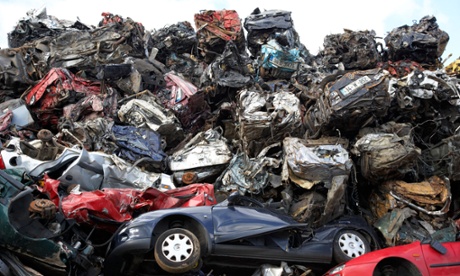
    Piles of crushed cars at a metal recycling site in Belfast, Northern Ireland.
    Piles of crushed cars at a metal recycling site in Belfast, Northern Ireland. Photograph: Alamy

    The 1972 book Limits to Growth, which predicted our civilisation would probably collapse some time this century, has been criticised as doomsday fantasy since it was published. Back in 2002, self-styled environmental expert Bjorn Lomborg consigned it to the “dustbin of history”.

    It doesn’t belong there. Research from the University of Melbourne has found the book’s forecasts are accurate, 40 years on. If we continue to track in line with the book’s scenario, expect the early stages of global collapse to start appearing soon.

    Limits to Growth was commissioned by a think tank called the Club of Rome. Researchers working out of the Massachusetts Institute of Technology, including husband-and-wife team Donella and Dennis Meadows, built a computer model to track the world’s economy and environment. Called World3, this computer model was cutting edge.

    The task was very ambitious. The team tracked industrialisation, population, food, use of resources, and pollution. They modelled data up to 1970, then developed a range of scenarios out to 2100, depending on whether humanity took serious action on environmental and resource issues. If that didn’t happen, the model predicted “overshoot and collapse” – in the economy, environment and population – before 2070. This was called the “business-as-usual” scenario.

    The book’s central point, much criticised since, is that “the earth is finite” and the quest for unlimited growth in population, material goods etc would eventually lead to a crash.

    So were they right? We decided to check in with those scenarios after 40 years. Dr Graham Turner gathered data from the UN (its department of economic and social affairs, Unesco, the food and agriculture organisation, and the UN statistics yearbook). He also checked in with the US national oceanic and atmospheric administration, the BP statistical review, and elsewhere. That data was plotted alongside the Limits to Growth scenarios.

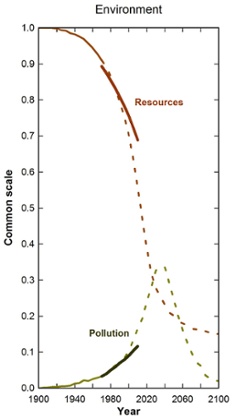
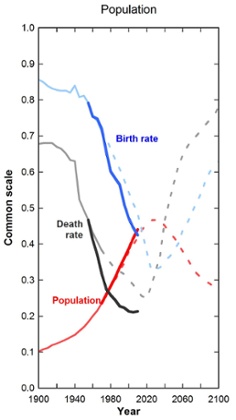
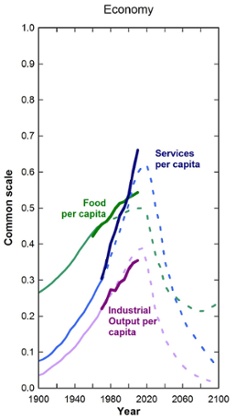
    The results show that the world is tracking pretty closely to the Limits to Growth “business-as-usual” scenario. The data doesn’t match up with other scenarios.

    These graphs show real-world data (first from the MIT work, then from our research), plotted in a solid line. The dotted line shows the Limits to Growth “business-as-usual” scenario out to 2100. Up to 2010, the data is strikingly similar to the book’s forecasts.
    limits to growth
    Solid line: MIT, with new research in bold. Dotted line: Limits to Growth ‘business-as-usual’ scenario.
    limits to growth
    Solid line: MIT, with new research in bold. Dotted line: Limits to Growth ‘business-as-usual’ scenario. Photograph: Supplied
    limits to growth
    Solid line: MIT, and research in bold. Dotted line: Limits to Growth ‘business-as-usual’ scenario. Photograph: Supplied

    As the MIT researchers explained in 1972, under the scenario, growing population and demands for material wealth would lead to more industrial output and pollution. The graphs show this is indeed happening. Resources are being used up at a rapid rate, pollution is rising, industrial output and food per capita is rising. The population is rising quickly.

    So far, Limits to Growth checks out with reality. So what happens next?

    According to the book, to feed the continued growth in industrial output there must be ever-increasing use of resources. But resources become more expensive to obtain as they are used up. As more and more capital goes towards resource extraction, industrial output per capita starts to fall – in the book, from about 2015.

    As pollution mounts and industrial input into agriculture falls, food production per capita falls. Health and education services are cut back, and that combines to bring about a rise in the death rate from about 2020. Global population begins to fall from about 2030, by about half a billion people per decade. Living conditions fall to levels similar to the early 1900s.

    It’s essentially resource constraints that bring about global collapse in the book. However, Limits to Growth does factor in the fallout from increasing pollution, including climate change. The book warned carbon dioxide emissions would have a “climatological effect” via “warming the atmosphere”.

    As the graphs show, the University of Melbourne research has not found proof of collapse as of 2010 (although growth has already stalled in some areas). But in Limits to Growth those effects only start to bite around 2015-2030.

    The first stages of decline may already have started. The Global Financial Crisis of 2007-08 and ongoing economic malaise may be a harbinger of the fallout from resource constraints. The pursuit of material wealth contributed to unsustainable levels of debt, with suddenly higher prices for food and oil contributing to defaults – and the GFC.

    The issue of peak oil is critical. Many independent researchers conclude that “easy” conventional oil production has already peaked. Even the conservative International Energy Agency has warned about peak oil.

    Peak oil could be the catalyst for global collapse. Some see new fossil fuel sources like shale oil, tar sands and coal seam gas as saviours, but the issue is how fast these resources can be extracted, for how long, and at what cost. If they soak up too much capital to extract the fallout would be widespread.

    Our research does not indicate that collapse of the world economy, environment and population is a certainty. Nor do we claim the future will unfold exactly as the MIT researchers predicted back in 1972. Wars could break out; so could genuine global environmental leadership. Either could dramatically affect the trajectory.

    But our findings should sound an alarm bell. It seems unlikely that the quest for ever-increasing growth can continue unchecked to 2100 without causing serious negative effects – and those effects might come sooner than we think.

    It may be too late to convince the world’s politicians and wealthy elites to chart a different course. So to the rest of us, maybe it’s time to think about how we protect ourselves as we head into an uncertain future.

    As Limits to Growth concluded in 1972:

    If the present growth trends in world population, industrialisation, pollution, food production, and resource depletion continue unchanged, the limits to growth on this planet will be reached sometime within the next one hundred years. The most probable result will be a rather sudden and uncontrollable decline in both population and industrial capacity.

    So far, there’s little to indicate they got that wrong.

  • Un-muzzle the scientists? Not so fast.

    Un-muzzle the scientists? Not so fast.

    Those with the lab coats do not have a monopoly on evidence

    Andrew Leach

    August 24, 2014

    Getty Images

    Getty Images

    Every so often, something happens that renews calls in this country for scientists within the federal government to have more unfettered rights to speak to media. This past week, it was the nearly comical number of layers of bureaucracy through which a request to hold a media briefing on the extent of Arctic ice erosion needed to pass. Previously, we’ve seen similar calls motivated by differences between Canadian and U.S. standards with respect to publication of research results or the presence of so-called minders at scientific conferences. I’ve hesitated to write on this despite often engaging in heated discussions on the subject, both on Twitter and in less virtual environments, because it’s not my area of expertise. It’s still not an area in which I have any formal training, and my experience is limited, but I feel that I can comment on some aspects of the debate based on the time I spent on sabbatical at Environment Canada, a department frequently attacked for the so-called muzzling of scientists.

    The basic arguments in favour of loosening the controls on government scientists to speak to media often follow from one of two points: either that the research is publicly funded, and so should be accessible to the public; or, that making researchers available to the media would show that the government is hiding evidence that might otherwise undermine its policy agenda. For example, when interviewed at a protest by scientists on Parliament Hill last year, University of Ottawa professor Jeremy Kerr stated that, “the facts do not change just because the Harper government has chosen ignorance over evidence and ideology over honesty.” That’s certainly accurate, at least insofar as the facts being generally invariant to the will of the Prime Minister, but the government of Canada has no monopoly over the facts—there are plenty of entities, government-funded and otherwise, that can do a fine job of holding the government to account externally, as professor Kerr’s comments to the Star illustrate.

    Related:
    Un-muzzle the scientists: Liberal science critic Ted Hsu responds
    When science goes silent

    For me, the key questions are whether government researchers should, themselves, be able to speak out when they feel a government policy does not align with the evidence (Added 2014-08-31  – the Professional Institute of the Public Service of Canada raised this question in their Big Chill Survey) and, if so, why we would only restrict that to a particular class of government researchers? To speak out publicly against government policy is, by the current definition, fundamentally at odds with the role of a public servant in our democracy. Public servants are expected to provide impartial advice to the policy development process and loyal implementation of government policies once decisions are taken. They are not supposed to critique that policy publicly when it doesn’t align with their interpretation of the evidence or their beliefs with respect to how that evidence should be weighed. Allowing public servants to be openly critical of government decisions – whether based on scientific evidence or any other criteria – turns the relationship between the bureaucracy and their democratically elected masters on its head, undermining the trust essential to an effective working relationship.

    Many would like to have you believe that there are issues for which we could live in a technocracy—where the science speaks so clearly as to the correct policy that there is no role for any other factors. I can’t think of a single instance where that would be so. Often-cited in debates on the muzzling of scientists is my University of Alberta colleague David Schindler and his ground-breaking work at the Experimental Lakes Area. What did that research tell us? It made clear, for the first time, the link between human activity, in particular industrial sulphur emissions and nutrient effluent from agriculture, and the health of lake ecosystems. It told us about the damages from pollution and was some of the most important and policy-relevant pieces of scientific work in this country’s history. What Dr. Schindler’s research alone could not tell us is what we should do about it. It did not tell us what costs we should be willing to impose on industry to prevent these damages, it did not tell us how Canadian economic activity, trade, and employment would react if certain policies were imposed, nor did it tell us how Canadians would prioritize expenses to defray these damages versus other potential uses of government and private sector resources. In other words, it gave us an important piece of the policy puzzle, but not the entire picture. You can’t prove, with science alone, what the policy should be—science isn’t normative—but only what is and what will be if you take a particular action.

    In a policy department like Environment Canada, policy decisions are made through a process that involves bureaucrats from different disciplines including scientists, engineers and economists. Senior bureaucrats interact with the minister’s office, with central agencies like the Department of Finance, and with the Privy Council Office, which acts as the bureaucratic liaison to the Prime Minister’s Office. When a policy proposal is on the table, there are different opportunities for arguments to be made, decisions to be challenged, and evidence to be presented. As an economist visiting Environment Canada for the year, I was fortunate to participate in briefings at every level and to be given the opportunity to present evidence on occasion. Sometimes, that evidence carried the day. Sometimes, I came out of a briefing feeling that I’d lost—that economic evidence as to the best policy option, data on the cost of taking one action over another, or predictions of the likely outcome had been ignored in favour of evidence presented by others. In most cases, it hadn’t been ignored, but it just hadn’t been given the weight I thought it should. You might imagine that it was always those with the lab coats pushing stronger action, while the economists pushed for weaker action. It wasn’t. At the end of the day, senior public servants and elected officials did what they were paid to do: they weighed the evidence and made decisions.

    The way the some unmuzzlers would have you believe that the system should work is that, when senior public servants or elected officials take a decision with which the scientists in the room do not agree, these scientists should — and it is largely those in the “hard” sciences that the unmuzzlers are talking about — because they are on the side of the evidence, be free to speak up and to contest that decision in the public arena. The problem with that, as I see it, is that those with the lab coats do not have a monopoly on evidence: across the federal government, there are a variety of public servants collecting and compiling data, conducting experiments, testing hypotheses, developing numerical models, and the like. Some are scientists in the conventional sense of the word (i.e. they wear lab coats) while some are economists, sociologists, statisticians, and engineers. It’s impossible to draw clear lines between what is “scientific evidence” presented to senior decision makers and what is not.

    Let’s imagine the government is considering a regulation on an industrial sector and, based on the evidence presented, senior decision-makers conclude that the costs in terms of reduced output, employment, and value-added of enacting stringent regulation are justified based on the benefits to the ecosystem and/or to human health presented by the scientists (in this caricature, you can imagine the scientists wearing their lab coats in the briefing if you prefer).  Now suppose that one of the experts involved—an economist in a central agency, for the sake of this caricature—decides that this decision is simply inconsistent with the evidence he or she presented. Suppose he or she decided that, if only the Canadian people were made aware of this economic evidence, they too would side with a “weaker” policy response. Clearly, it’s in the public interest to drop a brown envelope on someone’s doorstep so that the headlines the next morning might read something like, “Government considering regulation that would halt oil sands development, cost thousands of jobs,” with the story crediting an anonymous government economist privy to the discussions, right? That would push the government to make the right decision.

    In the caricature I’ve presented, the evidence would all be accurate, but it would be one-sided: the article in the newspaper would show you all of the costs of the policy and none of the benefits. The implication would be clear: that the government had ignored all these costs in reaching its decision, and Canadians should be outraged. The implication would also be entirely false. All that heroic economist would have done with his or her actions would have been to tilt the decision-making process toward their preferred weighing of the evidence. Would it be any different if the decision had gone the other way, toward the less stringent policy, and it were the scientist, clad as ever in his or her lab coat, dropping off the brown envelopes? I think not.

    Should we have more open government science? Perhaps. I think the better question is to what degree government-supported research should take place in arms-length agencies (the U.S. model for agencies like NASA and the Energy Information Administration come to mind) or outsourced to universities via government granting agencies as opposed to being housed in policy departments. Research housed outside of government departments would allow elected and bureaucratic offices to determine which questions are being asked by researchers or which subject areas are being explored without having influence over the answers or controlling the message. It would also mean that researchers were not privy to the policy discussions of the day and would not necessarily be involved when their research is used to support a decision. There are also options within the public service: perhaps Statistics Canada could broaden its role to collect and publish more environmental statistics such as the sea ice coverage, which was the subject of so much consternation this week, perhaps absorbing some of the functions now performed within Environment Canada. In the same way in which no one would ask a Statistics Canada official what government should do to combat youth unemployment or to raise median incomes when those data are published, no one would ask whether the extent of sea ice coverage should influence our climate change policy choices. When you’re asking officials from the department with jurisdiction over both our domestic climate change policies and our intervention in international climate change negotiations about sea ice coverage, the implications are very different. The questions to the scientist might even be policy-neutral, but I expect most of the resulting articles would not be.

    If you want to take the muzzle off government researchers, that’s fine if you want it for the right reasons. I’m all in favour of increasing the quality of information available both to our decision-makers and to the general public. However, we must do it without skewing the policy process. The only way to make sure that’s true if you want open access to researchers is to disconnect those undertaking primary and policy-relevant research from that process and from those departments. Whether that’s best done through arms-length institutions, through universities, or through agencies such as Statistics Canada is a topic for debate. Of course, there are some topics of current government research not suited to open inquiry, for a variety of reasons. Maybe you’re willing to sacrifice some of those topics for access to information? You might also find that some of our government’s best researchers prefer their seat at the policy table to the front pages of the newspaper. Maybe that’s a sacrifice you’re willing to make? Unfortunately, I doubt you’ll be able to rely on anyone in a lab coat to tell you with certainty which is best for the country.

    On the other hand, if your reason for removing the muzzle is because you think policy decisions need to be skewed or the government needs to be challenged, then there’s a better process for that that doesn’t involve sacrificing our public service. Rumour has it it will happen next October, if not sooner.

  • Daily update: Why were RET modellers instructed to ignore commercial reality?

    1 of 4
    AdDr Green – Solar Powerwww.drgreen.com.au/MonthlySpecial – 5kW System only $4490 + Free Meter or $48/wk. Hurry, ends 29th August!

    Daily update: Why were RET modellers instructed to ignore commercial reality?

    Inbox
    x

    Renew Economy editor@reneweconomy.com.au via mail12.atl111.rsgsv.net

    2:50 PM (32 minutes ago)

    to me
    Why were RET modellers instructed to ignore commercial reality?; Waburton says energy market modelling as bad as climate modelling; India poised to be world solar leader; The WA green power scheme that wasn’t; Queenslanders continue to rush to rooftop solar; Tag Pacific steps in to build solar plant at Rio Tinto mine; Japan JV to build world’s largest floating solar array; Who really benefits from reducing the RET; Cali’s EV strategy opens a portal the U.S. future; and how Germany may get 6-fold boost in wind power from fewer turbines.
    Is this email not displaying correctly?
    View it in your browser.
    RenewEconomy Daily News
    The Parkinson Report
    ACIL Allen says it was instructed by RET Review panel – headed by climate skeptic Dick Warburton – to ignore commercial realities around coal-fired generation. Such modelling would be rejected by any company board, and the government should do the same.
    After months of denying a bias against renewables and climate science, RET Review head Dick Warburton says globe not warming, developing renewables pointless.
    New report suggests road map for India’s solar sector to boost nation’s PV capacity by more than 140GW in 10 years.
    WA consumers rail against state-owned retailer Synergy, after being told their premiums were not invested in local environmental schemes.
    Households and businesses continue to defy expectations, and install large rooftop solar systems in Queensland despite change in tariffs.
    Less than two months after Ingenero’s collapse, Tag Pacific signs up to build a 1.7MW solar PV array to power Rio Tinto’s bauxite mine in Weipa, Qld.
    Kyocera and Century Tokyo Leasing announce plans to build a 2.9MW floating solar plant in in Hyogo Prefecture, west Japan.
    Reducing the RET is a step back from a clean energy economy that rewards coal and gas power companies at the expense of households and small business.
    California is poised to open a portal to America’s future, shoving Big Oil off the highways to make room for cleaner transportation alternatives.
    Germany expected to increase share of wind power from 15% fewer turbines, with overall power consumption remaining basically unchanged. What would that look like?
  • SPA: Newsletter, Issue 117, September 2014

    Click here to enable desktop notifications for Gmail.   Learn more  Hide
    2 of 14
    AdVisit Malaysiamalaysiaairlines.com – Fly to a Cultured City from AUD813. It’s Visit Malaysia Year!

    SPA: Newsletter, Issue 117, September 2014

    Inbox
    x

    SPA President <president@population.org.au>

    Attachments12:43 PM (22 minutes ago)

    to me
    SPA Logo

    Sustainable Population Australia

    www.population.org.au

    info@population.org.au

    02 6288 6810

    Dear SPA member or supporter,
    Please find attached the latest newsletter (no. 117, September, 2014) which is also available online at http://www.population.org.au/sites/default/files/newsletters/nl2014109_117.pdf.
    In it you will find:
    • a front page report on the Crawford Fund Conference in Canberra last week
    • two articles, one by Tim Roberts and Nigel Stace, and another by Leith von Onselen
    • précis of remaining speeches from the Ethics of Migration seminar in April
    • book reviews of ‘Adventures in the Anthropocene’ and ‘Facing the Population Challenge’
    • a submission by SPA on child marriage
    • members’ page with two letters and a hymn
    • SPA news including branch reports and an excellent initiative by the Queensland branch on reducing unwanted pregnancies in Australia
    • list of branch committees excluding WA’s which was elected last weekend after the newsletter printing

    All the best,

    Jenny Goldie
    SPA President

  • Sea water solar distiller

    Salt water well/Fresh water bucket (+2, -4)
    Saltwater + Desert (+2, -4)
    Saltwater main
    Saltwater Pipeline (+4, -1)
    Sea water solar distiller (+8)
    Seafood Pipeline (+8, -3)
    Supersimple reverse osmosis (+21, -4)(+21, -4)
    Water Vapor Pipeline (+10, -4)
    Whale matrix (+1, -7)(+1, -7)
    public:water: salt

    Sea water solar distiller

    Simple sea (or sewer lake) based water distillation

    (+8)
    (+8)
    [vote for,
    against]


    I propose a small “closed curcuit” unit, described below, which could be connected in a continuous pipe, to distill sea water in large quantities at low cost.Each unit, the size of a small row-boat, would be devided into two sections: the bioling section and the saved water section. A fresnel lens (or perhaps water filled bags to achieve the same) heat the dark-tinted water section, which is thermaly insulated from the rest of the sea water. The boiling steam is then passed into the clean “water storage”, where it condenses. The steam pipe is partially submerged in the sea, and so is the water storage, itself a long and thick pipe with an air snorkel, so that water can be extracted. The water storage has fins to let off the heat into the sea water. When water is being extracted from storage, the steam pipe automatically closes via a pneumatic-mechano contraption.

    This distilled water could be pumped up to mountains and entered into the underground water system, turning to drink water, in over-pumped areas. Or it could be used for irrigation and for showering (for drinking you need minerals in the water otherwise you get cretin [edit: corrected from Creton] disease, brain dammage or skin boils – as what happened to residents of the Jewish portion of Jerusalem during the 1947 siege, who drank only boiled cistern water).

    I got this halfdea after watching the funny GreenPowerScience.com movie on how simple and fast it is for the Ruhals to distill water from a mud-pond, using a large Fresnel lens to boil water in a bottle with solar energy, and just have it go into another bottle and condense.

    pashute, Jun 01 200
  • Why Waburton wants to set solar industry back a decade Giles Parkinson

    overseas is easywww.escapologist.com.au – Three English speaking countries where you can live well for less

    Daily update: Why Warburton wants to set solar industry back a decade

    Inbox
    x

    Renew Economy editor@reneweconomy.com.au via mail21.atl111.rsgsv.net

    3:42 PM (7 minutes ago)

    to me
    Why Waburton wants to set solar industry back a decade; Wind turbines in Aus may stop spinning; Sectors respond to RET review; Hunt says slashing RET will not break election promise; Napthine government accused of 25 attacks on clean energy; Samoa inaugurates 1st wind farm as Pacific turns away from diesel; Abbott environmental agenda harsher than he promised; US city passes law making solar ‘default’ generation resource.
    Is this email not displaying correctly?
    View it in your browser.
    RenewEconomy Daily News
    The Parkinson Report
    The Warburton review may cause a brief boom in rooftop solar, but it will kill the prospect of large scale solar farms, and set the industry back a decade in Australia – the country that should be leading the world in solar energy.
    Wind farms in Australia may have to close under proposals put forward by RET Review panel, which is accused of ignoring financing issues.
    Doctors, solar and wind tower manufacturers, developers and voluntary markets associations warns of devastating impacts of RET review.
    Hunt says slashing renewables target to 25,000GWh would not break an election promise – because 41,000GWh was nothing but a “flaw in system”.
    Report highlights what it describes as the Victorian Coalition Government’s “systematic campaign” against renewable energy and climate policies.
    The Pacific island country of Samoa has announced its first wind farm, developed by an Abu Dhabi renewable energy company, Masdar.
    Environmental protection is being given a lower priority than it has by any federal government since the first environmental legislation was introduced some 40 years ago.
    Austin Energy’s recent 5-cent solar contract was a big deal. Now it makes solar “default” generation to hedge against rising fossil fuel costs.