Author: Neville

  • India’s likely new PM big fan of solar, not of coal

    India’s likely new PM big fan of solar, not of coal

    By on 14 March 2014
    Print Friendly

    Australian coal producers – in particular the billionaire miners Gina Rinehart and Clive Palmer, – face another major roadblock to their dreams of digging up the Galilee Basin and other coal-rich resources: The likely new prime minister of India is not a big fan of coal.

    Narendra Modi, the leader of the Bharatiya Janata Party who is currently leading in the polls in the lead-up to the general election in May, is in fact a big fan of solar – and pioneered the first incentives for large scale solar power in 2009.

    As Bloomberg writes in this profile piece, if Modi wins the election: “One thing is clear: he’s signaling a clean energy revolution to end blackouts and revive economic growth.”

    Some observers suggest Modi will effectively abandon most new coal projects and turn instead to solar, potentially increasing the government’s already ambition solar targt 10-fold. Vineet Mittal, managing director of Welspun Energy,  a major Indian power producer and solar developer, told Bloomberg. “I wouldn’t be surprised if he came out with a 200,000-megawatt target by 2025.”

    Interestingly, Modi’s home state of Gujarat enjoys the highest take up of solar in India, 40 per cent of the country’s capacity of nearly 3,000MW, and it boasts the least blackouts in the country.

    India has been hamstrung for years by its chaotic infrastructure and the inability to deliver power reliably even to big business, let alone to some 300 million people without access to the grid.

    As we reported last week, when noting that BHP Billiton had insisted that coal was the only option for emerging economies, including India, the fact is that in India, energy companies, big and small, are walking away from coal-fired generation because of the costs and the risks.

    Much of the country’s easy-to-access surface coal has been extracted, with the remaining reserves harder to reach: underground, beneath cities or within national parks and tiger reserve. Imported coal is too expensive.

    As Associated Press reports, solar is about to cheap to build as coal, and without the headaches.

    “For the first time, solar electricity prices have fallen to near parity with India’s coal-generated power prices. Subsidies at about a third of cost put solar prices at about 7 rupees (11 US cents) per kilowatt/hour, versus coal’s 5-6 rupees per kilowatt/hour.
Solar projects also need fewer clearances and take just six to 12 months to develop, versus about eight years for a coal plant.

    “Today’s coal availability is inadequate. And investors are worried. In India, if there are coal shortages, there will be power shortages, and industrial growth will be inhibited,” said Vivek Pandit, senior director at the Federation of Indian Chambers of Commerce and Industry.”

    Modi’s solar program in Gujarat lured investment from Essar Group controlled by the billionaire brothers Shashikant and Ravikant Ruia, and SunEdison (which recently agreed to sell solar power from a 150MW power plant in Texas for less than 5c/kWh)

    Bloomberg quoted S.L. Rao, the head of India’s central electricity regulator from 1998 to 2001, as saying that the utility industry in India “has reached a stage where either we change the whole system quickly or it will collapse.”

    “The power sector needs tough politics, and the only person in politics today who might be capable of that kind of toughness is Modi,” he said.

    Coal currently generates 68 per cent of its electricity from coal. Most of this is supplied by the state monopoly Coal India, which sell it at a 44 percent discount to global prices. However, because Coal India is unable to guarantee deliveries, companies have sought contracts overseas, but then find themselves unable to make a profit on the prices regulated in India.

    Bloomberg says India is already forecast to be the sixth-largest market this year, behind China, Japan, the U.S., Germany and Italy, Bloomberg New Energy Finance estimates. Its goal to make solar PV as cheap as coal by 2022 is on track to be reached at least five years earlier, aided by a plunge in solar prices and higher costs for oil, gas and coal, according to Tarun Kapoor, the joint secretary at the Ministry of New and Renewable Energy.

    As Bloomberg reports:

    “We have to focus on generating more power from our abundant renewable energy resources,” Modi declared at a rally for 10,000 supporters in central Madhya Pradesh state on Feb. 26. “The time has arrived for a saffron revolution, and the color of energy is saffron.”

    Invoking the three colors of the Indian flag, Modi pledged an energy overhaul that would rival the so-called green and white revolutions in the 1900s. Those turned India into a major agricultural exporter and the world’s top milk producer.

    “God has showered our country with an abundance of renewable energy,” Modi told the crowd of poppy-seed farmers gathered near a sea of reflective solar panels. “If these renewable resources were exploited properly, we wouldn’t have required mining coal or spending so much on importing crude and petroleum products

  • 14 things we learned – and the Abbott government didn’t

    14 things we learned – and the Abbott government didn’t

    By on 14 March 2014
    Print Friendly

    Climate change is real, Australia’s policies are a joke, renewable energy investment is leaving Australia, wind and solar do not add costs to the grid, they don’t need new back-up, and they have been reducing prices. So, what’s the problem? Clarke and Dawe have the answer.

    The planet is warming, and so is Australia

    The latest survey compiled by the CSIRO and the Bureau of Meteorology – two institutions that the Abbott government has yet to remove or successfully muzzle – shows that Australia is almost a degree warmer, on average, than it was a century ago. And that is roughly in line with global rates of atmospheric warming. And, it is set to continue warming at a rate that depends on how fast greenhouse emissions can be reduced.

    The report says seven of Australia’s 10 warmest years have happened since 1998; over the past 15 years, very warm months have occurred at five times the long-term average, while very cool months have declined by a third; and by 2070, temperatures will be anywhere between 1C and 5C warmer than the 1980-1999 average, depending on future emissions cuts. Note the link between rising temperatures and emissions.

    Australia’s current emission reduction targets are completely inadequate

    That’s broadly the conclusion of the Climate Change Authority, the independent body that Abbott is trying to scrap, but hasn’t succeeded in doing yet.  The CCA says Australia’s current target of reducing emissions by 5 per cent is not credible, and should be lifted to something like 19 per cent, just to do Australia’s fair share, and if excess credits from Kyoto are included. (Otherwise it should be a 15 per cent reduction target). The CCA also says Australia could strike a good deal by snapping up cheap overseas permits, but the Abbott government says it doesn’t do that sort of thing.

    Australia’s new abatement mechanisms are a joke

    In the past week, three economic lions, as the SMH described them – former Treasury head Ken Henry, former RBA chief Bernie Fraser, and eminent economist Ross Garnaut – have dismissed Abbott’s Direct Action policy as something of a farce – a view shared by nearly everyone (except for the man that Scott Ludlam describes as the minister for Solitaire), especially those bankers and analysts who describe it as “unfinanceable” because it is so short-term. The appraisals of the three lions have been damning enough, but none quite as that of Lord Deben, a former Tory minister and now head of the UK’s Independent Committee on Climate Change, who described the Abbott government’s approach to climate change as being “so unintellectual as to be unacceptable; I mean it is just amazing.”

    Slashing renewable target will cost billions, push up prices, destabilise grid

    A new report from IES found that the winding back or scrapping of Australia’s Renewable Energy Target – as so many conservatives want to happen – would set new-build energy generation back by 10 years, cost up to $10 billion in lost renewables investments – and, ironically, drive up power prices and destabilise the grid. Abbott’s appointees to his RET review panel include a climate change denier, a fossil fuel lobbyist, and the former head of a coal and gas generation company.

    Investors are leaving Australia – just as they did a decade ago

    The last time the Coalition brought the renewable energy industry to a halt, a decade ago, newly built manufacturing plants were closed, major international companies packed up shop, and even the locals moved their bulk of their operations overseas, and to greener pastures. That is playing out all over again.

    “My members are looking at the United Kingdom, Ireland, the United States, France and some South American countries as having more stable investment environments for low-carbon opportunities,” said Nathan Fabian, the head of the Investor Group on Climate Change – citing the repeal of the carbon price and the likely demolition of the RET. Everyone agrees the large-scale renewable energy industry is at a standstill. The only bright light is the ACT’s 90 per cent renewables program, and the market for rooftop solar.

    Wind and solar don’t need backup

    The International Energy Agency stomped on a few old conservative chestnuts  with its investigation into variable renewable energy (VRE), its technical description for wind and solar. The first major furphy it demolished was about the need for new and expensive back-up to support wind and solar farms. Said the IEA: “No additional dispatchable capacity ever needs to be built because VRE (wind and solar) is in the system. On the contrary, to the extent of the capacity credit of VRE, its addition to the system reduces the need for other capacity.” German utilities RWE and E.ON can testify to that, because they are closing one quarter of their fossil fuel plants. So can Australian utilities, because they have already closed one tenth of their base load capacity.

    Wind and solar can comfortably provide 45% of generation at little no extra cost

    Furthermore, the IEA also said the established grids can comfortably absorb 45 per cent of wind and solar with little extra cost. In fact, it suggested, given that wind and solar costs were coming down so quickly, it would probably end up as a net benefit. An updated report from Stanford University’s Mark Jacobsen pointed to how the US could relatively smoothly transition to 100 per cent renewable energy.

    Wind power has been lowering costs

    A survey conducted by SKM on behalf of New Zealand-based renewable power giant Meridian and its new Australian green energy retailer PowerShop, found that wind contributed to 6 per cent of overall  supply in Victoria and South Australia during the January heat-wave, and as a result of that reduced average prices over the 7-day period by more than 40 per cent.

    This fits in with previous estimates by energy consultants Pitt & Sherry which found that in 2012/13, the average South Australian paid generators $88 a year less for the electricity he or she consumed than they did in 2009-10. And emissions have fallen too. In the US, General Electric CEO Jeff Immelt says new build wind costs 5c/kWh – that’s cheaper than coal.

    And solar has been lowering costs too

    Spark Infrastructure, which runs the electricity distribution networks in South Australia, said not only had rooftop solar PV – which amounts to 540MW now in the state – shifted the peak of demand by several hours into the early evening, it had also “helped reduce stress on the network during the heatwave.” And the actual cost of solar is falling too. In the US, SunEdison contracted to sell the output of a 150MW solar PV plant to a Texas utility for less than 5c/kWh. Add back in a tax credit and that is still an impressively low 8c/kWh, and most major module manufacturers say manufacturing costs are still falling by at least 20 per cent a year.

    Gas is pricing itself out of the market

    As renewable energy costs fall, fossil fuel costs are rising. Quickly. In Australia, the surge in gas prices ahead of the start of LNG exports has been breathtaking – with gas prices trebling in little more than a year. This has forced gas generators out of the market – almost all base load gas generators are either being mothballed or turned into peaking plants. The value of some has been written down. This means that coal-fired generation, which has fallen sharply since the introduction of the carbon price and the now-stalled surge in renewables, is likely to make a rebound.

    The decline in fossil fuels is irreversible

    Or so said RWE, the biggest utility in Germany, which is closing down fossil fuel plants and focusing on renewables, and distributed generation. The other  major utilities in Germany agree, and E.ON announced overnight it is closing one quarter of its fossil fuel capacity. In the US, the biggest utilities predict the same result. China, once the great hope of the coal industry, is likely to put a cap on consumption and cease being an importer. In India, the likely new prime minister – a big supporter of solar – is promising to reduce the share of coal, and some suggest he may increase India’s solar plan 10-fold to more than 220GW.

    Essentially, Abbott is pandering to vested interests

    More than a year ago, Bernie Fraser warned that an Abbott government was more likely to pander to the fossil fuel lobby. It turns out he was right. Fraser’s assessment of six months of an Abbott government decision making is that “the longer term community interests are being overwhelmed” by short-term business interests. Protection of incumbent utilities – many of them owned by state conservative governments – seems to be one driving factor.

    But Abbott is under intense pressure from major economies

    Abbott first horrified the international community on his position on climate policies during the climate change conference in Warsaw last November. Even then, delegates were aghast that climate change was not likely to be included in the upcoming G20 summit. Some suggested Australia may succeed in making the G20 completely irrelevant, particularly if it is used for little more than a grandstand for domestic rhetoric, which Abbott did in person at CHOGM and through proxy at Warsaw. Now it appears, the US, is putting intense pressure on Australia to rethink its G20 agenda and include important stuff like climate change. The chances are growing that G20 leaders will not want to bother with a trip to BrisVegas to sign a one page form letter on tax avoidance (Abbott says he wants to keep it “simple”) and to hear Abbott repeat his three-word domestic sloganeering.

    One day, this will translate into domestic pressure

    The biggest danger for Abbott is democracy – not so much in the political sense (after all, he wants the ABC to be nothing more than a 1930s-style political cheerleader) but in the democratisation of energy. This is the rollout of rooftop solar, the emergence of energy storage, and the options that will be chosen as they try and shield themselves from rising grid costs. The first test may come in Western Australia, possibly the most unsustainable grid of them all, and where the upcoming senate recount may test – for the first time – the political potency of the solar constituency. After all, there are several million of them.

    For the moment though, Abbott has a simple answer, as Clark and Dawe explain in their “welcome to contemporary Australia”.

  • National Rental Affordability Scheme

    Why this ad?
    Guaranteed SEO Serviceswww.seoquote.com.au/SEO – Page 1 in 90 Days or pay nothing. Australia’s Most Trusted SEO Firm!

    National Rental Affordability Scheme

    Inbox
    x

    Thomson, Kelvin (MP)

    12:22 PM (5 minutes ago)

    to Kelvin
    Dear All,
    The revelations concerning the National Rental Affordability Scheme are an example of how migration driven population growth undermines government efforts to solve social problems and meet infrastructure needs.
     
    Regards,
    Kelvin Thomson
  • Hansen Web Page and Reports.

    Home  »  Uncategorized   »   Hansen Web Page and Reports.

    Hansen Web Page and Reports.

    Posted in Uncategorized By Neville On March 1, 2014

    Dr. James E. Hansen

    Columbia University
    Earth Institute
    475 Riverside Drive
    New York, NY 10115 USA
    E-mail: jeh1@columbia.edu

    “Storms of My Grandchildren”, by James Hansen

    On the webpage “Updating the Climate Science: What Path is the Real World Following?”, Drs. Makiko Sato and James Hansen update figures in the book Storms of My Grandchildren (see LA Times review) and present updated graphs and discussion of key quantities that help provide understanding of how climate change is developing and how effective or ineffective global actions are in affecting climate forcings and future climate change. A few errata in Storms are also provided.

    Near Future Presentations

    Recent Communications

    Dr. Hansen periodically posts commentary on his recent papers and presentations and on other topics of interest to an e-mail list. To receive announcements of new postings, please click here.

    Go to older postings

    Recent Scholarly Publications

    Hansen, J., P. Kharecha, M. Sato, V. Masson-Delmotte, et al., Assessing “Dangerous Climate Change”: Required Reduction of Carbon Emissions to Protect Young People, Future Generations and Nature. PLOS ONE, 8, e81468.


    Hansen, J., M. Sato, G. Russell, and P. Kharecha, 2013: Climate sensitivity, sea level, and atmospheric carbon dioxide. Phil. Trans. R. Soc. A, 371, 20120294, doi:10.1098/rsta.2012.0294.

    Go to older publications

    Other Recent Publications

    Apr. 4, 2013: Keystone XL: The pipeline to disaster. Op-ed in the Los Angeles Times.

    Go to older publications

    Recent Presentations

    February 2014: Symposium on a New Type of Major Power Relationship: Presentation given at Counsellors Office of the State Council, Beijin, China on Feb. 24.
    + Download PDF (3.5 MB)

    December 2013: Minimizing Irreversible Impacts of Human-Made Climate Change: Presentation given at AGU Fall Meeting on Dec. 12.
    + Download PDF (4.3 MB)

    September 2012: A New Age of Risk: Presentation given at Columbia University on Sep. 22.
    + Download PDF (2.1 MB)
    + Download PPT (2.5 MB)

    Go to older presentations

    Recent TV Appearance

    in Recent News

    Recent Video

    December 2012: Discussion at Climate One about Superstorm Sandy and Carbon Pricing.

    Go to older video

  • Environmental defender almost murdered for her protests

    1 of 40
    Why this ad?
    3 Best Solar Power Quotessolarquotes.com.au/_Get_Free_Quotes – 1 Form – 2 Minutes – 3 Free Quotes. We Use 12,000 Reviews & Hand-Pick 3

    Environmental defender almost murdered for her protests

    Inbox
    x

    Friends of the Earth International web@foei.org via bounce.bluestatedigital.com

    9:57 PM (5 minutes ago)

    to me

    Neville,
    Last week María, a community organiser in Honduras, was brutally attacked by seven people with machetes, sticks and stones. Her community has firmly rejected plans to build a dam on their land. The government is not listening to them. In fact, authorities are looking the other way while these attacks intensify. Write to the Honduran government to demand protection for peaceful protestors and a full investigation into the savage attack on María Santos Domínguez and her family.

    Ms María Santos Domínguez’s husband and son came to her rescue but were also attacked. Her son lost his ear following a blow with a machete. The activist and her family have faced death threats on many occasions. She is the co-ordinator of the Organización del Consejo Indígena del Río Blanco y del Sector Norte de Intibucá (Indigenous Coucil of Río Blanco and the North of Intibucá) and an emblematic leader in the struggle for the defence of the local Gualcarque river and the indigenous Lenca territory.

    Honduras is one of the most dangerous countries in the world to be a human rights defender, owing to threats, defamation, judicial harassment, physical attacks and killings.

    Friends of the Earth International roundly condemns the attempt on the life of human rights defender María Santos Domínguez, as well as the attack on her husband and son. Friends of the Earth International considers the attack to be directly related to the peaceful and legitimate work of María Santos Domínguez and the Organización del Consejo Indígena del Río Blanco y del Sector Norte de Intibucá.

    Join us and demand that the Honduran government protect peaceful protestors and launch a full investigation into the savage attack on María Santos Domínguez and her family.

    Thanks for your solidarity,

    Friends of the Earth International


  • Religious leaders arrested at Maules Creek today!

    1 of 1
    Why this ad?
    1.5kW System From $2,399energyaustralia.com.au/Solar – Now W/ Free Upgrade To SMA Inverter Covered By Our Price Match Promise

    Religious leaders arrested at Maules Creek today!

    Inbox
    x

    Aaron Packard – 350.org Australia aaron@350.org Unsubscribe

    5:42 PM (16 minutes ago)

    to me

    Dear friend,

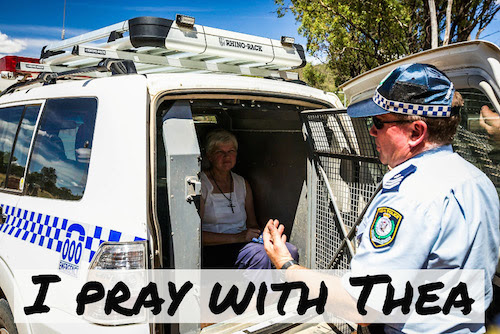
    Breaking news: Today religious leaders have been arrested at Maules Creek, for blocking access to the mine site. We need to tell their story – please take a moment to share the images below on social media, and forward this email to friends and family.

    When Bill McKibben toured Australia last year, he frequently reflected that one of the most heartening aspects of the massive civil disobedience to stop the Keystone XL pipeline in the United States was that it wasn’t just young people leading it. He saw ‘elders acting like elders’ and religious leaders, stepping up to protect the future of their grandchildren and the planet.

    Today, we have seen this here in Australia. Religious leaders – four Uniting Church Ministers, two Priests, one Catholic and one Buddhist, and a number of lay people – made the long trip to Maules Creek in northwest New South Wales to hold a prayer vigil at the gates to Whitehaven Coal’s mine construction site. They’ve added their voices to those of the traditional owners of the land — the Gomeroi people — who believe their sacred sites in the Leard Forest are being destroyed, to call for the mine to be stopped.

    Following the vigil, some of the religious leaders joined locals and supporters to block the entrance to the mine site, turning away trucks and heavy equipment. Several of those religious leaders were then arrested and detained by Police. One of those people was Thea Ormerod, head of the Australian Religious Response to Climate Change and grandmother of six. Thea has written an amazing op-ed in the Sydney Morning Herald, which has just gone live in the last hour. In that she said:

    “You may ask how such a group could endorse anything so radical, but this is a well-worn path for people of faith….The movement to wind down coal-mining in Australia may be counter-cultural but it is the truly conservative one. Its aim is to keep the Earth’s ecosystems more or less intact for those who suffer the impact of climate change in developing countries, for our own young people here and for future generations. Not a radical position at all.”

    Today’s events acknowledge that every legitimate avenue to stop the open-cut coal mine near Maules Creek has failed. Even though not one of the 212 submissions from the community supported the mine, the mine has been approved. And with climate policy being slashed by the Government, there comes a time where we have to make personal sacrifices to protect our future. That time has come.

    Can you take a moment to tell your networks, family and friends why you stand with Thea, and share the courageous action that she and the other people of faith took today?

    Click on the image above or here to share on Facebook. And for those that don’t pray, but are ready to stand with Thea, here’s an alternative image, captioned “I stand with Thea”.

    Also:

    The 350.org Australia team is heading to Maules Creek this weekend to join the Leard blockade protest. We hope you might be able to consider making it out there soon too!

    In solidarity,
    Aaron, Blair, Charlie, Josh, Phil, and many others


    350.org is building a global climate movement. Connect with us on Facebook and Twitter,