Author: Neville

  • Hazelwood owner told to shut Italian coal plant blamed for deaths

    Hazelwood owner told to shut Italian coal plant blamed for deaths

    By on 12 March 2014
    Print Friendly

    A fossil-fuelled power plant in Italy’s north – part owned by GDF Suez, the ultimate owner of Victoria’s Hazelwood brown coal generator – has been ordered to shut down two of its coal-fired generation units after a court ruled they were responsible for hundreds of human deaths and thousands of cases of heart and lung disease.

    Italian news site Rai News reported on Tuesday that a judge directed police to take control of the Vado Ligure plant in the northern district of Savona, after finding in favor of prosecutors in the case.

    Francantonio Granero, Savona’s chief prosecutor, had argued that emissions from the plant, owned by Tirreno Power, were responsible for more than 400 premature deaths between 2000 and 2007, and 2,000 cases of heart and lung disease.

    Tirreno Power, which is 50 per cent owned by French energy giant GDF Suez, called the study on the plant’s health effects “biased” in a statement to United Press International last month.

    The Vado Ligure plant in northern Italy consists of a combined-cycle unit powered by natural gas with a capacity of 800 megawatts and two coal-fired units, each with a capacity of 330 MW that date back to 1971.

    “They have shut down the two coal units, while the combined-cycle one is not affected by the measure,” a spokesman for Tirreno Power told Reuters on Tuesday, adding the ruling seemed to be related to a violation of environmental requirements. “We do not understand the rational for this decision.”

    The ruling could provide a timely heads up for GDF Suez, though, a subsidiary of which also owns a majority stake in, and operates, the Hazelwood coal plant and mine in Victoria’s La Trobe Valley, where a month-long fire has now become the subject of an independent inquiry.

    The inquiry will investigate how the blaze started, the emergency response and whether the regulatory requirements for the mine were stringent enough. Health and environmental responses will also be investigated, although the terms of reference have not yet been finalised.

    In the nearby La Trobe Valley community of Morwell, where residents have been badly affected by smoke and coal dust from the fire, the local Council has been given a $50,000 state government grant towards a recovery program, which it has kicked off by purchasing 24 special vacuum cleaners capable of filtering fine particles, as well as air-purifiers.

  • Renewables can do 24-hour base load anywhere, anytime

    Renewables can do 24-hour base load anywhere, anytime

    Sandi Keane 13 April 2013, 12:48am 46

    0
    Delicious Add
    0
    inShare


    The University of NSW has exploded the myth that renewables can’t do 24-hour base load. Dr Mark Diesendorf reports.


    renewable-energy-11
    Clean, renewable energy.

    THE FUTURE of civilisation and much biodiversity hangs to a large degree on whether we can replace fossil fuels — coal, oil and gas — with clean, safe and affordable energy within several decades. The good news is that renewable energy technologies and energy efficiency measures have advanced with extraordinary speed over the past decade.

    Energy efficient buildings and appliances, solar hot water, on-shore wind, solar photovoltaic (PV) modules, concentrated solar thermal (CST) power with thermal storage and gas turbines burning a wide range of renewable liquid and gaseous fuels are commercially available on a large scale.

    The costs of these technologies have declined substantially, especially those of solar PV. In 2012, despite the global financial crisis, global investment in these clean, safe and healthy technologies amounted to US $269 billion. Denmark, Scotland and Germany and several states/provinces around the world have official targets of around 100% renewable electricity and are implementing policies to achieve them.

    skeptical_scien.47ae7085537.originalThe principal barrier is resistance from vested interests and their supporters  in the big greenhouse gas polluting industries and from an unsafe, expensive, polluting, would-be competitor to a renewable energy future, nuclear power. These powerful interests are running a campaign of renewable energy denial that is almost as fierce as the long-running campaign of climate change denial. Both campaigns are particularly noisy in the Murdoch press.

    So far the anti-renewables campaign, with its misinformation and gross exaggerations, has received little critical examination in the mainstream media.

    The renewable energy deniers rehash, among others, the old myth that renewable energy is unreliable in supplying base load demand.

    Renewable energy is reliable

    In a previous article for The Conversation, I reported on the initial results of computer simulations by a research team at the University of New South Wales that busted the myth that renewable energy cannot supply base load demand. However at the time of the article, I was still under the misconception that some base load renewable energy supply may be needed to be part of the renewable energy mix.

    Since then, Ben Elliston, Iain MacGill and I have performed thousands of computer simulations of 100% renewable electricity in the National Electricity Market (NEM), using actual hourly data on electricity demand, wind and solar power for 2010.

    Our latest research, available here and reported here, finds that generating systems comprising a mix of different commercially available renewable energy technologies, located on geographically dispersed sites, do not need base load power stations to achieve the same reliability as fossil-fuelled systems.

    The old myth was based on the incorrect assumption that base load demand can only be supplied by base load power stations; for example, coal in Australia and nuclear in France. However, the mix of renewable energy technologies in our computer model, which has no base load power stations, easily supplies base load demand.

    Our optimal mix comprises wind 50-60%; solar PV 15-20%; concentrated solar thermal with 15 hours of thermal storage 15-20%; and the small remainder supplied by existing hydro and gas turbines burning renewable gases or liquids. (Contrary to some claims, concentrated solar with thermal storage does not behave as base load in winter; however, that doesn’t matter.)

    The real challenge is to supply peaks in demand on calm winter evenings following overcast days. That’s when the peak-load power stations, that is, hydro and gas turbines, make vital contributions by filling gaps in wind and solar generation.

    HRL_large
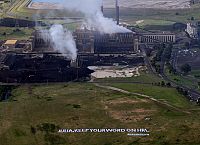
    Dirty HRL power station in Victoria’s Latrobe Valley

    We used the technology costs projected to 2030 in the conservative 2012 study by the Bureau of Resources and Energy Economics (BREE). (In my personal view, future solar PV and wind costs are likely to be lower than the BREE projections, and future fossil fuel and nuclear costs are likely to be higher.) Then, we did thousands of hourly simulations of supply and demand over 2010, until we found the mix of renewable energy sources that gave the minimum annual cost.

    Under transparent assumptions, we found that the total annualised cost (including capital, operation, maintenance and fuel where relevant) of the least-cost renewable energy system is $7-10 billion per year higher than that of the “efficient” fossil scenario.

    For comparison, the subsidies to the production and use of all fossil fuels in Australia are at least $10 billion per year. So, if governments shifted the fossil subsidies to renewable electricity, we could easily pay for the latter’s additional costs.

    Thus 100% renewable electricity would be affordable under sensible government policy, busting another myth. All we need are effective policies to drive the transition.

    (This article is an update published by RenewEconomy on 10 April 2013 of an earlier article published in The Conversation.)

    Creative Commons Licence

  • RET cuts will slash green investment, destabilise grid, lift prices

    RET cuts will slash green investment, destabilise grid, lift prices

    By on 12 March 2014
    Print Friendly

    A new report has found that the winding back or scrapping of Australia’s Renewable Energy Target would set new-build energy generation back by 10 years, cost billions in lost renewables investments, drive up power prices and destabilise the grid.

    Published by Intelligent Energy Systems Advisory Services (IES), the report also warns that changes to the RET could increase coal-fired generation by as much as 9 per cent, jeopardising Australia’s ability to meet its 5 per cent by 2020 greenhouse gas emissions reduction target under the Kyoto Protocol.

    The IES study uses electricity market modelling to assess the impact on Australia’s National Electricity Market if the current 41,000 GWh renewable energy target is cut to a “real” 20 per cent (as some incumbent generators want), or scrapped entirely from 2015 (as others want) – two of the more commonly predicted outcomes of the Abbott government’s current RET review.

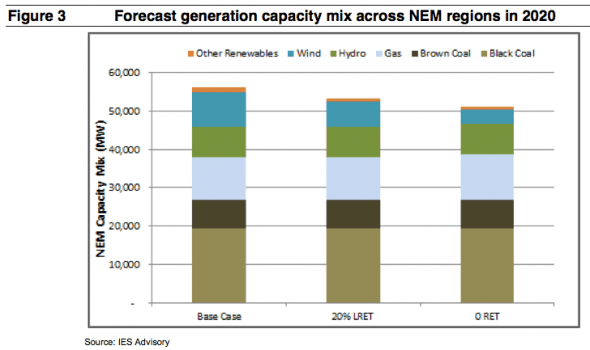
    “Under a reduced LRET, investments in electricity generation will fall dramatically,” says the report, with around 5,080MW less capacity expected to be built under the zero RET scenario, and 2,940MW less under the 20 per cent LRET scenario. The main victim will be wind generation.

    “Wind project development will reduce by 2,280MW under the 20 per cent LRET scenario, and by 5,100MW under the zero RET scenario, resulting in the loss of investment opportunity of $4.5 billion and over $10 billion respectively.”

    Even with the support of the LRET, the report notes wind developers are struggling to develop economically viable wind projects, with PPA (power purchase agreement) prices of below $90 per MWh offered by gentailers.

    Under a revised or scrapped RET scenario, and with the likely repeal of carbon tax, the picture looks bleak, with worsening project economics and difficulty in obtaining debt finance predicted to cause the stalling or cancellation of more than 2900MW of planned large-scale wind and other renewables projects.

    As you can see in the chart below, under the zero RET scenario, wind and other renewable generation falls by more than 50 per cent compared to the base case.

    Screen Shot 2014-03-12 at 9.32.12 AM

    As for solar, IES says around 223MW of large-scale solar PV or thermal solar developments were modelled in its study. “However, at LCOE of over $150/MWh these projects would not be economically viable without substantial government subsidies in place, even under the base case scenario.”

    Screen Shot 2014-03-12 at 9.32.08 AM

    Coal-fired power plants, meanwhile, would move up in the generation merit order, with black coal and brown coal generation predicted to increase by 9 per cent under the zero RET scenario and by 5.6 per cent under the 20 per cent LRET scenario compared to the base case scenario.

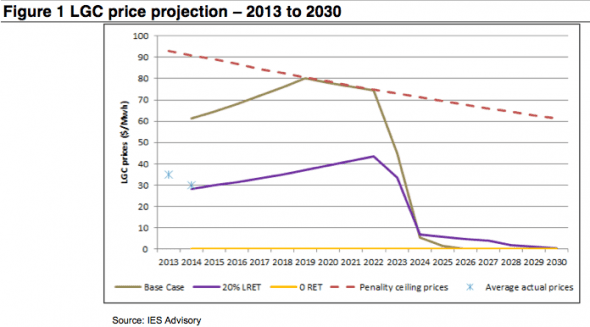
    The boost to coal would be largely due to rising gas prices, the removal of carbon prices and decreased LGC prices, which the IES estimates would be halved under the 20 per cent LRET scenario, falling 55 per cent lower than prices under the base case till 2024 – an effect IES says “will negatively impact the profitability and investment decisions of large-scale renewable projects.”

    Screen Shot 2014-03-12 at 9.32.19 AM

    The report also warns that a relatively low level of generation capacity investments could restrain economic growth and lower the level of services to consumers.

    “Potential under-investment in generation capacity in the NEM can create many challenges to network operators with increased network constraints and higher frequency of blackouts, and to independent retailers, industrials and consumers, inducing wholesale price volatility, difficulties in hedging and risk management, and weaker market competition,” says IES.

    Notably, it says, electricity prices under the zero RET scenario would be higher than prices under the 20% LRET scenario, with the reduction in renewable generation pushing up electricity pool prices.

    “This will at least partially counteract cost savings effected from scrapping the RET,” says the report.

    In conclusion, says the IES, “a halt to the LRET may not clearly outweigh the benefits of a well-set long term large-scale renewable energy target, nor will it result in the lowest electricity prices due to restrained investments in generation capacity.”

    The findings of the IES report will fan the fears of many in the renewable energy industry, who have long argued that the Renewable Energy Target is crucial to the health of the burgeoning and potentially lucrative sector.

    “If the review recommends a cut to the RET, it’ll be clear they’re looking after their fossil-fueled friends, not the interests of Australians,” said Leigh Ewbank, renewables spokesperson for Friends of the Earth, on Tuesday.

    Ewbank argues that, as well as driving up coal use and emissions, the dilution or scrapping of the RET would also cost Australia jobs.

    “The Renewable Energy Target review threatens 3,556 construction jobs and up to 600 full time jobs, Ewbank said, quoting SKM analysis commissioned by the Clean Energy Council.
    “For every megawatt of installed capacity, 0.7 jobs are created. It shows a typical 50 megawatt wind farm employs between five and six full-time staff.”

    S

  • European Flood Risk Could Double By 2050

    Site » News stories

    News

    European Flood Risk Could Double By 2050

    03.03.2014

    03.03.2014 07:26 Age: 9 days

    New research projects a massive increase in financial losses due to floods in Europe over coming decades as the risk of flooding doubles, concludes a paper published online this week in Nature Climate Change.


    Major floods, such as those that affected countries across Europe in June 2013 and that are currently afflicting parts of southern England, are expected to become more common under climate change, putting increasing pressure on disaster risk finance at both the national and the EU level.

    Brenden Jongman and colleagues show that peak monthly water discharges from European river sub-basins are a good indicator of flood risk. They find a high degree of correlation between peak discharges across sub-basins, which is due to large-scale weather patterns. This means that different rivers often flow high at the same time, threatening floods across large regions. The researchers also model present and future potential flood losses, taking into account both projected climate change and socio-economic development. Their computer simulations suggest that average annual flood losses could increase by 500% from now to 2050, with the frequency of extreme events — leading to losses due to floods of the magnitude suffered in 2013 (€12 billion) — approximately doubling over that period.

    Although the magnitude and distribution of losses can be contained by investing in flood protection, and their effects mitigated by increasing insurance coverage or by expanding current public compensation funds, the results of the study show that these measures have vastly different efficiency, equity and acceptability implications. The authors conclude that it may become increasingly necessary for European counties to help each other financially when major floods strike.


    Here is the text of a news release issued by the International Institute for Applied Systems Analysis which discusses this research.

    Losses from extreme floods in Europe could more than double by 2050, because of climate change and socioeconomic development. Understanding the risk posed by large-scale floods is of growing importance and will be key for managing climate adaptation.

    Current flood losses in Europe are likely to double by 2050, according to a new study published in the journal Nature Climate Change by researchers from the International Institute for Applied Systems Analysis (IIASA), the Institute for Environmental Studies in Amsterdam, and other European research centres. Socioeconomic growth accounts for about two-thirds of the increased risk, as development leads to more buildings and infrastructure that could be damaged in a flood. The other third of the increase comes from climate change, which is projected to change rainfall patterns in Europe.

    “In this study we brought together expertise from the fields of hydrology, economics, mathematics and climate change adaptation, allowing us for the first time to comprehensively assess continental flood risk and compare the different adaptation options,” says Brenden Jongman of the Institute for Environmental Studies in Amsterdam, who coordinated the study.

    The study estimated that floods in the European Union averaged €4.9 billion a year from 2000 to 2012. These average losses could increase to €23.5 billion by 2050. In addition, large events such as the 2013 European floods are likely to increase in frequency from an average of once every 16 years to a probability of once every 10 years by 2050.

    The analysis combined models of climate change and socioeconomic development to build a better estimate of flood risk for the region. IIASA researcher Stefan Hochrainer-Stigler led the modeling work on the study.

    He says, “The new study for the first time accounts for the correlation between floods in different countries. Current risk-assessment models assume that each river basin is independent. But in actuality, river flows across Europe are closely correlated, rising and falling in response to large-scale atmospheric patterns that bring rains and dry spells to large regions.”

    “If the rivers are flooding in Central Europe, they are likely to also be flooding Eastern European regions,” says Hochrainer-Stigler. “We need to be prepared for larger stress on risk financing mechanisms, such as the pan-European Solidarity Fund (EUSF), a financial tool for financing disaster recovery in the European Union.”

    For example, the analysis suggests that the EUSF must pay out funds simultaneously across many regions. This can cause unacceptable stresses to such risk financing mechanisms. Hochrainer-Stigler says, “We need to reconsider advance mechanisms to finance these risks if we want to be in the position to quickly and comprehensively pay for recovery.”

    IIASA researcher Reinhard Mechler, another study co-author, points out the larger implications arising from the analysis. He says, “There is scope for better managing flood risk through risk prevention, such as using moveable flood walls, risk financing and enhanced solidarity between countries. There is no one-size-fits all solution, and the risk management measures have very different efficiency, equity and acceptability implications. These need to be assessed and considered in broader consultation, for which the analysis provides a comprehensive basis.”

    End of news release.


    Abstract

    Recent major flood disasters have shown that single extreme events can affect multiple countries simultaneously, which puts high pressure on trans-national risk reduction and risk transfer mechanisms. So far, little is known about such flood hazard interdependencies across regions and the corresponding joint risks at regional to continental scales. Reliable information on correlated loss probabilities is crucial for developing robust insurance schemes and public adaptation funds, and for enhancing our understanding of climate change impacts. Here we show that extreme discharges are strongly correlated across European river basins. We present probabilistic trends in continental flood risk, and demonstrate that observed extreme flood losses could more than double in frequency by 2050 under future climate change and socio-economic development. We suggest that risk management for these increasing losses is largely feasible, and we demonstrate that risk can be shared by expanding risk transfer financing, reduced by investing in flood protection, or absorbed by enhanced solidarity between countries. We conclude that these measures have vastly different efficiency, equity and acceptability implications, which need to be taken into account in broader consultation, for which our analysis provides a basis.


    Citation

    Jongman, B, S Hochrainer-Stigler, et. al. (2014). Increasing stress on disaster risk finance due to large floods. Nature Climate Change (letter). doi: 10.1038/nclimate2124

    Read the abstract and see the paper here.

    Sources

    Press release from Nature.

    News release from the the International Institute for Applied Systems Analysis issued via the EurekAlert! Service of the AAAS here.

  • Kelvin Thompson re GDP

    Thomson, Kelvin (MP)

    11:06 AM (28 minutes ago)

    to Kelvin
    Dear All,
    Please see the following article questioning the value of GDP as a measure of economic progress.
    Regards,
    Kelvin Thomson MP
  • Long term Warming Likely to Be Significant Despite Recent Slowdown

    Text Size
    March 11, 2014
    RELEASE 14-073
    Long-Term Warming Likely to Be Significant Despite Recent Slowdown
    Earth Right Now. Your planet is changing. We're on it.
    Five new NASA Earth science missions are launching in 2014 to expand our understanding of Earth’s changing climate and environment.

    A new NASA study shows Earth’s climate likely will continue to warm during this century on track with previous estimates, despite the recent slowdown in the rate of global warming.This research hinges on a new and more detailed calculation of the sensitivity of Earth’s climate to the factors that cause it to change, such as greenhouse gas emissions. Drew Shindell, a climatologist at NASA’s Goddard Institute for Space Studies in New York, found Earth is likely to experience roughly 20 percent more warming than estimates that were largely based on surface temperature observations during the past 150 years.

    Shindell’s paper on this research was published March 9 in the journal Nature Climate Change.

    projection of Earth warming by 2099
    A new NASA study suggests that projections of Earth’s future warming should be more in line with previous estimates that indicated a higher sensitivity to increasing greenhouse gas emissions.
    Image Credit:
    NASA SVS/NASA Center for Climate Simulation

    Global temperatures have increased at a rate of 0.22 Fahrenheit (0.12 Celsius) per decade since 1951. But since 1998, the rate of warming has been only 0.09 F (0.05 C) per decade — even as atmospheric carbon dioxide continues to rise at a rate similar to previous decades. Carbon dioxide is the most significant greenhouse gas generated by humans.

    Some recent research, aimed at fine-tuning long-term warming projections by taking this slowdown into account, suggested Earth may be less sensitive to greenhouse gas increases than previously thought. The Fifth Assessment Report of the Intergovernmental Panel on Climate Change (IPCC), which was issued in 2013 and was the consensus report on the state of climate change science, also reduced the lower range of Earth’s potential for global warming.

    To put a number to climate change, researchers calculate what is called Earth’s “transient climate response.” This calculation determines how much global temperatures will change as atmospheric carbon dioxide continues to increase – at about 1 percent per year — until the total amount of atmospheric carbon dioxide has doubled. The estimates for transient climate response range from near 2.52 F (1.4 C) offered by recent research, to the IPCC’s estimate of 1.8 F (1.0 C). Shindell’s study estimates a transient climate response of 3.06 F (1.7 C), and determined it is unlikely values will be below 2.34 F (1.3 C).

    Shindell’s paper further focuses on improving our understanding of how airborne particles, called aerosols, drive climate change in the Northern Hemisphere. Aerosols are produced by both natural sources – such as volcanoes, wildfire and sea spray – and sources such as manufacturing activities, automobiles and energy production. Depending on their make-up, some aerosols cause warming, while others create a cooling effect. In order to understand the role played by carbon dioxide emissions in global warming, it is necessary to account for the effects of atmospheric aerosols.

    While multiple studies have shown the Northern Hemisphere plays a stronger role than the Southern Hemisphere in transient climate change, this had not been included in calculations of the effect of atmospheric aerosols on climate sensitivity. Prior to Shindell’s work, such calculations had assumed aerosol impacts were uniform around the globe.

    This difference means previous studies have underestimated the cooling effect of aerosols. When corrected, the range of likely warming based on surface temperature observations is  in line with earlier estimates, despite the recent slowdown.

    One reason for the disproportionate influence of the Northern Hemisphere, particularly as it pertains to the impact of aerosols, is that most man-made aerosols are released from the more industrialized regions north of the equator. Also, the vast majority of Earth’s landmasses are in the Northern Hemisphere. This furthers the effect of the Northern Hemisphere because land, snow and ice adjust to atmospheric changes more quickly than the oceans of the world.

    “Working on the IPCC, there was a lot of discussion of climate sensitivity since it’s so important for our future,” said Shindell, who was lead author of the IPCC Fifth Assessment Report’s chapter on Anthropogenic and Natural Radiative Forcing. “The conclusion was that the lower end of the expected warming range was smaller than we thought before. That was a big discussion. Yet, I kept thinking, we know the Northern Hemisphere has a disproportionate effect, and some pollutants are unevenly distributed. But we don’t take that into account. I wanted to quantify how much the location mattered.”

    Shindell’s climate sensitivity calculation suggests countries around the world need to reduce greenhouse gas emissions at the higher end of proposed emissions reduction ranges to avoid the most damaging consequences of climate change. “I wish it weren’t so,” said Shindell, “but forewarned is forearmed.”

    For more information about the Goddard Institute for Space Studies, visit:

    http://www.giss.nasa.gov

    -end-

    Steve Cole
    Headquarters, Washington
    202-358-0918
    stephen.e.cole@nasa.gov

    Leslie McCarthy
    Goddard Institute for Space Studies, New York
    212-678-5507
    leslie.m.mccarthy@nasa.gov


    NASA news releases and other information are available automatically by sending an e-mail message with the subject line subscribe to hqnews-request@newsletters.nasa.gov.
    To unsubscribe from the list, send an e-mail message with the subject line unsubscribe to hqnews-request@newsletters.nasa.gov.