Earth is running a fever. Atmospheric CO2 concentration now 397.54 ppm: http://1.usa.gov/ZyizbZ #NASA #climatechange pic.twitter.com/RzNiVWQe27
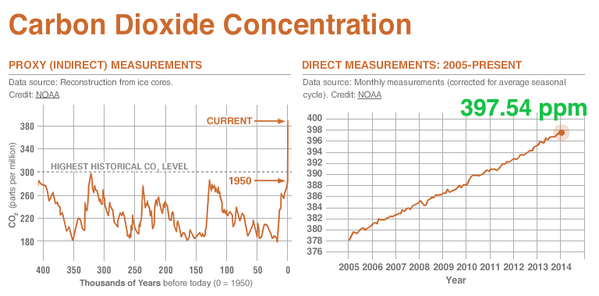
Earth is running a fever. Atmospheric CO2 concentration now 397.54 ppm: http://1.usa.gov/ZyizbZ #NASA #climatechange pic.twitter.com/RzNiVWQe27
 |
|
Sheerwind.com
|
If you were paying attention in school you must know that wind turbines convert kinetic energy from the wind into electrical power. But even the best of them will be a distant second to what Sheerwind has in store for us.
The energy technology company has designed a new innovative wind turbine named INVELOX that promises to produce six times as much electrical power as a conventional turbine does.
Utilizing the Venturi Effect, Sheerwind’s new funnel-shaped turbine basically sucks in air from all directions and pushes it down through a tube into a turbine generator. By doing so, it increases the velocity of the wind and lowers the pressure, which in turn speeds up the wind turbine installed in its lowest portion.
Sheerwind claims that not only is its turbine more efficient and has a less startup cost, it would also result in fewer bird deaths – which are a problem with its conventional predecessors.
The concept of Venturi Effect in the field of fluid dynamics is quite old, but it is the first time it is being used to produce electricity. If Sheerwind’s product is everything what it says it is, it would revolutionize the power making industry, and in the next few years, wind turbines would look like funnels instead of fans.

JILL LAWLESS And SETH BORENSTEIN
LONDON — The Associated Press
Published Wednesday, Feb. 12 2014, 9:34 PM EST
Last updated Wednesday, Feb. 12 2014, 9:38 PM EST
Britain’s weather service says it sees the tentacles of climate change in a spate of storms and floods battering the country, but has stopped short of saying that global warming directly caused the extreme conditions.
The latest round of bad weather slammed into Britain’s west coast on Wednesday with torrential rain and winds gusting up to 106 mph (170 kph). Trucks were toppled, trees were felled and a major chunk of the railway was closed.
The website of rail operator Virgin Trains greeted visitors with the words: “Do Not Travel.”
England, which has been lashed by wind and rain since December, had its wettest January since records began in 1766.
The resulting floods have drenched the southwestern coast of England, the low-lying Somerset Levels and the Thames Valley west of London, where hundreds of properties have been swamped after the Thames burst its banks.
Britain’s Met Office, the nation’s weather agency, said in a paper published this week that “there is no definitive answer” on the role played by climate change in the recent weather and floods. But it said there is “an increasing body of evidence that extreme daily rainfall rates are becoming more intense,” probably due to a warming world.
Met Office chief scientist Julia Slingo told the BBC that “all the evidence suggests there is a link to climate change.”
It was the latest in a series of assertions by weather agencies linking extreme weather events with human-made global warming. Last year the Met Office and the U.S. National Oceanic and Atmospheric Administration said events ranging from Superstorm Sandy flooding to U.S. heat waves to extreme rainfall in Australia and New Zealand had all been made more likely by climate change.
The Met office study discusses evidence of increasingly extreme weather events and links both Britain’s damp winter and the extreme cold that has hit the United States and Canada to “perturbations” in the jet stream over the Pacific Ocean and North America. But it does not say outright that global warming caused the flooding. To do that, scientists take months, sometimes years, to conduct detailed computer simulations — and the report said such research was needed in this case.
In the United States, NOAA research meteorologist Martin Hoerling said the Met Office study “identifies many challenges for research” rather than drawing firm conclusions.
But Pennsylvania State University climate scientist Michael Mann said it was “a remarkably blunt report for a group that is typically characterized by a staid approach.”
“The bottom line is this: we are indeed now seeing with our very eyes the impacts of climate change on severe weather, record heat, drought, more intense hurricane activity,” Mann said in an email. “The only question at this point is how far downstream this treacherous torrent we are going to paddle.”
A similar question — when will it end? — was being asked by many Britons, from flooded farmers to riverside residents piling sandbags against the encroaching waters of the Thames.
“I tried to prepare for this, I bought 100 pounds of sand and I called the council,” said Suhair Al-Fouadi, a resident of the town of Egham, who woke Wednesday to find a foot of water in her house. “But they would do nothing. Now I have water from the sewer coming in through my doors.”
The Met Office issued its highest-level red warning of “exceptionally strong winds” Wednesday for west Wales and northwest England. It said a gust of 106 mph (170 kph) was recorded at Aberdaron in northwestern Wales.
Railway operator Network Rail said the main west coast train line would close for several hours Wednesday evening because of the wind. Two Premier League soccer matches have been postponed because of safety concerns related to the weather, while a man in his 70s died of suspected electrocution while trying to move a tree that had downed some power cables near the English town of Chippenham.
London itself was expected to be safe from the flooding since it’s protected by the Thames Barrier, a series of 66-foot (20-meter) high metal gates across the entire river. The massive gates can be closed to stop the tide from coming up the Thames, which gives more space for the river to handle excess water from upstream. At low tide, the Thames barrier is then opened and the floodwaters flow to the sea.
Yet the Met Office says there will be no quick end to Britain’s flood misery.
At least one more storm is forecast for later this week. It says some areas could get up to 2.75 inches (7 centimetres) of rain — a month’s worth — by Friday.
A new study shows that there is at least a 76 percent likelihood that an El Niño event will occur later this year, potentially reshaping global weather patterns for a year or more and raising the odds that 2015 will set a record for the warmest year since instrument records began in the late 19th century.
The study, published on Monday in the Proceedings of the National Academy of Sciences, builds on research put forward in 2013 that first proposed a new long-range El Niño prediction method.
Although they occur in the equatorial tropical Pacific Ocean, the effects of El Niño events can reverberate around the globe, wreaking havoc with typical weather patterns. El Niños increase the likelihood for California to be pummeled by Pacific storm systems, for example, while leaving eastern Australia at greater risk of drought. Because they are characterized by higher than average sea surface temperatures in the equatorial tropical Pacific Ocean, and they add heat to the atmosphere, El Niño events also tend to boost global average temperatures.
By acting in concert with manmade greenhouse gases, which are also warming the planet, calendar years featuring a strong El Niño event, such as 1998, can more easily set all-time high temperature records.
Today, scientists can only reliably predict the onset and severity of El Niño events by about 6 months ahead of time. And this lead time may actually decrease due to Congressional budget cuts for ocean monitoring buoys that provide crucial information for El Niño forecasting.
The new study, by an international group of researchers, takes a starkly different approach to El Niño forecasting compared to conventional techniques. While the forecast models in use today tend to rely on observations of the ocean conditions and trade winds that generally blow from east to west across the tropical Pacific, the new method relies on an index that compares surface air temperatures in the area where El Niño events typically occur with temperatures across the rest of the Pacific.
The researchers found that a strong link between air temperatures across the Pacific and air temperatures in region where El Niño forms appears about one calendar year before an actual El Niño event. Taking advantage of this observation, the scientists devised a forecasting index based on the strength of the links between temperatures in and around the El Niño region. This index, the study said, points to a high likelihood of an upcoming El Niño late in 2014.
“Our approach uses another route,” said study coauthor Armin Bunde, a scientist at the Institute for Theoretical Physics in Giessen, Germany, in an email conversation. “We do not consider the water temperature in a specific area of the Pacific Ocean, but the atmospheric temperatures in all areas of the Pacific.”
While the the study claims to be more definitive than other forecasts, projections derived from ocean- and statistically-based models from the National Weather Service and the International Research Institute for Climate and Society (IRI) at Columbia University already show increasing odds, to the tune of twice the average risk, of an El Niño starting in the late summer or early fall as well.
Some leading El Niño forecasters were skeptical of the new study, in part because it puts forward a technique based only on statistics, with no improved understanding of the underlying physics of the Pacific Ocean and atmosphere. Bunde told Climate Central that he and his colleagues have yet to discover the physical connections between the rest of the Pacific and the El Niño region, but that they are still investigating.
“This is classic bravado — they make a forecast: if it is wrong, everyone forgets; if they are right, they get big points. In the meantime, people cite their papers,” said Lisa Goddard, director of IRI and a senior scientist there. “There is no physical explanation of what is going on.”
Bunde said the temperature index method is more reliable than traditional forecast techniques.
“When we give an alarm, the alarm is correct in 3 of 4 cases and false in 1,” Bunde said. “We can forecast El Niño about 1 year ahead. The conventional forecasts have a considerably shorter warning time of about 6 months, with a lower hit rate than our method. The disadvantage of our method is that we cannot predict the strength of the El Niño event. But we hope to overcome this shortage of our algorithm in the near future.”
Bunde said the extra 6 months of warning time could have significant economic benefits, since it covers an entire “agricultural cycle,” thereby giving farmers more time to adapt to wetter or drier than average conditions.
In the study, the scientists said they are aware of “the reputational risks” involved with making an El Niño prediction so far in advance. “Should our alarm turn out to be correct, however, this would be a major step toward better forecasting,” the study said.
However, Anthony Barnston, chief forecaster at IRI, told Climate Central that the new method is not likely to stand the test of time. “This scheme shows a good performance now, but after another 6 years (and 2 new El Niños) it may not look nearly as good, and they will have to change something to restore skill,” he said.

A year or two before its demise, Holden was offered the opportunity to throw in a small amount of money to try and help the development of an electric Commodore. The sum requested was minor, but refused.
In retrospect, the request was possibly a little like suggesting Kodak should go digital, or a coal-fired generator go green. Incumbents find it difficult to look beyond their own business model and the quarterly report to shareholders. And then they fall flat on their face.

Image courtesy of ShutterStock
The question about an EV manufacturing industry in Australia is an interesting one. There will be huge debate about whether an Australian EV maker could compete on the international market, in the same way that the local subsidiaries of Holden, Ford and Toyota struggled.
But there is one key element that may be overlooked – over and above the obvious technical talent and infrastructure that Australia deploys in its car manufacturing sector. And that is latent demand, and the potential support of the huge electricity utility industry, who could throw their considerable weight behind EV deployment to address their own weaknesses in their business model.
As RenewEconomy noted last year, the utilities industry has been looking for some time to EVs, and its infrastructure of storage and charging stations, as an antidote to declining demand and the threat of the death spiral. It’s about the only way they can see themselves being able to buy into the new distributed energy model.
It is remarkable to see how vocal those interests have become. The major utilities are now actively pushing EV adoption in their submissions to the Energy White Paper and other reviews. Could their involvement lead to the development of a “clean car” industry in Australia. There is an awful lot at stake, and an awful lot of reasons why it could.
The Australian Electric Vehicle Association says the departure of Mitsubishi, Holden, Ford and Toyota – owing to their “uncompetitive business models”, presents Australia with a unique chance to foster its own auto-manufacturing capacity.
“Whether it is foreign investment from a large automaker or a locally conceived EV, Australia is well placed to design, build and market EVs to the world,” it says in its submission to the energy white paper. “The AEVA strongly supports any effort to redirect funds away from petrol-burning carmakers, and towards producers of plug-in hybrids and pure EVs here in Australia.”
It notes that the exits of the big carmakers mean Australia will have three production lines available, excellent auto design skills (Australia is one of the few in the world to be able to design and build a motor vehicle from concept to delivery, and expertise gained in the construction of the hybrid Camry. The success of Tesla showed how EVs could appeal to the market.
It also notes that the high penetration of domestic solar in Australia is a natural fit to charge EVs at home, and 140,000 households who cashed in on the NSW solar bonus scheme will be looking for something to do with their excess capacity when those tariffs finish at the end of 2016.
Such ideas are likely to gain support from the utilities industry – retailers, generators, and network operators, to address the significant over-capitalisation of the network, and to arrest declining demand that are affecting other areas.
Origin Energy, for instance, is promoting the deployment of electric vehicles as one area of abatement that should be encouraged through the Direct Action process. “When bundled with a renewable energy product such as GreenPower, EVs can provide a zero emissions solution,” it writes in its submission to the Senate inquiry on Direct Action.
“They also provide other benefits, such as by shifting demand to off-peak times, thereby reducing costs on the electricity network.”
This theme has been taken up by AGL Energy, which says in its submission to the energy white paper that EVs could reduce the Australian economy’s reliance on imported liquid fuels by substituting domestically-generated electricity.
“This represents a significant opportunity to improve Australia’s structural trade position and energy security,” it says. Further, EVs have zero tailpipe emissions, and therefore do not contribute to air pollution or ‘‘smog.’’ Over time, high EV uptake could significantly improve air quality in urban areas.
AGL Energy argues that charging EVs, even in Australia’s current fossil-fuel dominated generation mix, would produce around 18kg of CO2e per 100 km of driving, about 35 per cent lower than an average petrol car, although roughly equivalent to a new midsize petrol sedan or hatch. And it says the electricity fleet will likely clean itself up much quicker than the petrol fleet. EVs charged using accredited GreenPower (as at 2010) would produce 2 kg CO2e per 100kms.
AGL Energy says that with the right price signals – such as time of use pricing it has been promoting for years, would enhance the utilisation rate of existing electricity grid infrastructure, and reduce unit pricing for all consumers. It suggests that Australia should consider government targets or mandates for electric vehicle uptake.
As the AEVA suggests: Electric vehicles present a major electricity storage option for the grid, as vehicle-to-grid energy flow would allow more intermittent sources of electricity such as that from solar and wind, to be utilised as the need arises. We believe that further investment into the development of “smart” electricity distribution networks is essential, and would deliver considerable efficiencies if executed properly. A high price should be offered to households who re-supply electricity from fully charged EVs, as this represents a premium reserve which can be accessed rapidly.
In short, an Australia EV manufacturing industry is a potential answer to so many issues – an Australian manufacturing base, employment, electricity bills, network death spirals, and emissions reduction – it could encourage the uptake of solar and other renewables. Bit of a no brainer really.
Update: This week, an EV battery charging facility powered by dual-axis solar trackers was installed at Kangaroo Island’s airport. The system will provide more than 100MWh of electricity, enough to offset the consumption of the local airport, and combined with 14kW rooftop solar PV system on Council Chambers, will support the charging of three Nissan LEAF electric vehicles.
K

|
|
|
Attention electric vehicles: 2014 will be good to you.
That’s the prediction from IHS Automotive, which said Tuesday it expects global production of EVs and plug-in hybrid EVs (PHEVs) to rise 67% this year. That compares with just a 3.6% increase in the production of all vehicles globally.
Several key factors account for the expected increase in electric vehicles.
“European emissions standards are tightening in the second half of this year,” Ben Scott, an analyst for IHS Automotive, said in a statement. “At the same time,” he added, “European automakers are introducing compelling new EV models.”
Those new additions to the EV landscape include BMW’s i3 electric city car and i8 PHEV sports car, the Audi A3 E-tron PHEV, Mercedes-Benz B-Class EV and Volkswagen E-Up EV (which won’t be sold in the U.S.).
This means more than 403,000 electrified vehicles are expected to be built in 2014, up from 242,000 in 2013. The 2013 figure itself was a 44% rise from a year earlier, IHS reported.
With so many new European models flooding the marketplace, the Europe, Middle East and Africa region is expected to build 40% of all EVs in 2014. Asia will build an additional 30%, while the U.S. will make about 27% of all EVs in the world, IHS said.
Much of that U.S. production is made up by the Nissan Leaf, Chevy Volt, Tesla Model S, and Ford C-Max plug-in hybrid.
As production increases, prices of EVs should continue to fall. The Nissan Leaf is $6,000 cheaper in 2014 than the same car was in 2012, the IHS report said. The price drop was crucial to the Leaf’s drastic rise in popularity in the U.S.: sales in 2013 were up 130% over 2012.
In the search for more customers, the Chevy Volt, Honda Fit EV, Fiat 500e, Ford Focus EV and plug-in version of the Toyota Prius all saw their sticker prices drop in 2013. “Price is the main reason why uptake of these vehicles hasn’t been as high as expected, so incentives are critical if countries are serious about the adoption of such vehicles,” the IHS report said.
Cheaper battery technology helps. A price war between lithium-ion makers LG (in the Chevy Volt) and Panasonic (in the Tesla Model S) is helping, and Samsung is entering the fray by building a battery for the BMW i3 and Fiat 500e.
China is another driver of EVs’ global popularity. The country is using government-sponsored mandates to drive sales of these cars in an effort to curb China’s significant pollution problem and the adverse health and economic effects it’s having. The city of Beijing is limiting sales of new cars while also deploying 20,000 EVs in 2014, and a total of 170,000 EVs by 2017, the IHS report said.
A


