Author: Neville

  • Slogans stifled debate – and we let them

    Slogans stifled debate – and we let them

    Posted 2 hours 53 minutes ago

    If we had pushed for solid policy ideas and not slogans before the federal election, we might be better prepared to address the issues that confront us, writes Jonathan Green.

    An election, at least in theory, gives our informed consent to the work of an incoming administration.

    Good word, administration. Is that what we hope for from our elected representatives, that they keep an eye on things? Run the firm on behalf of the stockholders?

    “The people of Australia thank you for your presentation and are pleased to offer you the opportunity to form a government based on the program you have outlined.”

    That kind of thing. Mind you, that’s a scenario that assumes:

    a: The voting public has some kind of determining influence over the electoral agenda; and

    b: That it gives much of a damn in the first place.

    Both somewhat contestable.

    Which takes us to the condescending mass of cliché and twaddle that was our most recent experience of the democratic miracle: A federal election in which both parties stood nervously in each other’s policy shadow, told us as little as they could about the concrete and problematic realities that confront us, never mind what either might do about them, then posed for a poll that hung all but exclusively on one simple proposition: we are not them.

    The issue of informed consent then is probably moot.

    The election was all about dumping a government seen as divided and dysfunctional. This is probably because in large part the previous government was divided and dysfunctional, an unfortunately overwhelming distraction given the gravity of the national circumstance. But that was the electoral narrative: getting rid of Labor.

    And now, with a new government in power the position of the country seems to grow more awkwardly complex by the day as we confront realities untamed by politics. In an election, reality can be sculpted, in government it must be confronted.

    It is entirely possible, for example, to gain power on the basis of the slightest of policy prescriptions. For Tony Abbott this amounted to a recurring and simple series of pledges:

    “We’ll build a stronger economy so everyone can get ahead. We’ll scrap the carbon tax so your family will be $550 a year better off. We’ll get the budget back under control by ending Labor’s waste. We’ll stop the boats. And we’ll build the roads of the 21st century because I hope to be an infrastructure prime minister who puts bulldozers on the ground and cranes into our skies.”

    As the weeks and months have moved on it has become increasingly clear that the terms of this electoral contest, terms largely determined by the government’s calculated minimalism, did us no favours.

    We went to the polls after an exchange of slogans rather than ideas … and the worst kind of slogans. Slogans that increasingly seem not to have been a shorthand for a more elaborate and considered system of policy and belief, but, well, slogans, entire of themselves.

    As we are beginning to see, as 2014 unfolds with its faltering in manufacturing and numerous other signs of an economy in “transition”, there was quite a bit of solid policy ground the 2013 election might have dealt with.

    Could our decision-making process on who might best administer our commonwealth have been aided by a robustly expressed series of thoughts on how we set about the restructure of an economy tripping out of a mining boom, stumbling towards the end of manufacturing and looking for a sustaining future direction?

    That sort of process would not have changed the outcome. The ALP was roadkill regardless of the detail of the campaign. But a more vigorous, a more testing debate might have been of benefit to the incoming government. You could argue, too, it was the debate we probably deserved, and that as a consequence we might now have a series of policy proposals that might extend beyond this encapsulation of the government’s current thinking on industry policy offered by the prime minister to AM’s Chris Uhlmann: “If you ask me, Chris, can I say what individual Toyota workers will be doing in four years’ time, I can’t give you that answer, but Chris, none of us know the answers to those questions. What we’ve got to do is remember that we are creative people in a capable country who have always faced the future with confidence and have always made the most of it.”

    Our 2013 discussions on the economy could also have been partnered by a more than rhetorical musing over the state of federal fiscal affairs; unless repeated exhortations to “stop the waste” will be sufficient to resolve the sort of structural imbalances that, if left unattended, seem certain to leave the federal budget in a state of spiralling decline.

    As the Grattan Institute put it last year: “Australian government budgets are under pressure. In the next 10 years, they are at significant risk of posting deficits of around 4 per cent of GDP. That means finding savings and tax increases of $60 billion a year.”

    Cutting the waste may not cut it.

    Resolving the troubled balance between declining commonwealth revenues and multiple running sores of galloping expenditure will be the work of one or two parliamentary terms and will involve comprehensive reimagining of what it might be to be an Australian economy in the 21st century.

    Anybody sign up for that in September 2013? No. Not really.

    And we all have to take some responsibility for that, for governments that can coast on their campaign rhetoric when in power no matter what aggravated circumstances they confront.

    If we had demanded better, if our media had pushed harder for more considered responses and insisted that the electoral argument go beyond cliché and slogan, then we might by now have a national conversation of the sort of maturity that seems, increasingly, demanded by the circumstances we confront.

    Because that’s the tricky thing about circumstances: they seem resolutely impervious to slogans.

    Jonathan Green hosts Sunday Extra on Radio National and is the former editor of The Drum. View his full profile here.


  • What does ocean acidification mean for sea life?

    A news stream provided by the Ocean Acidification International Coordination Centre (OA-ICC)

    What does ocean acidification mean for sea life?

    Published 12 February 2014 Media coverage Leave a Comment

    pic blog 12feb

    Photo by Dana Roeber

    February 7, 2013 — The sky is low and dusky, and the rain comes in blustery gusts as we make our way out onto a spill of rocks that juts seaward from the shore just north of Boiler Bay on the Oregon coast. Low tide is just beginning; at times it looks as if we’ll be swamped by waves. It’s October 30 and in the late afternoon gloaming, my eyes take a few minutes to adjust so I can begin to differentiate mussels from rock and to spot the clutch of seals watching our progress.

    To the scientists who make up the Ocean Margin Ecosystem Group for Acidification Studies, this spot is known as the Fogarty Creek Intertidal Long-Term Ecological Research Site. The obvious drama of this place comes from the waves and wind and charismatic whiskered marine mammals. But I’m here to witness a different kind of drama with Oregon State University graduate student Jeremy Rose, who specializes in marine ecology and is part of a team of scientists investigating the effects of ocean acidification on the small organisms that inhabit the rocky tide-pool landscape beneath our feet.

    While it can’t be seen in a glance, what’s happening to the marine environment on the Pacific Northwest coast as a result of the growing concentration of carbon dioxide in Earth’s atmosphere is indeed dramatic. Since the mid-18th century, human activity—mainly fossil fuel burning—has increased the atmospheric concentration of CO2 by about 40 percent. Because oceans absorb about a quarter of the CO2 released into the atmosphere each year, as more CO2 enters the atmosphere, more ends up in the ocean. “Think of carbon as a global pollutant that affects the ocean everywhere it touches the sky,” explains Stanford University marine science professor and Hopkins Marine Station director Steve Palumbi.

    As CO2 dissolves in seawater, chemical reactions produce an acid. Over the past 250 or so years, the acidity of the world’s oceans has increased 30 percent. Scientists believe oceans have not experienced the current level of acidity in about 2 million years. Not only that, but according to National Oceanic and Atmospheric Administration senior scientist Richard Feely, conditions are changing faster than anything seen in geologic history. If today’s global CO2 emission trends continue, scientists estimate that by the end of this century, oceans will be more acidic than they have been for more than 20 million years.

    And that’s a problem. The rise in dissolved CO2 and concurrent drop in pH (lower pH indicates higher acidity), changes ocean chemistry in a way that robs marine organisms, such as mollusks and corals, of the carbonate ions they need to build shells and skeletons. At the same time, the increasing acidity can erode the structures they’ve already built, and appears capable of disrupting their bodies in other ways that make it hard for them to thrive. This is bad news not only for the organisms themselves, but also for people who rely on them for food and jobs, and perhaps even more profoundly, for the stability of the ecosystems with which they—and we—are intertwined.

    Investigating Impacts

    The chemistry behind ocean acidification is well understood. What scientists are working on now is trying to understand what is happening within marine organisms and their coastal communities as the ocean’s pH drops at the same time marine environments experience other stressors such as warming temperatures, pollution and overfishing.

    Among their big questions: Can marine species adapt to this rapid change, and if so, how? Or as Morgan Kelly, a postdoctoral researcher studying ocean acidification impacts at the University of California, Santa Barbara, puts it, “Will evolution come to the rescue?”

    To begin to answer this question, scientists are exploring how—down to the subcellular level—marine species are responding biologically to acidification. They are also examining how individual species’ responses may affect marine ecosystems. An adverse impact to one species, or conditions that overwhelmingly favor another, can create imbalances in the marine food web and lead to survival problems for a whole suite of species. And on an even larger scale, scientists are investigating what such changes may mean for fisheries and the people who depend on them, and how marine policy and conservation might respond.

    Laboratory experiments are part of the picture. But because ocean conditions are so complex and difficult to replicate, scientists are also conducting research in places like Fogarty Creek. The OMEGAS project, which includes study sites along the northern California and Oregon coast, is tracking ocean pH with offshore sensors while monitoring what’s happening biologically at these sites to intertidal species as seawater becomes more acidic. As UC Santa Barbara professor Gretchen Hofmann explained at the 2012 Ocean in a High CO2 World meeting held in Monterey, Calif., in September, scientists are investigating the “fine tuning of populations to their local environment” in locations now experiencing the most dramatically lowered pH.

    Purple Urchin

    As Rose and I walk out on the rocks, at first I see only boulders and water. But as I crouch to get a better look, an intricate world comes into focus. Yards of pearly black mussels are punctuated by patches of pale whorled pointy shells of gooseneck barnacles. Beneath the surface of the water, trapped in small pools as the tide recedes, are clusters of anemones that look like upside-down branchless coral. I spot a few fat pink sea stars and several distinct types of algae. Among these are long, bright-green rubbery streamers, short dull olive bristly algae and delicate lacy salmon-colored coralline algae, named for the calcareous skeleton that looks like bones of an exceptionally tiny bird. Deeper underwater, nestled among the anemones, are the creatures we have come to see: Strongylocentrotus purpuratus, the purple sea urchin.

    Purple sea urchins are of interest to marine biologists studying ocean acidification for numerous reasons. These creatures live up and down the Pacific Coast where pH is changing markedly. Their habitat is one that naturally varies greatly with the ebb and flow of tides. It is also a highly structured community of species in which the sea urchins play an important role, as a food source for sea otters, in controlling algae and as a component of a healthy ecosystem. They’re also a well-studied species—so well studied that their entire genome has been sequenced, enabling scientists to investigate genetic impacts of ocean acidification. This information is essential to understanding the species’ future and how their fate may affect other ecological community members.

    Because the pH recorded on the Oregon coast is much lower than that in California (thanks to ocean circulation, seasonal winds and upwelling), how the northerly purple sea urchins are responding to ocean acidification will help scientists understand what may happen to this whole community of species as ocean pH drops further, explains Kelly. It appears that seawater pH affects how hard the urchins must work to maintain the biochemical balance within their cells. That some seem to be “doing okay” under lower pH doesn’t mean that all is well, says Kelly. It means they’re doing something to compensate.

    Tyler Evans, Kelly’s colleague at UC Santa Barbara, is an environmental physiologist and postdoctoral fellow investigating how higher dissolved CO2 and lower pH affect sea urchins’ genes. By looking at the individual genes, he hopes to see exactly which are being altered by the changes in seawater chemistry and how ocean acidification is affecting the genes’ ability to make proteins—among the most basic building blocks of life. Thus far, Evans explains, they’ve identified important changes in how sea urchins’ cells transport calcium and sodium. A balance of these is vital to urchins, both for maintaining healthy cell function and for shell building. If sea urchins have to work harder to maintain this balance, it could affect their development or ability to reproduce. If urchins fail to thrive, it would likely have an adverse affect on their entire community of mussels, sea stars, anemones, fish and marine mammals.

    “The behavioral and energy changes needed to maintain yourself as a species are really complicated,” explains National Center for Atmospheric Research scientist Joanie Kleypas, a pioneering ocean acidification researcher. Not only that, notes Stanford’s Palumbi, the costs of coping with changes such ocean acidification may take more than one generation to become apparent.

    Similar effects have been observed for species other than the purple sea urchin. In lab experiments, green sea urchin larvae exposed to low pH have grown more slowly and developed physiological abnormalities. Mussels exposed experimentally to low pH appeared to have increased metabolic rates, reduced reproduction and some immune system suppression—all clear indications that acidified conditions are adversely affecting these animals’ physiological functions.

    Natural Laboratories

    To investigate the ecological impacts of acidification over the long term, scientists are also studying what are effectively natural laboratories for high CO2—places where the gas bubbles up through vents in the ocean floor. One such site is in the Mediterranean, where UC Davis Bodega Marine Lab postdoctoral researcher Kristy Kroeker and colleagues are studying how these conditions affect the ecology of the local reef community.

    Reef communities are typically very biologically diverse, with numerous species that each play important roles in the community’s physical structure and food web, explains Kroeker. But under high CO2 conditions, certain algae begin to dominate while the coralline algae that depend on calcium carbonate fare less well, changing what the community provides in the way of food and shelter. Kroeker and her colleagues are investigating how seemingly small changes in these food and structure roles will play out on an ecosystem scale and how this compares to acidification-related changes at sites like Fogarty Creek.

    As Kleypas explains, such studies will help us understand if “a community is going to change a lot or not” under ocean acidification and how any changes that do occur might affect the community’s ecological resilience. Changes to a community’s anchor or keystone species—one that plays a crucial role in an ecosystem’s function—she explains, are the most likely to affect the whole food web.

    By learning which species are most vulnerable to acidification and which are better able to adapt, scientists can target conservation measures aimed at protecting those species, explains Kelly. This could involve curtailing other pollutants or development that’s adversely impacting vulnerable species and habitat, including by identifying potential reserves. Such actions can’t remove excess CO2 already in the system, but they can help build resilience. This could be particularly helpful where important fisheries may be affected, says Kelly. But, cautions Evans, “we really don’t know yet what it takes to survive in a low pH ocean, and we need that information to set conservation priorities.”

    Get a Grip

    Yet these are but short-term strategies as the world tries to get a grip on the carbon emissions that are ultimately responsible for ocean acidification.

    “First and foremost,” says NOAA outgoing administrator Jane Lubchenco, “we need to demand that our elected representatives take seriously the need to reduce carbon emissions, and that’s true at a national level but also at the local level.”

    The process of ocean acidification, like the other manifestations of climate change prompted by excessive atmospheric CO2, now cannot be reversed entirely. But with swift and dramatic action, the rate of change might be slowed. And to help lessen acidification’s impacts, scientists suggest addressing not only carbon emissions but other environmental stressors that can exacerbate these effects as well. We “also need to reduce other sources of pollution,” including excess nutrients from both urban and rural sources, Lubchenco says.

    This is exactly the strategy Washington state’s Blue Ribbon Panel on Ocean Acidification recommended in a report released in November. The report formed the basis of an executive order signed by Washington governor Chris Gregoire the same day. The first such policy aimed at tackling ocean acidification, both the report and the executive order (designed to implement the report’s recommendations), combine strategies to reduce CO2 emissions and other pollution that exacerbates acidification, along with $3.3 million in funding for research and implementation. The recommendations are also be part of legislation Washington state senator and blue ribbon panel member Kevin Ranker recently introduced—and that he says he hopes will be copied by other coastal states.

    “We have a lot of work to do,” says Lubchenco, noting that most people in the U.S. have not yet heard of ocean acidification. “But,” she says, “if they like eating oysters or salmon or enjoy watching whales or scuba diving in coral reefs, they should be paying attention—because it’s a serious threat.”

    “The basic policy message,” says Palumbi, is that carbon emissions are “a global pollutant, and we have to fix this problem.” While a shellfish hatchery may be able to control the chemistry of water in its tanks or choose a different species to farm, the same can’t be done in the world’s wild oceans.

    In the meantime, as effects of ocean acidification play out, scientists and policy makers continue the quest to understand how individual species and marine communities will fare and how this information can be used to protect them before even more dramatic changes occur. “When it comes to ocean acidification,” says Lubchenco, “we’re all still explorers.”

    Elizabeth Grossman, Ensia, 7 February 2014. Article.

    Rate this:

    Rate This

    Share this post!

    0 Responses to “What does ocean acidification mean for sea life?”

    1. Leave a Comment

    Leave a Reply

    Subscribe to the RSS feed

    Powered by FeedBurner

    Follow AnneMarin on Twitter

    Blog Stats

    • 704,901 hits

    OUP book

    Top Posts

  • Linking the floods with climate change – and why it’s important

    Linking the floods with climate change – and why it’s important

    Perhaps I’m sensitive, but there doesn’t seem to have been much debate about whether the current UK floods are linked with climate change. The connection has appeared for a day or two but has never been the story for long.

    I’m going to look at this in two ways: firstly, what it’s meant for public opinion, and secondly, why it matters.

    When the media aren’t talking about an issue, it generally doesn’t get polled about – so we don’t have much data on opinion about the floods and climate change. But we can cobble together a few different polls and get some sense:

    1)      People think the UK will suffer more flooding as a result of climate change

    A Defra poll last year found people overwhelmingly think that flooding has got more common, and will continue to do so*.

    2)      People tend to see weather extremes in general as climate change-related

    The last Carbon Brief energy/climate change poll tested how far record-breaking weather of the last few years is seen as linked with climate change. It found just under half think they’re linked: a plurality but hardly decisive.


    3)      These floods in particular haven’t really been linked with climate change

    The only poll I know of asking whether people connect these floods with climate change, by YouGov, found a roughly even split, with slightly more saying they’re probably not linked.

    This was done before the Met Office published their report making a link, which got a bit of coverage. But as Carbon Brief have shown, only a small proportion of news articles about the floods have mentioned climate change, so it would be surprising if opinion has changed hugely.

    Why does it matter?

    It’s contentious to say that climate campaigners should be declaring that these floods are the result of climate change.

    On the one hand, it seems plausible to say they are climate-related, because they’re exactly the kind of thing that’s projected to happen as a result of climate change, and they’re unlikely to have happened without the effects of human-caused warming. But on the other hand, it’s possible they might have happened without climate change – so we can’t be certain.

    But here’s the problem: we will never be certain that a particular weather event is linked with climate change. And showing what climate change means for the UK is a really good way of explaining why we need to tackle it. If we wait until we’re utterly certain – as opposed to just very confident – we’ll miss the last boat evacuating the village.

    So, there’s been very little discussion of the likelihood that this kind of weather and consequent flooding, which are freakish at the moment, will become increasingly normal.

    To give just one example of why that matters, there’s been a bit of buzz about the idea of building a lagoon in Bridgewater Bay. It would generate electricity and cut flooding in the Somerset Levels. Sounds a great idea, but it would cost a bomb and take years to build. If that buzz fades after a few months – because we don’t connect these rains with climate change so don’t think they’re likely to happen again for another 200 years – we might wait until a few more rounds of serious flooding before we even get started with the planning process, which would mean thousands more people flooded when we could have acted sooner.

    The flooding, being so dominant in the news, is a time when climate change could be part of everyday conversations and the consequences of its unmitigated impacts for the UK could be made clear. World-leading scientists are prepared to say that human activities have made these floods more likely – and that they’ll become increasingly common if we don’t act.

    Yet climate change has barely registered and as a result there has been very little discussion about how we stop these floods happening again in a world where more extreme weather will make them more likely. It may be too late to change the debate during this set of flooding, but it needn’t be the case next time.


    * In isolation, this question looks like it could be to do with planning decisions rather than just climate change. But in practice, it followed a question about long-term changes to the UK’s weather and is in a series with others about dry periods and snowfall etc, so I think it’s fair to assume it was interpreted as a question about climate change.

    FacebookShare

    This entry was posted on Tuesday, February 11th, 2014 at 22:13 and is filed under Climate Sock. You can follow any responses to this entry through the RSS 2.0 feed. You can leave a response, or trackback from your own site.

  • How does the Thames Barrier stop London flooding?

    11 February 2014 Last updated at 14:

    How does the Thames Barrier stop London flooding?

    By Tom de Castella BBC News Magazine

    Thames Barrier

    Continue reading the main story

    The Thames Barrier has been in record use over the past two months. How does it work?

    A map released by its operator, the Environment Agency, in December showed how London would look if sea levels continued to rise and there was no barrier. The Houses of Parliament, the O2 arena, Tower Bridge, and areas including Southwark, the Isle of Dogs, Whitechapel and West Ham were shown to be flooded.

    The barrier, built in 1982 on the Thames on the eastern side of the capital at Woolwich, was designed to protect 48 sq miles (125 sq km) of central London from flooding caused by tidal surges.

    Map of London showing how it might be affected by flood without the Thames barrier How London might be affected by flooding from the sea without the Thames Barrier

    At the moment, with so much rainfall travelling down the Thames, there is a danger during high tide that the extra water will be pushed back up river by the sea and cause flooding in the capital and to the west.

    To prevent this, the barrier has been used at record levels, says Eamonn Forde, one of its controllers. It has closed 28 times since 6 December. This represents one fifth of all the closures – about 150 – since it was inaugurated.

    Some years it hasn’t been used at all. When it shut in December 2012, it was reported to be the first closure since March 2010.

    The barrier, made up of 10 steel gates, reaches 520m (1,700ft) across the river. When open, the gates lie flat on the river floor and close by being rotated upwards until they block the river. The four main gates span 61.5m (200ft) and weigh more than 3,000 tonnes each. The barrier is closed just after low tide to create an empty “reservoir” for the river flow to fill up. It takes 75-90 minutes to close it, starting with the gates on the outside until the middle gates are shut.

    Thames barrier
    Thames barrier
    • Open – Allows the Thames to flow freely and ships to pass through the gates
    • Closed – Creates a solid steel wall preventing water flowing upstream towards the capital
    • Underspill position – Allows a controlled amount of water to pass under the gate and up the Thames

    With no barrier, at high tide, the sea would normally flow up the estuary and into London, pushing the river water back. With all the extra rainfall, this could worsen the flooding. The barrier prevents this from happening. The gates are left shut and the river water is held until the tide turns. Staff wait for the water on both sides to “equalise” – reach the same level – and then the gate is opened and the river water can rush out into the estuary.

    There is no danger that the water will overwhelm the barrier. “We’ve got a massive amount of room.”

    Continue reading the main story

    Oosterscheldekering

    Oosterscheldekering
    • Largest tidal surge barrier in the world, situated between Dutch islands of Schouwen-Duiveland and Noord-Beveland
    • One of 13 barriers in the Delta network, built to protect the Netherlands from flooding, it was opened in 1986 by Queen Beatrix
    • Designed to last 200 years; the plaque on the barrier bears the inscription: “Here the tide is ruled, by the wind, the moon and us”

    Storm surge from the North Sea, high tides and exceptional fluvial (river) flow are the three factors that make it necessary. At the moment the major factor is the amount of water flowing down the Thames. “We’re predominantly closing to help reduce levels the other side of Teddington Weir,” Forde says.

    How much difference is the barrier making?

    “We’re reducing the level by inches,” he says. That impact is felt up the Thames as far as Molesey – about 12 miles from central London. That is where the effect of the tide runs out. Inches may not sound a lot but it could be the difference between ground level and someone’s house, Forde says.

    The barrier was closed at 10:30 GMT on Tuesday, for instance. It was to open later when the tide turned. Forde expects it to close again on Wednesday. The forecasts for the staff at the barrier – they have weather and storm measuring systems based in the North Sea – show deteriorating weather. A spring (higher) tide is also beginning on Wednesday.

    For most of its history, London lacked such protection. In 1928, 14 people drowned when a swollen Thames overflowed between the City and Southwark to the east and Putney and Hammersmith to the west. According to contemporary reports, the streets were filled with water up to 4ft (1.2m) deep.

    thames flood of 1928 1928: The last time the Thames flooded the streets of London

    The 1953 North Sea flood, which resulted in one London death and flooding at Silvertown, in the east, prompted calls for a mechanism to protect the capital. Construction on the Thames Barrier began in 1974 and it was officially opened a decade late.

    The barrier was originally designed to last up to the year 2030. Recent analysis suggests that even with sea level rise from anticipated climate change the barrier will be sufficient protection until 2060-70.

    Follow

  • Oceans warmed at a rate of 12 Hiroshima bombs per second in 2013 as temperatures spiked

    1 of 1
    Why this ad?
    650% Investment Returnstodaysbestinvestments.com – Invest In Alternative Investments. Huge Profits. Free Top-Pick Guide!
     Courtesy of David Spratt

    climate code red

    Inbox
    x

    Climate Code Red noreply@blogger.com via google.com

    8:14 PM (40 minutes ago)

    to me

    climate code red


    Oceans warmed at a rate of 12 Hiroshima bombs per second in 2013 as temperatures spiked

    Posted: 11 Feb 2014 02:36 PM PST

    by Lindsay Abrams, via Salon.com 

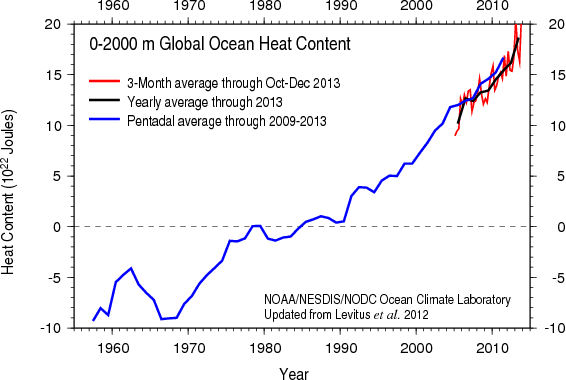
    Think global climate change hasn’t been very noticeable from where you’re standing? Down in the oceans (which is to say, over the majority of Earth’s surface), temperatures spiked last year, as warming proceeding at an incredibly rapid pace.
    Skeptical Science calls attention to the oceans’ temperature rise for the final quarter of 2013, which literally was almost off-the-charts:

    (via the National Oceanic Data Center)

    Put in terms that are easy (if horrifying) to visualize, Skeptical Science explains that the oceans used to be warming at a rate equivalent to about 2 Hiroshima bombs per second. Over the past 16 years, that’s doubled to a rate of 4 bombs per second. But in 2013, the warming became so dramatic that it was equivalent to 12 Hiroshima bombs every second. Seriously.

    When you hear climate skeptics talking about a “pause” in global warming, that’s where the heat is going — 378 million atomic bombs worth of it each year. And as Quartz points out, it’s not like the oceans are just storing all that heat for us and protecting us from the effects of climate change: warmer oceans mean more severe typhoons and hurricanes, rising sea levels and damage to marine life.

  • Australian research will help better locate wind turbines

    Australian research will help better locate wind turbines

    By on 12 February 2014
    Print Friendly

    CleanTechnica

    A new study published by an Australian researcher has determined that small- and medium-sized wind turbines can not only be placed in inefficient locations, but can be installed in locations where they will have no benefit whatsoever.

    The study was authored by Amir Bashirzadeh Tabrizia, from Murdoch University in Perth, Western Australia, who used Computational Fluid Dynamics (CDF) to model wind flows in order to perform a resource assessment for the installation of small wind turbines.

    As Tabrizia and his co-authors noted in their abstract, “the installation of small and medium-size wind turbines on the rooftops of high buildings has been often suggested by architects and project developers as a potential solution for achieving sustainable energy in building design.”

    They add, however, that “because of the presence of buildings and other adjacent obstructions, wind is normally turbulent, unstable and weak, in terms of direction and speed.”

    Quoted by Chris Thomas for the ScienceNetwork WA, Tabrizia notes that “the performance of small wind turbines in the built-environment is really sensitive to the place you put them. If you put them in wrong place, you will not get any power. Unfortunately, there are several bad examples around Perth where they have put the machines in shadow and they don’t work, not even in windy conditions.”

    Not only is there the likelihood that the turbines will have no practical benefit, but there is also the possibility of breaking and damage. Tabrizia noted instances where some of the turbines in “the built-environment … failed and broke.

    “There was even some damage to cars in parking lots, due to broken blades from the small turbines.”

    The aim of the study was to better simulate where wind turbines could be placed to maximise their efficiency, based on Computational Fluid Dynamics.

    “Through wind simulation in the target area, CFD helps to find the right place for the turbine with higher wind speed to avoid re-circulation and shadow zones, also putting the machine where it will generate more power,” Tabrizi said.

     Source: CleanTechnica. Reproduced with permission.