|
Why this ad?
 Get 3 Solar Quotes – Solar-Power-Australia.com.au – Compare 3 Solar Installers. Save Time & Money Now!
|
Green Light: Food waste, Australia’s coal and rediscovered toad
|
Inbox
|
x |

|
12:29 AM (9 hours ago)
|
|
||
|
||||
|
Why this ad?
Get 3 Solar Quotes – Solar-Power-Australia.com.au – Compare 3 Solar Installers. Save Time & Money Now!
|
|
Inbox
|
x |
|
12:29 AM (9 hours ago)
|
|
||
|
||||
|
Why this ad?
Landscape Garden Edging – www.kwikkerb.net.au/Garden-Edging – Make Your Garden Look Amazing. Call Us For Free Onsite Quote!
|
|
Inbox
|
x |
|
4:43 PM (18 minutes ago)
|
|
||
|
||||
Dear friend,
This e-mail is going to be a little long. But stick with us. It’s an important one.
Earlier this year, the planet lurched past 400 parts per million of CO2 — for the first time in human civilisation. That’s dangerously beyond the safe limit of 350 ppm – the number that scientists tell us is essential for a safe climate. Yet as we begin to create dangerous “new normals”, our politicians continue to ignore the facts. Tony Abbott is powering ahead with his plans to repeal the carbon price and introduce his laughable ‘direct action’ plan.
The moment has come – the moment to ask you to do important, challenging and powerful things. Last year Australia experienced an ‘Angry Summer’. Temperature records were smashed nationwide. And with the 12 months leading up to this September being Australia’s hottest on record, we can expect Summer 2013-14 to be one of extremes too.
This year we want to make it politically hot as well. That means we need you, out on the frontline. We need to show up and speak out. We need you to show Tony Abbott and the fossil fuel industry what direct action is really all about.
Pledge now to help us ramp up the fight against the coal and gas industry this summer.
Around the country, communities are fighting on the front lines of Australia’s coal and gas expansion. In New South Wales, the Maules Creek community is determined to stop Whitehaven’s plans to start a massive mine in the Leard State Forest. In WA, gas mining in the Kimberley and Midwest wildflower country is being fought at every turn.
In Queensland, the fight over the Galilee Basin, which would involve nine new massive coal mines, is heating up. If the Galilee Basin is opened up for exploitation, the impact will be global. Just six or seven places on earth have concentrated stores of carbon as large as the Galilee’s. Unless the carbon within them remains in the ground, catastrophic climate change is a certainty.
We have never confronted such a dramatic and dangerous expansion of fossil fuel extraction. It is time not only to challenge these projects individually, but to challenge this extreme expansion in a united effort. We need to fight it at every turn.
We’re calling this next phase of the fight “Summer Heat.” Over Summer 2013-14, from Northern Queensland to the South West of WA, we’ll be delivering the message that it’s time to stop the reckless expansion of the fossil fuel industry in Australia. And that means it’s time to stand up – peacefully but firmly — to the industry that is wrecking our climate, and our future.
Pledge now to stand up to the coal and gas industry.
We believe that mass action can breathe life into even the most hardened political fights, and so these actions will aim to unite thousands of people — perhaps sometimes on the other side of the law.
For those on the front lines these fights are often, understandably, about the local immediate impacts. And now all of us together need to add the weight of our anger and hope as well. It’s one big fight for our future. Front-line communities need and deserve reinforcements, pouring in to help the people who have been carrying these struggles as they begin to impact upon us all.
This movement isn’t made up of professional protesters. For the most part, it’s students, teachers, retirees, civil servants, farmers, businesspeople, fisher folk, artists, religious ministers. It’s about the people whose homes were demolished by the floods in Queensland or the fires in New South Wales.
We’ll be facing up against some powerful opposition. Mining magnates such as Clive Palmer and Gina Rinehart will do anything to make a profit, even at the expense of our planet. And with Tony Abbott as Prime Minister the fossil fuel industry has right of way. We can’t outspend them, but we have other currencies to work in: community, passion, creativity, spirit. And sometimes we will have to put our bodies on the line – like the climate movement in the United States has over recent years to halt the Keystone XL pipeline.
Here’s how it works.
This is the fight of the decade and we need you on board.
Let’s make summer 2013-14 an historic show of solidarity not just with the Australians who suffer most from the coal and gas industries, but with the people across the planet whose lives are at risk as the world warms — and indeed with the planet itself, beleaguered but still so worth fighting for.
If you weren’t needed, we wouldn’t ask. But in a fight as big as this, we are all needed, now more than ever.
In solidarity,
Blair, Aaron, Charlie, Josh, Simon, Katie, Alana, Claire, Sarah, Lexy, Isaac, Lily and the rest of the 350 Australia team
350.org is building a global movement to solve the climate crisis. Connect with us on Facebook and Twitter, and sign up for email alerts. You can help power our work by getting involved locally, sharing your story, and donating here. To
|
Why this ad?
Energy professional – www.internationalenergycentre.com – Enhance your career now! Scholarships in Energy
|
|
Inbox
|
x |
|
9:02 AM (11 minutes ago)
|
|
||
|
||||
Over the past couple of weeks we’ve looked carefully at your feedback about what the new Climate Council should focus on.
Our incoming CEO Amanda recorded this quick video to give you the inside word on our plans and how we’ve incorporated your feedback.
The overwhelming message is that you want us to do more. 98% of you said you want the Climate Council to increase the ambition of our work. We agree.
Communicating climate science is a long-term challenge. To increase our ambition — and keep doing our work over the long haul — we need stable funding. So we’re asking you, our Founding Friends, to continue your support in an ongoing way.
Some commentators in the media couldn’t believe that the Climate Council could be funded by the public. They asked how we’d keep going, once our initial start-up money runs out?
Well, we’ve already seen what happens when a lot of people give a little – it has a huge impact. If enough of our Founding Friends contribute a small regular donation of $5-$10 a week, together we will have built something that can last.
Here’s the summary of your feedback, and our vision for the Climate Council
You told us to increase our ambition. Here are the top priorities you endorsed:
Thanks for your thoughts.
Tim Flannery
PS – here are some of our favourite quotes on why you support us that we wanted to share!
Climate change is THE issue and we need authoritative and credible voices participating and leading public debate. – Judy
I am an 84 year old widow on a Centrelink pension and have 7 beautiful grandchildren. It is for them and our young people throughout the world. – Mary
The world is amazing, I want to keep it as pristine as possible for my children and grandchildren
Climate Code Red
climate code red |
The Abbott government: climate policy as culture war
Posted: 05 Nov 2013 09:04 PM PST
by David Spratt, first published at ReNewEconomy
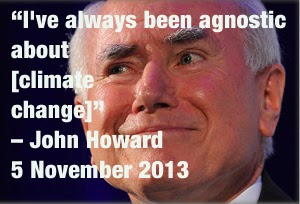
Overnight in London, former prime minister John Howard gave the climate-denialist Global Warming Policy Foundation’s annual lecture, telling his audience:
I’ve always been agnostic about [climate change]… I don’t completely dismiss the more dire warnings but I instinctively feel that some of the claims are exaggerated… I don’t accept all of the alarmist conclusions… You can never be absolutely certain that all the science is in.
Agnosticism masking denial has been Howard’s trademark. In February 2007, he told Lateline that 4-to-6 degrees Celsius of climate warming “would be less comfortable for some than it is now”. Yes, really!
Howard’s art has been well adopted by his protege and now Australian prime minister, Tony Abbott. In both opposition and government, the Abbott-led LNP is prosecuting climate policy as a “culture war”, a broad social polarisation between two conflicting sets of values, principally on the relationship between science and ideology, the role of government, the relationship between humans and nature, and the future of the fossil fuel industry and of society’s technological path. In some aspects it is not dis-similar to the politics brought to Washington by Newt Gingrich and, in a more extreme form, by the Tea Party, exemplified by Abbott’s recent “(carbon) taxation equals socialism” pitch.
The Abbott government’s climate policy exist in the space between denial and delay. It is founded on:
The Abbott government’s strategy is to:
But there are also realities that the Abbott government is desperate to avoid. These include:
The Abbott government will not be persuaded by reason and is not interested in compromise because this is a battle to be won, and compromise and negotiation are signs of weakness. For this government, fighting enemies is more important than reality-based policy-making. This is about the politics of resentment, fear and revenge, about winning, and about debilitating the enemy. Culture wars are not primarily about policy detail, but about building legitimacy and establishing dominance. These are Abbott’s goals and, in a fashion of being mirror opposites, they must also be ours.
A culture war mentality pervades the prime minister’s thinking, and was well described by Damon Young in Monday’s Sydney Morning Herald:
Tony Abbott recently pronounced the former government ”wacko”… Abbott’s message – that the former government is uniquely irrational and inept – is so consistent and vehement, it is difficult to believe that the Prime Minister is not genuinely committed to some version of this idea… He describe(s) the Labor government as ”the most incompetent and untrustworthy … in modern Australian history”… At the very least, Abbott seems to believe his caricature as he draws it. And so confident is Abbott of its veracity or popularity that he will sketch, without pause, his picture for a global audience…
Put simply: Abbott is committed to this caricature of his political rivals, or he at least believes that this portrait will sell as well abroad as it has domestically. Either way, this picture is worrying. It does not suggest practical wisdom: a knack for responding to milieu and ambiguity. It suggests an evangelist or apparatchik, for whom the world is neatly divided into us and them, goodies and baddies, my common sense and their lunacy. Instead, Abbott’s slur suggests that word so often reserved as an insult for the left: ideology.
Risk – Research – Resilience
Home » Disaster Risk Management » An Earthquake in Sydney: Could it happen here

 A few weeks ago a small earthquake shook areas of Sydney around Campbelltown. The tremor prompted an article in The Fifth Estate where experts warned that most people vastly underestimate the risks of an earthquake in Australia. Prior to this I had been researching the risk of an earthquake in Sydney as part of an assignment. I found that whilst the likelihood of a Sydney earthquake are small, the consequences could be great.
Although far from tectonic boundaries Australia is more seismically active than the interiors of other continental plates. Although these intra-plate earthquakes are less common than those that occur along plate boundaries, earthquakes with magnitude 7 or more can happen occasionally. Elsewhere in the world earthquakes of this magnitude, when they strike near major population centres, can cause significant damage and loss of life.
There are numerous faults throughout the urban area of Sydney. Although most of these show little sign of recent activity recurrence intervals on faults in Australia can measure in the order of tens to hundreds of thousands of years. At the foot of the Blue Mountains lies the 28 km long Kurrajong Fault Complex. This has been the subject of quite a bit of research as it could produce large earthquakes of magnitude 7 or greater. The likelihood of a large earthquake on this fault is highly uncertain, though it is probably smaller than 1 in 100,000 per year.
Sydney has a very low density. Of its 1.5 million dwellings 55% are separate houses and only 10% are in apartment buildings of 4 or more storeys. Some construction in the city survives from the early 1800s. Houses built prior to the 1930s are likely to be of poorer unreinforced masonry construction and more prone to structural damage or collapse in the event of an earthquake. Houses built since the 1980s should include modern seismic resistant elements based on the mapped hazard for Sydney at the time. Asbestos was a common construction material from 1945 to 1980 and could be disturbed by even light earthquake damage.
Sydney Airport handles 35.6 million passengers and 470,000 tonnes of cargo per year. In addition to the Airport a large amount of heavy industry is clustered around Botany Bay. This includes Port Botany, the Kurnell Refinery and Desalination Plant. All these assets are on unconsolidated or reclaimed land (notably the runways of Sydney airport) more likely to experience strong earthquake shaking.

Site classes for parts of Sydney (values D, DE and E show weaker soils and thus greater amplification of earthquake shaking)
Sydney is located in a moderate earthquake hazard zone for the Australian continent. A peak ground acceleration of 0.05g has an annual exceedance probability of 1 in 500. The likelihood of of different peak ground accelerations being exceeded in the Sydney area is given in the table below. Earthquake shaking can be much worse in soft, sandy or watery soils – indeed it’s on these soils that damage is often most severe. The amplification of ground acceleration can be up to a facor of three. Although most of Sydney sits on relatively firm ground there are many areas on softer soils. The most important of these is Botany Basin, which extends north from Botany Bay almost as far as the Sydney CBD. The Botany Basin is a low-lying swampy area with a water table close to the surface. There are other smaller areas of unconsolidated sediments and fill, particularly along the foreshore of Sydney Harbour. These areas are likely to experience greater ground shaking in an earthquake than older areas which sit on consolidated rock.
| 1/500 AEP2 | 1/1000 AEP | 1/2500 AEP | |
| Peak Ground Acceleration (g) | 0.05 | 0.1 | 0.15 |
| MMI | VI | VII | VII |
| Peak Ground Acceleration with soil amplification (g) | 0.15 | 0.3 | 0.5 |
| MMI with soil amplification | VII | VIII | IX |
| Typical damage at higher MMI | Slight damage and cracking in old buildings. Unsecured parapets, brick gables, unreinforced chimneys and tiles may fall. | Heavy damage to old poorly constructed buildings, some collapse. Some damage to reinforced masonry buildings. Houses not secured to foundations may move. | Many old buildings destroyed. Damage to reinforced masonry buildings some with partial collapse. Some damage to new structures. Houses shifted off foundations. Brick veneers fall. |
An earthquake on the Kurrajong fault complex could potentially produce even stronger shaking but is less likely.
Although these earthquakes are rare emergency planning should not be discounted. Emergency planning for flood and tsunami in NSW considers events this rare and rarer.
The combination of unconsolidated sediments and a high water table in the Botany Basin means that it may be susceptible to liquefaction. No investigations of this potential have been undertaken.

The threat of an earthquake in Sydney has received significant attention from the global reinsurance industry. In 2005 Munich Re included a Sydney earthquake as one of its top 10 scenarios for a 1000 year PML.3 Swiss Re considers an earthquake in Sydney to be one of its reference losses; an event with likelihood of 1/1,000 would have an economic loss of $20 billion.(18)
Other insurance risk modellers have prepared scenarios for an earthquake in the Sydney Basin. The one shown, estimates a loss of $11.3 billion for an earthquake of similar size to the Newcastle quake occurring 40 km south of Sydney.
A significant hazard is the collapse of unreinforced masonry awnings in older commercial districts. This was extensive in both the 1989 Newcastle and 2011 Christchurch earthquakes and led to fatalities. These awnings are prevalent in many commercial areas throughout Sydney.
Shaking amplified by local ground conditions and the possibility of liquefaction pose a potential hazard to the large industry around Botany Bay. Possible secondary impacts on travel and freight shipped through Sydney Airport and Port Botany could have flow-on economic effects to otherwise unaffected businesses. Damage to chemical plants or the Kurnell Oil refinery could lead to leaks, posing a risk to the surrounding population and having environmental impacts.
Despite ongoing work in the Sydney Basin on earthquake hazards there is still substantial gaps in knowledge of the risk. Further research is required to address these knowledge gaps.
The seismology of possible earthquake producing faults is still not well understood. Further research on these sites would help define the probability of an earthquake occurring.
More crucial is a proper assessment of earthquake vulnerability, particularly in areas known to have a combination of old buildings and unconsolidated soils. The methodology developed by Geoscience Australia for a report on earthquake hazards in Newcastle and Lake Macquarie could be replicated across Sydney, with initial priority given to the following areas:
Assessment of liquefaction potential in the Botany Basin and other similar areas should also be undertaken. Priority should be given to the areas that host key infrastructure, such as Sydney Airport.
A better understanding of the risk could help motivate governments to undertake mitigation and preparedness measures and prioritise areas for assessment.
Retrofitting of individual homes is likely to be expensive and not cost effective, however attention should be given to emergency infrastructure such as hospitals, important public buildings like schools and important heritage assets. City of Sydney Council has conducted seismic retrofitting of some of its town halls.
Special assessment should be made of masonry awnings in older commercial districts, particularly in areas where the ground conditions may lead to strong shaking. These proved to be particularly prone to collapse in the Newcastle earthquake.
Key industrial and aviation assets surrounding Botany Bay should be engaged to undertake detailed seismic risk assessments including addressing liquefaction. Retrofitting should be considered where indicated by these risk assessments. These facilities should also audit their business continuity and emergency plans to ensure minimal disruption to operations in the event of an earthquake.
Assessment of the seismic safety of bridges on Sydney’s extensive road and rail network should also be conducted.
The geology and urban geography of Sydney could create specific challenges for an earthquake response in Sydney. The low density of Sydney, potential for widespread shaking and areas likely to experience higher intensities due to local ground conditions will create widespread low-moderate damage with pockets of heavier damage. The low likelihood of an earthquake and lack of lived experience also pose challenges to community education and engagement. New South Wales may wish to develop a State Earthquake Emergency Sub-Plan similar to that used in Victoria. Alternatively Supporting Plans for key functions that may also be required in other disasters could be developed.
Key functions that will need to be addressed include Damage Assessment, Search and Rescue and Debris Management. Other elements of an earthquake response are already provided for in other emergency plans, however these should be reviewed to ensure that they would function appropriately in an earthquake emergency.
Damage assessment is required during the immediate response for activities like search and rescue and for the longer term recovery to determine whether buildings are safe to re-inhabit.
Use of new technologies could be used for rapid damage assessment. Creating social media and other technological solutions solely for earthquake is unlikely to be feasible, but the capacity to cope with reports of earthquake damage could be incorporated into other tools developed for hazards such as hailstorms.
Prioritising areas for longer term assessment could also be challenging, as will sourcing enough qualified engineers to conduct assessments. Rules of thumb for initial checks by unqualified personnel may need to be developed. This could identify buildings that need further inspection.
Although a substantial portion of Fire and Rescue NSW and the NSW State Emergency Service have search and rescue capabilities, including the rescue of people from collapsed and damaged structures there exists no plan for a large scale dispersed search and rescue operation.
Coordination and communication between the different rescue services will be critical to ensure that the worst affected areas receive the resources they need, yet are not overwhelmed with emergency services personnel.
Some areas will generate large amounts of debris as a result of destroyed structures and those needing to be demolished. Existing landfill sites are not likely to be adequate for the possibly large debris loads. This debris may also contain hazardous materials including asbestos. Careful management and disposal of this debris will be required to ensure that emergency service and waste management personnel and the broader community are not exposed.
1Local Magnitude, also known as Richter Magnitude.
2Annual Exceedance Probability: A measure of the chance per year of an event of that level or higher occurring.
3Probable Maximum Loss: A measure of the maximum loss in an insurance portfolio for a single event over a particular time period.
A few weeks ago a small earthquake shook areas of Sydney around Campbelltown. The tremor prompted an article in The Fifth Estate where experts warned…
The fires keep on coming and so does the coverage. Here’s more of the best commentary: Lateline: Fire expert, Professor David Bowman, discusses the latest…
For the second time in 18 months NSW is under a State of Emergency due to a natural disaster. You can read the wording of…
The NSW Government has declared a State of Emergency with regard to the bushfires in the Blue Mountains and the forecast deteriorating weather conditions. One…
|
||||||||||||
|


 •
•  •
•  •
•  •
• 




