Author: Neville

  • Institute head: Caspian Sea level may rise two metres after 2020

    Institute head: Caspian Sea level may rise two metres after 2020

    inShare
    Institute head: Caspian Sea level may rise two metres after 2020
    3 October 2013, 15:33 (GMT+05:00)

    Azerbaijan, Baku, Oct. 3 / Trend I. Isabalayeva /

    It is predicted that after 2020 the Caspian Sea level will rise by up to two metres, acting director of the Institute of Geography of the Azerbaijani National Academy of Sciences Ramiz Mammadov told Trend today.

    According to him, currently there are no critical changes in the Caspian Sea level.

    “The Caspian Sea level is lowering,” he said. “In particular, it went down by 15-20 centimetres. The specialists call it a period of stabilisation as the lowering of the sea level by 15 to 20 and even 30 centimetres will not cause any economic or social damage.”

    He stressed the Caspian Sea level has relatively stabilised since 1995. This period will last until 2020.

    “There is an assumption that after 2020 the sea level will rise by up to two metres,” he said. “But we are not 100 per cent sure.”

    He also expressed his views as to the information of the sea rising.

    “Temporary shoreline changes are connected with the winds,” he said. “If the wind is blowing from the sea, it drives the water on to the shore and vice versa. This process cannot be called a change in the sea level.”

    The sea level is measured in those places where external factors cannot influence it, for example closed bays, Mammadov said.

    Do you have any feedback? Contact our journalist at agency@trend.az

    Tags: Caspian Sea

  • Let’s be honest – the global warming debate isn’t about science

    Let’s be honest – the global warming debate isn’t about science

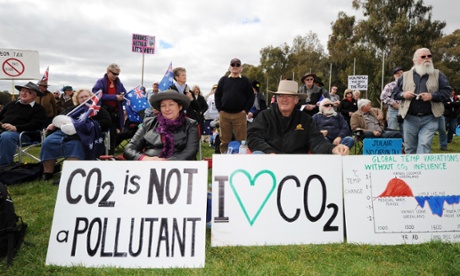
    The scientific evidence on human-caused global warming is clear. Opposition stems from politics, not science.

    Anti-carbon tax protesters in Canberra.

    Anti-carbon tax protesters in Canberra, motivated by politics, not science. Photograph: Torsten Blackwood/AFP/Getty

    The 2013 Intergovernmental Panel on Climate Change (IPCC) report states with 95 percent confidence that humans have caused most, and probably all of the rapid global warming over the past 60 years. Approximately 97 percent of climate experts and peer-reviewed climate science studies agree.

    There are of course open questions yet to be answered by climate scientists – precisely how sensitive the climate is to the increased greenhouse effect, for example. But even in a best case, low sensitivity scenario, we’re headed for dangerously rapid climate change if we continue on our current business as usual path. And the worst case scenario, which is just as likely as the best case scenario, would mean we’re headed for a global catastrophe.

    The IPCC warns that if we want to avoid very dangerous climate change, we’re on track to blow through our allowed carbon budget in as little as two to three decades if we continue on our current path of relying on fossil fuels. If we’re lucky and the low sensitivity scenario is accurate, perhaps we’ll have an extra decade or two, but even in this best case scenario, we’re on an unsustainable climate path.

    Politically biased media climate coverage is not a coincidence

    The scientific evidence is what it is, and it has no political bias. The same is not true of the media outlets that cover the topic. It’s not a coincidence that politically conservative tabloids and newspapers like the Daily Mail, Telegraph, Australian, and Wall Street Journal spend a disproportionate amount of time amplifying the voices of the less than 3 percent of climate contrarian scientists, as well as many non-scientist contrarians.

    It’s certainly not the case that David Rose has some brilliant insight into the state of climate science that climate scientists don’t have. He and his fellow climate contrarians simply approach the question backwards. They start from their political ideological opposition to climate solutions and work backwards, seeking out cherry picked evidence to justify their predetermined conclusions, thus ignoring the 97 percent of inconvenient scientific evidence. This climate contrarianism ideological bias is illustrated in a new study, summarized by Graham Readfearn:

    “if you’re a conservative who believes the world runs best when businesses operate in a “free market” with little government interference, then the chances are you don’t think human-caused climate change represents a significant risk to human civilisation.”

    Let’s debate the solutions

    Even if you’re not convinced by the scientific evidence, you should support taking action to mitigate global warming. What if you’re wrong, as the body of scientific evidence indicates is the case? There is unquestionably a possible scenario in which our greenhouse gas emissions cause harmful and potentially catastrophic climate damages.

    I know what contrarians are thinking – what if I’m wrong, and we end up wasting money deploying green technologies, cleaning the air and water and transitioning away from limited fossil fuel resources in the process? That’s why we need everyone helping to craft the best possible solutions to maximize the economic benefit of this inevitable transition.

    Take the USA as a prime example. The Obama Administration recognizes the need to reduce greenhouse gas emissions, but Republicans in Congress refuse to even consider any climate legislation. As a result, government greenhouse gas regulations are the only available option. From an economic perspective, it’s far from an ideal solution, but because the Republican Party won’t participate in crafting better legislation, we’re forced to implement less than ideal solutions.

    The situation in Australia and Canada is even worse, with politically conservative parties running the governments and refusing to take any action to achieve serious greenhouse gas emissions reductions. The new Australian Prime Minister has even vowed to eliminate Australia’s carbon pricing system.

    Are you a supporter of the free market? Then advocate for allowing the free market solve the problem by pricing greenhouse gas emissions. The debate should be about how to best achieve greenhouse gas emissions reductions with maximum economic benefit.

    To utilize the free market by pricing carbon emissions, the main options are a carbon cap and trade system or a carbon tax. Then there’s the question of what to do with the revenue generated by the emissions price. Some options include reducing the federal deficit, funding green technology research and deployment, lowering other taxes, and returning the funds directly to the citizens. A growing number of Republicans in the USA favor the latter, revenue neutral carbon tax approach.

    British Columbia has a revenue-neutral carbon tax, offset by decreases in income taxes, and the system enjoys broad support from 64 percent of citizens. The province’s economy is doing well and its greenhouse gas emissions are falling. They’ve shown that a well-crafted climate solution can work.

    We need conservatives to be constructive, not obstructive

    Ultimately this climate ‘debate’ is not about science. The scientific evidence is crystal clear that humans are causing rapid global warming. The longer we wait to do something about it, the more climate change we commit ourselves to, and higher the chances are for a climate catastrophe. From a risk management perspective, failing to take action to reduce greenhouse gas emissions is just plain stupid. Opposition to climate action isn’t about the science, it’s about the politics and policies.

    So let’s debate those policies. The more input we have from different political and ideological perspectives, the better crafted the solutions will be. After all, Republicans came up with the concept of cap and trade as an alternative to government regulation of pollutants, and it was a good, successful idea.

    Denying the science and obstructing the solutions will only make the problem worse. It also results in climate solutions that are far from ideal, like US government greenhouse gas regulations instead of legislation allowing the free market to solve the problem. We need everyone on board to help craft the best possible climate solutions and help grow the economy in the process.

    Climate change is a situation that fits the adage “you’re either part of the solution or you’re part of the problem.” Be part of the solution.

    Green light

    close

    Sign up for the Green light email

    The most important environment stories each week including data, opinion pieces and guides.

    Sign up for the Green light email

  • This is a final email from me as this campaign is now complete!

    A final thank you + how to support The Climate Council

    Inbox
    x
    Cameron Neil via CommunityRun camneil76@gmail.com via controlshiftlabs.com
    2:57 PM (18 minutes ago)

    to me

    Hi everyone

    This is a final email from me as this campaign is now complete!

    All 5,295 of you joined me in calling for a citizen-funded Climate Commission – and now we have one, The Climate Council. Thank you and kudos on showing your support and helping to make this happen! Because of people like you, The Climate Council has already raised close to $1 million to continue its important work.

    You can financially support The Climate Council here – with a one-off donation or a weekly or monthly contribution via credit card, cheque or direct debit: https://secure.climatecouncil.org.au/.

    You can volunteer your time and skills to The Climate Council by filling in the form here: https://docs.google.com/forms/d/1nqhDf-Yj_2xoqf2wYSiG0Koz5OfGpVRsk7rb2e68sXg/viewform?edit_requested=true (note that they have been indundated with offers of assistance and may take a few weeks to get back to you!).

    To keep up with the work of The Climate Council and stay informed on the latest developments in the climate science and its implications for us, visit their website and connect with them via email or social media: http://climatecouncil.org.au/.

    Once again, thanks for lending your voice to this campaign.

    Cameron

    You received this email because you signed the petition ‘We’ve done it! Your ‘citizen-funded Climate Commission’ = the new Climate Council!’. If you don’t want to receive emails from the ‘We’ve done it! Your ‘citizen-funded Climate Commission’ = the new Climate Council!’ campaign in the future, please unsubscribe.

  • From: Ricken Patel – Avaaz.org Sent: Friday, 4 October 2013 1:09 PM Subject: what happened after I signed the petition?

    —– Forwarded Message —–
    From: Ricken Patel – Avaaz.org <avaaz@avaaz.org>
    Sent: Friday, 4 October 2013 1:09 PM
    Subject: what happened after I signed the petition?
    Dear amazing community,I often get asked by Avaazers, “what happens after I sign a petition?” And the truth is, a HECK of a lot! Every Avaaz campaign springs from a massive global mandate, and then zeroes in on the best way for our voices to win. Here’s just two of our victories from the last few weeks:

    Remember when 2 million of us came together to stop the flogging of a 15-year old rape victim in the Maldives? Her sentence has been quashed! Here’s what our team did to win:

    Maldives ad
    Our ads threatened the profits of officials who owned parts of the tourism industry
    1. Spoke for hours with the Maldivian Attorney-General and Ministers and emailed the President at his personal account.
    2. Commissioned opinion polls showing massive support for reforms to protect girls. And wrote an Op-Ed in a major national paper.
    3. Persuaded a top Islamic scholar to speak out against flogging.
    4. Threatened to run an ad (right) in tourism publications, affecting the country’s major industry.
    5. Visited the Maldives and the location where the girl was held, pressing officials directly.

    Ahmed Shaheed, former Foreign Minister of the Maldives said “The Avaaz contribution was the spearhead of the campaign to overturn the flogging sentence; a petition signed by millions, a country visit, a public opinion survey, and persistent follow-up all proved irresistible.”

    Another example: Remember how almost 2 million of us rallied to stop the Maasai tribe in Tanzania from being kicked off their land for a hunting reserve? Last week, the Prime Minister announced they could stay! The petition provided a powerful basis for what the team did next:

    Maasai
    Maasai women gather to protest the eviction. Photo by Jason Patinkin
    1. Got CNN and the Guardian to visit the Maasai and break the wider story to the world.
    2. Advised Maasai elders on their campaigning strategy.
    3. Flooded Ministers and the President with messages — forcing a debate in cabinet and Parliament.
    4. Ran a hard hitting newspaper ad in an influential paper which publicly shamed the government.
    5. Persuaded diplomats worldwide to raise the issue — embarrassing the government.
    6. Financially supported Maasai elders to travel to the capital where they gathered to ‘occupy’ land outside of the Prime Minister’s office for weeks, refusing to leave until he met them.
    Education cheque
    Gordon Brown said: “A million dollars has been raised via the brilliant Avaaz.org, in just a few days.”Brazil Open Vote
    Key Brazilian Senator joins Avaaz “open vote” naked protest sending a clear message: “we have nothing to hide”

    The victory belongs to the Maasai people, but our community helped them win by making this a global issue the government could no longer ignore. This hopefully ends a 20 year land battle!!

    Of course, our community does a LOT more than petitions. Last week, we raised a $1 million challenge grant in a few days to donor governments to put Syrian refugee kids in school. At a UN meeting, I was able to put a cheque on the table and issue the challenge on behalf of over 40,000 Avaaz donors. UN Education Envoy Gordon Brown, who chaired the meeting, called our community’s effort a “magnificent and impactful intervention” in getting other governments to give!

    And often it’s not the Avaaz team but our community that does the direct lobbying. For example in Brazil, we’re inches away from winning a massive fight to end the shady practice of ‘secret voting’ in the Congress. Our huge push helped win the vote in the lower house and right now, Senators’ telephones are ringing off the hook as Avaaz members across Brazil use our online calling tool to directly tell them to stop this corruption — experts say a win is likely in days!

    It’s this unique magic mix between a gigantic and spirited community of citizens able to speak out, donate, and lobby, and a small team of top notch advocates able to take smart, strategic actions at the highest level with democratic legitimacy, that makes our campaigns increasingly unstoppable.

    If we keep believing in each other, and growing in size and in commitment, there’s no limit to the good we can do in the world. Thank you so much for the honour and the joy to be part of and serve this community. It’s something truly precious we have here — let’s keep building Avaaz.

    With love and appreciation,

    Ricken and the team

    PS — You might not know that Avaaz is different from just about every other global organization in that we are 100% funded and guided by our community. Every campaign we run is first polled and tested to a random sample (you might think of it as a jury) of our community, that tells us exactly how the whole the community will react. I may be the CEO, but you’re my boss. If you don’t like something (and I don’t mean 51% like it, but 81% like it) then our team go back to the drawing board and come up with a better option for you. We have never, ever, broken this rule. So at the end of the day, it is your wisdom, the collective wisdom of our community, matched with the smartest suggestions the team hears from you and come up with ourselves and from our partners and experts, that determines what we do every single day.

    When you add to that the fact that 100% of our funding comes from small online donations (we strictly refuse any donations from corporations, governments, foundations, and even individual donations over 5000 Euros), I think Avaaz may be one of the purest organisational expressions of people-powered change in the world today. Make that an organisation served by a beautiful team of wonderfully talented and deeply committed people that I wish I could introduce you all to, and we’ve got a kind of magic that can build the world we dream of.

    PPS — If you want to chip in to help keep it all going, click here: https://secure.avaaz.org/en/october_reportback_a/?bBYMjdb&v=29778


    Avaaz.org is a 26-million-person global campaign network
    that works to ensure that the views and values of the world’s people shape global decision-making. (“Avaaz” means “voice” or “song” in many languages.) Avaaz members live in every nation of the world; our team is spread across 18 countries on 6 continents and operates in 17 languages. Learn about some of Avaaz’s biggest campaigns here, or follow us on Facebook or Twitter.

    You are getting this message because you signed “Join Avaaz!” on 2012-06-22 using the email address ngarthurslea@yahoo.com.au.
    To ensure that Avaaz messages reach your inbox, please add avaaz@avaaz.org to your address book. To change your email address, language settings, or other personal information, contact us, or simply go here to unsubscribe.

    To contact Avaaz, please do not reply to this email. Instead, write to us at www.avaaz.org/en/contact or call us at +1-888-922-8229 (US).

    Click here to Reply or Forward
  • Researchers Find Historic Ocean Acidification Levels: ‘The Next Mass Extinction May Have Already Begun’

    Researchers Find Historic Ocean Acidification Levels: ‘The Next Mass Extinction May Have Already Begun’

    By Katie Valentine on October 3, 2013 at 4:41 pm

    An Elkhorn coral bleached by record-hot water in 2005.An Elkhorn coral bleached by record-hot water in 2005.

    CREDIT: AP/NOAA

    The oceans are more acidic now than they’ve been at any time in the last 300 million years, conditions that marine scientists warn could lead to a mass extinction of key species.

    Scientists from the International Programme on the State of the Ocean (IPSO) published their State of the Oceans report Thursday, a biennial study that surveys how oceans are responding to human impacts. The researchers found the current level of acifification is “unprecedented” and that the overall health of the ocean is declining at a much faster rate than previously thought.

    “We are entering an unknown territory of marine ecosystem change, and exposing organisms to intolerable evolutionary pressure,” the report states. “The next mass extinction may have already begun.”

    Acidification causes major harm to marine ecosystems, especially coral, which has a hard time building up its calcium carbonate skeleton in acidic water. Coral reefs serve as nurseries to many young fish, so they’re essential both to ecosystem health and the survival of the fishing industry. If temperatures rise by 2 degrees C, the study found, coral may stop growing altogether, and may start to dissolve at 3 degrees C. Similarily, acidic ocean waters can hamper shellfish larvae’s ability to grow shells. Acidification is already hurting the shellfish industry — in the U.S., northwestern and East Coast shellfish industries have struggled to adapt to increasingly acidic waters. And pteropods, tiny sea snails that are a keystone species in the Arctic and are an essential food source for many birds, fish and whales, are also threatened by acidity — they too require strong calcium carbonate shells to survive.

    It’s not just acidification that’s threatening the oceans, either — the report found the oceans are facing a “deadly trio” of stressors, with warming waters and decreasing oxygen also majorly affecting marine ecosystem health. Warming waters coupled with ocean acidification are posing increasingly severe threats to Antarctic krill, which play a vital role in the Antarctic marine food chain, and are also helping lead to huge outbreaks of jellyfish. And as water temperatures rise, coral is increasingly vulnerable to bleaching.

    Meanwhile, depletion of oxygen is caused by two things: climate change and nutrient runoff, mostly from agriculture, the report stated. Scientists have predicted ocean oxygen content could experience a decline of between 1 and 7 percent by 2100. The impacts of this decrease in oxygen and increase in “dead zones” or areas with no oxygen, are varied, but include a decrease in habitat for large ocean predators such as tuna and marlin that have high oxygen requirements. Dead zones, as their name suggests, are deadly to creatures on the ocean floor, who aren’t able to escape to more oxygen-rich waters. Since the 1960s, the number of dead zones have doubled every ten years, according to the report.

    The report urged world governments to take fast action to ensure temperatures don’t rise past 2 degrees C. Current limits, it warned, weren’t enough to ensure the health of coral reefs, since there is will be a time lag of several decades between a decrease in levels of atmospheric CO2 and the levels of dissolved CO2 in the ocean. It also found overfishing is still causing major declines in key ocean species. At least 67 percent of fish stocks are being overfished, the report found, but stricter oversight and monitoring of commercial fishermen and giving more control of fisheries to local communities would help decrease overfishing. Indeed, some local governments have been successful in stopping depletion of fish in their waters. When one Mexican town banned fishing, it saw its marine biomass increase by 463 percent while fishing improved in regions just outside the preserve.

    Yet even if governments take the suggested steps, the report notes, they must do more to save the oceans as we know them.

    “Ultimately, however, [these measures] must be undertaken within a wider re-evaluation of the core values of human society and its relationship to the natural world on which we all rely,” it states. “The future of humanity and the future of the ocean are intertwined.”

  • Iranian Scientists Simultaneously Convert Carbon Dioxide, Methane to Useful Chemicals

    Iranian Scientists Simultaneously Convert Carbon Dioxide, Methane to Useful Chemicals
    Iranian Scientists Simultaneously Convert Carbon Dioxide, Methane to Useful Chemicals

    TEHRAN (FNA)- Iranian researchers succeeded in the simultaneous conversion of carbon dioxide and methane to useful chemicals at low temperature through photocatalytic reaction by using titanium dioxide nanoparticles deposited on stainless net.

    CO2 and CH4 are considered as the most important greenhouse gases and they play an important role in increasing the problems caused by greenhouse effect and also in global warming. The simultaneous decomposition of CO2 and CH4 can be suggested as an appropriate solution to reduce the concentration of greenhouse gases in the earth’s atmosphere.

    Among the methods that decompose the stable molecules of CO2 and CH4, those that operate at lower temperatures are most favored. Semi-conductive catalysts have recently attracted the attention of scientists due to their photocatalytic activity to initiate and carry out reduction-oxidation (redox) reactions. The conversion of CO2 is a reduction reaction while the conversion of CH4 is an oxidation one. The use of ultraviolet light to overcome the thermodynamic ban in some undesirable reactions can be useful from the thermodynamic points of view.

    In this research, the simultaneous conversion of carbon dioxide and methane to useful chemicals at high temperature through photocatalytic reaction was investigated by using titanium dioxide nanoparticles deposited on stainless net.

    Results showed that the photocatalytic system produced in this research had very desirable performance at laboratorial scale. It is considered an important step towards the production of a photoreaction with the ability to convert carbon dioxide and atmospheric methane to chemicals at industrial scale.

    Results of the research have been published in details in March 2013 in Journal of the Taiwan Institute of Chemical Engineers, vol. 44, issue 2, pp. 239-246.