Author: Neville

  • Ground zero in Australia’s fight against infectious diseases

    Ground zero in Australia’s fight against infectious diseases

    First published:
    Monday 5 August 2013 9:01AM
    By:
    Professor Clement Boughton

    Australia’s early settlements were for many years immune to foreign infectious diseases by virtue of the fact that most sufferers had either died or recovered by the time they arrived. But gradually Europe’s diseases—smallpox, scarlet fever, measles and diphtheria—all made it to the mainland, resulting in wave upon wave of panic-inducing outbreaks, as Professor Clem Boughton writes.


    On the 25th of May 1881, the child of Mr Chong, a Chinese immigrant living at 223 Lower George St Sydney was found to be suffering from smallpox. Smallpox had been a scourge for centuries and the cause of many thousands of deaths and much disability. From Lower George St, the contagion spread to other streets in the city and inner suburbs. The public reaction was predictable—one of virtual panic.

    Smallpox was a quarantinable disease. Sufferers had to be isolated from the community until they were no longer infectious and contacts who might have been infected also had to be isolated in case they developed the disease. This was done initially at the North Head Quarantine Station that was designed to accommodate passengers and crew from overseas ships carrying cases with quarantinable diseases. Obviously this station should not be filled with land based patients, as a ship could arrive at any time with a quarantinable disease aboard, so a couple of old hulks were also pressed into use until more satisfactory arrangements could be made. In addition, the Station was remote from the city and at that time, not near any hospital facilities.

    When finally Australia was discovered by Europe, such diseases as  measles, diphtheria, poliomyelitis and whooping cough did not enter this country for some time.  Because of the long time needed to sail from England and Europe, often longer than the incubation periods of these diseases, such infections usually died out when all those on board who were susceptible had been infected.

    This was the occasion for the establishment of the Board of Health in NSW, and it was appointed specifically to deal with this frightening emergency. And so 500 acres of land located well out of town, nine miles in fact, at a place called Little Bay down near La Perouse, were allocated for the establishment of an emergency quarantine hospital to handle the problem. This was remote sandy scrubby country to which only unmade roads and tracks gave access.

    The initial accommodation consisted of a series of bell tents hastily erected on a flat area of grassy ground adjoining the beach of Little Bay, and the first patients were admitted in wet and windy weather in September 1881. However, Constable Houlahan, who was put in charge, did a great job in making admissions to the settlement welcome.

    In the meantime, construction of more substantial accommodation along the cliffs facing the Pacific Ocean proceeded apace. Because of the urgency of the situation, the quickest construction methods were used and this meant building with wood and corrugated iron—not designed for long life in the salty air of the seashore. Still, the crisis had been met to everyone’s satisfaction.

    The epidemic continued until February 1882 and during the nine months it lasted, there were a known 157 cases, most of whom were treated at the Coast Hospital as the new hospital came to be known. Its name was changed to the Prince Henry Hospital in 1934. Forty of these smallpox cases died, a case fatality rate of 25%. These victims were buried in a hospital cemetery some distance south of the newly constructed wards.

    Smallpox was introduced into Sydney from time to time on ships bringing the virus from infected overseas ports, and periodically the place was reopened to accommodate such cases. After 1884 it was decided to use the Coast as a convalescent centre for patients from the city hospitals to free up their beds. And then the reasonable suggestion was made to make it the infectious diseases hospital for Sydney, a decision welcomed by the city hospitals as a highly transmissible infectious disease inadvertently admitted could result in the closure of one or more of their wards for several weeks..

    The story of the Coast Hospital is related to the intriguing history of infectious diseases in this country. The Australian continent separated from the great south Gondwanaland Continent about 70 million years ago, and migrated northwards. Because of its extreme geographical isolation from the rest of the world for many millions of years, most of the communicable diseases that evolved in the major populated centres of Europe were not to be found among Australian indigenes.

    When finally Australia was discovered by Europe, such diseases as  measles, diphtheria, poliomyelitis and whooping cough did not enter this country for some time.  Because of the long time needed to sail from England and Europe, often longer than the incubation periods of these diseases, such infections usually died out when all those on board who were susceptible, had been infected. Also while the sizes of communities in Australia were small, when infectious diseases like measles were introduced, they died out because there were not enough susceptibles to keep them going.

    Measles (morbilli) probably made its first appearance in Australia in October 1834 among the passengers of the ship David Scott which sailed direct from London to Sydney; this resulted in an outbreak of the disease in Sydney. Another outbreak started in 1850 in Victoria as a result of importation of the infection on the ship Persian from England, and reached NSW in 1853.

    Scarlet fever was first recognised in NSW between 1840 and 1850 and was noted then to cause high death rates among indigenes. Towards the end of the 19th century it was quite virulent, causing many deaths and much disability. Penicillin could have quickly controlled the infection, but of course was not available until the late 1940s.

    Whooping cough appeared in NSW in March 1828 having arrived on the ship Morley which carried convicts from England. It swept uncontrollably through the colony, causing many deaths including the son of Governor Darling. There were explosive outbreaks from 1858, with 80% of deaths occurring in babies in the first two years of life. Death rates among indigenes were again very high.

    Diphtheria was first recorded in Victoria in October 1858, to which state most English immigrants went. The disease was prevalent in England in June 1858. It took a heavy toll of children until the introduction of vaccine in the late 1920s.

    By the time the Coast Hospital had been established in 1881, these diseases had become endemic in Sydney.

    Poliomyelitis (infantile paralysis) was first recorded in sporadic form in 1887 when cases were reported on the Clarence River NSW and in Port Lincoln SA, and thereafter in sporadic outbreaks until the early 1900’s when it became endemic. Parents’ greatest fears were that their children could become paralysed for life, or die from asphyxia. It was not until 1963 that it could be controlled by the injectable Salk and then the oral Sabin polio vaccine.

    Smallpox made a re-appearance in 1913 among workers in a clothing factory in Chalmers St Sydney; this time it was variola minor, a less virulent form of smallpox called alastrim. It was apparently brought into Australia by the ship SS Zealandia from Vancouver. The disease spread through Sydney and to a number of country towns including Taree, Stroud, Moree, Walgett and Yass and continued until 1919, being responsible for some 2400 cases in total, but no deaths.

    Smallpox was declared in 1980 by WHO to be globally eradicated by means of Jennerian vaccination—one of mankind’s greatest achievements.

    The numbers of cases of scarlet fever, measles, diphtheria and whooping cough admitted to the Coast Hospital from the community, increased each year, until in the 1920s there were up to 2000 admissions of some of these diseases in a year. In Australia as a whole, in the decade 1926 to 1935 there were 4074 deaths from diphtheria alone, when the total population was only 6.6 million. The vaccine was introduced during that decade and numbers of cases and deaths steadily declined, until in the decade from 1986 to 1995 there were none.  In the decade 1946 to 1955, polio caused 1013 deaths.  After the vaccines became available, the number of cases declined to zero by 1985.

    At the Coast in the early years prior to immunisation there were no ways of effectively protecting staff members from these illnesses, and many succumbed. They were very brave people. One can visit the museum at the Prince Henry Hospital site at Little Bay recounting its history. It is open on Sundays between 10am and 4pm in Ward 1.

    This hospital had many tumultuous years ahead, which included, in addition to the infectious diseases of childhood, bubonic plague, cholera, leprosy, sexually transmissible infections, poliomyelitis and influenza epidemics, and the vicissitudes of politics.

    One message comes through very loud and clear:  that is, without adequate immunisation of our communities, we can never fully protect our people, and especially our children, from these terrible vaccine preventable infectious diseases.  Mistaken prejudice is still undermining full effectiveness of our immunisation programs, with the risk that these diseases could reappear here, as is now happening in the UK, USA and Europe. We must not let this happen.

    Professor Clement Boughton is from the University of New South Wales and worked at the Prince Henry Hospital for many years. Find out more at Ockham’s Razor.

    Add comment

  • ARCTIC SEA ICE Sea ice extent


    Polar Portal
    Welcome

    Welcome to the new arctic monitoring web-site
    The Danish Arctic research institutions present updated knowledge on the condition of two major components of the Arctic: The Greenland Ice Sheet and the sea ice

    ARCTIC SEA ICE

    Sea ice extent


    Sea Ice coverage on the northern hemisphere


    The figure shows daily updated sea-ice extent in the Arctic, calculated as the total area of ice-covered ocean. The sea-ice cover expands throughout the winter and reaches its maximum in early March. The melt season begins when the sunlight intensifies in the spring, and in late summer the ice-covered area is down to about a third of the winter maximum.

    The ice-covered area is calculated from the ice-type data from the Ocean and Sea Ice, Satellite Application Facility (OSISAF), where areas with ice concentrations higher than 15% are classified as ice and below 15% as open water.

    The grey shaded area corresponds to the climate mean plus/minus 1 standard deviation.

    Sea Ice coverage on the northern hemisphere


    The figure shows a map with daily updated sea-ice coverage in the northern hemisphere. The scale goes from white, representing 100% ice cover, to black that defines the ice edge. The blue colour indicates coastlines. The melt season begins when the sunlight intensifies in the spring and in late summer the ice-covered area is down to about a third of the winter maximum.

    The ice-covered area is calculated from the ice-type data from the Ocean and Sea Ice, Satellite Application Facility (OSISAF), where areas with ice concentrations higher than 15% are classified as ice, and below 15% as open water.

  • Population strains pose transport challenges

    Population strains pose transport challenges

    Changing workforce patterns pose future challenges for transport infrastructure planning in Australian cities, the State of Australian Cities 2013 report has found.
    The report found Australia had one of the highest population growth rates in the OECD, with half of that coming from net overseas migration.
    “Since the average growth of major cities is slightly above the national rate, this indicates many Australian cities have some of the highest growth rates in the developed world,” it says.
    “There are large differences in the age and gender of those moving to and from individual capital cities. Canberra, Darwin, Perth and to a lesser extent Brisbane are attracting high numbers of mainly male 15 to 24-year-olds.
    “Sydney is losing significant numbers of residents across all age groups but overseas migrants are taking their place at a rate that keeps Sydney growing, albeit below the national average.”

    State of Cities report released

    Minister for Infrastructure and Transport, Anthony Albanese said the previous three editions of the publication generated enormous interest and had been downloaded more than three million times.
    “Compiled by the Major Cities Unit within my Department, this latest ‘report card’ builds on the previous three, providing an even more comprehensive analysis of the progress and performance of the nation’s 18 biggest cities,” Mr Albanese said.
    “As well as giving us a better understanding of how our cities work, the report also identifies the specific initiatives of local councils and State planning authorities which are proving effective at promoting more productive, sustainable and liveable urban communities.”
    He also announced the release of a second report, Walking, Riding and Access to Public Transport, which he said set out the simple steps that Governments and employers could take to increase the proportion of people walking and riding for short trips, and to connect to public transport hubs.
    “For its part, the Federal Government has agreed that all future urban road projects must include a safe, separated cycle way, where practical,” he said.
    “As one of the most urbanised societies in the world, and with our cities generating 80 per cent of our national income, our continuing prosperity largely depends on the productivity, sustainability and liveability of our cities.
    “Right now, major projects are under way in Melbourne, Adelaide, Perth, Brisbane, Sydney and on the Gold Coast.”
    The report can be accessed at this PS News link.

    Edition 373, 6 August 2013
  • Global Investigation Reveals True Scale of Ocean Warming

    Global Investigation Reveals True Scale of Ocean Warming

    Aug. 4, 2013 — Warming oceans are causing marine species to change breeding times and shift homes with expected substantial consequences for the broader marine landscape, according to a new global study.


    Share This:

    The three-year research project, funded by the National Centre for Ecological Analysis and Synthesis in California, has shown widespread systemic shifts in measures such as distribution of species and phenology — the timing of nature’s calendar — on a scale comparable to or greater than those observed on land.

    The report, Global imprint of climate change on marine life, will form part of the Intergovernmental Panel for Climate Change Assessment Report due for publication in 2014, and is published in this month’s Nature Climate Change. It was undertaken by eminent scientists at 17 institutions across the world, including the University of Queensland, Plymouth University, Aberystwyth University, and the Scottish Association for Marine Science (SAMS).

    One of the lead authors of the report, Professor Camille Parmesan, National Marine Aquarium Chair in Public Understanding of Oceans and Human Health within Plymouth University’s Marine Institute, said the study offered a “very simple, but important message.”

    Professor Parmesan said: “This is the first comprehensive documentation of what is happening in our marine systems in relation to climate change. What it reveals is that the changes that are occurring on land are being matched by the oceans. And far from being a buffer and displaying more minor changes, what we’re seeing is a far stronger response from the oceans.”

    The research team assembled a large database of 1,735 changes in marine life from the global peer-reviewed literature which helped them investigate impacts of climate change. The team found that 81% of changes were in a direction consistent with climate change.

    The evidence showed that the leading edge or ‘front line’ of some marine species, such as phytoplankton, zooplankton and bony fish, is moving towards the poles at the average rate of 72km per decade, which is considerably faster than the terrestrial average of 6km per decade — and this despite the fact that sea surface temperatures are warming three times slower than land temperatures.

    They also found that spring phenology in the oceans had advanced by more than four days, nearly twice the figure for phenological advancement on land. The strength of response varied among species, but again, the research showed the greatest response in invertebrate zooplankton and larval bony fish, up to 11 days in advancement.

    Professor Mike Burrows at SAMS said: “Most of the effects we saw were as expected from changes in climate. So, most shifts in the distributions of, say, fishes and corals, were towards the poles, and most events in springtime, like spawning, were earlier.”

    Some of the most convincing evidence that climate change is the primary driver behind the observed changes could be found in footprints that showed, for example, opposing responses in warm-water and cold-water species within a community; and similar responses from discrete populations at the same range edge.

    Dr Pippa Moore, Lecturer in Aquatic Biology from Aberystwyth University, said: “Our research has shown that a wide range of marine organisms, which inhabit the intertidal to the deep-sea, and are found from the poles to the tropics, have responded to recent climate change by changing their distribution, phenology or demography.

    “These results highlight the urgent need for governments around the globe to develop adaptive management plans to ensure the continued sustainability of the world’s oceans and the goods and services they provide to human society.”

    Share this story on Facebook, Twitter, and Google:
  • Reflections on a changing Arctic: Less ice means faster warming

    Reflections on a changing Arctic: Less ice means faster warming

    • 04 Aug 2013, 18:20
    • Roz Pidcock

    The Arctic is intricately linked to earth’s climate. As Arctic sea ice declines, the effects are being felt far beyond the Arctic region. Now a new study shows how losing sea ice means the top of the planet is absorbing more heat than it did just three decades ago – and it makes for a sobering read.

    Scientists have noticed big changes in the Arctic since satellites started observing earth from space, thirty years ago. The area covered by sea ice is getting smaller and the ice is getting  thinner, due largely to  rising global temperature.

    The loss is most noticeable at the end of summer, when sea ice shrinks to a minimum, as part of its seasonal cycle. In September 2012, Arctic sea ice reached its lowest extent since satellite records began.

    Knock-on effects

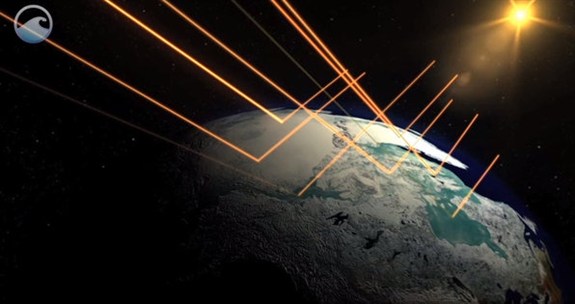
    Losing sea ice has  knock on effects for climate. One of the most direct consequences is that losing sea ice changes something scientists call albedo. Albedo is a measure of how well the earth’s surface reflects sunlight.

    Snow-covered sea ice has a high albedo, reflecting up to 85 per cent of sunlight. As the area covered by ice and snow gets smaller, sunlight that would have been reflected is  absorbed by open water instead, warming it up.

    Albedo

    The albedo effect in the Arctic. Source: NASA

    It’s not only the ocean that warms. Heat from the warmer sea is released back into the air – raising atmospheric temperatures too. In turn, this melts more ice. It’s largely for this reason that the Arctic region is warming twice as fast as the rest of the planet.

    To find out how much Arctic ice loss is likely to influence and be influenced by warming in the coming century, scientists need a good understanding of how albedo has changed in response to recent temperature changes.

    This is exactly what new research, published today in Nature Climate Change, looks at. It examines how Arctic albedo has changed over almost three decades, between 1982 and 2009.

    The team of scientists from Finland use new satellite measurements of reflectivity throughout the melt season, from May to August, to look for trends over time across the whole Arctic region.

    Rapid decline

    Every month except May has seen a decline in sea ice albedo over the 28-year period, the research finds. The exception didn’t come as a surprise, say the researchers. Other studies have shown thick snow cover in May means the albedo doesn’t change much.

    The most rapid drop in albedo is seen in the month of August, when snow and ice melt is highest. The data suggests a fall in albedo of about three per cent per decade over the study period.

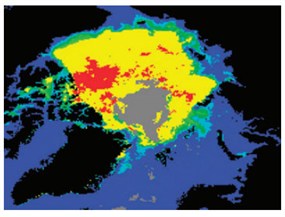
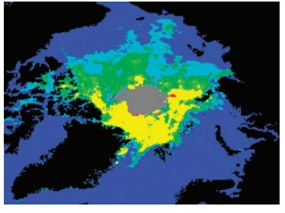
    The loss is pretty clear in the satellite images below, which show albedo for the month of August in 1985 on the left and in 2008 on the right. Marked in red, areas with an albedo of 75 per cent or more have all but disappeared and have been replaced by green, which represents about 40 per cent. There is quite a lot more light blue, up to 30 per cent, and dark blue, which is 15 per cent and under.

    Arctic Albedo1Arctic Albedo2

    Satellite images for August showing the shift from higher albedo (red) to lower albedo (blue) between 1985 (left) and 2008 (right). Source: Riihela et al., (2013)

    Albedo is also affected by changes in the condition of the ice that remains. For example, ice is getting darker as industrial soot – known as black carbon – is finding its way into the Arctic.

    Data from other studies suggest the rate of Arctic ice melt has accelerated since the 1990s, which might imply the rate of albedo loss has accelerated too. The new paper looks at this possibility but concludes there is too much year-to-year variability in this short time frame to come to any firm conclusions.

    While albedo loss is most pronounced in August, the paper points out the drop in early summer is most important for global temperature, as that’s typically when solar output is at its highest.

    A warming Arctic has implications for the neighbouring Greenland ice sheet and Arctic wildlife – from the smallest algae to the biggest predators. On top of these more established impacts, scientists think sea ice loss might be disrupting winter weather in the northern hemisphere – another way that the impacts of change at the top of the planet might extend well beyond just the Arctic region.

    Source: Riihela et al., (2013) Observed changes in the albedo of the Arctic sea-ice zone for the period 1982 to 2009. Nature Climate Change, doi:10.1038/NCLIMATE1963

    Note: The embargo has been lifted on this paper, but Nature Climate Change hasn’t put it online just yet. we’ll add a link to the article when it’s published.

  • Homeless Persons Week highlights growing problem amid lack of affordable housing

    • Australia Votes
      • Prime Minister Kevin Rudd pledges extra $450m for out-of-school care
    • Australia Votes
      • Kate Ellis says about 68,000 additional children will be accommodated by the extra funding

    «»

    ( Why would we accept Asylum Seekers, when we can’t house our own homeless people.)

    Homeless Persons Week highlights growing problem amid lack of affordable housing

    Posted 3 hours 52 minutes ago

    More than 100,000 Australians are homeless and the numbers are rising because of a lack of affordable housing. Social affairs reporter Sally Sara spoke with Daniel Strickland from Mission Australia.

    Social affairs reporter Sally Sara

    Source: ABC News | Duration: 3min 16sec