Author: Neville

  • PNG asylum deal could be in breach of UN convention

    PNG asylum deal could be in breach of UN convention

    Broadcast:
    Monday 22 July 2013 7:35AM (view full episode)

    A respected expert on international refugee law has told RN Breakfast that Australia doesn’t have an asylum problem, but a political problem, and refugees are paying the price, as James Bourne reports.


    The Federal Government has continued to defend its decision to send all asylum seekers arriving by boat in Australia to Papua New Guinea. Under the regional agreement, Australia will bear the full cost of the plan—including the cost of genuine refugees being resettled.

    Dr James Hathaway, an expert on international refugee law, told RN Breakfast that Kevin Rudd’s announcement on Friday was entirely unprecedented.

    ‘This plan is without question the most bizarre overreaction I have seen in more than 30 years of working on refugee law,’ said Dr Hathaway. ‘It just makes no sense.’

    ‘The only mandatory deportation to PNG is going to be so-called boat arrivals. Does the Prime Minister think that every refugee should arrive with a Qantas first class ticket in order to be real?’

    The people who are so desperate—who so fear for their loss of life that they’re prepared to put their fate into the hands of smugglers and take a horrible boat journey to survive—are the very ones that Australia seems to want to punish.

    Dr James Hathaway, international refugee law expert

    Dr Hathaway, a professorial fellow at the University of Melbourne, suggested that the deal struck between Australia and Papua New Guinea was in breach of the the United Nations Convention relating to the Status of Refugees.

    ‘The convention itself says you can’t penalise refugees for arriving without authorisation,’ he said. ‘There is no visa that Australia or anybody else gives for a person to come and seek asylum.’

    ‘To take people who are… coming and asking for asylum and dumping them into the hell hole of PNG is in my view both an illegal penalty and a discriminatory penalty, which puts Australia in breach of the convention on two points.’

    The crisis Prime Minister Kevin Rudd says is addressed by the deal doesn’t even exist, Dr Hathaway said. Compared to other developed countries, Australia’s intake of 30,000 refugees is ‘a totally average, absolutely manageable number’.

    ‘What is really striking about this is that Australia, unlike any developed country that I know, has been attracting almost exclusively genuine refugees as boat arrivals,’ Dr Hathaway told RN.

    ‘It’s the boat people who seem to have attracted his ire. It’s the most extraordinarily bizarre singling out of the group that…ought to be the very group that we should care about the most,’ he said.

    ‘So Australia does not have an asylum problem, it has a political problem, and refugees are being made to pay the price for Kevin Rudd wanting to appear, I think, more butch that Julia Gillard and more reactionary than Tony Abbott.’

    ‘The people who are so desperate—who so fear for their loss of life that they’re prepared to put their fate into the hands of smugglers and take a horrible boat journey to survive—are the very ones that Australia seems to want to punish.’

    Dr Hathaway suggested that sending genuine refugees to Papua New Guinea was a reckless plan, despite the nation being a signatory to the Refugee Convention.

    ‘We’re talking about a country that ranks 168th in the world in terms of life expectancy, where more than half the country doesn’t have sanitation or clean water, one in two women in PNG have been raped, homosexuals can to jail for 14 years, this is where we’re going to send people who have done nothing wrong, other than have the courage to say that they don’t want to be persecuted for who they are in the country where they lived.’

    The High Court’s 2011 ruling on the Gillard government’s proposed Malaysia Solution stated that an arrangement that doesn’t legally guarantee refugees the right to work, education and access to the courts breached obligations under the UN refugee convention. Despite these rights not being guaranteed by the PNG agreement, Australian Attorney General Mark Dreyfus has said that the arrangement ‘complies with our international obligations under the refugee convention’.

    Dr Hathaway disagrees.

    ‘The word ‘rights’ doesn’t even appear in the agreement that the Prime Minister of Australia signed with the Prime Minister of PNG,’ he said. ‘That’s what makes it illegal.’

    ‘The government seems to think that its only obligation under the convention is to make sure that somebody at risk of being persecuted doesn’t get sent back to persecution.’

    ‘That argument is what the government put to the High Court of Australia in the Malaysia case and the High Court quite explicitly rejected that argument.’

    Add comment

  • Key to ocean life shows large regional variations

    19 July 2013 Last updated at 20:36 GMT

    Key to ocean life shows large regional variations

    By Simon Redfern Reporter, BBC News

    A plankton bloom west of Ireland in the Atlantic Plant plankton blooms in the ocean can be seen from space.
    Iron, key for ocean plant plankton growth, shows larger variations than previously recognised, with implications for models of climate.

    Microscopic marine plants, phytoplankton, lock up atmospheric carbon dioxide, but a lack of iron limits photosynthesis.

    In Nature Communications, researchers report regional iron variations in the oceans of up to 10,000 times.

    This observation is expected to improve ocean-climate models.

    Photosynthetic life is limited by low availability of iron in as much as one third of Earth’s surface oceans. The problem for phytoplankton is particularly acute around the Southern Ocean.

    Dr Will Homoky, lead author of the paper by teams at the Universities of Southampton and South Carolina, said: “Iron acts like a giant lever on marine life, storing carbon. It switches on growth of microscopic marine plants, which extract carbon dioxide from our atmosphere and lock it away in the ocean.”

    In separate studies, scientists have previously added iron to the ocean in iron-limited areas, which typically generates large blooms of phytoplankton. This has been suggested by some as a possible geoengineering solution to capture carbon from the atmosphere and transfer it to the ocean.

    It remains unclear what the fate of phytoplankton carbon, at the base of the food chain is, however, and the role of iron for fertilising the oceans is a developing field of research.

    Dr Homoky commented: “Satellite images of the oceans show less phytoplankton growth in the eastern South Atlantic off the African coast, than in the western South Atlantic, off South America. Our primary hypothesis is that there are more micronutrients like iron being mixed into the surface ocean from the south African continent than from South America.”

    The key to understanding these variations is now to understand how elements mix into the surface of the ocean, and how this in turn changes ocean life and potentially locks up atmospheric carbon dioxide.


  • Swarm of earthquakes rattle central NZ

    (UPDATED TO 6.9 )

    Swarm of earthquakes rattle central NZ

    By Matthew Theunissen , Teuila Fuatai

    Send your quake related stories, photos or video to newsdesk@nzherald.co.nz 

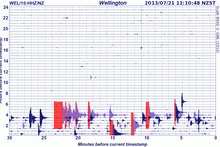
    A swarm of earthquakes has rattled central New Zealand today.

    Expand
    A swarm of earthquakes has rattled central New Zealand today.

    Wellington and the top of the South Island have been hit by a 6.5 magnitude quake this afternoon.

    The quake, which was centred 30km east of Seddon, the site of all the seismic activity in the last couple of days, was 11km deep.

    Experts say it is unlikely the swarm of earthquakes which rattled central New Zealand today signals “the big one” could be on the way, but people should still be prepared.

    At least 30 earthquakes have struck since 5am, the largest being a magnitude 5.8 in the Cook Strait between Wellington and Seddon at 7.17am.

    There have been seven earthquakes measuring above magnitude 4 since 5am. Most have been centred in the strait off Seddon but there have been quakes further south off Kaikoura and as far north as Wanganui.

    It is the second time in three days a severe quake has struck near Seddon – a magnitude 5.7 quake shook the region on Friday – prompting fears an even larger earthquake could be on the way.

    But GNS Science seismologist Anna Kaiser said earthquakes of this magnitude were not unusual in the region.

    ”… When we get one of these events there will be increased seismicity in the region and there’s always the possibility of a larger event but it’s unlikely,” she said.

    However, she said people should be prepared for a large earthquake striking at any time.

    Lea Hayward from Blenheim was in bed when the largest of today’s earthquakes occurred.

    “I actually felt three this morning and they were all reasonable shakes,” said

    “I think people are [apprehensive], and I’ve been like that myself – is the big one going to come? I do know a few friends who are going to get their emergency supplies updated, and I myself need to do that.”

    Seddon Supervalue owner Kevin Kamat said some items were bounced off the shelves.

    “It was certainly quite a big one and quite scary, sure. It lasted a wee while and there were quite a few aftershocks. It seemed quite a bit bigger than the one on Friday.”

    Stores around Wellington said while the quakes were unnerving, there was no major damage.

    Grandslam Liquor store staff member Robert Henry was surprised nothing was broken at the Brooklyn store.

    “It felt kind of bad, but nothing fell down, miraculously.”

    The quake forced the temporary closure of Wellington’s rail network this morning with services replaced by buses while the tracks were inspected, KiwiRail said.

    Train services on the Kapiti Line, Hutt Valley and Johnsonville had since resumed but closures remained in place between Wellington, Waikanae and Masterton.

    Wellington City Council spokesman Richard MacLean said there had been no reports of damage to infrastructure .

    “We did some building checks on Friday after the first big shake.”

    Larger buildings such as the Town Hall may be inspected tomorrow.

    “Because the shakes are not getting to a size where they are causing obvious damage, we are just taking things slowly,” he said.

    “If the magnitude increases, then obviously we’ll jump into action this afternoon.”

    Twitter was full of comments about the quake this morning.

    “Oh damn that was scary. Crouched in the doorway still shaking,” said Laura Vincent.

    Rochelle Iti wrote after a magnitude 4.9 aftershock: “Excuse me while I move to Australia before #Wellington becomes the new Christchurch”.

    Tobias Brockie: “my parents, who live in chch, have both texted me with concern at first and then scornful dismissal in the wake of that quake.”

    Journalist Barry Soper said the quake was “fair rocking”.

    “15 floors up when the quake struck: Heather, let’s watch from the balcony. Barry: Let’s stand under a door jam, oh so boring but safe!”

    APNZ

    By Matthew Theunissen Email Matthew, Teuila Fuatai Email Teuila

  • The Arctic Methane Monster Stirs

    The Arctic Methane Monster Stirs

    The Arctic Methane Monster Stirs: NASA’s CARVE Finds Plumes as Large as 150 Kilometers Across Amidst Year of Troubling Spikes

    In late June and early July, Barrow Alaska showed two methane readings in excess of 1975 parts per billion. Sadly, this most recent methane spike is likely not to be an outlier.

    The Barrow spike came in conjunction with a number of other anomalously high methane readings in the Arctic region during 2013. Most notably, the Kara, Barents and Norwegian Seas all showed atmospheric methane levels spiking to as high as 1935 parts per billion during the first half of 2013.

    Averages in this and other regions around the Arctic are at new record highs even as atmospheric methane levels continue inexorably upward. For reference, Mauna Loa shows average global atmospheric methane levels are now at around 1830 parts per billion. These levels were around 700 parts per billion at the start of the industrial revolution before they rocketed upward, roughly alongside increasing CO2 concentrations, as fossil fuel based industry saw its dramatic expansion over the past couple of centuries.

    Now, human global warming is beginning to unlock a monstrous store of methane in the Arctic. A source that, in the worst case, could be many times the volume of the initial human emission. To this point, areas around the Arctic are now showing local methane levels above 1950 parts per billion with an ever-increasing frequency. The issue is of great concern to scientists, a number of which from NASA are now involved in an investigative study to unearth how large and damaging this methane beast is likely to become.

  • Is the Season for Climate Change Denial Finally Over?

    Dan Lashof

    Director, NRDC’s climate center

    GET UPDATES FROM Dan Lashof

    Is the Season for Climate Change Denial Finally Over?

    Posted: 07/18/2013 8:06 am


    99
    74
    3
    338
    Get Green Newsletters:

    Three years after the National Academy of Sciences, a grouping of our country’s top scientists, declared “Climate change is occurring, is caused largely by human activities, and poses significant risks,” it’s hard to believe that there are still Senators who call climate change a “hoax.”

    One year after a prominent climate skeptic, Berkeley Professor Richard Muller, took an independent look at all the data and wrote an op-ed in the New York Times declaring that global warming is real, and that “Humans are almost entirely the cause,” it is surprising to see editorial boards that still deny there is anything to worry about.

    Six months after the United States experienced the hottest year in our history and the arctic ice pack shrunk to the smallest extent ever recorded, it confounds logic that some captains of the fossil fuel industry still insist that there is no evidence that climatic changes are occurring due to the use of their products.

    And just months after the amount of heat-trapping carbon dioxide in the atmosphere passed 400 parts per million, a concentration higher than ever before seen in human history, it defies understanding why the U.S. Congress refuses to take steps to protect our health and our communities from the threat of climate change.

    But because the deniers persist, it’s good news that Sen. Barbara Boxer (D, Cal.) has called together a collection of scientists and other experts Thursday to testify before the Senate Environment Committee at a hearing aptly titled, “Climate Change: It’s happening now.”

    Only in Washington would that be a controversial proposition — 97 percent of climate scientists acknowledge that climate change is caused by human activity and 65 percent of the American people say it’s a serious problem. Sen. Boxer’s group of climatologists, oceanographers, meteorologists and economists will outline the current state of climate science.

    This much we know: seven of our 10 warmest years in the U.S. have occurred since 1998, and globally the 15 hottest years on record have all occurred since 1997. The American West has been steadily drying over recent decades, and last year wildfires burned 9.3 million acres of forests and fields.
    We are already paying high costs for the consequences of our changing climate. Last year, crop losses due to record drought, damage from storms and floods, wildfires and other disasters aggravated by climate change caused $140 billion in damage in the U.S. alone. New York City says it will need to spend $20 billion to protect itself from rising sea levels caused by climate change and to fortify its defenses against a repeat of the devastating sea surge from Superstorm Sandy.

    The time for denial is long over. Now is the time for action. That’s why President Obama last month promised to tackle the United States’ largest single source of heat-trapping carbon dioxide, our 1,500 existing power plants. They account for 40 percent of our national carbon footprint, yet there has until now been no federal limit on the amount of carbon pollution they can emit.

    The administration can act without waiting for Congress to pass a new law because the Clean Air Act already gives the Environmental Protection Agency the ability and the responsibility to reduce this pollution. At the president’s request, the EPA, taking input from the states, industry, scientists and the public, will devise cost-effective regulations, a task it has done for many other pollutants over the decades, nearly always at a cost far less than opponents initially claimed.

    Predictably, opponents once again cried that the president was killing jobs and hurting the economy, without even knowing what approach the EPA will take and what the plan will look like.

    The Natural Resources Defense Council studied the issue and came up with a plan that tailors pollution limits to the energy mix of each state, and gives electric utilities the flexibility to hit their targets in the most cost effective way. By relying heavily on ending energy waste and improving energy efficiency, our plan would slash power plant carbon pollution by 26 percent at a cost of only one percent of industry revenues. An analysis by independent economic experts shows that it would create over 200,000 jobs and save families money on their electric bills.

    We are already paying a high price for failing to confront the climate change threat. The longer we delay taking action, the more these expenses will rise, and the more our children and our grandchildren will suffer the impacts.

  • Solar farm to be built on land that goes under water

    Solar farm to be built on land that goes under water

    Comments (18) »

    An artist impression of the solar farm planned for Valdora.
    An artist impression of the solar farm planned for Valdora.

    SUNSHINE Coast council plans to build a $24.2 million solar farm on land that goes almost a metre under water every two years, and more than two metres under in a maximum flood event.

    However, council officers have recommended the site because of its size, closeness to a 33kV power grid, availability and price.

    Sunshine Coast councillors have been advised choices that fit the criteria are limited.

    According to official records, the land on Yandina-Coolum Rd goes 2.36m under water in a maximum flood event, is affected by flooding to a depth of 0.79m every two years, and is subject to minor flooding every wet season.

    Maximum flood levels could rise to 3.02m over time due to sea level rises associated with climate change.

    Deputy mayor Chris Thompson confirmed yesterday that an option had been taken up on the site.

    The execution of that option would be dependent on the outcome of expressions of interest, to be advertised today, from companies interested in supplying material for the project, building and operating it.

    When council officers in 2011 approved what was then a commercial venture for the 50ha property on Yandina-Coolum Rd it was noted that the site was heavily constrained by flooding which would result at times in workers being trapped by floodwaters.

    Councillors voted unanimously on June 29, 2011, in favour of Energy Parks Australia Pty Ltd’s application for a material change of use on the site despite 54 submissions opposing the project which also received 43 submissions of support.

    The heavily conditioned approval required that all structures would have to be built on pads at least 2.5m high to maintain floodwater clearance.

    Detailed design work still has to be done as has soil testing to determine the degree and cost of foundations.

    Financial analysis done to date suggests savings of $9.4 million can be achieved over 30 years by the council owning a 10kw power source.

    However the project would be a draw on council cash reserves for the first 11 years with no significant return before 2033.

    An additional $10 million economic benefit has also been factored in.

    Despite those estimated benefits it is understood that several councillors were taken by the surprise by Mayor Mark Jamieson’s announcement of the council’s involvement in the project.

    A final vote on whether to go ahead has still to be made.