Author: Neville

  • Ice Probes to Measure Melting Polar Ice, Rising Seas

    Ice Probes to Measure Melting Polar Ice, Rising Seas

    Denise Chow, LiveScience Staff Writer
    Date: 03 June 2013 Time: 05:27 PM ET
    inShare1
    Meltwater stream on the Greenland ice sheet.
    Meltwater stream on the Greenland ice sheet.
    CREDIT: Roger Braithwaite via NASA

    Special instruments installed in Greenland and Antarctica to measure melting ice may help scientists more accurately predict the rate of rising sea levels in the future.

    Earlier this year, David Holland, a professor of mathematics at the Center for Atmosphere Ocean Science at New York University, spent two months installing devices on the Greenland Ice Sheet and the West Antarctic Ice Sheet.

    These instruments, which are all roughly the size of a large suitcase and weigh about 100 pounds (45 kilograms), will study the atmosphere by collecting information on wind, air temperature and humidity. Other water-based devices will gather data on ocean temperatures, enabling the researchers to track the movement of warm ocean currents that melt portions of the ice sheets.

    “Right now, there seems to be more melting going on than before,” Holland told LiveScience. “By measuring the melting glaciers, we can see how much water is going into the ocean and raising sea levels.” [Photos of Melt: Glaciers Before and After]

    When ice melts, the water flows down slopes and eventually empties into the ocean, causing sea levels to rise. But, understanding why these changes are happening — and how much sea levels are rising — remains challenging, Holland said.

    This is partly because researchers do not have enough data on melting ice in Greenland and Antarctica. Currently, most of the changes in the ice sheets have been observed by satellites in space.

    “We can see that the ice is getting lower, and the oceans are rising higher,” Holland said. “But, there is only so much we can see from space. We cannot see into the ocean, or below the ice surface, so that’s why we go to these locations and put instruments into the ocean.”

    With more precise measurements, scientists may be able to determine the extent that human activities are contributing to the dwindling ice sheets, he added.

    “Right now, we don’t have enough data to really distinguish if what’s going on is completely natural, or related to human activity in a changing climate,” Holland said. “We need sustained measurements for several years in order to separate natural changes from possible anthropogenic changes.”

    As more and more information is collected, researchers will be able to feed data into complex mathematical formulas to develop computer models of rising global sea levels, Holland explained. He intends to use these instruments indefinitely to track long-term changes in the polar ice sheets.

    “You can’t build a model until you have observations of what you’re trying to build,” Holland said. “Polar regions, particularly Antarctica, are very difficult to access, which is why we hope this will really benefit our researchers and, really, the entire international community.”

    Follow Denise Chow on Twitter @denisechow. Follow LiveScience @livescience, Facebook & Google+. Original article on LiveScience.com.

  • Govt moves changes to Gonski reforms

    Govt moves changes to Gonski reforms

    AAPUpdated June 4, 2013, 8:13 pm

    States that don’t agree to the federal government’s plan for schools will be funded in line with the present model but will be allowed to sign on after the June 30 deadline.

    School Education Minister Peter Garrett has introduced amendments to the Australian Education Bill 2012 to address gaps in the legislation from last November.

    They detail how states and the non-government sector will be paid and how they would be held accountable under the national education reform agreement (NERA).

    Mr Garrett said school results just weren’t good enough, and if Australia was to win the economic race it needed to improve the “broken” school funding system.

    “The amendments … ensure that we right a moral wrong, and that we secure our economic future,” he told the House of Representatives.

    “The purpose of the amendments is to enshrine in law a national approach to funding school education that ensures that schools are funding according to the needs of their students.”

    The government wants the amendments to pass parliament by June 27, the last sitting day before the September 14 election.

    A June 30 deadline was set for states and territories to agree to the new funding model, which is based on the schools review headed by businessman David Gonski.

    But the legislation does not prohibit them signing up later.

    If they don’t sign up, they will lose money once time-limited national partnerships end. Most of these are due to wind up within 12 months.

    States and territories would have to enact national school education policy initiatives and pass on non-government schools funding to approved authorities as a condition of grants under the new plan.

    The bill includes the current funding model for schools so states and territories that don’t sign up to the new plan will keep their present indexation.

    Schools below a set schooling resource standard (SRS) would receive 4.7 per cent growth a year in commonwealth funding.

    Schools above the SRS would receive 3.0 per cent annually until they are in line with a new, higher standard for all.

    Once schools reach the SRS, their funding would increase at 3.6 per cent a year.

    Schools will receive extra loadings for size, location, indigenous students, students from low socio-economic backgrounds or with a disability.

    The minister would be able to cut or delay payments if a state or territory failed to comply with any conditions of funding.

    Schools would have a greater ability to appeal their funding loadings under the new bill.

    There would be a two-stage step, with the first appeal to be assessed by a senior education departmental officer while a second review would be done by the Administrative Appeals Tribunal (AAT) if needed.

    NSW and the ACT have signed up.

    A future government would have to amend the legislation to scrap the funding package and scrap the bi-lateral agreement between the commonwealth and state.

    The amendments were agreed after the house voted down, by a single vote, a long opposition amendment.

    That amendment was essentially a manifesto about the need for all students to have a quality education.

    With its amendment defeated, the opposition didn’t oppose the bill.

    However the final stages of its passage were adjourned to later on Tuesday night.

  • PM urged to personally sell asylum message

    PM urged to personally sell asylum message

    By Ehssan Veiszadeh, AAPUpdated June 4, 2013, 8:40 pm

    Prime Minister Julia Gillard has been urged by one of her strongest supporters to do a better job selling her party’s asylum seeker policies or risk losing the debate to the Liberals.

    Government MP Laurie Ferguson reportedly told Ms Gillard in a caucus meeting on Tuesday Labor would be “dead” in western Sydney seats if she didn’t personally take up the public debate on asylum seeker policies.

    His warning comes after a Newspoll, published in The Australian, showed the coalition’s lead over the government increasing to 16 points.

    If the 58-42 per cent opinion poll result was repeated at the September 14 election, Labor’s representation in parliament would be nearly halved to 37 seats.

    Mr Ferguson, who is one of Ms Gillard’s strongest supporters, says Labor can recover “very strongly” in western Sydney if the prime minister personally engages with the electorate on boats.

    “I believe this message is far more central than people might think,” Mr Ferguson told reporters in Canberra.

    “This issue cuts across and causes us credibility issues.”

    Mr Ferguson said asylum seeker policy was a major concern for people in his western Sydney electorate.

    “I want to emphasise this is not just racist rednecks (who are concerned with asylum boats),” he told ABC television.

    “These are Muslims, these are Buddhists, these are people from Malaysia, these are people from Bangladesh who convey this to me.”

    He said Labor had not successfully explained to the electorate how difficult it was to manage refugee policies.

    “Quite frankly, on default, the Liberals are going to win on this issue because people have somehow got a view that they’ve got some solution,” Mr Ferguson said.

    Ms Ferguson said Ms Gillard was the best person to lead Labor into the September election, particularly on the area of asylum seekers.

    “I think that Julia Gillard is one person that people know she’s a tough nut,” he said.

  • More buoys keeping watch on Pacific weather & currents

    More buoys keeping watch on Pacific weather & currents

    Updated 4 June 2013, 8:35 AEST

    Scripps Institute of Oceanography and the US navy have joined forces in a buoy drop to creat a better observation network in the event of natural disasters.

    More buoys keeping watch on Pacific weather & currents (Credit: ABC)

    Ten global drifter buoys have been released from the Navy’s the amphibious dock landing ship, “Pearl Harbor”.

    The buoys measure ocean currents up to 15 metres in depth, sea surface temperatures and atmospheric pressure. All are important elements in creating an observation network, allowing for more accurate weather forecasts.

    Luca Centurioni from the Scripps physical oceanography research division talks about their efforts to maintain and improve observations in the Pacific.

    Presenter: Geraldine Coutts

    Speaker: Luca Centurioni, Scripps Physical Oceanography research division, University of Southern California

     2

    Share this story

           
  • Acceleration of Ocean Denitrification During Deglaciation Documented

    Acceleration of Ocean Denitrification During Deglaciation Documented

    June 3, 2013 — As ice sheets melted during the deglaciation of the last ice age and global oceans warmed, oceanic oxygen levels decreased and “denitrification” accelerated by 30 to 120 percent, a new international study shows, creating oxygen-poor marine regions and throwing the oceanic nitrogen cycle off balance.


    Share This:

    By the end of the deglaciation, however, the oceans had adjusted to their new warmer state and the nitrogen cycle had stabilized — though it took several millennia. Recent increases in global warming, thought to be caused by human activities, are raising concerns that denitrification may adversely affect marine environments over the next few hundred years, with potentially significant effects on ocean food webs.

    Results of the study have been published this week in the journal Nature Geoscience.

    “The warming that occurred during deglaciation some 20,000 to 10,000 years ago led to a reduction of oxygen gas dissolved in sea water and more denitrification, or removal of nitrogen nutrients from the ocean,” explained Andreas Schmittner, an Oregon State University oceanographer and author on the Nature Geoscience paper. “Since nitrogen nutrients are needed by algae to grow, this affects phytoplankton growth and productivity, and may also affect atmospheric carbon dioxide concentrations.”

    “This study shows just what happened in the past, and suggests that decreases in oceanic oxygen that will likely take place under future global warming scenarios could mean more denitrification and fewer nutrients available for phytoplankton,” Schmittner added.

    In their study, the scientists analyzed more than 2,300 seafloor core samples, and created 76 time series of nitrogen isotopes in those sediments spanning the past 30,000 years. They discovered that during the last glacial maximum, the Earth’s nitrogen cycle was at a near steady state. In other words, the amount of nitrogen nutrients added to the oceans — known as nitrogen fixation — was sufficient to compensate for the amount lost by denitrification.

    A lack of nitrogen can essentially starve a marine ecosystem by not providing enough nutrients. Conversely, too much nitrogen can create an excess of plant growth that eventually decays and uses up the oxygen dissolved in sea water, suffocating fish and other marine organisms.

    Following the period of enhanced denitrification and nitrogen loss during deglaciation, the world’s oceans slowly moved back toward a state of near stabilization. But there are signs that recent rates of global warming may be pushing the nitrogen cycle out of balance.

    “Measurements show that oxygen is already decreasing in the ocean,” Schmittner said “The changes we saw during deglaciation of the last ice age happened over thousands of years. But current warming trends are happening at a much faster rate than in the past, which almost certainly will cause oceanic changes to occur more rapidly.

    “It still may take decades, even centuries to unfold,” he added.

    Schmittner and Christopher Somes, a former graduate student in the OSU College of Earth, Ocean, and Atmospheric Sciences, developed a model of nitrogen isotope cycling in the ocean, and compared that with the nitrogen measurements from the seafloor sediments. Their sensitivity experiments with the model helped to interpret the complex patterns seen in the observations.

    This study was supported by the National Science Foundation.

    Share this story on Facebook, Twitter, and Google:

    June 3, 2013 — As ice sheets melted during the deglaciation of the last ice age and global oceans warmed, oceanic oxygen levels decreased and “denitrification” accelerated by 30 to 120 percent, a new international study shows, creating oxygen-poor marine regions and throwing the oceanic nitrogen cycle off balance.


    Share This:

    By the end of the deglaciation, however, the oceans had adjusted to their new warmer state and the nitrogen cycle had stabilized — though it took several millennia. Recent increases in global warming, thought to be caused by human activities, are raising concerns that denitrification may adversely affect marine environments over the next few hundred years, with potentially significant effects on ocean food webs.

    Results of the study have been published this week in the journal Nature Geoscience.

    “The warming that occurred during deglaciation some 20,000 to 10,000 years ago led to a reduction of oxygen gas dissolved in sea water and more denitrification, or removal of nitrogen nutrients from the ocean,” explained Andreas Schmittner, an Oregon State University oceanographer and author on the Nature Geoscience paper. “Since nitrogen nutrients are needed by algae to grow, this affects phytoplankton growth and productivity, and may also affect atmospheric carbon dioxide concentrations.”

    “This study shows just what happened in the past, and suggests that decreases in oceanic oxygen that will likely take place under future global warming scenarios could mean more denitrification and fewer nutrients available for phytoplankton,” Schmittner added.

    In their study, the scientists analyzed more than 2,300 seafloor core samples, and created 76 time series of nitrogen isotopes in those sediments spanning the past 30,000 years. They discovered that during the last glacial maximum, the Earth’s nitrogen cycle was at a near steady state. In other words, the amount of nitrogen nutrients added to the oceans — known as nitrogen fixation — was sufficient to compensate for the amount lost by denitrification.

    A lack of nitrogen can essentially starve a marine ecosystem by not providing enough nutrients. Conversely, too much nitrogen can create an excess of plant growth that eventually decays and uses up the oxygen dissolved in sea water, suffocating fish and other marine organisms.

    Following the period of enhanced denitrification and nitrogen loss during deglaciation, the world’s oceans slowly moved back toward a state of near stabilization. But there are signs that recent rates of global warming may be pushing the nitrogen cycle out of balance.

    “Measurements show that oxygen is already decreasing in the ocean,” Schmittner said “The changes we saw during deglaciation of the last ice age happened over thousands of years. But current warming trends are happening at a much faster rate than in the past, which almost certainly will cause oceanic changes to occur more rapidly.

    “It still may take decades, even centuries to unfold,” he added.

    Schmittner and Christopher Somes, a former graduate student in the OSU College of Earth, Ocean, and Atmospheric Sciences, developed a model of nitrogen isotope cycling in the ocean, and compared that with the nitrogen measurements from the seafloor sediments. Their sensitivity experiments with the model helped to interpret the complex patterns seen in the observations.

    This study was supported by the National Science Foundation.

    Share this story on Facebook, Twitter, and Google:
  • Floods inundating central Europe kill at least seven people

    Floods inundating central Europe kill at least seven people

    Czech Republic declares state of emergency after five die, with at least two killed in Austria and thousands of people evacuated

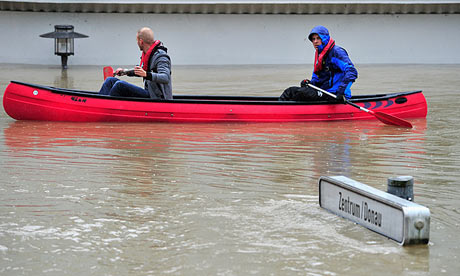
    A canoe is steered past a street sign for the Danube river and the city centre of Passau, Germany,

    A canoe is steered past a street sign for the Danube river and the centre of Passau, Germany, as flood levels neared 2002’s historic highs. Photograph: Lennart Preiss/Getty

    Volunteers piled up sandbags in an effort to keep the Vltava river from swamping the Czech capital’s historic centre after floods across central Europe forced factories to close and drove thousands from their homes. At least seven people have been killed.

    Five people were killed at the weekend in the Czech Republic, where the flooding was the worst in a decade and a state of emergency was declared, while in Austria two people died and another two were missing.

    Officials in Prague, which is listed by the UN as a World Heritage Site, shut the metro system, and in streets near the river soldiers put up flood defences.

    Tigers at Prague zoo were tranquilised and moved out of an enclosure at risk from flooding. The Charles bridge, a favourite spot for tourists that dates back to the 14th century, was closed.

    Officials hoped the flood defences in Prague should hold, but said the river level was likely to rise again on Tuesday morning. “The story is not yet over here,” said the environment minister, Tomáš Chalupa.

    Tree trunks floated by in the muddy brown water. A riverside path, usually populated with cyclists and people sitting at cafes, was under water on Monday.

    “We left England yesterday and it was sunny and warm. We didn’t expect this; we don’t even have our raincoats,” said a British tourist, Alison Tadman, who came to Prague with her husband, Adrian, to celebrate her 47th birthday. She and her husband were sheltering in a McDonald’s restaurant. “We’re pretty disappointed,” she said.

    Some of the worst flooding was around the Danube river, which starts in Germany and snakes its way through countries including Austria, Slovakia and Hungary on its way to the Black Sea. The river was swollen by heavy rain at the weekend.

    In Germany, the interior minister flew to the flood-hit regions on Monday and the chancellor, Angela Merkel, was preparing to go on Tuesday, a government spokesman said.

    Shipping was stopped on parts of the Danube and Rhine rivers in Germany, and along the whole Austrian stretch of the Danube, because of the high waters. The rivers are important arteries for moving grain, coal and other commodities.

    Thousands of people living in low-lying areas in Austria and the Czech Republic had to be evacuated from their homes.

    The death toll in Austria rose on Monday after a man listed as missing was found dead in the province of Vorarlberg, local police said. The 58-year-old had failed to return home from a party on Saturday.

    In the Austrian city of Salzburg, 160 passengers were put up overnight in army barracks after the floods stranded their train. The Austrian foreign minister, Michael Spindelegger, told reporters the situation in some areas was very fraught.

    The risk on Monday was that the flood danger could follow the course of the Danube river downstream to other European countries along its route.

    Workers put up flood barriers along the banks of the Danube where it passes through the Slovak capital, Bratislava, and police shut several roads.

    “We are getting bad news from Germany and Austria. We have to do all we can to protect … the capital,” the Slovak prime minister, Robert Fico, said.

    In Hungary, where the capital, Budapest, is also built on the banks of the Danube, state media quoted György Bakondi, head of the national disaster authority, as saying that 400 people were working on flood defences.

    He said water levels in the river could reach or even exceed the height seen in the record flooding of 2002.

    Daily Email

    close

    Sign up for the Guardian Today

    Our editors’ picks for the day’s top news and commentary delivered to your inbox each morning.

    Sign up for the daily email

    Daily Email

    close

    Get the Guardian’s daily US email

    Our editors’ picks for the day’s top news and commentary delivered to your inbox each morning. Enter your email address to subscribe.

    Sign up now
    Daily Email