Author: Neville

  • Fossil fuel divestment campaign’s victory in Australia will be a moral one

    Fossil fuel divestment campaign’s victory in Australia will be a moral one

    Global climate divestment campaigns led by 350.org and Bill McKibben will have a larger moral impact than financial one

    Damian blog : coal in Australia BHP Billiton Announces Record Financial Results

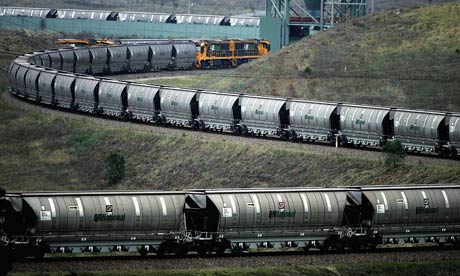
    A coal train awaits loading at BHP Billiton’s Mt Arthur coal mine in Muswellbrook, Australia. Photograph: Ian Waldie/Getty Images

    Journalist and climate activist Bill McKibben is in Australia in June on his epic Do The Math tour, which aims to highlight the danger of fossil fuel company oil and coal reserves and encourage divestment.

    The tour was kick started by McKibben’s Rolling Stone article, Global Warming’s Terrifying New Math, which argued that in order to stay below the 2C warming limit, the global economy has a budget of less than 565 gigatons of carbon dioxide. Unfortunately, fossil fuel companies have reserves of carbon from oil, coal and gas of almost 3000 gigatons — far exceeding the climate’s safe limit if it were to all be burned.

    This “math” has been known for some years before McKibben’s article. The Potsdam Institute wrote about humanity’s carbon budget back in 2009, noting that even if we stayed within budget, we still had a 25% chance of going over 2 degrees warming. Alarmingly, the Potsdam report said global emissions must start falling by 2015 and that reductions must exceed even the most ambitious public targets tabled by governments so far.

    Nevertheless, although McKibben didn’t invent the “math”, he certainly deserves credit for catapulting it back into the spotlight.

    Tied to the tour is the 350.org sponsored carbon divestment campaign, targeting mainly students on campuses around the USA (and now Australia) to pressure their university administrations to dump investments in fossil fuel companies. The message of the campaign is that these students can no longer tolerate “business as usual”.

    The campaign has started to spread to churches, local councils, and in Australia, work is under way for activists to start campaigning to superannuation funds.

    And in the USA it has been remarkably successful. More than 300 American colleges have active Go Fossil Free campaigns.

    Universities like Harvard or MIT have multi-billion dollar endowment funds. While individual college funds may represent just a small drop in the ocean of international financial markets, the Go Fossil Free campaigns are trying to tap into something deeper with their divestment campaigns.

    Divestment campaigns historically have never been about economic pressure. The effectiveness of the South African apartheid divestment campaigns were due to the moral pressure they placed on governments and businesses. They made toleration of apartheid in the USA, Britain and other countries (including Australia) impossible. University campuses were the hubs of much of the campaign activities, engaging not just students but academics and the trustees of university administered funds.

    The divestment by the University of California Berkeley’s divestment of $3 billion in 1986 was later credited by Nelson Mandela as a catalyst for the collapse of the apartheid government.

    Unfortunately, there’s every indication that the big fossil fuel companies targeted by McKibben — like Exxon, BP, Chevron and BHP Billiton — are less concerned than Apartheid South Africa was in global public opinion. For example, BP has managed to bounce back from the Gulf of Mexico oil spill.

    It’s likely they also have more economic and political clout. The big fossil fuel companies are some of the most profitable companies in history. BHP Billiton for example made a modest $10 billion profit in 2012, and Exxon made over $42 billion.

    Given these numbers, it is unlikely that even the $32 billion Harvard endowment would make much of an impact, even if the entire fund was invested in fossil fuel companies. In Australia, only the University of Melbourne has over a billion dollars in their endowment, and even if all the Australian universities combined divested, the business practices of BHP and Chevron are unlikely to change.

    I think the real impact of the divestment campaigns must come from their moral authority. Universities (and hopefully superannuation funds) that do divest are taking a moral stand. That stand must be accompanied by efforts throughout the university to highlight the risks posed by dangerous climate change.

    Universities train the business leaders of the future. In fact, the graduate schools are often training the business leaders of today! Most business schools include compulsory courses in ethics, but the carbon budget math needs to be embedded into accounting, finance and economics classes from the undergraduate to graduate level.

    Lecturers teaching actuaries about risk should be explaining the effects of runaway global warming and the ecological crisis that will occur if we cross over 2 degrees in warming. Engineering and project management students should look at sustainable energy and ecologically sound product supply chains.

    And commerce students need to come to grips with the fact that as we get closer to reaching or exceeding our carbon budget, those fossil fuel reserves may become unburnable, leaving investors stranded.

    With more and more reports warning of the dire risks if we do not change course, the Go Fossil Free campaign has its work cut out to ensure we don’t cross the limit in 2015.

    Last year, I had the opportunity to see McKibben and Naomi Klein at the Boston leg of the Do The Math tour and found it excellent and informative.

  • Oklahoma tornado followed by extreme weather warnings for four states

    Oklahoma tornado followed by extreme weather warnings for four states

    Oklahoma, Texas, Louisiana and Arkansas told to expect tornadoes, hail storms and thunderstorms on Tuesday
    Oklahoma tornado – live coverage of developments

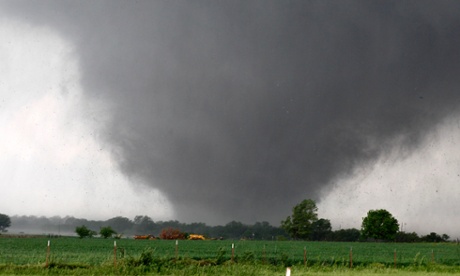
    A tornado passes across south Oklahoma City.

    A tornado passes across south Oklahoma City. Photograph: Paul Hellstern/AP

    More than 50 million people across a swathe of the Great Plains states were braced for a second round of extreme weather on Tuesday, from hail storms to tornadoes, after the devastation that was visited on an Oklahoma town on Monday. The storm prediction centre of the National Weather Service in Norman, Oklahoma forecast isolated tornadoes across large parts of Texas, Oklahoma, Arkansas and Louisiana.

    “There is obviously more wild weather taking place across the southern plains today,” said Tom Kines, a meteorologist at Accuweather. “I suspect it’s only going to get worse as the day wears on out there.”

    Moore, the suburb of Oklahoma City where at least 24 of people were killed on Monday, was unlikely to suffer another tornado, although it was in the path of a line of thunderstorms. South-eastern Oklahoma, central and north-eastern Texas, south-western Arkansas and north-western Louisiana were warned that they were at risk of tornadoes and other severe storms, including hail the size of golf balls, as a severe weather system began making its way out of New Mexico. That included much larger metropolitan areas even than those in the way of the tornado cells on Monday, including the cities of Dallas-Fort Worth and San Antonio in Texas and Shreveport in Louisiana.

    “The tornadoes yesterday were very destructive. They weren’t the run of the mill tornadoes. They were as bad as it can get,” said Kines. “Today again there is likely to be some large tornadoes like yesterday. Obviously the places that do get hit by them the damage is going to be very bad.”

    In southern Oklahoma and northern and central Texas, the tornado watch went in effect from 10am until 7pm central time. “Persons in these areas should be on the lookout for threatening weather conditions and listen for later statements and possible warnings,” the tornado watch said.

    The storm centre said to expect gusts of wind of up to 80mph. Flash-flood warnings were also in effect for parts of Arkansas and Louisiana, with the storm system forecast to dump several inches of rain in a short time frame on Tuesday afternoon. The line of thunderstorms was also forming up into the mid-Mississippi valley.

    Residents in a great swathe of the country – more than 50 million people – were advised to monitor radio and television broadcasts for possible storm warnings throughout the day and into Tuesday night.

  • Nasa Helps Pinpoint Glaciers’ Role in Sea Level Rise

    EARTH OBSERVATION

    NASA Helps Pinpoint Glaciers’ Role in Sea Level Rise
    by Staff Writers
    Washington DC (SPX) May 22, 2013


    The Aletsch Glacier in Switzerland is the largest valley glacier in the Alps and it has been losing mass since the mid-19th century. A new study using data from two NASA satellites found that glaciers like this one lost an average of 571 trillion pounds of ice per year from 2003 to 2009, which contributed to about 30 percent of the total observed global sea level rise during the same period. Credit: Frank Paul, University of Zurich.

    A new study of glaciers worldwide using observations from two NASA satellites has helped resolve differences in estimates of how fast glaciers are disappearing and contributing to sea level rise.

    The new research found glaciers outside of the Greenland and Antarctic ice sheets, repositories of 1 percent of all land ice, lost an average of 571 trillion pounds (259 trillion kilograms) of mass every year during the six-year study period, making the ocean rise 0.03 inches (0.7 millimeters) per year.

    This is equal to about 30 percent of the total observed global sea level rise during the same period and matches the combined contribution to sea level from the Greenland and Antarctica ice sheets.

    The study compares traditional ground measurements to satellite data from NASA’s Ice, Cloud, and Land Elevation Satellite (ICESat) and Gravity Recovery and Climate Experiment (GRACE) missions to estimate ice loss for glaciers in all regions of the planet. The study period spans 2003 to 2009, the years when the two missions overlapped.

    “For the first time, we have been able to very precisely constrain how much these glaciers as a whole are contributing to sea level rise,” said Alex Gardner, Earth scientist at Clark University in Worcester, Mass., and lead author of the study. “These smaller ice bodies are currently losing about as much mass as the ice sheets.”

    The study was published in the journal Science.

    ICESat, which stopped operating in 2009, measured glacier change through laser altimetry, which bounces lasers pulses off the ice surface to inform the satellite of changes in the height of the ice cover.

    ICESat’s successor, ICESat-2, is scheduled to launch in 2016. GRACE, still operational, detects variations in Earth’s gravity field resulting from changes in the planet’s mass distribution, including ice displacements.

    The new research found all glacial regions lost mass from 2003 to 2009, with the biggest ice losses occurring in Arctic Canada, Alaska, coastal Greenland, the southern Andes and the Himalayas.

    In contrast, Antarctica’s peripheral glaciers — small ice bodies not connected to the main ice sheet — contributed little to sea level rise during that period. The study builds on a 2012 study using only GRACE data that also found glacier ice loss was less than estimates derived from ground-based measurements.

    Current estimates predict all the glaciers in the world contain enough water to raise sea level by as much as 24 inches (about 60 centimeters). In comparison, the entire Greenland ice sheet has the potential to contribute about 20 feet (about 6 meters) to sea level rise and the Antarctic ice sheet just less than 200 feet (about 60 meters).

    “Because the global glacier ice mass is relatively small in comparison with the huge ice sheets covering Greenland and Antarctica, people tend to not worry about it,” said study co-author Tad Pfeffer, a glaciologist at the University of Colorado in Boulder.

    “But it’s like a little bucket with a huge hole in the bottom: it may not last for very long, just a century or two, but while there’s ice in those glaciers, it’s a major contributor to sea level rise.”

    To make ground-based estimates of glacier mass changes, glaciologists perform on-site measurements along a line from a glacier’s summit to its edge. Scientists extrapolate these measurements to the entire glacier area and carry them out for several years to estimate the glacier’s overall mass change over time.

    While this type of measurement does well for small, individual glaciers, it tends to overestimate ice loss when the findings are extrapolated to larger regions, such as entire mountain ranges.

    “Ground observations often can only be collected for the more accessible glaciers, where it turns out thinning is occurring more rapidly than the regional averages,” Gardner said. “That means when those measurements are used to estimate the mass change of the entire region, you end up with regional losses that are too great.”

    GRACE does not have fine enough resolution and ICESat does not have sufficient sampling density to study small glaciers, but the two satellites’ estimates of mass change for large glaciered regions agree well, the study concluded.

    “We now have a lot more data for the glacier-covered regions because of GRACE and ICESat,” said Gardner. “Without having these independent observations, there was no way to tell that the ground observations were biased.”

    The research involved 16 researchers from 10 countries, with major contributions from Clark University, the University of Michigan in Ann Arbor, Scripps Institution of Oceanography in San Diego, Trent University in Ontario, the University of Colorado at Boulder and the University of Alaska Fairbanks.

  • US Groundwater Levels Are Falling Faster Than Any Time in the Past Century

    US Groundwater Levels Are Falling Faster Than Any Time in the Past Century

    By Mat McDermott

    Photo: brewbrooks/Flickr

    A new study from the US Geological Survey reveals that groundwater aquifers in the United States have been depleted at record high levels over the first decade of the 21st century, resulting both in a long term threat to water availability, particularly in major agricultural areas of the nation, as well as being a surprising contributor to global sea level rise.

    The study examined groundwater depletion in the US from 1900-2008 (see image below), finding that there was a major increase in water withdrawal immediately after World War 2—the result of the rise of suburbia and national prosperity after the US was the last country standing. This was nothing in comparison to what happened from 2000-2008, though.

    Image: USGS

    Since 2000 the average rate of groundwater depletion was 25 cubic kilometers per year, nearly 2.8 times higher than the 20th century average for the nation. Globally, groundwater depletion has been even more precipitous in the same time period, averaging 145 cubic kilometers per year.

    The USGS says the amount of groundwater depletion in the US from the start of this century alone can account for more than 2 percent of observed sea level rise since then. If that sounds bad, the global contribution of groundwater depletion to sea level rise from 2000-2008 has been about 13 percent of the total observed sea level rise.

    Looking at the Ogallala Aquifer, under 440,300 square kilometers in the middle of the nation’s prime agricultural land from South Dakota south to Texas, the groundwater depletion from 2000-2008 is roughly one-third of the entire depletion over the entire previous century. Since the 1940s, essentially since the beginning of what we’d now call industrial agriculture and intensive irrigation, the water table has fallen over 160 feet in places.

    Making things worse, this area is smack dab in the middle of the some of the most-affected areas of multi-year drought. According to the latest info from US Drought Monitor, much of the area which the Ogallala Aquifer is under is either in extreme or exceptional drought (the highest levels) lasting well over six months. It is also the very area where the proposed Keystone XL tar sands pipeline would pass through, creating a very real threat to water supplies when a spill occurs—note, the use of ‘will’ is very purposeful; as recent events have shown it is not a question of if a pipeline will have an accident, but rather when.

    What’s causing the record levels of water withdrawal? Reuters quotes Leonard Konikow of the USGS, who places the blame on a variety of factors, all linked to rising population levels: Agriculture is a major culprit, as is the energy industry; precipitation declines in both summer and winter, linked to climate change, have failed to replenish aquifers.

    Though outside the scope of this particular report, similar conditions exist globally. In the past decade alone the world population was increased by one billion people. Since 1950, when water use first started really climbing in the US, global population has increase by nearly 4.5 billion people. If water levels continue to be depleted at such a fast rate, it looks increasingly likely that water will be the commodity we war over in the future.

    Read more: http://motherboard.vice.com/blog/us-groundwater-levels-are-falling-faster-than-any-time-in-the-past-century#ixzz2U1TqZFYq
    Follow us: @motherboard on Twitter | motherboardtv on Facebook

  • Is peak oil never going to happen?

    Is peak oil never going to happen?

    By  Sebastian Blanco RSS feed Google+

    Posted May 21st 2013 12:33PM

    Comments131

    You can make a coherent, logical argument for cars that don’t burn gasoline without once mentioning global petroleum supply. You can talk about international relations and the power of gasoline exporters (just read the first three paragraphs of this for a bit of history). You can talk about climate change. You can talk about the health effects of CO2 in the air. But the fact remains that gasoline (or diesel) remains the go-to fuel for almost every passenger vehicle on the planet, so the question of how much black gold is out there is an important one. The answer, though is not so clear.

  • Climate Change and Wildfire

    Climate Change and Wildfire

    May 21, 2013 — Concerns continue to grow about the effects of climate change on fire. Wildfires are expected to increase 50 percent across the United States under a changing climate, over 100 percent in areas of the West by 2050 as projected by some studies. Of equal concern to scientists and policymakers alike are the atmospheric effects of wildfire emissions on climate.


    Share This:

    A new article published in the journal Forest Ecology and Management by U.S. Forest Service scientists synthesizes recent findings on the interactions between fire and climate and outlines future research needs. Authored by research meteorologists Yongqiang Liu and Scott Goodrick from the Forest Service Southern Research Station (SRS) and Warren Heilman from the Northern Research Station, the article homes in on the effect of emissions from wildfires on long-term atmospheric conditions.

    “While research has historically focused on fire-weather interactions, there is increasing attention paid to fire-climate interactions,” says Liu, lead author and team leader with the SRS Center for Forest Disturbance Science. “Weather, the day-to-day state of the atmosphere in a region, influences individual fires within a fire season. In contrast, when we talk about fire climate, we’re looking at the statistics of weather over a certain period. Fire climate sets atmospheric conditions for fire activity in longer time frames and larger geographic scales.”

    Wildfires impact atmospheric conditions through emissions of gases, particles, water, and heat. Some of the article focuses on radiative forcing from fire emissions. Radiative forcing refers to the change in net (down minus up) irradiance (solar plus longwave) at the tropopause, the top of the troposphere where most weather takes place.

    Smoke particles can generate radiative forcing mainly through scattering and absorbing solar radiation (direct radiative forcing), and modifying the cloud droplet concentrations and lifetime, and hence the cloud radiative properties (indirect radiative forcing). The change in radiation can cause further changes in global temperatures and precipitation.

    “Wildfire emissions can have remarkable impacts on radiative forcing,” says Liu.

    “During fire events or burning seasons, smoke particles reduce overall solar radiation absorbed by the atmosphere at local and regional levels. At the global scale, fire emissions of carbon dioxide contribute substantially to the global greenhouse effect.”

    Other major findings covered in the synthesis include:

    • The radiative forcing of smoke particles can generate significant regional climate effects, leading to lower temperatures at the ground surface.
    • Smoke particles mostly suppress cloud formation and precipitation. Fire events could lead to more droughts.
    • Black carbon, essentially the fine particles of carbon that color smoke, plays different roles in affecting climate. In the middle and lower atmosphere, its presence could lead to a more stable atmosphere. Black carbon plays a special role in the snow-climate feedback loop, accelerating snow melting.

    Land surface changes may be triggered that also play into future effects. “Wildfire is a disturbance of ecosystems,” says Liu. “Besides the atmospheric impacts, wildfires also modify terrestrial ecosystem services such as carbon sequestration, soil fertility, grazing value, biodiversity, and tourism. The effects can in turn trigger land use changes that in turn affect the atmosphere.”

    The article concludes by outlining issues that lead to uncertainties in understanding fire-climate interactions and the future research needed to address them.

    Share this story on Facebook, Twitter, and Google: