Finding electricity in water waves
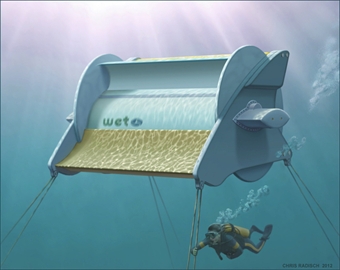
WET Rotor
Special to the Hamilton Spectator,Jim Unsworth

You’ve heard about wind turbines, those big propellers that whirr away in the countryside generating electricity.
But what would happen if you used slow water currents instead of air to drive them?
Imagine being able to generate electricity from trickling water at an economical cost with virtually no impact on the environment.
That’s the goal behind new technology that two Hamilton businessmen are raising capital for on behalf of Ottawa-based Waterotor Energy Technologies Inc.
Ken Spurling of Blazon Co. Ltd., and board member of Waterotor, with associate Jim Unsworth are pounding the pavement to raise $6 million in capital to move the technology closer to market.
They argue the Waterotor technology is an affordable, environmentally friendly way to generate electricity, especially in developing countries that have no electricity or have to rely on expensive fossil-fuel driven generators. They contend that early testing has shown the Waterotor can generate electricity at a cost of 5 or 6 cents per kWh. That compares to the 6.7 c/kWh to 12.4 c/kWh that electricity users pay in Ontario. Elsewhere in the world it can be more than 40 cents.
Engineers have been drawing power from fast-moving waterways for eons, but slow moving water is only more recently being seen as a potential power source
Air turbines are criticized for harming birds and bats as well as being noisy. But Unsworth says the Waterotor blade is much smaller and moves much more slowly than wind-powered turbine blades. Unlike propeller-style air turbines, the Waterotor unit turns like a sideways barrel.
He says fish and other marine life either move over or under the unit without being harmed. As for noise, the blade moves so slowly, that virtually no noise is created, he says.
The technology was developed by Fred Ferguson of Ottawa, an award-winning inventor who is CEO and chief technology officer of the company. Ferguson, a direct descendant of Samuel F.B. Morse, the inventor of the telegraph, has a background in aeronautics and essentially retooled his knowledge from air to water.
For more than five years, his company has been developing the technology with various test projects in the Gatineau River in Ottawa, among others.
The turbines are 10 by 8 feet wide and 7½ feet high. Each unit would cost about $80,000 and is capable of generating up to 5 kilowatts of electricity, enough electricity for a few houses. Typically, several Waterotor units would be placed side-by-side in the water.
The technology needs water flow speeds of 1.7 and 6.5 mph. Research has shown irrigation canals are typically below 5 mph and more than 90 per cent of all river currents and major ocean currents are below 6.5 mph.
Hamilton environmentalist and Green Party member Peter Ormond says the technology appears to be low-impact renewable energy. “However, appropriate sites must be reviewed and monitored to ensure that impacts on the local habitat are minimized.
“Especially as communities embrace conservation and demand management, the Waterotor system is a very exciting technology that represents the new generation of innovative technologies that are replacing the outdated mega-power plants with local sources of environmentally friendly renewable energy options.”
Professor Bryan Karney, chair of the division of environmental engineering and energy systems department at the University of Toronto, says he feels the kW/hr cost estimate “seems a bit like wishful thinking before one knows the installation environment, generation details, mounting challenges, stability issues, transmission issues, hydraulic capacity, and the role of introducing a significant resistance element into the flow.”
But he feels the technology shows promise and believes water turbines could play role in supplying future energy needs.
905-526-4687 | @Markatthespec
Leave a Reply
You must be logged in to post a comment.