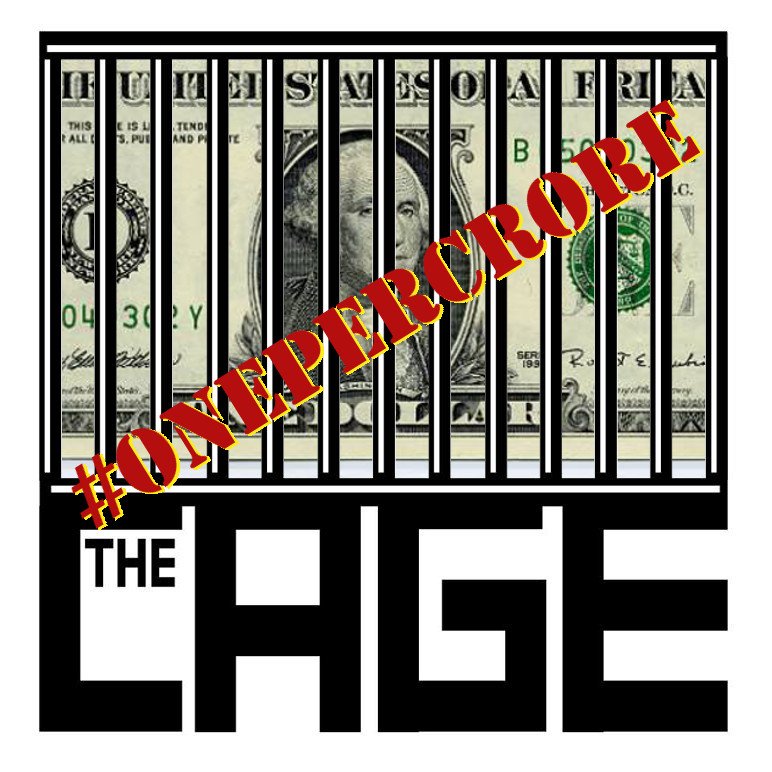
The Cage, like the Matrix, ensnares and enslaves us. We voluntarily assist in building our own trap, borrowing money to make banks richer, plugging ourselves into a system that feeds off our energy and activity to enrich its owners. The Cage started life as a radio show, exposing the workings of the cage by turning the paradigm on its head, locking the powerful into “The Cage” until they answer the question …
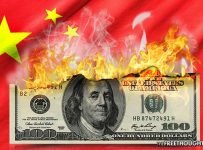
Although apparently random and etiquette busting, Trump’s tweets are carefully calculated to evoke particular responses. One message that is notably absent from all the bluster about Chinese trade is any discussion of China trading oil in Yuan. While the mainstream press argues that this is because it does not matter, a long term reading of the background indicates that it might.
The power of the dollar in propping up the US empire has been a recurrent story on The Generator since its inception in 2005. From Robert Newman’s History of Oil in 2005 to last month’s Petro-Yuan article in Modern Diplomacy the Generator has reported regularly on the US tendency to intervene militarily whenever the hegemony of the US dollar is threatened.
For over a year, a range of alternative press has been speculating on the US reaction of the Chinese announcement of its intention to trade oil in Yuan but it is rare for the mainstream press to include this in its discussion of the basis of the US trade war. It is completely absent from Trump’s tweets.
The mainstream press insists that this is mere fantasy. In April, shortly after China began trading oil in Yuan, Forbes ran a long article titled Why the Petro-Dollar is a myth and the Petro-Yuan mere fantasy that thoroughly debunks the notion of oil trading being the basis of US dollar hegemony and, by implication, the notion of a Petro-Yuan being a threat to a non-existent Petro-Dollar. The debunking relies on the argument that the US dollar is the preferred currency because of the US pre-eminence as a trading nation and the world’s largest economy,
It is not only the conspiracy theorists and the alternative media pointing out that these two pillars of US global dominance may not be reliable in the long term. The trade war between China and the US is news precisely because China is threatening to topple the US from the top perch and the repercussions will be many and various. Who knows, some of those tired old conspiracy theories might even turn out to be relevant.
His empire was initially built on his work in artificial intelligence and natural languages that brought him in contact with the establishment through the campaign for the hearts and minds in Afghanistan. He then multiplied those earnings by building software that predicted share prices based on the behaviour of investors rather than the value of the investments. That investment engine generated the cash to begin building a media empire that could then use all the techniques developed over the years to exponentially amplify the power of those media holdings. The current UK investigation shows how that media empire and software tools were used to manipulate Brexit and the Trump election.
Who knows what he plans to do know that he has got a President in his pocket and the attention of the industrial military complex but one can be sure he has moved to a seat at the “big table”. That is the one per crore, the seven hundred people who make the big decisions that affect the rest of us.
The great British Brexit robbery: how our democracy was hijacked
Who is the One per Crore. 700 people control almost half the wealth in the world. Who are they?
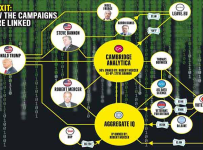
A motivated US billionaire – Mercer and his chief ideologue, Bannon – helped to bring about the biggest constitutional change to Britain in a century. There are three strands to this story. How the foundations of an authoritarian surveillance state are being laid in the US. How British democracy was subverted through a covert, far-reaching plan of coordination enabled by a US billionaire. And how we are in the midst of a massive land grab for power by billionaires via our data. Data which is being silently amassed, harvested and stored. Whoever owns this data owns the future.
To anyone concerned about surveillance, Palantir is practically now a trigger word. The data-mining firm has contracts with governments all over the world – including GCHQ and the NSA. It’s owned by Peter Thiel, the billionaire co-founder of PayPal and major investor in Facebook, who became Silicon Valley’s first vocal supporter of Trump.
Facebook was the source of the psychological insights that enabled Cambridge Analytica to target individuals. It was also the mechanism that enabled them to be delivered on a large scale.
The company also (perfectly legally) bought consumer datasets – on everything from magazine subscriptions to airline travel – and uniquely it appended these with the psych data to voter files. It matched all this information to people’s addresses, their phone numbers and often their email addresses. “The goal is to capture every single aspect of every voter’s information environment, and with the personality data enabled Cambridge Analytica to craft individual messages.”
This article originally appeared on the ABC but was removed citing “editorial standards”. The fact was brought to the attention of the Generator News by News Daily The article itself was retrieved from the Web Archive
Tax-free billions: Australia’s largest companies haven’t paid corporate tax in three years
Exclusive by chief economics correspondent Emma Alberici
Qantas CEO Alan Joyce, one of the most prominent supporters of the Turnbull Government’s proposed big business tax cut, presides over a company that hasn’t paid corporate tax for close to 10 years.
The period roughly coincides with Mr Joyce’s tenure at the helm of Australia’s flag carrier.
Alan Joyce, the CEO of Qantas, is a major supporter of corporate tax cuts in Australia. (AAP: Joel Carrett)
Despite generating income of $106.4 billion, the flying kangaroo has avoided paying tax on that bounty since 2009, thanks to Australia’s generous tax concessions, depreciation provisions and the ability to offset company losses against past and future profits.
New analysis by the ABC reveals Qantas is not alone — its tax behaviour is consistent with about 380 of Australia’s largest companies. ATO corporate tax transparency data — confirmed in email exchanges with company representatives — reveals about one in five of the country’s biggest companies have paid no tax for at least the past three years.
Not one of Australia’s biggest airlines has paid corporate tax since at least 2013, including Virgin and its subsidiary Tigerair, Etihad, Emirates and Qatar.
Each one of those companies has sold billions of dollars worth of tickets in Australia.
When asked for an explanation, both Qantas and Virgin pointed the ABC to their historical losses and the entirely legitimate use of Australia’s tax laws that allow them to offset those losses against future profits indefinitely.
Both companies were at pains to point out that, notwithstanding their zero corporate tax liabilities, they had continued to collect and pay departure taxes, fuel and alcohol excises, payroll tax, GST and FBT.
Presumably that’s what the Etihad spokesman was alluding to in his statement to the ABC.
“Etihad is fully compliant with all Australian tax requirements, and has paid all the taxes it is obligated to do so under Australian law.”
EnergyAustralia’s tax-free decade
At a time when Australian households have seen their electricity prices soar, the country’s leading energy retailer, EnergyAustralia, hasn’t been paying corporate tax. EnergyAustralia paid no corporate tax for the decade to 2016.
For the three years to June 2016, EnergyAustralia’s 1.7 million electricity and gas customers across eastern Australia helped it record $24 billion worth of income on which no tax was paid.
An EnergyAustralia spokesperson said the company’s performance, “reflects how the power-generation sector is underpinned by assets that were built last century”.
“Since 2006, EnergyAustralia has written down the value of its assets by $1.9 billion.”
How much tax did the big banks pay?
Ten years after the global financial crisis — which they are largely responsible for creating — some of the world’s most prominent investment banks are collecting tidy sums of income in Australia and not paying corporate tax.
Among them is Malcolm Turnbull’s old employer, Goldman Sachs, which recently won a lucrative contract with the NSW Government.
Described by Rolling Stone Magazine as, “the great vampire squid wrapped around the face of humanity, relentlessly jamming its blood funnel into anything that smells like money”, Goldman will be paid $16.5 million as the state’s financial adviser on the sale of the $16.8 billion WestConnex motorway in NSW.
The investment bank generated revenue of $1.84 billion over three years but paid zero corporate tax.
Ditto for JPMorgan Chase which raked in $2.2 billion and hasn’t paid corporate tax since at least 2013.
In one of the most audacious explanations advanced to the ABC for the non-payment of corporate tax, a spokesman for America’s biggest bank said JPMorgan was still suffering the aftershocks of the financial crisis which meant its Australian operations continued to operate at a loss.
But late last year, it emerged JPMorgan Chase agreed to pay a record $13 billion fine to US federal and state authorities in 2013.
The purpose of this fine was to settle claims it had misled investors in the years leading up to 2008.
Could the bank be writing that fine off against its Australian income? The spokesman didn’t care to elaborate.
Shifting profits overseas
88 per cent of people, polled by Reuters, think corporate tax avoidance leads to a culture which poses the question: “Can we get away with it?” (Supplied: Thomson Reuters)
Curiously, French bank BNP Paribas also appeared to have made some bad investments taxpayers were having to compensate it for.
It hasn’t paid corporate tax for at least three years – like Goldman, JPMorgan Chase, American Express, Barclays Bank and the Royal Bank of Scotland.
The oldest foreign bank in Australia (resident here since 1881) told the ABC that despite attracting close to $10 billion in income since 2013, BNP failed to make any profits.
BNP said its losses, “included the write off of bad debts from lending to certain Australian domiciled companies”.
As far as the local financial services sector goes, Babcock and Brown International stands out among the 2,000 company names in the Australian Taxation Office’s public records.
Babcock and Brown remains the country’s biggest corporate failure, having collapsed in 2009 with debts of more than $10 billion.
According to the ATO, Babcock and Brown International (a wholly owned subsidiary of the liquidated group, Babcock and Brown Ltd) reported $1.7 billion worth of income for the three years to 2016.
It paid no corporate tax.
CEO Michael Larkin, who has been with the Babcock group for 14 years, told the ABC the money was taxed elsewhere in the world where Babcock and Brown International engages in business.
He wouldn’t be drawn on what the company does overseas, where or how much tax has been paid in other jurisdictions.
Australian tax law has allowed foreign companies to shift profits to affiliates or parent groups offshore in the guise of payments for services.
They’ve also been entitled to lend money to their Australian operations at inflated prices to create excessive tax deductions in Australia.
This can all work to render the Australian business loss-making, therefore not required to pay corporate tax.
For local companies, the dividend imputation system is a unique tool that allows businesses to pass tax credits on to their investors.
Australia and New Zealand are now the only two OECD countries to offer imputation which results in around a third of corporate tax revenue in Australia being handed back to investors.
Put simply, it means a 30 per cent corporate tax rate with franked dividends raises roughly as much as a headline 20 per cent rate without them.
Over the past 30 years, a number of countries have abandoned dividend imputation, including the UK, Germany, Finland, Norway, Singapore and Malaysia.
Thanks to legislation passed in 2013, the Australian Tax Office now publishes an annual record of total income received, taxable income and tax payable for the roughly 2,000 Australian companies with annual turnovers of more than $100 million.
It’s called The Corporate Tax Transparency Data which is somewhat of a misnomer given the numbers say nothing about how businesses use deductions and concessions to reduce their taxable incomes.
All the focus on the tax shenanigans of foreign technology and media companies has diverted our gaze from the taxpaying habits of some of their home grown rivals.
The media colossus reported total income of $8.5 billion and even boasted a $71 million profit in 2014/15 but no corporate tax was paid.
The company’s corporate affairs boss, Liz Deegan, wrote to the ABC to clarify that: “News Corp Australia has deductible operating costs and certain tax incentives and allowable credits, like R&D and franking credits, that offset the revenue disclosed.”
Its partly owned pay-TV company, Foxtel, received a $30 million gift from the Federal Government in the last budget, ostensibly to provide better coverage of female sports.
In the three years prior, Foxtel had also not paid corporate tax. Fairfax, News Corp’s newspaper rival in Australia, paid $53.1 million in corporate tax over the same period.
The tax-free club
Software giant Atlassian also pointed to R&D tax concessions when explaining why it too hasn’t paid corporate tax for the past two years on accumulated income just shy of $1 billion.
A tally of the three years’ available data reveals some of this country’s most recognised names haven’t paid corporate tax since at least 2013.
They include Broadspectrum (formerly Transfield Services) which collected $8.6 billion in income over three years. An estimated 30 per cent of that income ($2.5 billion) was paid directly by the Federal Government for running Australia’s offshore detention facilities. Broadspectrum was taken over by Spanish conglomerate Ferrovial in 2016.
Among the others who’ve escaped paying any corporate tax for three years are Bluescope Steel, Ansell, Amcor, Billabong International and TransurbanHoldings.
The big property and construction companies Lend Lease, Grocon, Stockland and GPT are also part of the corporate tax-free club.
Mackay Sugar and CSR who’ve been lobbying against a sugar tax haven’t paid corporate tax for three years either.
Not going down without a fight
The Turnbull Government knows well that forensic tax audits are an expensive and resource-sapping exercise, especially when they involve the complex interpretation of other countries’ tax codes and their intersection with ours.
Federal Treasurer Scott Morrison has committed $679 million over four years to a new Tax Avoidance Taskforce.
New laws to combat complicated corporate structures whose core purpose is to avoid tax have also been passed.
But if Australia wants the likes of Apple, Google and Facebook to pay more tax on the phones and advertising it sells in Australia, some of our biggest taxpayers, BHP and Rio Tinto should arguably be paying more tax in China where they sell most of their iron ore.
Among all the murky detail of corporate tax arrangements, one thing is clear: companies with the financial firepower of BHP and Rio Tinto aren’t going to accept a negative assessment from the ATO without a fight.
Both of Australia’s biggest miners are currently in dispute over their Singaporean marketing operations (corporate tax rate of 17 per cent).
Convoluted corporate arrangements see BHP and Rio sell commodities they’ve mined in Australia to their Singapore businesses, which on-sell the iron ore et al in to export markets (predominantly China) often with a hefty mark-up.
The ATO rejects the legitimacy of the tax structure and is seeking $1 billion in tax, interest and penalties from BHP and about half that ($500 million) from Rio.
A BHP spokesman told the ABC, “The primary tax in dispute represents less than 2 per cent of the $66 billion in taxes and royalties paid in Australia over that 11-year period … BHP does not agree with the ATO’s position.
“Consequently, we have objected to all the amended assessments and intend to continue to defend our position, including by initiating court action if necessary.”
Perhaps unsurprisingly, some of the country’s most trusted corporate advisers, including the Boston Consulting Group and MYOB, paid no tax for the three years to 2016.
Even the industry groups — Chartered Accountants (CAANZ) and the Certified Practising Accountants (CPA) have paid nothing, or next to nothing, in corporate tax over the that period on account of their “mutual” status which excludes membership fees from assessable income.
CPA Australia reeled in $493 million in income between 2013 and 2016.
Australia’s tax laws allowed them to pay just $1,967.00 in corporate tax.
Chartered Accountants Australia and New Zealand is a relatively new group.
In its two years as a registered entity for tax purposes it has paid zero corporate tax on $240 million in income.
The Prime Minister Malcolm Turnbull will today decree a Royal Commission into Sexual Staff Relations known as the Royal Commission into Bonks, i.e. #bonkcommission.
He will say, “Far from being tawdry or salacious, the investigation will provide clear guidelines as the what is and is not appropriate in navigating the complex world of human relations in the intense workplace environment that is Australian Parliament House.”
The announcement follows yesterday’s revision to the Code of Ministerial Conduct trending online as #bonkban.
The Prime Minister will also say. “The Commission will find it desirable to set up a Register of Staff Relations.”
Those failing to accurately use the Register will be deemed to have committed a #bonkommission.
The PM says there will be zero tolerance for #bonkemissions in his APH
He will also announce a new APH (Australian Parliament House) clean furniture policy. Breaches of this policy will be known as #bonkemissions.
International media and parliamentary supervisors watch developments in Australia with interest. Some commenttators consider the Australian PM an endangered species known as The Woolly Malcolm.
As the civil war in Syria officially draws to a close, the imperial states withdraw with much media fanfare. Their influence, though, remains in the form of corporate armies paid by national governments to maintain the pressure where their interests demand. Russia maintains a significant corporate army in Syria, though it has stepped back a little from a direct combat role after suffering significant casualties.
Hot on the heels of the announcement of new laws allowing start up companies to seek investment via crowdsourcing an investment vehicle for organic agriculture has been launched.
The Organic and Restorative Investment Coop, known as ORIC, will be launched in Melbourne next month.
The aim of the Coop is to facilitate investment into agriculture that offers a fair price to farmers and nurtures the ecology that supports us all. The new crowd-sourced equity funding laws allow individual investors to put up to $10,000 into a company raising less than $5 million.
A full interview with board member Robert Pekin is available on Soundcloud. Fundamentally, Robert tells Geoff that ORIC is a method for putting land ownership back in the hands of the people, thereby reversing the current trend of denuding the landscape of people and destroying community and human scale agriculture.