Category: Columns

Geoff has written for publications as diverse as PC User and The Northern Star His weekly columns have been a source of humour and inspiration for tens of thousands of readers and his mailbox is always full.
Here you can find his more recent contributions.

  • Blockchain: Starting Guide for beginners

    Blockchain: Starting Guide for beginners

    Author: Brian Reel

    ISBN: 1983889105

    Publisher: self-published, Brian Reel

    BLOCKCHAIN: Starting Guide For Beginners, All About Blockchain, Cryptocurrencies, Mining And Future Of Money was self published by Brian Reel in January 2018 and provides a high level overview in straightforward business English.

    Reel takes us through the actual processes of creating, using and trading in BitCoin as well as different ways of using the blockchain on which BitCoin is built. Each topic is dealt with in a practical way. The chapter on mining bitcoins, for example, discusses the method by which the block chain is stored and promulgated and how that is applied in the creation of new BitCoins (mining) and how companies are engaging in that mining exercise.

    The information is general, providing information for the educated layperson, rather than providing technical information or specific methods for engaging in these activities. Like many of the introductory texts, especially those self published, the book is short and snappy, skipping across the surface of these complex topics.

    For those who want to get an overview of the landscape quickly, this is probably ideal. Those who prefer to take more control of their research, though, a weekend on your favourite search engine may produce more useful (and current) results.

    You can buy the ebook for $US0.99 by clicking here.

  • Getting ahead of Bitcoin

    Getting ahead of Bitcoin

    Whether you are an investor, a programmer or an entrepreneur BitCoin will radically and directly change your life in the next couple of years.

    School teachers, activists and artists might not be directly in the firing line but Bitcoin’s underlying technology, the blockchain, is going to affect us all. The questions are how and how fast.

    This article answers your basic questions about the blockchain and tells you where to go for more in-depth information

    What is this thing called Blockchain?

    If you doubt the radical changes that technology has wrought on society in the last three decades, just watch the queue for wifi at the Guangzhou Airport. We are so addicted to the Internet it is the first thing we organise when we get to our accommodation on a weekend away, move house, or plan where we will spend the day working “out of the office”.

    The Blockchain is the next layer of the network that already connects us and enables our communal activity.

    The telecommunications network allowed us to speak to each other, leave messages and then, by 1964, send electronic signals and printed documents. The microchip allowed us to use personal productivity software to do things that had previously required volumes of pen and paper. The combination of the two allows us to maintain our diary, perform our banking, watch movies, take photographs and share all of that activity with loved ones, friends and colleagues over a hand held device. Most of us now see the smart phone and our connection to the network as an essential accessory in our daily life.

    Now, that networked computer has been empowered by the addition of a public record of all the transactions we perform. That public record is called the blockchain and it provides an accurate, immutable history of relevant online activity that will change the nature of trust. That reliable and permanent record of all transactions will rapidly replace the public record, institutions and governance in ways that we can only begin to imagine. It will be applied to supply chain logistics, as well as all transactions where a chain of custody, provenance or proof of ownership is importance.

    Think about it.

    We currently keep our money in a bank because we trust the bank to keep it safe. As that money has become completely virtual, we connect to the bank simply to record our transactions so that we can check our balance and make spending decisions based on accurate, up-to-date information. Now that the network itself has an accurate, up-to-date record of all our transactions and our account balance, the role of the bank is significantly reduced.

    And that is just the role of the BitCoin. Imagine the same technology applied to documents that record ownership. Every online photograph can be registered and every use of it tracked using the blockchain. Lab results, works of art, any object worth protecting can be protected by the blockchain. A complete chain of custody, provenance, or transaction history can be recorded automatically as an object moves through different hands.

    This can be applied to the storage of personal health records, the maintenance history of a car, the tagging of electrical appliances, viewing of online files.

    This transition will take some time, just as the smartcard has taken some time to replace cash. When we think about the transition from credit cards, through eftpos to smartcards and cashless transactions and then the current wave of cardless transactions we can see that these revolutions have long lead times and then very rapid implementations once the technology reaches a critical mass. Each wave of that transition had its own impact on the businesses involved and the impact over the last two decades has been remarkable.

    We are now reaching the point where BitCoin has moved out of the experimental and speculative phase into mainstream investing and blockchain applications are being implemented in organisations worldwide and the technology is being built into mainstream operating systems and development environments.

    What do you need to know?

    RIght now the world of virtual currency is exploding. Initial coin offerings (ICOs) are disrupting the financial landscape and entrepreneurs are exploring a brave new world of distributed applications to facilitate business models that were considered fanciful half a decade ago.

    The adventures of BitCoin have been well publicised – if not well explained – and most of us understand that something big is afoot, but we are not sure exactly what.

    The good news is the basic technologies are now well established and understood and a second generation of books explaining it all has emerged. Luckily, these books are targeted at specific audiences: Entrepreneurs, corporate managers, programmers, academics and investors. There are quick-to-read books that cost little and explain things simply as well as in-depth books to help you to make strategic decisions or, at least, decide strategically where to focus your further investigations. The

    This article introduces you to the cream of the crop. We have deliberately selected books available both physically and as ebooks. We have provided links to Amazon so that you can load them directly into your Kindle at a couple of clicks, but given you the details needed to shop around and get them in your preferred format, from your preferred provider as fast as possible.

    Conclusion

    Some people prefer to do their own research, others to get information packaged in a dense and digestible package, tailored to their needs. The introductory texts discussed here provide a quick introduction in such a manner, though the very short ones do not provide much more depth than a weekend session with Dr Google.

    If you are after an introduction to Blockchain, rather than simply BitCoin, Alan T Norman’s Blockchain Explained is my value-for-money recommendation. You can buy the Kindle edition directly for $US3.14 by clicking here. It is too detailed for some readers, though. Shorter books include Brian Reel’s BlockChain: Starting Guide for Beginner’s and Artemis Caro’s BlockChain: The Beginner’s Guide

    As you would expect, the three O’Reilly publications are more serious works at a more serious price. Each text has a specific audience:

    Blockchain: Blueprint for a new economy is the theoretical high level text aimed at strategic thinkers, Mastering BitCoin is the technical text aimed at tech savvy readers interested in financial applications and Decentralised Applications is aimed directly at programmers in the distributed application space.



  • Brexit was the practice run for Trump

    Brexit was the practice run for Trump

    … and Trump is the practice run for taking over the US establishment.

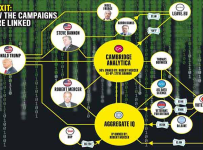
    As reported here a little over a year ago, Robert Mercer has been building a media empire specifically designed to consolidate power.

    His empire was initially built on his work in artificial intelligence and natural languages that brought him in contact with the establishment through the campaign for the hearts and minds in Afghanistan. He then multiplied those earnings by building software that predicted share prices based on the behaviour of investors rather than the value of the investments. That investment engine generated the cash to begin building a media empire that could then use all the techniques developed over the years to exponentially amplify the power of those media holdings. The current UK investigation shows how that media empire and software tools were used to manipulate Brexit and the Trump election.

    Who knows what he plans to do know that he has got a President in his pocket and the attention of the industrial military complex but one can be sure he has moved to a seat at the “big table”. That is the one per crore, the seven hundred people who make the big decisions that affect the rest of us.

    For more information about the seven hundred, see the founding document or the initial analysis of how to identify the One Per Core.

    The great British Brexit robbery: how our democracy was hijacked 
    Logo for the #OnePerCrore
    Who is the One per Crore. 700 people control almost half the wealth in the world. Who are they?

    A motivated US billionaire – Mercer and his chief ideologue, Bannon – helped to bring about the biggest constitutional change to Britain in a century. There are three strands to this story. How the foundations of an authoritarian surveillance state are being laid in the US. How British democracy was subverted through a covert, far-reaching plan of coordination enabled by a US billionaire. And how we are in the midst of a massive land grab for power by billionaires via our data. Data which is being silently amassed, harvested and stored. Whoever owns this data owns the future.

    To anyone concerned about surveillance, Palantir is practically now a trigger word. The data-mining firm has contracts with governments all over the world – including GCHQ and the NSA. It’s owned by Peter Thiel, the billionaire co-founder of PayPal and major investor in Facebook, who became Silicon Valley’s first vocal supporter of Trump.
    Facebook was the source of the psychological insights that enabled Cambridge Analytica to target individuals. It was also the mechanism that enabled them to be delivered on a large scale.


    The company also (perfectly legally) bought consumer datasets – on everything from magazine subscriptions to airline travel – and uniquely it appended these with the psych data to voter files. It matched all this information to people’s addresses, their phone numbers and often their email addresses. “The goal is to capture every single aspect of every voter’s information environment, and with the personality data enabled Cambridge Analytica to craft individual messages.”
  • Warming poles drive wild weather

    Warming poles drive wild weather

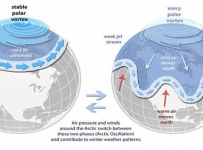
    The “Beast from the East” that froze Europe last week is actually closer to the Game of Thrones Winter crossing The Wall. The Wall is a jet-stream driven by the temperature difference between the poles and continental Eurasia and North America. As the Arctic warms dramatically that differential disappears and the arctic airmass leaks south. The Vortex that froze northern USA in 2014 in a way that shocked the public at the time, has returned intermittently since and has now hit Northern Europe as well.
    This is the atmospheric equivalent of the Gulf Stream that controls the weather in the North Atlantic, carrying warm tropical water up the East Coast of America to the West Coast of England. It is the Gulf Stream that keeps Eastern USA, England and Ireland comparitavely warm. The Ice Ages of pre-history occurred when the gulf stream was turned off.
    Following a discussion about the impact of the gulf stream on ocean currents in live science discussions about whether global warming could cause an ice age fuelled hilarity among client skeptics. The notion was at the heart of the 2004 movie, The Day After Tomorrow. It took five years of more considered discussion for this simplistic notion that the planet will fix itself by simply flipping its major settings to engender a more nuanced discussion. Looking back over more than a decade of reporting on the politics of climate change what appears more important than our oversimplification of science in an attempt to get simple and clear explanations is the tendency to see these solutions as saving humanity. Rather than confronting the very real difficulties of the small changes in front of us, we immediately look to the more distant future in an attempt to find grand solutions.
    How Climate Change Interacts With the Polar Vortex
    The entire region of the Arctic above the 80 degree North Latitude line has been 8.64 degrees Celsius warmer than normal for all of 2018 thus far. This is an extraordinary departure for a region that plays a critical role in how the Earth’s climate system functions. When the Jet Stream winds slow, they tend to meander — forming large ridges and deep troughs. The elongated ridges and troughs eventually break like waves — pushing against the circulation of the Polar Vortex.
    Scientists alarmed by ‘crazy’ temperature rises
    Record warmth in the Arctic is unprecedented. The north pole gets no sunlight until March, but an influx of warm air has pushed temperatures in Siberia up by as much as 35C above historical averages this month. Greenland has already experienced 61 hours above freezing in 2018 – more than three times as many hours as in any previous year. The question now is whether this signals a weakening or collapse of the polar vortex, the circle of strong winds that keep the Arctic cold by deflecting other air masses. The vortex depends on the temperature difference between the Arctic and mid-latitudes, but that gap is shrinking because the pole is warming faster than anywhere on Earth. While average temperatures have increased by about 1C, the warming at the pole – closer to 3C – is melting the ice mass.
    New study sharpens focus on Antarctic ice loss 
    Accelerating ice losses from the West Antarctic Ice Sheet and reveal surprisingly steady rates of flow from its much larger neighbor to the east.
     
    Stronger storms mean new ‘category six’ scale may be needed
    Traditional scale used goes only to five but strength and intensity of storms is increasing, stimulating creating a category six to reflect the increasing severity of tropical cyclones in the wake of warming sea temperatures and climate change.Scientifically, six would be a better description of the strength of 320km/h storms, and it would also better communicate the well-established finding now that climate change is making the strongest storms even stronger,
    Climate change will push European cities towards breaking point
    Uurgent need to adapt urban areas to cope with floods, droughts and heatwaves. The research highlights the urgent need to design and adapt our cities to cope with these future conditions.They found the British Isles have some of the worst overall flood projections, with the high scenario predicting half of UK cities could see at least a 50% increase on peak river flows.
    There is a super-hot sport over the North Pole. It has forced the normal frozen Arctic air to the south, creating this crisis.  We should call this the Dragon from the north, not the Beast from the East. The media has not discussed the connection. This is the only so-far-ultimate consequence of warming the planet and the oceans.  
    the Unusually Warm Arctic Might Scare Your Pants Off
    Cities in Europe, meanwhile, are getting hit with unusually cold temperatures and snowfall. That’s days after the U.S. East Coast had record highs.
    Siberian blast to SMASH Britain with ‘coldest winter snap
    Watch the video of icy weather moving into England
    A Large Area of Open Water Forms North of Greenland During February
    Warm winds blowing at up to gale force intensity from the south have assaulted the ice with high waves and above-freezing temperatures for about four days now. The ice edge north of Svalbard is being rapidly beaten back. Perhaps more disturbing, is the fact that the ice pack to the north of Greenland has also now withdrawn — opening up a huge polynya.
    Onset Of Climate Tipping Points
    The global effect of Arctic melting will create almost as much global warming as already produced by the total rise in atmospheric CO2. Once a temperature threshold is breached, abrupt events follow due to amplifying feedbacks, even within a few years, examples being  (1) freeze events which followed temperature peaks during past interglacial peaks due to influx of cold ice-melt water into the north Atlantic Ocean; (2) the Dansgaard–Oeschger warming events during the last glacial period; (3) the Younger dryas stadial freeze and the Laurentian stadial freeze. In some instances it only took a temperature rise of about 1-2 degrees Celsius to trigger extensive ice melt, with a flow of cold melt water into the oceans that triggered abrupt transitions that could occur over a few decades and even few years.
  • Efficient technologies increase consumption

    Efficient technologies increase consumption

    Increasing energy efficiency has long been promoted as a realistic means of reducing consumption and so lowering carbon emissions and resource consumption. Only problem is, gee whiz, that it does not work. Figures of the last two decades of energy use indicate that given an increase in efficiency, the resultant price drop encourages additional use and so increases consumption. In other words, the tendency is for humans to consume as much as we can afford rather than as much as we need.
    The battle then is not to simply create better technologies but to better manage our lifestyle expectations and our behaviour.

    From The TYEE …

    The more ‘efficient’ our technology, the more resources we consume in a downward spiral of catastrophe. Thanks to efficiency an airline ticket is one of the most environmentally damaging goods money can buy.
    The transition from incandescent to LED lights won’t result in any lasting savings as more efficient lighting resulted in more light consumption and therefore higher overall energy spending; efficiencies in cooling technologies encouraged more air conditioning and refrigeration everywhere; although it takes about three times less energy to make a ton of paper than it did in 1965, we photocopy one billion documents  with a 22% growth rate; each unit generated by non-fossil-fuel sources displaced less than one-tenth of a unit of fossil-fuel-generated electricity.
  • Church and State collude to worship money

    Church and State collude to worship money

    From The Cage – 6th September 2016

    We have had quite a few stories about the role of money in the news recently. This week it was the Universal Basic Income in Finland. Last week it was the attempt to eliminate cash in Sweden and the tactical undermining of the US dollar by Russia and China.
    The premise of the Cross this morning is that the worship of money has replaced the worship of God. That the death of God has largely occurred because money is the new deity.
    One of my day jobs is grilling citizens about their financial position for a well known research company. We ask them everything from their attitude to legalizing marijuana to their marital and parental status, but more than a third of the questions are about finance. What I have learned from that experience is that most people understand that civilization is in trouble. They get climate change, they get environmental damage, they understand that global capitalism is amoral at best and more likely immoral.
    They know all this, but they head off to work every day, they borrow money from banks, they dance with debt, and they accept the incarceration and torturing of refugees because they are afraid. They know that the poor are going to suffer most when the shit hits the fan and they don’t want to end up at the bottom of the heap.
    The challenge for those of us who want progressive reform, who want to create a fairer world, based on community not corporation, built on purpose and not profit, funded by a steady state economy not the fairy tale of infinite economic growth … the challenge for you and me, dear listener, is that we have to somehow break the cycle of fear, the race to the finish line. They fear the angry, hungry hordes who have been exploited so we can enjoy cars, phones and plane trips while they work for $1 a day making our clothes, our cars, our household appliances. They worry that the injustice will be reversed, that the first will be last and it really is harder for a rich man to enter heaven than for a camel to pass through the eye of a needle.
    That is the madness and the brilliance of the populist politician. That is the fundamental premise of capitalism. The old Monty Python joke “What did the Romans ever do for us,” goes to the heart of the problem. Unless there is a real alternative to the Cage people willingly lock themselves in, hoping they are safer in the Cage than they are in the wild.
    This is also the fundamental basis of law, policing and property. The state emerges to protect or expand itself. It alienates people from their natural relationships with the earth, and offers them the bounty of property, regular food and an easier life. And the act of creating boundaries, of creating property requires the policing of those boundaries, the regulation of that property and so policing emerges.
    The state evolved from tribalism to kingdom by the creation of agriculture to support a military caste. The evolution of empires required the invention of slavery and then taxation. Instead of simply destroying the neighbours in the quest for plunder, we learned to enslave them instead.
    The incorporation of religion into the apparatus of the state, elevates the ruler into the priest caste and places them above the military caste. It is a more effective way to subjugate the population than by violent oppression. Two weeks ago we discussed the rise of Christendom in Europe as a way of taming and thus harnessing the violence of the Norsemen, the Normans who had emerged from Scandinavia in Viking long boats and dominated England, France and Italy. By blessing them and turning their attention to Jerusalem under the banner of the Cross, the Abbots of Europe managed to preserve their wealth and dominance of Continental politics.
    The invention of a rule of contract law and double entry book keeping in Venice elevated secular society above the simple machinations of the church and Venice cynically stole a whole French army destined for Jerusalem and shipped them to Constantinople instead to smash the Christian Turks who threatened their trade.
    We will come back to that after this message from our deity