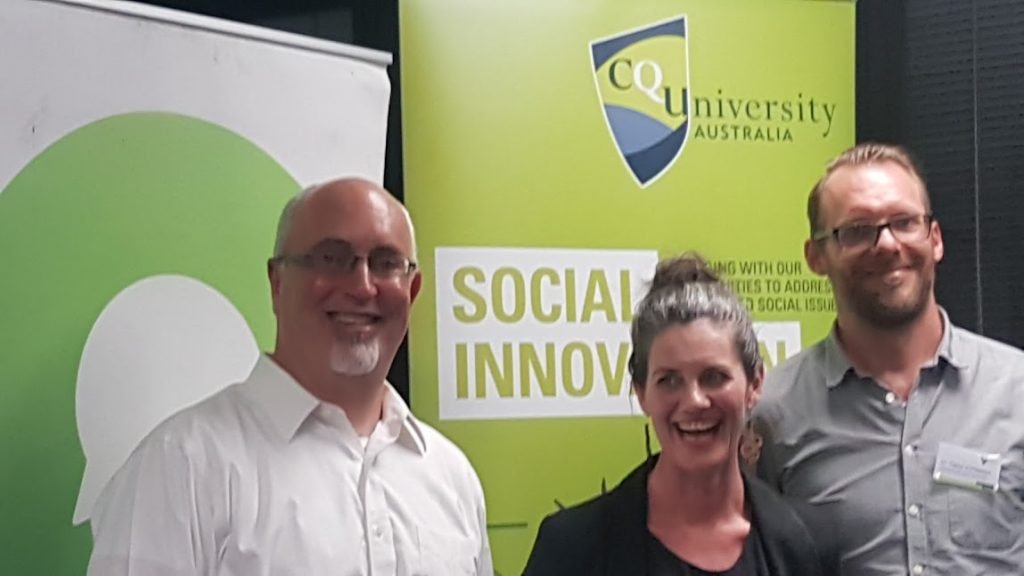
Visiting professor Jay Friedlander brought his abundance approach to social enterprise at CQ University in Brisbane last night, Monday November 4th. Hosted by Dr Tobias Andreasson of CQU and Emma-Kate Rose of QSEC, Professor Friedlander outlined his Cycle of Abundance and the Social Enterprise bootcamp that he runs.
“Many approaches to sustainability have focused on using
less, doing without … we have adopted the scarcity model of the economists,” he
told 30 social entrepreneurs, gathered to discover how his institute in Maine,
USA helps start up founders bridge the business gap.
The College of the Atlantic is a tiny campus, nestled into
an island in the far north east corner of the United States, which takes 350
students through a Masters of Human Ecology using a hands on learning approach
in which they build a social enterprise as part of their education. The system
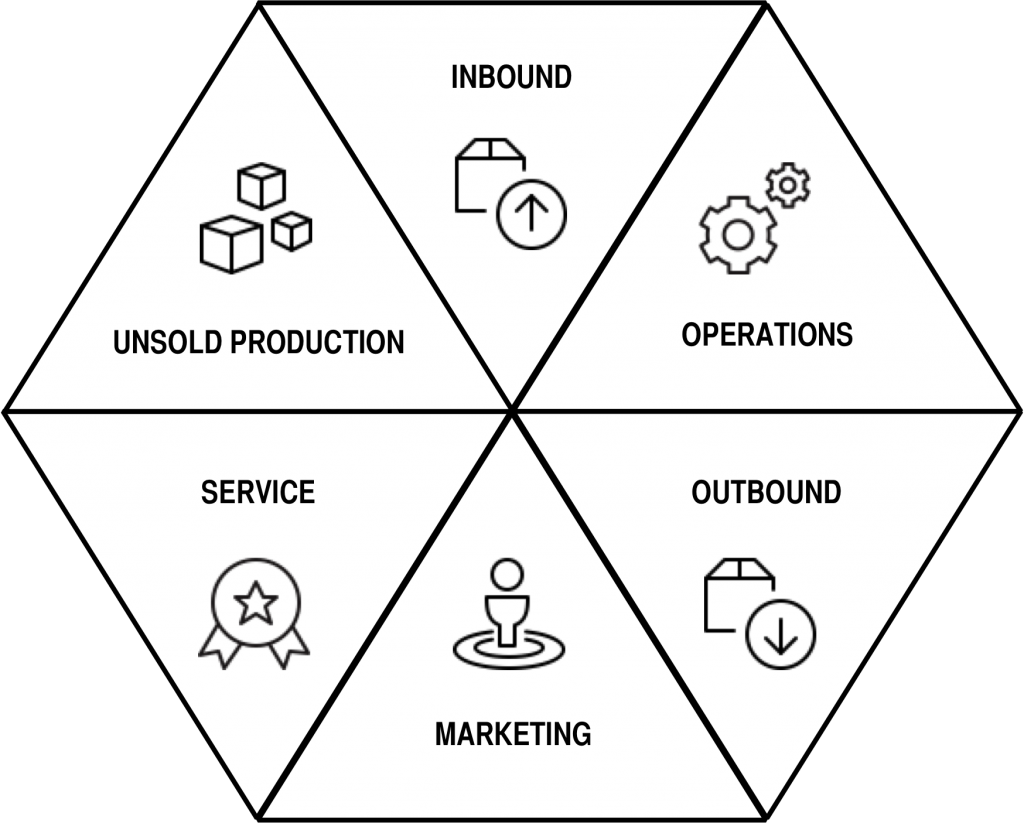
uses variations on a business model canvas which replaces waste with a category
of goods known as “unsold production”. He described these subtle shifts in
thinking as the basis of promoting a new approach to business.
He described the intensive MBA 101 as a key component in
taking the visionary, passionate founders through the process of understanding
the basic building blocks of a business. They all start off pursuing their
passion then at some point they realise, Oh My Goodness, I am now running an
enterprise and I don’t know the first thing about management and systems.
“We found that process to be so transformational that we
decided to take it off campus and run it as a three day boot camp.” The boot
camps have run in 19 US states and various Australian organisations are looking
at adopting them here.
Jay Friedlander, Emma-Kate Rose and Tobias Andreasson at CQU
In response to questions from the floor, he said that while
each sustainable enterprise can only shift the world a little, it is the
network of social enterprises that will build a model for the future and the
mutual support will help the sector scale.
He noted that operating at scale can lead entrepreneurs to
focus on growth instead of their vision but he pointed out that it is critical.
“For example, after fifteen years in building and promoting organic fast food
in the US we are still less than one percent of the market. If the 99% of
commerce heed over the cliff, we are going with them. We need to scale up massively,
to make a difference.”
Geoffrey Wade knows the power of coaching; he delivers it to his corporate clients for a living. He spoke at the invite-only Connect Collaborative in Brisbane last week, sharing some of the research that informs his practice and some of the lessons he has learned.
Surprising to many in the room, including this little black duck, he shared research showing that coaching more than doubles performance in areas of “complex activity, like sales”. Given the dependency of any business on sales this makes a pretty compelling case.
He also noted that four in five people rate themselves as
good to excellent coaches, but measurement shows that less than one in ten
actually do even the most basic first step in successful coaching, pay
attention to what the person is doing.
Geoffrey Wade of Onirik
Mr Wade believes that coaching is basically a process of
helping people to improve their practice and so it makes sense that you need to
watch and measure the existing behaviours as a first step to improving them.
He said the other mistake that is almost universally made is
that we manage people by measuring their results. “Telling the best performers
that you want to raise their targets might work, because they know what they
are doing,” he said, “but that is not going to get you radically different
results. The way to really make a difference is to turn around the people who
are struggling, they sometimes perform and sometimes do not. They do not know
what they are doing wrong and it is your role as coach to help them work that
out. No-one wants to be a poor performer, it is simply that they do not know
the techniques required to improve.”
As we all nodded sagely at the self-evident logic of what he
was saying, in full knowledge that most of us have been making all the mistakes
he pointed out, he dropped a bombshell that woke up the room and refocused our
attention.
“To get this right,” he said, “You have to follow a simple
ratio. Praise everyone five times, for each time you offer them corrective
feedback.”
His research indicates that there is no point hammering
people for poor performance, you simply crush their morale and cause them to
lose interest. The praise, he says, is the sweetener that encourages them to
want to perform, the corrective action is the support and advice they need to
do so.
“It might help to remember not to criticise a mistake or
poor performance the first time you see it.”
Geoffrey excludes safety issues from this general rule, noting that they have to be called out as soon as they are observed. The rest though can be run through the ‘zip your lip’ filter. “The first time is random, the second time is co-incidence and the third time is a pattern.” He finds this equally applicable to parenting, sports coaching and business. “If you say to someone, I have watched you do that twice before and now I see you doing it again, clearly this is something we need to address, they know you are on the ball. They also know that you are not going to tolerate poor performance and that you are not prone to knee jerk reactions. That is a pretty powerful way to earn someone’s respect.”
He said that the absolutely worst technique ever taught to
manager and coaches is the “sandwich technique” known at the school I went to
as the “shit sandwich technique”. “You are doing a good job, Jim. Your sales
numbers are not good enough, but the customers love you and that’s important.”
Not only does burying the corrective advice between two
layers of praise confuse the message every time you use it, repeating the
pattern undermines your credibility. Everyone soon works out that you are using
a formula and it reduces the value of the comment and the respect in which you
are held. “If there is one message I want you to take away from this it is to
dump that technique. Write it on a paper and burn it, wave rooster feathers
over it and tear it in half, whatever ritual you need to use to cleanse your mind,
do it. You must never, ever, use the sandwich technique again.
The notion of values being core to business success is not restricted to the profit-for-purpose sector, impact investing or philanthropic work.
Apple is widely held to be a world leading example of market domination through value identification
Brand strategy approaches like Simon Senik’s Why, the Business Model Canvas, or the currently fashionable disrupt to succeed approach are all based on identifying the value that you offer to your customer and placing that value at the core of your business. All refer to Apple as a leading example of this thinking.
Even traditional sales and branding approaches, though, depended on the identification of your Unique Value Proposition (UVP)
We do not have to assert any new world view
to assign an important role to your values as a business owner or director of
an organization.
The importance of value to a brand is that
it overcomes price, convenience and other considerations that undermine profit.
If we appeal to the values that we have in common with our customers they will
reward us with their dollars.
Values, then are the core of a brand and
the basis of your message, raison d’etre and brand.
But wait, there’s more.
At the heart of the logic about brand value
is the recognition that our values tie us together. It is our values that make
us feel to be part of something.
In his best-selling book Good Profit, Charles G Koch – yes he is one of those Koch brothers – writes “What I consider to be good profit comes from creating superior value for our customers while consuming fewer resources and acting lawfully and with integrity. Good profit comes from making a contribution in society.”
We can complement our drive for profit,
then, with a drive for values. In fact, we can release our profit to harness
our values to create that network of stakeholders with common values that in
turn will future proof our business by creating a community of values that
supports our business.
It seems like heresy to put something other
than profit at the heart of our business strategy.
After all, business cannot survive without
profit. If you are running an organization that is not balancing its books,
that is losing money, then you will have to close the doors and you will lose
everything you have built.
Profit is absolutely essential to success
in business.
The key, though, is that profit is
necessary, but it is not sufficient.
I can make a profit by bullying people to
give me money, I can make a profit by stealing, I can make a profit by selling
the river running through my city, the clouds above or the trees in the local
park, but none of these business models are sustainable. Eventually, the
stakeholders whose resources I am appropriating will find some-way to stop me
from profiting from taking their stuff.
It is only when we contribute value to our
stakeholders that they support us.
By overtly declaring that value, and
working with our stakeholders to build and protect that value we can future
proof our businesses.
A community with common values collects and nurtures value within the community
The advantage that nearly all small
business has over its larger competitors is that it is already part of a
community. The fact that you work in an area where your customers know you is
your secret weapon, a starting point that cannot be replicated by the world’s
biggest corporations, by global trade agreements or by unsympathetic
governments.
You can release your profits to invest in
nurturing secret advantages like that and build the stakeholder community that
will future proof your business, simply by identifying the values that you have
in common.
Values and identity politics.
There is one potential danger in the focus
on values and building communities with like values and that is the sense of
tribal belonging that it creates.
It is this tribal urge at the heart of
values that has made religion and other belief systems such a powerful tool in
imperial conquest. You do not need such a huge army to force distant
populations to pay taxes if they believe in the values that you offer them.
I am an unlikely person to be quoting Charles
G Koch, because the values that drive the Koch brothers enormous coal business,
their funding of climate denial media and the support of conservative politicians
and their politics of fear are the same values that he considers to be the
basis of Good Profit. I have been selective in my use of his quotes to show
that the application of values to business is not a partisan view. He is
selective of the philosophers that he quotes in his identification that
Economic Freedom is the most important freedom of all and the moral duty of government.
We promote our values, then, at the risk of
fanning the flames of tribalism. Identifying our values identifies groups of
people who will support us come hell or high water. If we work together to
support each other, we weave a community that is self-reinforcing and resists
outside attempts to break it up.
The relationship between values and the circular economy is that those communities will then find ways to close the loop, keep value in the community and reduce the wastage of energy, resources and value from the community. But that is the topic of the next article.
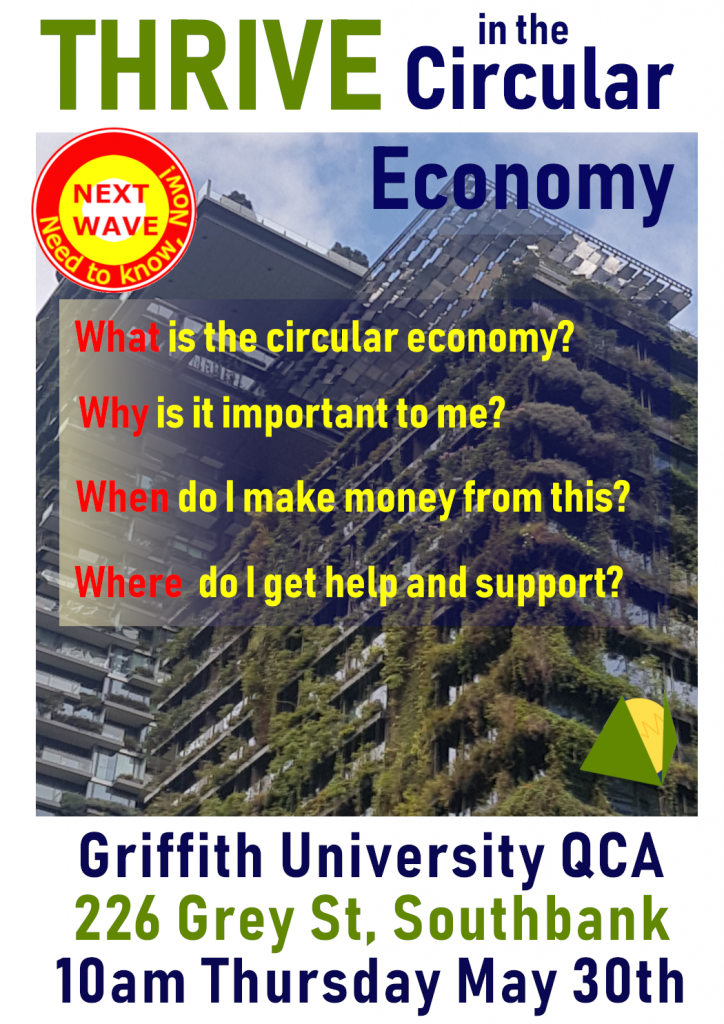
Attendees to Small Business Week on Southbank are invited to
discover the opportunities presented by the Circular Economy at Griffith
University, Southbank at 10am on May 30.
Circular Economy opportunities in Australia alone represent billions
of dollars of dormant value that can be released by Small and Medium
Enterprises focused on the sector. “Many companies assume that the Circular
Economy is specifically focused on waste,” said lead strategist for Great
Notion, Geoff Ebbs, “The truth is that it is focused on wasted value.”
Business owners and managers attending the workshop at QCA
Grey St South Bank will be brought up to speed on strategies, tools and
opportunities to engage with the Circular Economy.
Dr Rob Hales, Director of Griffith Sustainability will launch a short course in the Circular Economy aimed directly at small business.
The course has been developed in conjunction with CELabs, a
Circular Economy laboratory funded by the Qld Government to engage 65 corporates
in building a template for the Circular Economy that will be presented at the inaugural
Circular Economy Conference in Finland in June.
Marjon Wind of the CELab will outline the project in detail.
Free tickets are available to attend the event, information packs and vouchers to hands-on workshops are available for $125.
The circular economy differs from a linear economy because the output of one process is the input of another.
The available outputs of the food production are uneaten vegetable matter and sewage from which we can harvest nutrients, energy, water and solid waste. Natural ecosystems are circular in that plants and animals accumulate nutrients and grow during their life, and then release those nutrients back to the environment as they excrete, or when they die.
An ecosystem is a circular economy built of component linear processes. An ant nest organizes and concentrates nutrients that form a valuable supply for nearby trees or scavenging beetles. A tree accumulates resources and stores them in the form of timber.
A specific ecology may also rely on external cycles. A rainforest, for example, relies on a larger circular system for its water. The water cycle injects water into the rainforest which releases it to the sea. The rainforest is also a net user of energy. Sunlight powers the growth of the forest, and is the primary source of energy for all other life forms.
Of course, sunlight also powers the water cycle, evaporating water and driving the winds that move clouds around the earth. Our fossil fuels come from ancient forests. The only sources of energy on earth that are not derived from sunlight are the gravitational pull of the tides and the geothermal energy from our molten core.
When planning a circular economy, it is critical that we take note of this net use of energy, and the reliance on larger cycles, so that we do not cripple each component of the ecosystem with artificial constraints. Linear processes can participate in a circular economy if their waste provides valuable inputs to other areas of the economy.
Edison went through many thousands of
versions of the electric light globe, literally, before finding one that worked
and could be mass produced.
Photo credit: Richard Warren Lipack / Wikimedia Commons.
It is these thousands of iterations that
led to his famous observation that success is one percent inspiration and 99
percent perspiration.
The one percent inspiration is critical,
though. Without an idea that drives us forward, we would never keep going
through the endless repetition of trial and error that builds success.
It is that inspiration that builds staff
and customer loyalty and that gives your brand meaning.
Many branding tools, discussions and
seminars, including Simon Sinek’s famous Why Ted Talk, emphasise the importance
of passion in building your unique brand identifier.
But inspiration has another, deeper
significance for business in tough times.
Nearly all businesses, and business models,
have a reasonable chance of succeeding when the economy is booming, but we need
something special when the going gets rough. The customer and staff loyalty,
and their willingness to pay for our unique value, is an important ingredient
in the recipe for survival.
The challenge in tough times is to find
that competitive edge that allows us to thrive while others are struggling.
Some businesses become more aggressive, use their market position to dominate
their competitors, or their global reach to drive down costs. These strategies
are exploitative. In the current global economic climate, these strategies
exacerbate the problems we all face, not ameliorate them.
The premise of Great Notion is that
innovation and inspiration provide a non-exploitative differentiator and allow
us to build stronger, long lasting relationships with our stakeholders. We can
expand by exploiting others, or we can outcompete them by being better, and
being better in this context usually means being smarter.
Putting your inspiration at the core of all
your business practice, or identifying the inspiration that belongs at the
heart of your business practice allows you to build value, based on your
values, rather than on exploiting your customers, staff or suppliers.
That is the way to build thriving, viable,
sustainable business. Now, that’s a great notion.