Category: Energy Matters

  • Car makers ‘failing consumers’ on emission data


    The online survey involving members of the public found that only half (52% of attempts by consumers to find CO2 figures for specific UK cars were successful. Less than 5% of the 363 people who took part came across the widely recognised A-G energy efficiency label while attempting to look up emissions data.

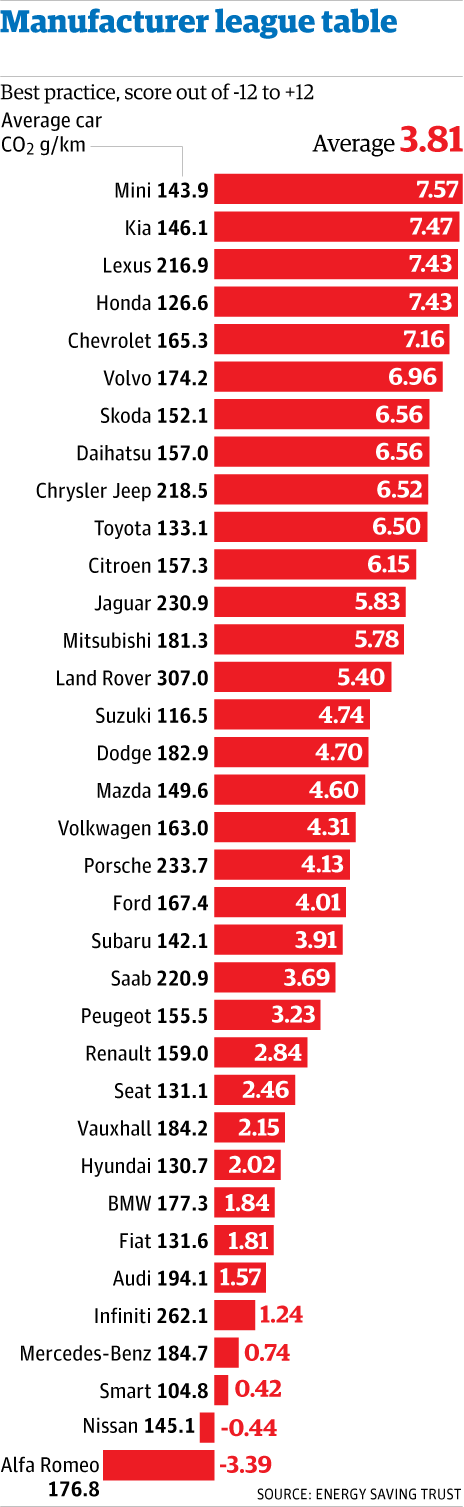
    Mini, Kia, Lexus and Honda were lauded for the ease of use and accessibility of finding CO2 data on their sites, while the worst – ranked by user experience criteria – were Alfa Romeo, Nissan, Smart, and Mercedes-Benz.

    The consultancy Ecolane, which carried out the survey, rated the websites on five “design principles” including site navigation; providing CO2 data alongside core data such as performance; how clearly individual models and different “trims” are described; whether comparative emissions information was provided (such as the A-G label); and whether the sites relied on large downloads of PDF files. The report also evaluated how long it took survey respondents to find the data.

    car league table

    The average time taken to find CO2 figures for cars ranged from 74 seconds for Lexus to nearly eight minutes for Alfa Romeo, whose site came bottom of the overall usability table. Other sites coming in for criticism included the low ranking Smart site – “very slow and difficult to find correct model. CO2 not given high importance compared to other car features such as equipment and style” and the Seat site which received the ultimate condemnation “about as easy as dealing with the civil service”. At the opposite end of the spectrum was Peugeot. One tester said: “Very easy to find the emissions data, all sites should be like this.”

    Car makers must display a car’s fuel consumption and CO2 data in their showrooms but are not legally required to do so on their sites. Marian Spain, the director of strategy at the Energy Saving Trust, said: “Nowadays most people do initial online research when looking into buying a new car. Our research shows that in many cases, finding out the running costs of cars and their impact on the environment from the car manufacturer website is like looking for a needle in a haystack.”

    Blake Ludwig, managing director for the We Are Futureproof group, said: “More and more people want to choose greener, more efficient cars, but our study shows that some car makers expect them to spend time hunting around confusing websites for information. Other car markers have got it right, putting the data upfront and easy to find, and we think all companies should have to follow this model.”

    A spokesperson for the Society of Motor Industry Manufacturers and Traders said: “Vehicle manufacturers are highly aware of the important role driver information can play in reducing road transport emissions and the significant influence this data has on a person’s purchasing decision.”

    A Department for Transport spokesperson said the government recognised that people wanted “clear information on the environmental credentials of new cars” and pointed to the requirements to show figures for new cars in showrooms and government’s voluntary scheme for used cars. But they said the government was not looking to mandate car makers to improve CO2 data on their own websites.

    Consumers can also find CO2 figures elsewhere online, such as on the government’s Act On CO2 site and the VCA website.

  • History of the electric vehicle

    Electricity is one of the oldest automobile propulsion methods still in use today. The invention of the electric vehicle is attributed to various people, including the Hungarian inventor of the electric motor, Ányos Jedlik, Vermont blacksmith Thomas Davenport, Professor Sibrandus Stratingh of Groningen, the Netherlands, and Scotsmen Robert Davidson and Robert Anderson. The invention of improved battery technology, including efforts by Gaston Plante in France in 1865, as well as his fellow countryman Camille Faure in 1881, paved the way for electric cars to flourish in Europe. France and the United Kingdom were the first nations to support the widespread development of electric vehicles, while the lack of natural fossil resources in Switzerland resulted in the rapid electrification of its railway network to reduce its dependence on foreign energy. English inventor Thomas Parker, who was responsible for innovations such as electrifying the London Underground, overhead tramways in Liverpool and Birmingham, and the smokeless fuel coalite, claimed to have perfected a working electric car as early as 1884. Before the pre-eminence of internal combustion engines, electric automobiles also held many speed and distance records. Among the most notable of these records was the breaking of the 100 km/h (62 mph) speed barrier, by Camille Jenatzy on April 29, 1899 in his ‘rocket-shaped’ vehicle Jamais Contente, which reached a top speed of 105.88 km/h (65.79 mph). Before the 1920s, electric automobiles were competing with petroleum-fueled cars for urban use of a quality service car.[2]

    German electric car, 1904, with the chauffeur on top

    It was not until 1895 that Americans began to devote attention to electric vehicles, after A.L. Ryker introduced the first electric tricycles to the US, many innovations followed, and interest in motor vehicles increased greatly in the late 1890s and early 1900s. In 1897, electric vehicles found their first commercial application as a fleet of electrical New York City taxis, built by the Electric Carriage and Wagon Company of Philadelphia, was established. Electric cars were produced in the US by Anthony Electric, Baker, Columbia, Anderson, Edison [disambiguation needed], Studebaker, Riker, and others during the early 20th century. In 1917, the first gasoline-electric hybrid car was released by the Woods Motor Vehicle Company of Chicago. The hybrid was a commercial failure, proving to be too slow for its price, and too difficult to service.

    1912 Detroit Electric advertisement

    Despite their relatively slow speed, electric vehicles had a number of advantages over their early-1900s competitors. They did not have the vibration, smell, and noise associated with gasoline cars. Changing gears on gasoline cars was the most difficult part of driving, and electric vehicles did not require gear changes. Electric cars found popularity among well-heeled customers who used them as city cars, where their limited range proved to be even less of a disadvantage. The cars were also preferred because they did not require a manual effort to start, as did gasoline cars which featured a hand crank to start the engine. Electric cars were often marketed as suitable vehicles for women drivers due to this ease of operation.

    Thomas Edison and an electric car in 1913 (courtesy of the National Museum of American History)

    Acceptance of electric cars was initially hampered by a lack of power infrastructure, but by 1912, many homes were wired for electricity, enabling a surge in the popularity of the cars. At the turn of the century, 40 percent of American automobiles were powered by steam, 38 percent by electricity, and 22 percent by gasoline. 33,842 electric cars were registered in the United States, and America became the country where electric cars had gained the most acceptance. Sales of electric cars peaked in 1912.

  • Glowing walls could kill off the light bulb


    The Carbon Trust has awarded a £454,000 grant to Lomox, a Welsh company that is developing the organic light-emitting diode technology. The trust said it would be two and a half times more efficient than energysaving bulbs and could make a big contribution to meeting Britain’s target of cutting carbon emissions by 34 per cent by 2020. Indoor lighting accounts for a sixth of total electricity use.

    The chemical coating, which can be applied in the form of specially treated wallpaper or simply painted straight on to walls, can also be used for flat-screen televisions, computers and mobile phone displays.

    As the system uses only between three and five volts, it can be powered by solar panels or batteries. Lomox, which will use the grant to prove the durability of the technology, believes it could be used in the first instance to illuminate road signs or barriers where there is no mains electricity.

    Ken Lacey, the chief executive of Lomox, said that the first products would go on sale in 2012. “The light is a very natural, sunlight-type of lighting with the full colour range. It gives you all kinds of potential for how you do lighting,” he said.

    Although organic light-emitting diodes (LEDs) have been available for several years, Mr Lacey said that concerns over cost and durability had prevented further development. He said that Lomox had developed a much cheaper process and discovered a combination of chemicals that were not vulnerable to the oxidation that shortened the operating life span of other types of organic LEDs.

    Mr Lacey said the technology could be used to make flexible screens that could be rolled up after use, or carried into a presentation, for example.

    Mark Williamson, director of innovations at the Carbon Trust, said: “Lighting is a major producer of carbon emissions. This technology has the potential to produce ultra-efficient lighting for a wide range of applications, tapping into a huge global market.

    “It’s a great example of the innovation that makes the UK a hotbed of clean technology development.”

  • Qatar to use biofuels? What about the country’s energy consumption?


    Qataris have the highest carbon footprint on the planet. The country’s per-capita emissions from burning fossil fuels are way ahead of any other nation, and almost three times those of everybody’s poster bad boy, the US. This is all the more extraordinary since Qatar’s electricity is mostly generated from burning natural gas, which has half the emissions of coal.

    Those emissions have also risen almost fourfold since 1990. But, thanks to the vagaries of the Kyoto Protocol, the country is not penalised for this. Qatar is by some measures the second richest country in the world, but for the purposes of climate law, it is classified as a developing nation. And so it has no emissions targets.

    How come Qatar’s emissions are so high? The main reason is its soaring use of energy. By the end of next year Qatar will have six times the electricity-generating capacity it had as recently as 1995. One outlet for all this power is industry, based round its huge natural gas reserves. Just this week, the national gas company announced a deal with ExxonMobil for a new $6bn (£3.69bn) petrochemicals plant.

    A lot of Qatar’s gas is exported as liquefied natural gas – the country is the world’s largest producer of the stuff. It’s a fairly clean fuel at our end, but takes a lot of energy to liquefy in Qatar. So to that extent Qatar is taking a hit to allow Europe and North America to cut their emissions – handy for helping us meet the Kyoto Protocol, but not much good for the planet.

    The Qatari government recently used this argument to downplay its emissions. In its recent Human Development Report, it called them “relatively modest”.

    But that is not the real story. Those Qatari emissions are so extraordinarily high for another reason. Qataris just don’t seem to care.

    Sure, there is the biofuels initiative from the state airline. Sure, a year ago Qatar held a conference to discuss how to cut its emissions without damaging the economy.

    But if its rulers were serious about cutting emissions they might charge for their energy supplies. Yes, you read that right. Qatari households get their electricity free. So why would they cut down on how much they burn?

    Oh, and they get their water free as well. And in Qatar, even more than most places in the Middle East, water is liquid electricity. Almost every drop coming out of the taps is produced from desalinating seawater. This is extremely expensive in energy – and therefore expensive in carbon emissions.

    But because the water is free, Qataris waste it like, well, water. Despite being a desert state with virtually no rainfall, the country has among the highest per-capita water uses in the world. Use averages around 400 litres per head per day. According to Hassan Al-Mohannadi, a geographer at the University of Qatar, people in “big, often palatial houses” consume up to 35,000 litres per day.

    Even here, they have a way of blaming foreigners. According to Hassan Al-Mohannadi, one reason water use is so high is that “the large number of foreign domestic servants, who come from water-rich countries, are not educated in water conservation”.

    Water consumption continues to rise, so Qatar is building more desalination plants. If Qatar was serious about cutting its carbon footprint it would do something about water demand. At the least, it might charge for the stuff.

    Will Qatar’s emissions carry on up? Looks Likely. Electricity demand is currently rising by about 7% a year. That is not as fast as the national economy, which is growing by 11% annually – the fastest boom on the planet.

    But stopping this out-of-control carbon-emitting juggernaut will take more than an Airbus full of biofuels.

  • The electric car revolution will soon take to the streets


    The North American International Auto Show in Detroit is the domestic auto industry’s biggest annual showcase, and the new models have traditionally been brought out in a son et lumière of dancing girls, deafening music, and dry ice smoke. The few green cars that made it this far were usually for display only — very few actually made it to showrooms.

    But not this year. It’s become a race to market for green cars, and soon you’ll be able to buy many of the electric vehicles that were on display last week in Detroit. The auto show featured one hybrid and battery electric car introduction after another. Although the only truly road-worthy, plug-in electric vehicle you can buy today is the $109,000 Tesla Roadster, by the end of 2010 it will be joined by such contenders as the Nissan Leaf, Coda sedan, and the Think City.

    Indeed, the entire auto industry — from giants such as Ford, GM, and Renault-Nissan to startups such as Fisker Automotive — has joined the movement to build and market affordable electric vehicles.

    There’s a reason the automakers in Detroit are finally plugging in as something more than a greenwashing exercise. Spurring them forward is a historic confluence of events. Chief among them are Obama administration green initiatives, including Department of Energy (DOE) loans and grants, as well as economic stimulus funds that provide $30 billion for green energy programs, tax credits for companies that invest in advanced batteries, and $2.4 billion in strategic grants to speed the adoption of new batteries. (Much of that money is going to Michigan, which despite record unemployment is emerging as something of a green jobs center.)

    Other factors behind the push to manufacture electric vehicles are a federal mandate to improve fuel efficiency to an average of 35.5 miles per gallon by 2016, concerns about global warming and peak oil, and sheer technological progress building better batteries.

    Even without federal largesse, some companies are moving aggressively into the electric vehicle market. A prime example: Coda Automotive, a southern California start-up, has raised an impressive $74 million in three rounds of private funding. CEO and President Kevin Czinger is a former Goldman Sachs executive, as is co-chairman Steven Heller. Among the company’s investors are Henry M. Paulson, who was Goldman Sachs’ chairman and Treasury Secretary under the second President Bush. Clearly, these former investment bankers see electric cars as a good bet.

    A key factor in making today’s electric vehicles possible is the rapid development of the energy-dense lithium-ion battery. William Clay Ford Jr., the executive chairman of the company that bears his name, told me in Detroit, “Five years ago, battery development had hit a wall, and we were pushing hydrogen hard. But now so much money and brainpower has been thrown at electrification that we’re starting to see significant improvements in batteries in a way we hadn’t anticipated. Now we have the confidence that the customer can have a good experience with batteries.”

    Drawing a huge crowd, Tesla Motors Chairman and CEO Elon Musk showed off his company’s 1,000th electric Roadster at the auto show. “For a little company, it’s a huge milestone,” he told me. “A year ago, we had built only 150 cars. We had two stores then, and now it’s a dozen.”

    For a major automaker, 1,000 cars would not be much to show for a year, but electric vehicles are still in their infancy. And since the electric car’s first swan song in the 1920s — when the widespread availability of petroleum ushered in the era of the gasoline-powered car — very few start-up companies have reached the milestone of making green vehicles, especially battery-powered ones.

    Here’s a look at some of the prime contenders bringing battery cars and plug-in hybrids to market:

    * Renault-Nissan Alliance. This is the one automaker with a truly global plug-in strategy and the means to carry it out. Under the Nissan banner, the company will deploy the Leaf battery sedan, with 100-mile, all-electric range. Nissan isn’t just dumping its sleek entry into the market — it’s also building a home charger with new partner AeroVironment and partnering with local, state and federal governments — both in the U.S. and abroad — on public charging stations. In partnership with Better Place, the company will deploy a second Renault electric vehicle as part of its plan to wire up Israel with charging stations for electric cars. Renault-Nissan chief Carlos Ghosn predicts that electric vehicles could constitute 10 percent of world car sales by 2020.

    * Ford Motor Company. Ford’s green strategy includes a plug-in version of the new Focus for 2011 and a “next-generation” hybrid — based on its global compact-car platform, or C-platform — in 2012. The company announced in Detroit that it would invest $450 million in Michigan as part of its electrification strategy. Michigan Governor Jennifer Granholm told me at the auto show that until recently the state “wasn’t sure it had a viable auto industry.” Today, she said, the state is enjoying $1 billion in new auto-related investment, much of it jump-started by a combination of federal funding and state tax credits.

    * General Motors. GM’s big news is the Chevrolet Volt, which has definitely helped the company’s image. The Volt, which uses a small gas engine to generate electricity for its electric motor, is a lot of fun to drive if the version I drove recently in Michigan is any indication. Until now, GM has stumbled in its hybrid strategy, and it really needs this car — which will go on sale at the end of the year for a hefty $40,000 — to be a hit. But success may be more a matter of perception than actual sales. “In terms of numbers, the Volt will be pretty small for the first couple of years,” says product chief Bob Lutz. A Cadillac version of the Volt is also a possibility.

    * Tesla Motors. This California start-up launched at the top of the market with its $109,000 Roadster, which combines sexy looks with supercar performance (zero to 60 in 3.9 seconds). The company is on something of a roll, having sold 10 percent of itself to Daimler for $50 million, and landed $465 million in DOE funding for its forthcoming Model S sedan — a Maserati-like, more practical version of the Roadster. Tesla’s Musk says that the company’s strategy has always been to use its sale of performance cars to finance its third vehicle, a mass-market electric vehicle. The company is currently looking at California locations for a Model S factory.

    * Fisker Automotive. Perhaps Tesla’s closest competitor when it comes to glamour electric vehicles, Fisker – whose CEO is Danish-born automotive designer Henrik Fisker — is preparing to debut a high-performance plug-in hybrid (zero to 60 in 5.8 seconds, with 67 mpg fuel efficiency) known as the Karma at the end of the year. Al Gore is on the waiting list. Fisker also has a lower-cost car in the wings, called Project Nina. Fisker won $528 million from the DOE to build the Nina in a former GM factory in Delaware.

    * Coda Automotive. This start-up will deliver, in late 2010, a small battery-powered sedan with batteries from its own joint venture in China. The car is based on the Saibao, a Chinese car, but Coda has put a host of western companies to work honing an electric drivetrain for it. “A large part of our mission is to accelerate adoption of all-electric vehicles,” Coda CEO Kevin Czinger told me. “We have put together a core group of auto and battery engineers, and are leveraging specialty automotive firms that we think can get us to the right price point.” Coda will launch with an Internet marketing strategy in California only, but it will have the capacity to produce 20,000 cars a year.

    * Think Global. Think is a survivor, with perhaps the longest and most colorful history among green automakers. It is a Norwegian company that attracted Ford Motor Company investment in the late 1990s with its plastic-bodied City commuter car. Ford sold the company in 2003 and it went through bankruptcy proceedings in late 2008. It has since emerged under the partial ownership of U.S. battery company Ener1, which snagged $118 million in DOE funding to expand its battery production in Indiana. Think electric vehicles will also be built there starting in 2011, in hard-hit Elkhart — once proudly known as the “RV Capital of the World” — and now suffering the effects of the recession. The two-seat Think City (with approximately 100-mile range on lithium-ion batteries) will sell for less than $20,000 in the U.S., but that price does not include the leased battery pack and includes the $7,500 federal tax credit for electric vehicles.

    The list of players in the electric vehicle race goes on. Toyota is building plug-in hybrids and fuel-cell vehicles, and showed off a small cousin of the Prius in Detroit. Chrysler has an ambitious electric vehicle rollout that’s been stalled by the company’s bankruptcy and merger with Fiat. Honda continues to deploy clever hybrid cars, including the upcoming two-seat CR-Z it showed in Detroit. BMW has electrified the Mini for a test program, and has similar intentions for the Concept ActiveE, a plug-in version of the Series 1 BMW coupe. And Audi has shown sudden interest in this segment, debuting the second of its electric e-tron vehicles.

    By this time next year, electric cars will no longer be just on auto show stands, but will have arrived in showrooms at last.

  • The open-source hydrogen car set to change the industry

    The open-source hydrogen car set to change the industry

    Alex McDonald

    20th January, 2010

    Cars are evil, right? But what if they ran on hydrogen, did 300 miles per gallon, were leased rather than owned, and were produced under an open source business model…

    We have often been introduced to the car of tomorrow, but one company has now created a car with the future in mind. But it is about far more than just a car, it’s about a business model that is challenging the very architecture of the auto industry.

    Riversimple’s network electric car is a hydrogen fuel cell powered car, with unique technologies that enable it to run on a 6kW fuel cell, with a fuel consumption equivalent to 300 miles per gallon and greenhouse gas emissions at 30g per km, well-to-wheel – less than a third of that from the most efficient petrol-engine cars currently available. 

    It also has the potential to be 10 times cleaner still if the hydrogen is produced from renewable energy.

    Open source

    But what is extraordinary about Riversimple is that their business model is trying to move away from the current auto industry practice that has left us with the inefficient, one-size-fits-all car.

    The first departure from the conventional business plan is that the designs of the car will be released under an open source licence. This allows people to freely build on ideas and designs, speeding up innovation and enabling technologies to be quickly improved, meeting the needs of people rather than markets.

    ‘There is such a yawning gap between the environmental performance of cars and what is sustainable, that I don’t believe a purely competitive world can ever get us there,’ says Hugo Spowers, the brains behind Riversimple.

    ‘[open source] really does produce this constant and very rapid drive toward absolute excellence, which I think is needed in the current circumstances. I have precious little faith in regulation ever pushing us in that direction.’

    Shared learning

    To aid the development of the open source hardware community, Riversimple has set up the 40 Fires Foundation, an open-source hardware group that anyone can join to share expertise and develop technologies.

    Before any official launch, the foundation has already registered over 300 people with expertise in various areas, showing the huge potential for an open-source technology community.

    And this potential can be far reaching:

    ‘Open source allows [developing] countries to build their own technological capacity without having to be liable for any cash fees to the first world,’ says Spowers. The foundation can also take briefs from other countries, adapting technologies as required.

    Small-scale production

    Complementing the open source philosophy, the manufacturing requirements of the car mean that the size of production plant will be greatly scaled down.

    The low component count of the cars and their carbon composite bodies, means that smaller plants will be needed. Riversimple expect one plant to manufacture around 5,000 cars a year, unlike the production of the conventional pressed steel bodies, where a factory will spit out about 300,000 a year of the same model – necessary for the economies of scale.

    ‘When you are doing it at that scale,’ says Spowers, ‘the breakeven volume at which a model becomes commercially viable is 100 times lower. So you can genuinely build cars that suit people’s needs, rather than the opposite extreme which is the lunacy of the “world car”.’

    As a result, the industry can become more distributed: it will be possible to have smaller plants in different places, making different models that are more suitable for different geographies or cultural needs.

    Cars will not be sold

    Another significant departure from the conventional business model is that the cars will be leased, not sold. The leasing will include the maintenance of the car, the fuel and the recycling of the car at the end of its life.

    The idea behind leasing the cars is primarily to bring the incentive of making the cars more sustainable in their production, maintenance and use, back to the manufacturer.

    ‘There’s no driver for resource efficiency if we sell the car,’ says Spowers. ‘If we sell the cars… we have a direct incentive to sell as many cars as possible, so there’s absolutely no commercial sense to build in longevity, low running cost or fuel efficiency – the opposite in fact.’

    In providing the opportunity to produce niche specific cars, Riversimple will also be paving the way for a wider cultural shift in car use. The leasing of the cars will undermine the ‘commodity value’ of the car, leaving drivers only with the use value of the car and, as designs develop and specialised cars are produced, people will – in theory – lease the right car for the right job, rather than the right car for their image.

    Car clubs

    With this in mind, Riversimple expects car clubs to be major customers.
    ‘Car clubs tease apart the functionality of cars,’ says Spowers.

    For most people, he says, ’95 per cent of their [car] requirements will be covered by a certain set of needs, but they buy a car to meet 100 per cent of their needs, and that’s dictated by the last 5 per cent. If 95 per cent of their requirements is on their own, commuting a 20 mile distance and then every couple of weeks they’ll go away with the family, they’ll buy an estate car for that one journey every couple of weeks. …

    ‘If you have car clubs – and they really have mushroomed recently – it means that people can buy the car for 95 per cent of their needs and rely on the car club for the 5 per cent. I think that is a really crucial element in moving towards much more niche, specific, appropriate vehicles for appropriate uses.’

    Riversimple cars are expected to be on trial in the UK from 2012. Around 50 cars will be leased in one or two cities, supported by the local authority.

    Several local authorities have expressed interest including Oxford and Leicester.

    Hydrogen fuel

    One of the major challenges for the Riversimple concept is getting the hydrogen to the cars. In partnership with BOC and participating Local Authorities, Riversimple hopes to overcome this by starting small and building the infrastructure as demand grows.

    Hydrogen refuelling stations will be built in the participating cities, and, as the cars and their hybrids become more popular, the network will build and eventually become extensive enough to support intercity travel.

    The efficiency of the Riversimple car is expected to make the transportation of enough hydrogen to fuel stations feasible.

    Opportunity

    Spowers himself conveys an infectious sense of urgency.
    ‘There’s a window of opportunity of about ten years in which I think we’ve got a chance of establishing this,’ he says. ‘In about 10 years time, people will have a steel bodied fuel cell car with probably a 60 KW fuel cell system in a commercially viable, ordinary five-seater family car.

    ‘The problem with that is that it will require about four times as much fuel than a car built on the principles we are advocating. And once fuel cell cars are available in the conventional steel bodied platform, then it will be very much harder to ever go back and re-address the fundamental architecture. I don’t think you’ll be able to do it.’

    If the opportunity is missed, says Spowers, cars will be made for the mass market, people will depend on one-size-fits-all and innovation will remain slow.