Category: Greenwash – Companies falsely claiming green cred.

The typical image of the Mediterranean is a blue sea with white-walled houses clinging to the rocky landscape. Every spring, after the Easter processions when the Mistral stops blowing, house-proud citizens freshen up those walls with a bucket of whitewash. The power of a simple mixture of lime, chalk and water to hide the ravages of a year’s wear and tear is so compelling it has entered the language. When a politician puts the best face on a difficult policy, we accuse them of ‘whitewashing’ the truth. The language lives and whitewash has now acquired a green tinge as companies appeal to environmentally careful consumers. Some of them claim green credentials where no green credentials exist. Culprits range from “green phones” through “eco-credit cards” to “clean, green nuclear power”. The Australian Consumer and Competition Commission has had to step in and regulate the offset of carbon dioxide emissions and provide guidelines and definitions for the term “climate neutral”. Your challenge is to develop the necessary X-ray vision to see past the greenwash to the facts underneath. A mixture of specific examples and general principles are provided here to hone your green wash detectors.

  • There’s no right and wrong to tackling climate change


    Not so with climate change. Climate change is a ‘wicked’ problem. There is no unambiguous formulation of what the problem is and no opportunity to learn from other, similar cases. Proposed solutions are so embedded in matrices of social, economic and political cause and effect that they are likely to spawn further unforeseeable and unwelcome side effects. It is not surprising that some have despaired and are now suggesting that we must cut through this Gordian knot and find a more direct solution through climate engineering. Pumping aerosols into the stratosphere, it is claimed, would allow us to control the planet’s temperature directly, bypassing these troublesome entanglements and this social inertia.

    But climate change has come to signify far more than the physical ramifications of human disturbance to the composition of the earth’s atmosphere and its energy balance. Climate change has become as much a social phenomenon as it is a physical one. Arguments about the causes and consequences of climate change – and the solutions to it – have become nothing less than arguments about some of the most intractable social, ethical and political disputes of our era: the endurance of chronic poverty in a world of riches; the nature of the social contract between state and citizen; the cultural authority of scientific knowledge; and the role of technology in delivering social goods. Climate change has become a metaphor for the imagined future of human life and civilisation on earth. 

    The different meanings that can be attached to the idea of climate change are illustrated well by considering ways in which the issue is framed in India. For many in this country, the key concerns are how to secure financial reparations for environmental damage caused by northern nations through the proxy of climate and how to use climate change to advance the development of the 500 million people living in absolute poverty. This framing of climate change is very different from that which prevails in much western discourse and implies a very different set of international and domestic policy prescriptions. The issue is less about how to reverse a two-degree temperature change, how to save polar bears or how to avoid metaphorical tipping points than it is about how to secure hundreds of billions of dollars to invest in basic human welfare.

    It is not surprising, then, that arguments about climate change are invested with powerful ideological instincts and interests. Solutions to climate change vary from market-based mechanisms and technology-driven innovation to justice-focused initiatives and low-consumption localism as a form of lifestyle, each carrying ideological commitments. It is despairingly naive to reduce such intense (and legitimate) arguments to the polarities of ‘belief’ or ‘scepticism’ about science.

    Belief in what, exactly? Is it the belief that humans are contributing significantly to climate change? Yes, science can speak authoritatively on this question. Or a belief that the possible consequences of future change warrant an emergency policy programme? Scientific evidence here offers only one strand of the necessary reasoning. Or a belief that such an emergency policy programme must be secured through an international, legally binding targets-and-timetables approach, such as Kyoto? On this, science has very little to say.

    On the other hand, what exactly is it that the so-called sceptics are charged with? Scepticism that environmental scientists, businesses and central government are in collusion to fabricate evidence? This is barely plausible. Or scepticism that claims about the future that are based on scientific knowledge are sometimes overstretched and underplay uncertainties? The latter is a warning that all would do well to heed. 

    The problem here is the tendency to reduce all these complexities into a simple litmus test of whether or not someone believes orthodox scientific claims about the causes and consequences of climate change. This is dividing the world into goodies and baddies, believers and deniers. Climate change demands of us something much more sophisticated than this. 

    Rather than reducing climate change to arguments about how settled – or not – the science is (predictions in environmental science are rarely, if ever, settled), we need to provide the intellectual, educational, ethical and political spaces to argue fearlessly with one another about the very things that the idea of climate change demands we take a position on. These include our attitudes to global poverty, the role of the state in behavioural change, the tension between acting on knowledge or on uncertainty, the meaning of human security and the value of technological innovation. Where we stand on issues such as these will determine which sort of solutions to climate change we choose to advocate. 

    None of these things is new. They have been around for a long time – for at least the 50 years since novelist and physicist CP Snow declared that advancing science and technology was the only sure way to secure human welfare. 

    But the idea of climate change – suggesting, as it does, that our current development trajectory may not be as systemically benign as we might wish – demands that we re-examine these troubling issues. We must examine them explicitly and honestly. And we must respect the different legitimate positions people adopt about these ideological and ethical entanglements when they appear in public spaces. Indeed, we must foster such exchanges without applying the sleight of hand that turns them back into arguments about belief (or otherwise) in scientific claims.

    Neither scientists nor politicians should try to discredit unorthodox views about how to respond to climate change by using the pejorative labels of ‘denialist’ or ‘flat-earther‘. Scientists must learn to respect their public audiences and to listen more closely to them. Now is no time for the elite to despair of democracy. We have only one planet, but we also have only one political system that most people would choose to live under. Politicians must learn not to hide behind science when asked to make complex judgements. Science is useful as a form of systematic critical enquiry into the functioning of the physical world, but it is not a substitute for political judgement, negotiation and compromise. 

    • Mike Hulme is professor of climate change at Britain’s University of East Anglia. His latest book, Why We Disagree About Climate Change: Understanding Controversy, Inaction and Opportunity , is published by Cambridge University Press.

    • This article was first published in the spring 2010 issue of the RSA Journal, a publication of the London-based Royal Society for the Encouragement of Arts, Manufactures and Commerce, and is used here with permission.

  • Coral reefs crucial to origin of new marine species, finds study


    Wolfgang Kiessling of the Humboldt University of Berlin, who led the study, said: “We found that coral reefs are very active at generating biodiversity in the oceans, and that they export biodiversity to other ecosystems. This was a surprise because many people had assumed that reefs were ecological attracters – that species go there from other places.”

    He and colleagues in Germany and the US studied a database of fossil organisms that lived on the sea floor from the Cambrian period, about 500m years ago. They compared the number of new genera that first appeared in coral reefs with those in other shallow-water environments and found the reefs were responsible for about 50% more. The results are published tomorrow in the journal Science.

    The team looked at fossils of so-called benthic organisms, such as starfish, clams and corals that live on the seabed. They ignored fossils of fish, which do not offer clues to where they evolve, because after they die their remains can float elsewhere.

    Kiessling said the study offered extra incentive to protect coral reefs. “If we lose the coral reefs we lose the ability for marine ecosystems to generate new species in the future. I suspect that new species evolve every single day, but unfortunately not as fast as they go extinct.”

    Increasing carbon dioxide in the atmosphere damages coral as seas become warmer, which causes the coral to bleach, and become more acidic, which makes it hard for the tiny animals to repair their exoskeletons.

    Experts say the world has already passed the safe level of carbon dioxide in the atmosphere for coral reefs, and even the most ambitious carbon cuts planned for coming decades will fail to save them

  • Wall Street plays carbon trading

    OXFORD, England — Marc Stuart and Pedro Moura Costa have become multimillionaires in a booming new market designed to fight global warming.

    Now, their empire is under attack.

    Their firm, United Kingdom-based EcoSecurities Ltd., helps companies in the industrialized world meet their obligations to pollute less by selling them "credits" that fund clean-air projects in poorer nations. Last year, some $9.4 billion in these credits were traded, up from almost none four years earlier.

    The market’s anything-goes early days now appear to be ending. United Nations officials who regulate the trade have started questioning scores of proposed projects, from hydroelectric plants in China to wind farms in India. The issue: whether they provide real environmental gains, or are just padding the pockets of middlemen like EcoSecurities.

    [Marc Stuart]EcoSecurities’ woes are a prime example of how tough it is proving to be to launch a coordinated world-wide attack on global warming. The carbon-credit industry’s growing pains come just as Congress is considering similar pollution-cutting rules targeting U.S. industries.

    EcoSecurities is one of the main players in an international market that was created as part of the Kyoto Protocol to combat global warming. A key premise of the system is that, because greenhouse gases damage the atmosphere no matter where they originate, society should attack them first where the cleanup is cheapest, in the developing world. But policing that far-flung market has proved to be tricky because it involves valuing a commodity, climate-warming emissions of gas, that is far less tangible than oil or gold. [Go to map.] See a map with photos and details on some of EcoSecurities’ top credit-generating projects world-wide.

    The "credits" sold by EcoSecurities and its rivals are supposed to fund clean-air projects in the developing world that otherwise wouldn’t get built. But the U.N. is worried that players in the market may be gaming the system by putting a green imprimatur on some projects that would have happened anyway, defeating the intent of the U.N. program.

    The tougher U.N. scrutiny is necessary to "ensure the environmental integrity of the system, because otherwise it’s not achieving its purpose," says Kai-Uwe Barani Schmidt, the top administrator for the U.N. board that referees this trade.

    EcoSecurities is one of the largest and most aggressive of a dozen or so major firms that scour the globe for projects like these, then profit by selling credits to help fund them. The main buyers are companies in Europe and Japan, whose governments have ratified the Kyoto Protocol, a global agreement imposing pollution caps on industrialized nations. Like EcoSecurities, most of the project developers are based in Europe.

    That business is now in turmoil. Late last year, EcoSecurities said it would fail to deliver one-quarter of the credits it had promised. Its stock has fallen nearly 70% since that write-down — and 80% since its peak last summer. The firm’s two co-founders, Messrs. Stuart and Moura Costa, have lost about $147 million on paper due to the stock’s overall decline.

    Mr. Stuart acknowledges that his firm, in its race to dominate the field, sometimes pushed the envelope. "The first couple of years, this business was a land grab," he says. But many projects, he says, didn’t generate as many credits as originally estimated, leading to last year’s big write-down.

    The firm’s approach "was very successful at first, but it did leave a bit of a mess to clean up," says Mr. Stuart, a former Ultimate Frisbee champion at the University of Pennsylvania, who holds a master’s degree in environmental law and economics from the London School of Economics. He is frank about the problems the industry faces.

    "I guess in some ways it’s akin to subprime," says Mr. Stuart, 43 years old, referring to the subprime-debt woes rattling the U.S. economy. "You keep layering on c- until you say, ‘We can’t do this anymore.’"

    Pushing Back

    EcoSecurities has helped assemble about 10% of all developing-world projects approved so far by the U.N., more than any other player. Its main rivals include Camco International Ltd., which says it, too, has had projects delayed. Another rival, AgCert International PLC, says the tightening of U.N. rules has contributed to the company’s filing for protection from creditors in Ireland, its home country.

    EcoSecurities is pushing back. It notes that the vast majority of its projects ultimately get approved. And it argues the U.N. crackdown hurts the environment more than it helps, since it delays clean-air projects and cuts off a funding source. It says regulators have failed to set clear rules — and now they’re changing their standards midstream.

    One thorny issue: Who should vouch for the quality of clean-air projects? EcoSecurities says the U.N. scrutiny adds bureaucracy because it duplicates work already done by independent auditors who are hired to vet all projects. The U.N. panel should stick to an "executive and supervisory role," EcoSecurities says.

    U.N. officials have questioned whether the auditors have been tough enough. The concern centers on whether auditors, who are hired by project developers, are adequately staffed to police the environmental legitimacy of the swelling number of projects. The auditors strenuously defend the quality of their oversight.

    While that debate rages, EcoSecurities has been busy refocusing on projects less likely to raise red flags. For instance, it is shifting to projects to curb secondary greenhouse gases, such as nitrous oxide, produced in obscure industrial processes like nylon making. The problem, as EcoSecurities executives point out, is that targeting secondary gases does nothing to combat fossil-fuel use, which according to the U.N. is the primary man-made contributor to global warming.

    The situation is "extraordinarily frustrating," Mr. Stuart says.

    The trade in developing-world credits results from a provision of the Kyoto Protocol called the Clean Development Mechanism. A 10-member U.N. board vets proposed projects to ensure their environmental legitimacy. The independent auditors accredited by the U.N. act as the board’s field inspectors, traveling the globe to certify whether a project is up to snuff.

    Each credit is essentially a permission slip to emit one ton of carbon dioxide into the atmosphere. Currently these credits sell for $16 to $24 apiece.

    EcoSecurities went public in late 2005 and was an immediate market darling. Mr. Moura Costa, 44, a Brazilian forestry expert living in Oxford, recalls that by early 2006 he was telling the firm’s lawyers to ink contracts for new projects at the rate of one per working day. "It was a madhouse," he says.

    Permissive Board

    Over the next 18 months, EcoSecurities contracted more than 200 additional projects around the world — from Nicaragua to Inner Mongolia — promising tens of millions of emission credits. Its stock price nearly tripled. Messrs. Stuart and Moura Costa became multimillionaires on paper.

    EcoSecurities’ rise coincided with a permissive U.N. board. In 2004 and 2005, the board automatically approved 95% of the projects proposed to it, according to U.N. statistics. [A Leader Stumbles]

    Mr. Schmidt of the U.N. says the board was thinly staffed at the time. By its current standards, he says, some proposals "probably went through without" proper scrutiny.

    In mid-2006, there was an early hint that regulators were toughening their stance. The issue: manure.

    Decomposing manure at farms emits methane, a greenhouse gas. The projects involve placing a tarp over the manure to capture and dispose of the rising gas. EcoSecurities expected at least 10% of its credits to come from projects like these.

    But in 2006 the U.N. tightened its rules, requiring animal farms to measure the amount of methane they were capturing rather than simply estimating the number based on a formula — and use the lower number. That move slashed by more than one-third the number of credits a typical animal-waste project would produce for sale.

    Suddenly, the projects no longer made economic sense, Mr. Moura Costa says. EcoSecurities canceled most of them, erasing about $100 million in potential profit.

    Still, investors remained impressed with the company, because it continued to grow. Last July, with the stock near its peak, Mr. Stuart sold 2.2 million shares for about £8 million, or about $16 million, and Mr. Moura Costa sold 1.3 million shares for about £5 million as part of a secondary offering, according to financial filings. The two men remain the biggest shareholders with a 20% stake between them.

    Having money was a big change for the two men, Mr. Stuart says, recalling that when EcoSecurities was young he routinely charged up thousands of dollars of debt on his credit card to help keep it operating. After the stock sale, Mr. Stuart traded his 1994 Mercury Sable for a $55,000 black Lexus hybrid sedan.

    Around then, the U.N.’s crackdown started in earnest. The U.N. staff zeroed in on projects they had reason to believe might be financially viable even without revenue from the sale of credits. Last year, the U.N. board gave automatic approval to only 57% of proposed projects, down from 95% in 2004 and 2005. Overall, it rejected 9% of proposed projects last year, more than double its rejection rate in 2006.

    One of the proposals blocked was an EcoSecurities project at a grain-processing plant in Uberlandia, Brazil, to replace oil-fired boilers with one using renewable energy like scrap wood. The U.N. said EcoSecurities hadn’t proved that it needed revenue from selling credits to make economic sense.

    EcoSecurities wasn’t surprised the project got shot down: The company’s own calculations showed that replacing the boilers made marginal economic sense even without the sale of credits.

    The project "was in the gray zone" of the rules, Mr. Stuart says. He likens the U.N. panel to the Internal Revenue Service: "You push things as hard as you can, within what you think are reasonable guidelines. But every now and then the IRS will push you back."

    Value Judgment

    The U.N.’s Mr. Schmidt says it doesn’t surprise him that borderline projects like these get submitted. "If I were not to expect such behavior, I would be living in the wrong world," he says. Nevertheless, he says, "I don’t see this particular case as trying to cheat."

    Determining whether or not a project needs carbon-credit revenue is "a value judgment," he says. "It is one of the biggest challenges" of the carbon trade.

    Mr. Schmidt, who has known Messrs. Stuart and Moura Costa for more than a decade, says he respects the company. "We have a very good relationship," he says. "We also know we have certain roles to play."

    U.N. officials acknowledge that calculating whether a project can be economically viable without carbon-credit revenue is subjective. For instance, the calculus can swing widely based on whether oil prices surge, or fall. Similarly, it involves guesstimates of how long a project — whether a hydroelectric generator or methane-recapture effort — will remain operable.

    EcoSecurities has more than 100 projects approved by the U.N., and only a handful rejected. But many of its proposed projects now are being held up by the U.N. for review. That’s bad news for EcoSecurities because it delays its ability to start selling credits. The company originally operated on the assumption that U.N. approvals would take two months, on average. But now they’re taking an average of nine months.

    Obsessed with Detail

    Starting last year, the regulators were "getting more and more obsessed with detail," raising questions that weren’t relevant to projects’ environmental integrity, Mr. Moura Costa recalls. He and other EcoSecurities executives expressed frustration to U.N. officials. The company’s message, he says: "This is ridiculous."

    Last fall, concern about the U.N.’s more activist role boiled over at EcoSecurities’ headquarters here in Oxford. The company uses a computer database it calls "Carbo" to monitor the rate at which its projects produce credits. As the U.N. clamped down, Carbo’s "siren was going off," Mr. Stuart recalls.

    In October, EcoSecurities executives gathered in the boardroom to confront a striking reality: In the space of months, the entire landscape of their industry had changed. Poring over their biggest projects, they debated how much of their business would need to be simply written off.

    A big write-down "would have significant consequences to the company," Mr. Moura Costa recalls warning.

    Ultimately, on Nov. 6, the company announced its write-off of 23% of the credits it had promised to deliver. Its stock fell 47% that day.

    Since then, the stock has fallen further. It closed Friday on the London Stock Exchange’s AIM at 84 pence, giving it a market capitalization of £94.9 million.

    Last month, EcoSecurities, which has 300 employees in 30 offices world-wide, reported a widened loss for last year of €45 million on revenue of €7.2 million.

    EcoSecurities’ largest shareholder, other than the two founders, is banking giant Credit Suisse, which bought an approximately 9% stake last summer when the stock was near its peak. Since then, Credit Suisse has lost two-thirds of its $60 million investment.

    "We don’t believe the market is valuing the stock fairly," says Paul Ezekiel, who heads Credit Suisse’s carbon business and who sits on EcoSecurities’ board.

    Given the lack of clarity in the U.N.’s rules, it’s not fair to fault EcoSecurities for trying to maximize the number of credits it produces, he says. "It’s like saying the speed limit’s going to be between 50 and 90. So do you drive 55 or do you drive 85?"
  • Whack on the Greenwash

    What do you care?

    You purchase an environmentally friendly product to avoid damaging the environment: This primarily means conserving resources. The recipe is to buy well-made products using simple components that can be repaired, re-used and, as a last resort, recycled. We aim to minimise:

    • Packaging (which is a complete waste of resources and is polluting as well)

    • The use of resources (in manufacture, maintenance and use)

    • The energy consumption (in manufacture, use and transport)

    • Pollution (in manufacture, use and disposal)

    As well as expecting a “green” product to consume a minimum of resources while it is being used, we need to measure the consumption of resources over the entire life cycle of the product. The side bar, How green is that light globe examines the complete lifecycle of that well known climate saviour, the compact fluorescent light globe.

    Do you really need that?

    Some products claim to exist to enhance the environment in some way but this is generally false. In general, not buying a product offers the greatest benefit of all, so the first rule is that a product must be necessary. By this rule,

    • A timer that switches off lights and claims to be “green” because it saves electricity is a waste.

    • A bread maker that mixes the dough for us consumes electricity, to save us a small amount of physical effort.

    • A dishwasher is a labour saving device that costs energy to manufacture and run, despite the manufacturer’s claims that it is uses less hot water than hand washing.

    Each of us has to decide how important those environmental concerns are. That is an entirely personal decision.

    • I remember to turn off lights because my wife kindly follows me around the house reminding me.

    • I make more bread with a breadmaker than I do when I have to do it by hand. This saves me money, but has a negative impact on the environment.

    • I consider the dishwashing machine a useless and annoying household appliance: Most of my friends swear by them.

    How do they cheat? Let me count the ways

    Canadian environmental consultant, Terrachoice, surveyed 1018 products that made 1,753 environmental claims, to test whether those claims were justified. They concluded that 99 per cent of the products made a claim that did not withstand scrutiny.

    Terrachoice decided that the problems fell into six categories which they call the six sins of greenwashing.

    1. Sin of the Hidden Trade-Off: We give you energy efficiency, but a short product life, highly toxic waste or some other problem. More than half of claims commit this sin.

    2. Sin of No Proof: It is very common for products to claim certification but not provide any evidence, such as a certifying authority. ‘Environmentally friendly,’ ‘Completely organic’ etc.

    3. Sin of Vagueness: Many products, simply make a vague claim, such as ‘completely natural’ which may or may not be a good thing, and may or may not mean anything.

    4. Sin of Irrelevance: The ‘So what?’ factor. CFC-free products: Aren’t CFCs banned? Fat-free orange juice: Isn’t that normal? Occurs only rarely.

    5. Sin of Fibbing: A few products pretend to be something they are not. Cotton fabrics that claim to contain seaweed, for example. Far more common are false claims to certification.

    6. Sin of Lesser of Two Evils: A small number of products are designed to cash in on some fad or craze, but do not make a balanced effort. E.g organically grown fruit, transported across the world.

    These six sins have been very useful in examining some of the products outlined below.

    The Oricom Eco series cordless phone

    http://www.oricom.com.au/product.asp?prod=173#

    The phone’s claim to environmental fame is that it is 40% more energy efficient than previous models by the same manufacturer. The marketing also boasted that the packaging was recycled and minimal but it did not impress Rosy Whelan on The Generator. She said that the packaging was mostly plastic, and the charger was “typical”.

    Deeming it a case of the Sin of Irrelevance, Rosy put it back in the box to return to the shop.

    Even the more reputable Nokia 3110 Evolve suffers from overstating the benefits. In that case, the cover is made of 50% plant-based plastics, it uses 60% less packaging and boasts a charger that uses only 6% of the electricity specified in the Energy Star requirements. The use of plant based plastics is to be commended, but given the amount of rare minerals and toxic components in a mobile phone, it is really lip service.

    The GE Eco Mastercard

    General Electric is the world’s seventh largest corporation, one of the two largest manufacturers of nuclear power plants, jet engines and other military hardware.

    This product claims to help the environment by putting one percent of what you pay on your purchases into carbon offsets. It publicly claimed that spending $7,200 per annum with the credit card can offset the average person’s carbon dioxide emissions. Even using the company’s own calculations there is no way this could account for more than someone’s emissions through electricity consumption.

    http://www.gemoney.com.au/en/credit_cards/eco_mastercard/

    Despite detailed information about how the calculations are performed, the company does not say anything about where the money will be spent. The eco card is part of an overall plan by GE Ecomagination and partner GreenOrder to green the company. The other projects include desalination plants, cleaner and more efficient aircraft jet engines and diesel locomotives, wind turbines, cleaner coal and solar technology, and compact fluorescent light bulbs. In other words, credit customers may be forking out dollars to help fund General Electric’s expansion and internal emission reduction program. It could even be getting paid twice for those emission reductions as well as claiming them as environmental benefits on its triple bottom line – we simply don’t know.

    Certainly the sin of vagueness has been committed, possibly fibbing as well.

    We don’t know a lot of things about this product, but we do know that the company follows the well oiled and despicable practice of many credit card vendors and lures customers with the offer of balance transfers, which transfer real cash payments to GE Money well before the poor sucker gets any relief from their credit card debt. Read that story in full .

    Woolworths Green Stores

    In 2007, Woolworth’s announced its GreenStore concept for smaller stores across the country. The stores feature energy efficient lighting, refrigeration and air conditioning. They will also discourage the use of disposable plastic bags.

    This is a classic case of the sin of the hidden trade off. The real problem with supermarkets is that they rely on economies of scale to squeeze every possible cent of profit out of the entire value chain. That directly encourages large scale industrial farming, centralised storage and distribution and energy intensive packaging and preservation. These are the retail sector’s major contributors to global warming. Those contributions far outweigh any saving that in store electrical efficiency may make.

    The company has a serious PR problem on its hands as small communities band together to fight the incursion of this corporate retailer and its predatory pricing and purchasing practices into their communities.

    World’s worst practice.

    Sick of Greenwash, the German people voted the nation’s nuclear power industry as the world’s worst example of greenwashing in December 2007. The German Atomic Forum had run a series of advertisements featuring farm animals in idyllic settings with ‘clean, green’ nuclear power stations in the background. In the offending advertisements, the nuclear industry claimed to be ‘Germany’s unloved climate protectionists’.

    Of course, nuclear power stations produce very little carbon dioxide to produce the steam that turns the turbines, but they do leave behind toxic waste that lasts tens of thousands of years. Worse still, the mining and processing of uranium ore consumes vast quantities of energy and water, releases alpha particles into the atmosphere and leaves behinds poisonous heavy metals.

    Go with Grandma

    While the detailed analysis of any product may be too laborious for every shopper on every shopping trip, the rules that governed our grandparents approach to purchasing provide a good rule of thumb.

    If you can grow it, do. It costs you practically nothing, you will get the health benefits of fresh food and no energy is wasted on processing, packaging or transport. You may need to spend some energy preserving it, but certainly no more than a factory would spend.

    Make it don’t buy it. Why pay for a factory on the other side of the city, nation, world to make something you can make your self. Again, you know what’s in it, it has no packaging, or transport. If it’s food it’s good for you, if it’s an appliance you know how it works.

    Buy quality that lasts. The throw-away culture we live in squanders resources that we will not have in a decade or two. I still have the kettle my parents got as a wedding present, but every kettle I’ve bought in the last two decades has lasted less than three years. This is rubbish. Literally.

    Only buy what you can afford. The debt crisis comes because we want more than we need. Personal credit cards did not exist fifty years ago. I bet your Pop never said, “Don’t worry, I’ll pop it on the plastic.”

    They are hardly a scientific analysis of greenwash, but they are not a bad way to avoid the sins it attempts to hide.

    — ENDS —

    Giovanni Ebono is the founder of The Generator. Ongoing analysis of Greenwash is available at www.thegenerator.com.au. Just look for the Greenwash button in the left hand menu.

  • Blogger calls for end to Greenwash

    Time to Stop the Greenwashing

    Dr Glen Barry of Earth Meanders  


    Global ecological sustainability depends upon identifying and acting upon ambitious, sufficient eco-policies now; and rejecting misleading, exploitative and inadequate reformist pandering

    The Earth and all species including humans are threatened with imminent ecological ruin. You should be afraid, very afraid. Yet real hope remains that fundamental social change can avert looming failure of global ecosystems. The biggest current obstacle to such change is that now that everyone, every product and every business claims to be "green"; we have been diverted from urgent, adequate ecological change required to secure being.

    Many mainstream (and some "radical") environmentalists, most businesses and essentially all governments are greenwashing — misleading the public regarding the environmental benefits of their practices, policies and products. Certified FSC logging destroys ancient forests, climate and water. Coal is unlikely to ever be clean as existing plants emit into the atmosphere, and sequestration is unproven. Biofuels hurt the environment, geo-engineering will destroy remaining natural processes, and buying more stuff is rarely good for the environment.

    It is time to stop the greenwashing. After two decades of successfully raising awareness regarding climate change, forest protection and other challenges to global ecological sustainability; increasingly my time is spent reacting to dangerous, insufficient responses that fail to address root causes of ecological decline, provide a false sense of action, and frequently consolidate and do more environmental harm.

    Many "greenwash" to make money, some to be perceived as effective advocates, while others believe incremental progress without changing the system is the best that can be done. Yet all are delaying policies necessary simply to survive. The greatest obstacle to identifying, refining, espousing and implementing policies required to maintain a habitable Earth may come from "environmentalists" proposing inadequate half-measures that delay and undermine the rigorous work that must be done to bring humanity back into nature’s fold.

    Sufficient policies required to save the Earth are massive in scope and ambition. Deep-seated change is required in how we house, feed and clothe ourselves; in our understanding of acceptable livelihoods and happy lives; and in our relationship with the biosphere and each other. To maintain a livable Earth there is no alternative to less people and consumption, a smaller and restorative economy, and an end to cutting natural vegetation and burning fossil fuels.

    Systematic failure of global ecosystems and social systems must be addressed in more than a token manner. A whole series of policy actions exist that we know are needed, would work, are sufficient, and could start immediately. These include massive investments into subsidizing renewable energy, implementing population controls, banning coal, ending old-growth logging and financing carbon emission reductions.

    Given the Earth has already exceeded what can be sustained in these regards, not only must the destruction stop, but massive regional scale ecological restoration must commence to establish rewilded and connected ecological reserves. Economic growth beyond steady-state use of natural capital must be stopped, and sustainable relocalized communities built around bioregions.

    Certainly ecologically positive technology has a role to play. Living in the country and needing a vehicle I recently chose the best transportation option society offers me and bought a Toyota Prius. But leading environmentalists touting technology as the primary emphasis to save our environment are dreadfully misinformed, and are obviously unaware of the ecological nature of being. They seem to have forgotten about the primacy of maintaining and restoring ecosystems.

    Even as we personally strive to live frugal, rich lives; necessary consumption should focus upon durable items that will last. Strong tools and minds are required to grow food, make a righteous living, and otherwise practice ecological living. Excessive consumption is a poor substitute for a truthful, fully aware, knowledge filled and experience rich life. All can and should enjoy some luxuries, rather than some enjoying all.

    Global ecological threats are intensifying — oceans lifeless, forests tattered, water scarce, and the atmosphere perhaps irreparably damaged. This occurs even as a climate change backlash builds, largely as a result of truthful apocalyptic warnings presented without adequate policies that go beyond greenwash responses and actually promise a hope filled solution likely and able to succeed.

    Given this increased urgency and public awareness, the environmental community must espouse rigorous, sufficient polices "while the iron is hot" and demand real actions that are sufficient to solve global ecological crises. And greenwashers beware: if you stand in the way of sufficient ecological responses to the greatest emergency of all times, you will be exposed as Earth destroying charlatans and resisted.

  • Recycling is just rubbish

    Recycling is just rubbish

    This is the reprint of an article from 2007. Statistics have not been updated and refer to 2007. Shockingly, most of these numbers are worse today than they were 11 years ago.

    The business of waste

    Our major metropolitan areas are running short of landfill and it is being transported increasing distances. Sydney ships around 400,000 tonnes of waste to Woodlawn, near Canberra, every year. Domestic waste makes up around 30 per cent of the total waste produced  with more than 40 percent of that waste goes to land fill. The vast majority of domestic waste is still dumped.

    Recycling of paper, plastic and metals not only reduces the cost of burying that waste in landfill it generates revenue. The separation of biomass from the waste stream to generate energy, via methane, and fertiliser, via compost, also produces revenue at the same time as reducing landfill.

    Capturing methane from landfills reduces greenhouse gases as well. Currently Australian landfill sites produce around ten million tonnes of methane each year, of which two tonnes are curently captured and used to generate electricity. This is a tenfold increase over the previous decade.

    Recycling of domestic waste is in its infancy but is well established in the construction sector. Building and demolition generates one third of Australia’s waste, but recycles steel, concrete and timber in significant quantities. Timber is mostly recovered and reused in renovations, concrete is crushed and used as aggregate in subsequent construction while steel is melted down and reincorporated into new steel products.

    Recycled steel consumes 40 per cent less energy than making steel from raw materials, concrete recycling saves no energy (but involves less quarrying), timber is generally re-used rather than recycled.

    In short, recycling is a significant, and growing, sector of the waste business. The waste business loves recycling because there is money in it.

    Is recycling for real?

    In Stupid White Men, Michael Moore writes,

    I think recycling is like going to church — you show up once a week, it makes you feel good, and you’ve done your duty. Then you can get back to all the fun of sinning!

    He argues that most recycling doesn’t actually happen: The waste companies simply dump the stuff in landfill and pocket the extra money they get paid for picking up two bins instead of one.

    I have personally encountered recycling trucks at the waste transfer depot, quietly dumping paper, cans and PET bottles in with the old sofas, food scraps and building rubble headed for landfill. That was a decade ago, and one example is no proof of widespread abuse. However, Moore cites investigations carried out in Washington DC, that lead him to conclude that the practice is widespread.

    Whatever transgressions might lead us to think that not all waste in our recycling bin gets recycled the overwhelming trend is toward greater use of recycling facilities as a more cost effective way of processing waste. The problem is that we are asking the wrong question. The question is not, ‘How can we better manage our waste?’, but ‘How can we waste less?’

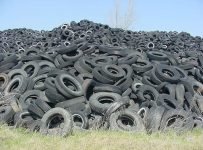
    53 million tyres are thrown out in Australia every year
    53 million tyres are thrown out in Australia every year

    Waste in context

    The danger to our grandchildren from polluted air, water and overburdened landfill is negligible compared to the danger that they will not have enough energy, food and water to enjoy any kind of lifestyle we might wish for them.

    In 1798 Thomas Robert “Pop” Malthus famously predicted that the world would run out of food by 1850.

    He predicted terrible wars, followed by “epidemics, pestilence and plague … [while] gigantic, inevitable famine stalks in the rear.” His simple analysis – that food production increases arithmetically, while unchecked population growth increases exponentially – failed to account for the wonders of the industrial revolution.

    His basic premise was revived early in the twentieth century when, despite the carnage of two world wars, population figures were clearly on an exponential curve while food production was not. The “Green Revolution” of the 1950s saw a further increase in food production thanks to the wonder of fertilisers, pesticides and preservatives all made from fossil fuel. Malthusian gloom was discredited once more.

    Now, we see a third major revival of the concept on a global scale.

    In the green corner we have peak oilers, climate warriors and defenders of the environment. They point out that the world’s fisheries are in crisis, one quarter of the world’s population live in water catchments that cannot supply their demands, we have used half the available petroleum reserves in 150 years and will use the other half in less than forty, carbon dioxide levels are an order of magnitude higher than geologically normal, the world’s forests are disappearing before our eyes and we do not have sufficient arable land to feed the projected population in 2020 even if we manage to sustain current levels of production.

    In the blue corner, the titans of capital point to technological solutions, clean coal, nuclear energy and algae as the miracles that will sustain us. Who needs forest, farms and fish when we can power economic growth using microscopic organisms and subatomic particles? Human history has proved our resilience as a species. We may well evolve a synthetic ecology and maintain our virtual lifestyle. It seems unlikely that we will solve world poverty on the way. Nor will we achieve consensus that this is the future we want to leave our descendants.

    Looked at in terms of this debate, waste becomes a symptom rather than a cause. The waste mountain we produce each year is simply the difference between the resources we consume, and the resources we actually use to survive. Of course, the waste mountain itself is only one part of the resources we squander, we also pump our sewerage out to sea, our unused nutrients into our rivers, and our exhaust fumes into the atmosphere.

    However undesirable the nature of civilisation’s residue, the bigger problem is the squandering of irreplaceable resources. We pump oil from the ground, convert it into plastic, use it once and then throw it away. That oil took millions of years to create and its energy – captured from the sun by prehistoric plants – will never be available again. Intercepting the waste stream to capture that plastic, then using more energy and toxic chemicals to turn that plastic into another bag, a plastic garden stake or a poly-fleece sweater which in turn gets thrown out or recycled again, may be slightly less wasteful than burying it, but it is still a significant waste of finite resources.

    The only logical solution is to reduce our consumption. Unless we do, we face a future of increasing conflict as the world’s wealthy take more resources from the poor. The looming increase in grain prices to satisfy the demand for grain based ethanol fuels is a very real example that will make news headlines in mid-2008.

    Waste management policy-makers talk about the four Rs: Reduce; re-use; recycle and remove. The first two of these go directly to conserving resources, but have almost nothing to do with waste management.

    Reducing waste involves consumption patterns and is generally considered outside the scope of government influence. Resource taxes are considered from time to time, and howled down by industry concerned about the impact on profits. Incidentally, carbon trading is a form of resource tax now being demanded by industry, but only because it has become an integral part of the global economy.

    Re-use of goods that would otherwise become waste is also outside the scope of the waste management industry. Trading of second-hand goods is the simplest form of re-use, but for effective resource management re-use has to be designed into a product before manufacture. An electric appliance made from plastic that is moulded together cannot be taken apart and repaired, or refitted for another purpose. A building that is constructed as cheaply as possible to meet the minimum building regulations becomes nothing but scrap, once the integral structure begins to weaken.

    To reduce the amount of resources we waste, we have to manage our consumption rather than our rubbish.

    You, the consumer

    The only person that can reverse these dynamics, is you. In fact, the consumer is the most powerful person in the economic food chain. After all, we are the ones who buy the products that pay for everything else.

    It is challenging to think that little old you and me can influence the patterns of  waste production and resource consumption as we go about our daily lives. After all, our homes only produce about one quarter of the waste that trundles off to landfill every year, we use about one fifth of the water consumed across the country, one quarter of the energy and one sixth of the transport fuel. How on earth, you may ask, can we affect the other much larger chunk of society.

    The fact is that although we only directly consume a small amount of the resources used by the society we live in, indirectly we are reponsible for one hundred percent. It is our insurance premiums, superannuation payments, bank interest, entertainment budget and the profits generated from every purchase we make, that keeps the wheels of industry turning. If we start to be careful exactly who we give our money to, we can make a real difference to the world, fast.

    The first step in the right direction is to use eco-friendly alternatives where possible. These include recycled (post consumer waste, or PCW) paper, driving a Prius (if you can afford one) and buying goods made from natural materials like Zelfo rather than plastic and aluminium. Buying products that minimise the harm you do to the environment is a significant step you can take as a consumer. On its own though, this is as much a “feel good” approach as anything else. What is required is a framework that really gives some meaning to those purchasing decisions.

    You can salvage the warm inner glow you once got from recycling by tackling the first two of those four Rs, reducing and reusing. You can achieve all that is needed with your wallet and a little ingenuity. Along the way, you can replace the thrill of acquisition with the power of community. You can enjoy life more, by taking less. All it requires is a simple adjustment of values.

    There are three ways to do this.

    1.    Live more simply, that is actually have less stuff.

    2.    Buy things that last, that is keep things for longer so we do not throw stuff away.

    3.    Buy things that are made so that once they have served their initial purpose the components from which they are made can be re-used with minimal reprocessing.

    By changing your lifestyle in accordance with earth friendly values, you can make an even greater difference. Consider the following four steps.

    Shop locally

    Become an active participant in your local community. Walk to the shops, buy goods made in your area. You will reduce the transport involved in shipping goods around the world and reverse globalisation by demanding goods made locally. Take holidays locally, socialise with the people in your neighbourhood. This builds a decentralised independent economy in which you are an active player. The best news is you become a part of a community and it feels good.

    Do it yourself

    Whether it is preparing your own food, repairing things that wear out, or picking up items that other people don’t need any more, you can significantly reduce the resources you consume. Yes, you need skills to do these things but acquiring those skills is satisfying, in a way that sitting down in front of the television can only emulate. Once you start looking at the items you own with DIY eyes, you’ll soon recognise that quality is cheaper in the long run. Well-made goods last longer and can be easily repaired when they begin to wear.

    Generate value

    Grow your own food, make things that other people want, offer your services to your friends, family and the community. The switch from consumer to supplier puts you in a completely different relationship with the community in which you live. You are rewarded by the payment and respect you receive. Instead of being envied because you have the largest TV screen, the most attractive swimming pool or most expensive car, you are loved because of what you do.

    Share generously

    In a world based on consumption, sharing is foolish. If you are always seeking more, the last thing you want to do is give things away. If you value happiness and community over wealth and acquisition, the situation is reversed. Sharing your time, resources, and the goods you create connects you with other people, makes them happy and in turn makes you happy.

    Reality check

    Agriculture uses 80 per cent of the water collected in Australia, industry and transport uses over 80 per cent of the energy generated. Less than one third of the waste generated in Australia comes from our homes. This article detailes how your consumption patterns can make a difference.

    Someone has to buy the goods that industry create. Someone has to pay for the buildings that get knocked down and rebuilt. Someone has to eat the rice or wear the cotton that consumes the water taken from our rivers.

    Your choices as a consumer drive the economy that consumes the resources that destroy the ecosystems that will sustain your grandchildren. Refuse to live in a cheap building that is only built to last for fifty years, refuse to buy water and energy intensive products, refuse to drive to work in peak hour traffic and park in a concrete parking lot. Value everything you do by the impact it has on the environment and live accordingly.

    Not only that, the values of acquisition and consumerism drive economic growth, by learning to live well without consuming more we are turning the economic model on its head.

    An Egyptian friend of mine used to say, “The best revenge is to live well.” I’m not sure who he was avenging, but I am avenging the destruction of the planet. It sure feels better than filling up the recycling bin every fortnight.

    Giovanni Ebono is host of The Generator on Bay FM, community radio station of the year, and director of the Ebono Institute www.ebono.org