Category: Articles

  • Percentage of global population living in cities, by continent

    Percentage of global population living in cities, by continent


    Studies have shown city dwellers have smaller carbon footprints than their countries’ national averages


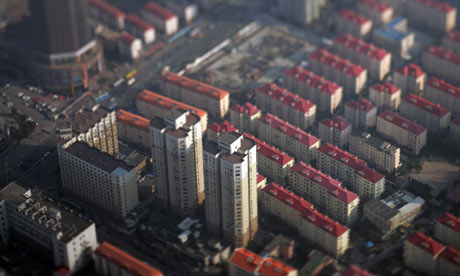
    Shanghai housing

    The percentage of China’s population living in cities rose from 13% to 40.4% between 1950 and 2005. It is predicted to rise to 60.3% by 2030. Photograph: Dan Chung


    Since 1950 there has been a huge worldwide increase in the percentage of population living within cities. The trend shows no sign of stopping – for the next 20 years, the flow of people is predicted to continue soaring.


    Some commentators believe this move to urban living is good for the environment because of denser housing and greater use of public transport. Studies have shown city dwellers on four continents have smaller carbon footprints than their countries’ national averages.


    In 1950, the population living in UK cities was 79% – already a large figure – but one which is set to rise to 92.2% by 2030. Elsewhere, China’s percentage rose from 13% to 40.4% between the years 1950-2005, and is predicted to rise to 60.3% by 2030. With so many migrating from rural areas, what does this mean for Chinese agriculture and its domestic food security? In all likelihood, it will look more like the UK – importing an increasing proportion of its food with the wealth generated by its urban industry and commerce.


    But it’s Botswana that has experienced the largest influx. Next year, 61.2% of its population are expected to live in urban areas, yet back in 1950 only 2.7% of Botswanans lived in cities.


    DATA: Percentage of global population living in cities, by continent 1950 to 2030


    • Can you do something with this data?
    Flickr Please post your visualisations and mash-ups on our Flickr group or mail us at datastore@guardian.co.uk


  • 1.300 Chinese children near smelter suffer lead poisoning

    1,300 Chinese children near smelter suffer lead poisoning


    • Officials close ‘unapproved’ manganese plant in Hunan
    • Second case in a month involving mass poisoning of pupils
    阅读中文 | Read this in Chinese


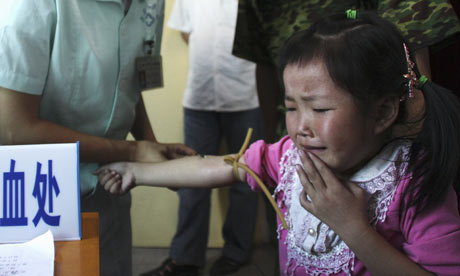
    Child has blood sample taken for examination of lead levels in blood at hospital in Wugang

    A child who lives near Wugang manganese smelting plant has her blood sample taken to examine the lead levels. Photograph: China Daily/Reuters


    More than 1,300 children have been poisoned by a manganese factory in central China, the state media reported today, amid growing fears about the prevalence of heavy metal pollution nationwide.


    The exposure of mass lead contamination in Wenping township, Hunan province, is the second case in as many weeks, prompting accusations that the authorities have failed to adequately regulate toxins that build up over time.


    A local government official told the Xinhua news agency that tests of children living near the smelter showed that 60-70% had unhealthy levels of lead in their blood. With tests continuing, more positive cases are expected.


    The authorities closed the factory last week and detained two executives on suspicion of “causing severe environment pollution”.


    The plant reportedly opened in May 2008 without the approval of the local environmental protection bureau within 500m of a primary school, a middle school and a kindergarten.


    Although the factory had only been operating for a year, the blood of 1,354 local children was found to have more than 100mg of lead per litre, the limit considered safe.


    A gradual build up of lead in the bloodstream can lead to anaemia, muscle weakness and brain damage.


    The plant is unlikely to have gone ahead without support from the local government. Many poor districts ignore environmental regulations to attract investment, and Hunan is notorious for its heavy metal industry. The Wugang city government said it had demanded an overhaul of more than 100 plants, including seven other smelters.


    But the problem is likely to be nationwide because authorities are not obliged to conduct expensive tests for heavy metals, which tend to accumulate over time rather than be emitted in noticeable bursts.


    In a separate case in Shaanxi, northern China, last week, 615 children tested positive for lead poisoning attributed to a nearby smelter, which is now due to cease operating this Saturday

  • Wind farms and polluted skies: the great paradox of China

    Wind farms and polluted skies: the great paradox of China


    China is on its way to becoming the world’s largest producer of renewable energy, yet it remains one of the most polluted countries on earth. From Yale Environment 360, part of the Guardian Environment Network


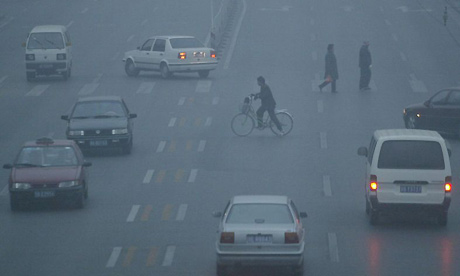
    Pollution in Beijing

    Pedestrians, cars and a bicycle make their way through thick pollution in Beijing. Photograph: Peter Parks/AFP/Getty Images


    This month, on the first anniversary of the opening of the 2008 Summer Olympic Games, Beijing’s skies were a hazy gray. Walking down the street, one was left with a tickle in the throat and burning eyes. A recent study published in the Journal of Environmental Science and Technology, conducted jointly by Peking University and Oregon State University, found that Beijing’s $20 million investment to scrub the skies for the Olympics in fact had little impact on air quality. The U.S. embassy in Beijing now maintains a Twitter feed posting data from an air-quality monitoring station on the embassy compound; readings of large particulates in the air in recent weeks have ranged from “unhealthy” to “very unhealthy” to “hazardous.”


    The experience of daily life in Beijing hardly gives the impression that the last year has been a watershed for the environment in China. Being in the capital, one can’t help but feel a little quizzical glancing at recent headlines from newspapers in Washington, New York, and London announcing China’s green-tech revolution. (This is what an eco-friendly revolution feels like?) It’s tempting to shrug and wonder whether the legacy of new green initiatives will be as lackluster as the “green Olympics” – or to feel blue at the lack of promised “blue skies.”


    Yet for an entirely different perspective on China’s recent environmental progress, take the ultra-modern bullet train a half-hour southwest of Beijing to the port city of Tianjin. In just a little over four years, a mix of government and foreign investment has transformed this mid-sized Chinese city into the global manufacturing hub of the world’s wind power industry. China’s installed wind capacity has doubled in each of the past four years. Many experts seem reasonably optimistic that China could meet its ambitious renewable energy plans to derive at least 15 percent of all energy from renewable sources by 2020. The country also is striving to reduce energy intensity per unit of GDP by 20 percent over a five-year period.


    These two targets represent some of the most ambitious green goals in the world, and are expected to make China — in just over a decade — the world’s largest producer and consumer of alternative energy.


    China watchers worldwide have taken note. Earlier this month, a prominent American venture capitalist and the CEO of General Electric published a joint op-ed in The Washington Post, enthusing, “China’s commitment to developing clean energy technologies and markets is breathtaking” — even outpacing the U.S. and putting Beijing “in the lead today.”


    • This article was shared by our content partner Yale Environment 360, part of the Guardian Environment Network
    From the outside, China is seen as passing spectacular new renewable energy goals, building massive wind farms and hydropower stations overnight and perhaps one day even giving American and European companies a run for their money in the global green-tech market. But from the inside, what emerges is a more muddled picture. The daily experience is that the air and water quality is bad, in some places getting marginally better or staying the same, in some cases getting worse.


    “How do you reconcile these different pictures of China?” asks Barbara Finamore, founder and director of the Natural Resources Defense Council’s China Program. “Both are true at once. It’s something we struggle with all the time.”


    Indeed, China may soon be simultaneously the greenest and the blackest place on earth. The country is poised to be at once the world’s leader in alternative energy — and its leading emitter of C02. Alternative energy as a percentage of the total energy mix is increasing, but it will complement — not replace — growth in coal power. In fact, in a decade coal is expected to supply about 70 percent of China’s energy. Because of the sheer scale, diversity, and complexity of China, it is possible for the country to take some great green leaps forward, in particular progress toward its alternative energy and energy efficiency targets, while at the same time having its rivers remain black and its air quality a health hazard.


    To some extent this varied picture is to be expected. As Deborah Seligsohn, a senior fellow at the World Resources Institute’s China Program, explains: “I think the government is trying very hard, and they’re a developing country with huge challenges — different things will move forward at different speeds.”


    But there may also be another pattern at work. As Beijing-based political commentator Zhao Jing — who writes in the English-language press under the name of Michael Anti — puts it: “There are really two sets of ‘green’ issues in China, the global and the domestic — those where economic interests align with green targets, and those where they don’t.” In his estimation, China has made striking progress on the former set of issues, and rather less on the second.


    For example, China has made impressive gains in quickly developing its alternative energy industry, in part because large new investments benefit everyone — from wind turbine manufacturers to local governments (which gain tax revenue from new industry) to future consumers. Yet, on domestic air and water pollution — where what is needed is stricter regulatory enforcement, potentially limiting industry — Chinese environmental groups believe the picture may be getting worse. And the environmental lawyers and advocates who would bring these issues to the attention of authorities are facing tougher crackdowns than ever.


    At the same time, China is pouring billions of dollars into alternative energy — a commitment that, when taken as a percentage of GDP, is 10 times that of the United States. “China’s biggest green achievement has been to develop alternative energy,” says Jin Jiamin, founder and executive director of Global Environmental Institute, a Chinese NGO based in Beijing. “In the U.S., it takes time for ideas to become reality. But in China, it’s different. It’s easy for any new policies to be implemented quickly.”


    Julian L. Wong, founder of the Beijing Energy Network and now a Senior Policy Analyst at the Center for American Progress, says that the outlook and reported figures so far look good. He points to government statistics indicating that energy consumption per unit of GDP dropped by 10 percent between 2006 and 2008. One reason for rapid progress, he explains, is that these key energy initiatives are backed by China’s powerful National Development and Reform Commission, the ministry responsible for economic development.


    “Using energy more efficiently makes good economic sense,” he says. And diversifying China’s energy portfolio also appeals to Beijing, which has been concerned with energy security since the 1980s.


    Of course, there are some important caveats. In China, “alternative energy” includes both hydro and nuclear power, which are often not classified as such elsewhere. “Please remember, there are negative environmental consequences for dams and nuclear,” says Hu Kanping, editor of the Beijing-based Environmental Protection Journal. “I do not think those are really ‘clean’ energy sources.” This month China announced plans to increase nuclear energy capacity tenfold over the next decade.


    While the installation of wind turbines has proceeded at a furious pace in China, not all of the newly installed capacity is actually available to consumers through the grid. “Renewable energy providers often can’t always get access to the market,” says Ray Cheung, a senior associate at the World Resources Institute. “If you’re a solar or wind energy company in China and you can’t gain access to the grid, nobody’s going to buy your power.”


    Forbes recently reported that as many as 30 percent of “wind power assets” are not adequately connected to the grid. The obstacles are in part technical (the existing grid has not been designed for the fluctuating energy production from wind power), and in part political (the powerful companies that control access to the grid often have cozy relationships with coal energy suppliers and can block green newcomers).


    Finally, while progress is almost certainly being made on both alternative energy and energy efficiency in China, it’s worth noting that most data for quantifying that progress has been supplied by the government itself. For instance, the state-owned People’s Daily publishes the quarterly figures on energy efficiency that are in turn cited by both domestic and international press. “There’s still the question of how can we verify figures,” says Wong.


    Overall, however, on these emerging fronts the trends seem positive. But on domestic environmental issues — those that impact the daily lives of the Chinese people — the picture is less rosy.


    “Water quality is probably deteriorating,” says Jin Jiamin, of the Global Environmental Institute. “The reason is industrial pollution.” Indeed, the Ministry of Environmental Protection’s most recent annual report on the state of the environment acknowledges that cleanup efforts failed to make improvements in the water quality of China’s seven major rivers. Mortality from cancers linked with pollution — including stomach cancer and liver cancer — continues to rise, according to Ministry of Health statistics. Smog blankets large Chinese cities. The toxic industry of importing dangerous “e-waste” (used electronics and computer parts containing hazardous chemicals) continues to flourish in Guizhou, as documentary photographer Alex Hofford has demonstrated, despite laws in place to shut down the profitable trade.


    The reality is that, even as investment to stimulate new green industries is thriving in China, enforcement of green regulations that may limit industrial and economic activity is not. As Charles McElwee, a Shanghai-based environmental lawyer, explains: “Most actions aimed at energy will have some impact on local environment, but China has not shown willingness to commit the same level of resources to enforce existing environmental laws, which would have the most immediate impact on citizens.”


    And as The Washington Post has reported, tough economic times have brought even laxer environmental enforcement for factories in southern China. Peng Peng, research director of the Guangzhou Academy of Social Sciences, a government-affiliated think tank, told the Post: “With the poor economic situation, officials are thinking twice about whether to close polluting factories, whether the benefits to the environment really outweigh the dangers to social stability.”


    While China’s national priorities have shifted, its politics haven’t. When economic and environmental priorities align, astoundingly rapid transformation is possible. But when interests compete, the economy still trumps the environment.
  • Blocked rivers threaten livelihood of Brazilian tribes

    Blocked rivers threaten livelihood of Brazilian tribes


    Plans to build more than 200 hydroelectric dams bring prospect of cheap electricity but destruction of Amazon habitats


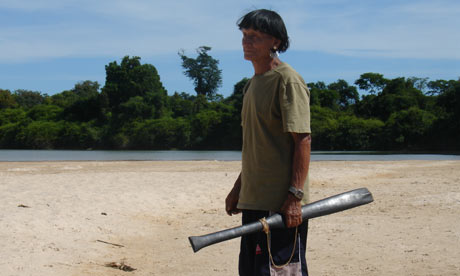
    Melobo, shaman, standing on Xingu river

    Activists say government plans for up to 16 new hydroelectric plants pose an unprecedented threat to the 14 tribes that live in the park. Photograph: Tom Phillips


    Once they were threatened by wildcat gold-miners and a measles epidemic that slashed their population to just 56. But now the Ikpeng, a proud tribe of Amazon warriors, say a new catastrophe looms over their future: the damming of the rivers they depend upon for food.


    Across Brazil alarm bells are ringing over plans to build at least 229 small hydroelectric dams, known as PCHs, which the government hopes will generate electricity and drive economic development.


    Opponents say they will damage the environment and destroy the livelihoods of thousands of Brazilian tribespeople.


    There are 346 PCHs in Brazil, with another 70 under construction and 159 awaiting licences. If the construction of dams continues, “the fish will run out and the waters will start to go down,” warned Komuru Txicao, a local tribesman. “Here in the forest we don’t need electricity. We need fish, water and land.”


    Other hydroelectric projects planned by the government are huge — the $4bn Belo Monte dam further north along the Xingu river from Pavuru would be the third biggest plant of its kind on earth, producing over 11,000 megawatts of electricity. While Belo Monte has been described by the government as a “gift from God”, critics say it will destroy lives, homes and traditions.For Komuru and his neighbours, the immediate concern is the construction of a network of PCHs around the Xingu national park in Mato Grosso state. Komuru fears the dams will block the tributaries of the Xingu, itself the largest tributary of the Amazon.


    According to the National Electric Energy Agency (Aneel), four PCHs – the Paranatinga II, Culuene, ARS and Ronuru – operate near the reserve; another, Paranatinga I, is waiting for its licence. Aneel says 13 PCHs are being built in Mato Grosso state, while another 19 projects are awaiting licences. The government says such dams will help power the agricultural revolution that is sweeping Brazil’s mid-west and bring electricity to small towns.


    Recent years have seen the Ikpeng, a proud tribe of Amazon warriors, embrace many of the comforts and distractions of the outside world.


    Three months ago wireless internet was installed here in Pavuru, one of over 30 villages located in the Park — a vast, 2.8 million hectare indigenous reserve home to some 5,000 Indians from 14 different ethnic groups. Today Ikpeng teenagers spend their afternoons downloading tracks by artists such as Enrique Iglesias and the US rapper 50 Cents while many of the tribe’s hunters use shot-guns rather than the traditional bow and arrow to hunt spider monkeys and wild-boar in the surrounding forests.


    “Things are changing,” admitted Karane Txicao, 28, sat behind an HP laptop in the village’s concrete internet cafe. “Now people never leave the front of the computer screen.”


    Several of the traditional huts – or owros – also shelter large television sets, powered by a diesel generation which is switched on at 9am each day and turned off at 9pm.


    But unlike the telenovelas and MP3s, government plans for PCHs around the Xingu Park have met with a furious reception.


    “It is very worrying,” said Kumare, a resident who is the local head of Funai, Brazil’s indigenous agency. “This will directly affect us. They are damming all of the rivers.” Kumare said the dams would make it impossible for the fish to migrate upstream thus decimating the main source of food for the reserve’s Indians.


    Last March the conflict escalated when eight staff from the electricity company responsible for one PCH spent five days held “hostage” near Pavuru. They were released only after the president of Brazil’s indigenous agency, Funai, personally intervened. “We didn’t kill them, we ‘arrested’ them,” recalled Komuru.


    Similar battles are raging across the Amazon region, where plans to build roads, hydroelectric dams and other major infrastructure projects have triggered a conflict between those who want to protect the world’s largest tropical rainforest and its indigenous tribes and those wishing to drive development and relieve poverty. A dispute over the Belo Monte dam turned violent in May when an engineer from the Brazilian power company Eletrobras was attacked during a presentation about the plant. President Luiz Inácio Lula da Silva has sought to allay fears over the dam, vowing that it “would not be shoved down anyone’s throat”.


    But concerns grew in July when a federal court lifted an embargo on the Belo Monte licensing process, clearing the way for a bidding round later this year.


    Having witnessed the Ikpeng’s plight in the 1960s, Melobo, an Ikpeng shaman, who says he is around 60 years old and wears 15 shell ear-rings in each ear, fears history may be repeating itself. “The farmers ruin the Indian’s things,” Melobo said, in heavily accented Portuguese, standing on the banks of the Xingu river. “They ruin the Indian’s water. They ruin the Indian’s land.””We don’t want to negotiate,” added Komuru. “We don’t want money. We don’t want things that are worth nothing. We want our land.”

  • World Population Clock

  • Archived-Australia’s proposed Emission Trading Scheme-The Tax Policy Dimension


    Archived-Australia’s Proposed Emission Trading Scheme-The Tax Policy Dimension


    With Australia moving towards an integrated action to reduce carbon emissions, including developing an Australian Emissions Trading Scheme (AETS), the effects of such a scheme need to be properly addressed by the Australian tax system. 
     
    A joint report of the Institute of Chartered Accountants in Australia (the Institute) and Ernst & Young, released on 7 April, recommends tax policies which are consistent with reducing global carbon emissions while maintaining and enhancing Australia’s economic attractiveness.  
     
    The report argues that our current tax system will not properly deal with the AETS in a number of areas and makes a number of recommendations including the following:


    • An exemption is needed from income tax and capital gains tax in relation to the free allocation of AETS permits to all recipients. 
       

    • For GST purposes, emission permits be characterised as things other than goods and real property to avoid difficulties that may arise in respect of international trade. Furthermore, any transactions involving AETS permits should have a uniform GST treatment. 
       

    • In the event that the AETS is introduced prior to the abolition of stamp duty in some states, those states should be encouraged to exempt the transfer of AETS permits and offset credits from stamp duty until relevant stamp duty is fully eliminated. 
       

    • Clarity and consistency of treatment of expenditure is needed to ensure that costs incurred in relation to the abatement of greenhouse gases are deductible for Petroleum Resources Rent Tax purposes.
    The report also identifies some potential tax incentives geared towards reducing the burden on business of the significant capital expenditures and adjustments associated with AETS. The following actions are proposed for the Government to consider: 


    • Increase the deduction on eligible clean technology R&D expenditure  
       

    • Extend the scope of the Refundable Tax Offset for companies developing Clean-tech technologies  
       

    • Allow companies using depreciating assets for R&D on Clean-tech technologies to claim an annual one-third write-off for qualifying plant expenditure at the rate of 125 per cent, to recognise the costs associated with commercialising new clean technology or incorporating clean technology into existing operations  
       

    • Consider improving the expenditure eligible for outright deductibility.
    View a copy of the report – Australia’s Proposed Emissions Trading Scheme – The Tax Policy Dimension.