Category: A sustainable economy

  • Efficient technologies increase consumption

    Efficient technologies increase consumption

    Increasing energy efficiency has long been promoted as a realistic means of reducing consumption and so lowering carbon emissions and resource consumption. Only problem is, gee whiz, that it does not work. Figures of the last two decades of energy use indicate that given an increase in efficiency, the resultant price drop encourages additional use and so increases consumption. In other words, the tendency is for humans to consume as much as we can afford rather than as much as we need.
    The battle then is not to simply create better technologies but to better manage our lifestyle expectations and our behaviour.

    From The TYEE …

    The more ‘efficient’ our technology, the more resources we consume in a downward spiral of catastrophe. Thanks to efficiency an airline ticket is one of the most environmentally damaging goods money can buy.
    The transition from incandescent to LED lights won’t result in any lasting savings as more efficient lighting resulted in more light consumption and therefore higher overall energy spending; efficiencies in cooling technologies encouraged more air conditioning and refrigeration everywhere; although it takes about three times less energy to make a ton of paper than it did in 1965, we photocopy one billion documents  with a 22% growth rate; each unit generated by non-fossil-fuel sources displaced less than one-tenth of a unit of fossil-fuel-generated electricity.
  • Pollution kills 20 million people

    Pollution kills 20 million people

    Greenpeace artwork in the Philippines
    Greenpeace Philippines created this artwork to highlight the impact of plastics on the aceans

    Life expectancy is falling in the US as the impact of pollutants on cancer in children, and untreatable diseases spread from industrially farrmed food into the population. As the impact of pollutants on childhood health is better understood experts warn that cancers, asthma and obesity have become normal characteristics of the population. Pollution is directly killing over 20 million people a year, wiping out the equivalent of a nation like Australia or a US state like Florida or New York, every year. The impact of industrial use of antibiotics in food production means that untreatable diseases are being transmitted into the population through the food chain.

    A US-UK trade deal threatens to export the horrors of US corporate livestock production
    Around 75% of the antibiotics used in the US are fed to farm animals. Our city is under siege, and we are knocking down our own defences. The EU and the UK are no paragons. The Guardian has revealed that both pork and chicken sold here are infected with resistant superbugs.
    The Precautionary Principle Asks “How Much Harm Is Avoidable?” Rather Than “How Much Harm Is Acceptable?” 
    In 1980, breast milk in the US was so contaminated with DDT, PCBs and other industrial poisons. If it were cow’s milk, it would be banned. After two decades of failed “chemical regulation,” babies everywhere in the world are drinking industrial toxicants in breast milk. In 2005 umbilical cord blood from newborns showed that babies are now  “pre-polluted” with 200 industrial compounds. In the US, children’s health is deteriorating. childhood cancers has risen 27% since 1974; childhood asthma, obesity, learning and behaviour problems doubled.  Industrial poisons have spread worldwide because regulators have relied on a quantitative risk assessment to determine which chemical releases are “safe.” But “safe” amounts of 80,000 chemicals have contaminated the entire planet, so today noone is safe.
    Junk Planet: Is Earth the Largest Garbage Dump in the Universe?
    Approximately 19 million premature deaths occur annually as a result of the way societies use natural resources and impact the environment to support production and consumption. This will give you a reasonably comprehensive summary of the types of garbage being generated (focusing particularly on those that are less well known), the locations into which the garbage is being dumped and some indication of what is being done about it and what you can do too.
    Desperate Need to Halt ‘World’s Largest Killer’ — Pollution
    Analyses impacts on human health and ecosystems brought on by air, land, freshwater, marine, chemical and waste pollution. “None of us is now safe, so now all of us have to act. The health effects are stark, with air pollution alone killing some 6.5 million annually, affecting mostly poor and vulnerable people.”
    Deposit schemes reduce drink containers in the ocean by 40%
    Some eight million metric tonnes of plastic ends up in the ocean every year. There has been a push to get rid of plastic straws, and even Queen Elizabeth II has banned single use plastics from Royal Estates. How effective is a cash for containers program? While there is evidence that container deposits increase return rates and decrease litter, until now there has been no study asking whether they also reduce the sources of debris entering the oceans.
    The image in this story came from Greenpeace Philippines.
    http://cnnphilippines.com/news/2017/05/12/dead-whale-cavite.html
  • Old white man praises women

    Old white man praises women

    Hawkenn promotes Drawdown
    Hawken says men should stand back and let women run the show

    Touring Australia to promote his project and book Drawdown, Paul Hawken told audiences in Brisbane on Thursday and Byron Bay on Friday that overwhelmingly, women are the solution to climate change.

    Hawken edited the 100 solutions presented in the book. Each solution selected for publication was modelled by the team of scientists that form the organisation Drawdown. Two of the top ten solutions specifically deal with the role of women. Solution #6 is the education of girls and solution #7 is family planning. Hawken described these solutions as pathways to the same outcome, which is empowerment of women, leading to a reduction in population growth which is one of two major factors driving environmental damage. Per capita consumption multiplied by the world population is the sum of total resource consumption on the planet. As well as impacting population levels, the empowerment of women leads directly to preferential investment in less aggressive and wasteful approaches to production and commerce, Hawken said.

    A separate solution is to supporting women running small scale farms. That has a significant effect on the production of carbon. “Women running small farms produce more food than corporate agriculture,” Hawken told enthusiastic audiences, “that means that we do not have to accept the lie that we need big agriculture to feed the billions of people living in mega cities.”

    He challenged the notion that corporate agriculture is feeding society. “Think about what they produce,” he said, “Corn, soy, sugar, highly refined grains and foodstuffs that cause obesity, diabetes, heart attacks. They are not feeding society, they are funding big pharma.”

    He also pointed out that the military is one of the biggest contributors to environmental and societal harm, destroying landscapes, agriculture and societies on an enormous scale. He said that while he suspects world peace is probably the number one solution to reducing climate chaos, it has been left out of the book because there is no data available to model the impact of reversing it.

    While the tour is largely complete, there are plenty of opportunities online to see Hawkens expounding the value of the book.

  • Philippines expands crackdown on polluting mines

    Philippines expands crackdown on polluting mines

    Regina Lopez is applying the heat to miners who pollute water
    Regina Lopez is applying the heat to miners who pollute water

    Philippines environment secretary, Regina Lopez, last week cancelled one third of new mining contracts on environmental grounds. She also rejected calls to reverse her earlier decision to close 23 of the existing 41 mines in the Philippines on the grounds they are polluting drinking water. “You kill the watershed, you kill life” she told media last week. Despite the threat of legal action from international business, the environment secretary has the full backing of President Duterte. This is the second time he has publicly supported her actions since appointing her last June.

    Philippine Environment Minister Continues Mining Crackdown

    The Philippines’ environment minister stepped up a crackdown on mining on Tuesday, cancelling almost a third of the country’s contracts for undeveloped mines and rejecting any challenges to earlier orders to shut more than half of all operating pits.

    http://www.telesurtv.net/english/news/Philippine-Environment-Minister-Continues-Mining-Crackdown-20170214-0014.html 

    https://dailybrief.oxan.com/Analysis/DB212888/Philippines-mining-sector-outlook-bleak-under-Duterte

  • Industry and activists demand bipartisan energy policy

    Industry and activists demand bipartisan energy policy

    Inustry wants renewables
    Members of seven peak industry bodies have joined forces to demand a coherent and stable renewable policy

    Energy producers and consumers including the Aluminium Council of Australia and the Cement Industry Federation have jointly written an open letter demanding stable, long-term, non-partisan energy policy.

    Head of the Aluminium Council, Bruce Cox, said that the industry is not concerned how energy is produced, only that it is reliable. “The aluminium industry in Tasmania is very profitable and Tasmania uses around 85% renewables,” Cox told ABC Radio this morning.

    The Federal Minister for Energy, Josh Frydenberg immediately blamed the Labor Party for being too focused on renewable energy.

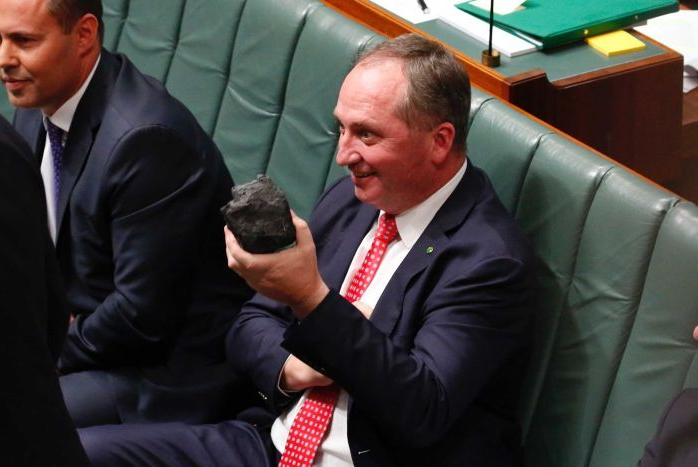
    COALition politicians take the farcical approach to debate

    http://www.smartcompany.com.au/business-advice/politics/82728-business-groups-join-plea-politicians-energy-stop-brawling/

    http://www.abc.net.au/news/2017-02-14/energy-australia-boss-worried-about-power-bills/8267070


  • Chinese factory replaces 90% of workers with robots

    Chinese factory replaces 90% of workers with robots

    Charlie Chaplin on automation in the 1936 movie Modern Times
    Charlie Chaplin on automation in the 1936 movie Modern Times

    A Chinese factory in Dongguan, Southern China has replaced 90% of its 690 workers with robots resulting in a 150% increase in production and a fall in defects from one in four to one in twenty products. The initiative is part of the Made in China 2025 program that aims to rapidly increase production in China, despite rising wages and environmental concerns. Magazine Monetary Watch notes that automation has led to better wages and conditions in some European countries but not in much of the developing world

    https://www.youtube.com/watch?v=rVlhMGQgDkY

    http://monetarywatch.com/2017/01/chinese-factory-replaces-90-human-workers-robots-sees-250-production-increase/?doing_wp_cron=1486248726.4281659126281738281250