Category: General news

Managing director of Ebono Institute and major sponsor of The Generator, Geoff Ebbs, is running against Kevin Rudd in the seat of Griffith at the next Federal election. By the expression on their faces in this candid shot it looks like a pretty dull campaign. Read on

  • IF ALL THE ICE MELTED. Explore the world’s new coastlines if sea level rises 216 feet.

    3 of 66

    The collapsing Antarctic ice sheet, by itself, will cause #SeaLevelRise over 10′

    Inbox
    x
    Neville Gillmore
    The collapsing Antarctic ice sheet, by itself, will cause #SeaLevelRise over …
    3:26 PM (2 hours ago)

    John James

    4:16 PM (1 hour ago)

    to me

    IF ALL THE ICE MELTED. Explore the world’s new coastlines if sea level rises 216 feet.

    On 23/03/15 3:26 PM, “Neville Gillmore” <nevilleg729@gmail.com> wrote:
    The collapsing Antarctic ice sheet, by itself, will cause #SeaLevelRise over 10′ but #Florida still builds on coast ? environmentalhealthnews.org/t/-73253697870…
  • Monstrous melt: Distant Antarctica glaciers have scientists worried

    Home
    News
    Local
    Sports
    Opinion
    A & E
    Life
    Business
    Video
    Photo

    Advertisement
    Monstrous melt: Distant Antarctica glaciers have scientists worried
    March 22, 2015 12:00 AM
    Share with others:
    0
    inShare

    By the Editorial Board

    The great ice sheet of West Antarctica has begun sliding into what scientists believe is an irreversible collapse. It will take a century, but once glaciers that took tens of thousands of years to form are gone, the absence will result in a sea level rise in the Northern Hemisphere of at least 10 feet.

    If this were the only scenario to worry about, it would be more than enough to qualify as a catastrophe. Unfortunately, West Antarctica isn’t the only ice formation that may disappear from the bottom of the world.

    A glacier in East Antarctica is also melting. It, too, could affect the sea levels of North America in ways that will cause residents of the hemisphere to regret that climate change deniers were ever taken seriously.

    According to a new paper in Nature Geoscience by an international team of scientists, the Totten Glacier of East Antarctica is the fastest-thinning sector of the world’s largest ice sheet. The study said its rapid erosion is the result of warm ocean water flowing beneath it. Because it holds back even more glaciers, they will slip more quickly into the ocean.

    While global warming remains debatable only among those determined to save the energy sector from further regulation, the evidence that fossil fuel consumption is having a disastrous impact on the environment is irrefutable. The amount of ice that the Totten Glacier is losing every day to nearby warm waters is “equivalent to 100 times the volume of Sydney Harbor every year,” said the Australian Antarctic Division, which helped craft the paper.

    Those in Congress and in industries that oppose addressing this problem will be dead before their disregard of scientific consensus has been definitively refuted. It’s their grandchildren who will inherit a world where the weather is more chaotic and Antarctica is on its way to becoming an open sea.

    Meet the Editorial Board.

  • [New post] NSW 2015 – the final week BEN RAUE The Taklly Room

    Click here to enable desktop notifications for Gmail.   Learn more  Hide
    More

    1 of 64

    [New post] NSW 2015 – the final week

    Inbox
    x

    The Tally Room <donotreply@wordpress.com>

    10:30 AM (18 minutes ago)

    to me

    New post on The Tally Room

    NSW 2015 – the final week

    by Ben Raue

    With five days to go until election day, you can now read through the entirety of the Tally Room guide to the NSW state election.

    Profiles of all 93 seats are now available, including final lists of candidates. Most seats now feature comment threads discussing that electorate, and everyone is welcome to join in!

    In addition, I have written a guide to the Legislative Council, as well as a summary of NSW political history, a summary of the last four years in NSW politics, a summary of the recent redistribution, and an article going through the key seats in the election.

    I appeared on FBI Radio’s Backchat program again on Saturday morning to discuss optional preferential voting, and I’ll be on the show again on election morning. I’ll also be joining 2SER’s Election Nerds from 7pm to 9pm on election night, and I’m also going to be appearing on Radio National later this week (more details to come).

    Meanwhile, we have seen a number of polls released in the last few days. An Ipsos poll yesterday had the Coalition leading 54-46 over Labor. In addition, Reachtel has released three polls showing Labor leading in Ballina, Newtown and Strathfield.

    You can use this post as an open thread to discuss the state election, as we enter the final week.

    Ben Raue | March 23, 2015 at 9:30 am | Tags: New South Wales 2015 | Categories: Uncategorized | URL: http://wp.me/ppI95-6Mx
  • Guardian launches divestment campaign 350 org

    Click here to enable desktop notifications for Gmail.   Learn more  Hide
    Something’s not right.
    We’re having trouble connecting to Google. We’ll keep trying…
    Errors: 101
    More

    1 of 63

    Guardian launches divestment campaign

    Inbox
    x

    Charlie Wood – 350.org Australia <350@350.org>

    4:34 PM (2 minutes ago)

    to me

    Dear Neville,

    Last Monday, The Guardian, one of the world’s most respected and influential newspapers, joined the fight to keep fossil fuels underground by launching its very own divestment campaign in partnership with 350.org. In less than a week, more than 118,000 people have added their support.

    In a watershed moment for the growing divestment movement, The Guardian is setting its sights on the fossil fuel investments of two of the largest philanthropic health and development organisations — the Bill and Melinda Gates Foundation and the Wellcome Trust.  Both are heavily invested in the industry wreaking havoc on our climate — a move that’s completely at odds with their missions to create a better world.

    Both foundations are full of good people who recognise the huge threat that climate change poses to the health of millions — but their investments are out of step and actively undermining their own good work. Join our new campaign with The Guardian to end this double standard now:

    Call on the Wellcome Trust and Gates Foundation to divest from fossil fuels!

    Together, we can convince these leading philanthropic organisations to lead by example and stop profiting from the industry wrecking our chances of a safe, healthy future. If the Gates Foundation and the Wellcome Trust divest from fossil fuels, it will send a powerful signal that tackling climate change and promoting global health and development are two sides of the same coin.

    We know this can work – it already is! The fossil fuel divestment movement is winning new victories every week – from the City of Oslo to the Rockefeller Foundation and councils across Australia – each act of divestment helps build an even stronger case for keeping fossil fuels underground.

    With enough of us on board – and working with The Guardian newspaper – we know that we can convince huge health and development charities like Wellcome and Gates to divest and create the watershed moment needed for climate action.

    Sign the petition now – and then please share it widely with friends and family

    It makes no sense to help those affected by climate change by using money made from the fossil fuel industry. And it’s increasingly clear that fossil fuels are a bad long term investment too. To avoid the climate crisis, we’re going to have to leave 80% fossil fuels in the ground — which means current fossil fuel shares are massively overvalued and investors could lose billions.

    This is a battle we must win, and together we will.  Over the coming months we’ll be working with The Guardian, Avaaz and other global partners to help us secure some major divestment wins around the world – please do join us.

    Charlie

    P.S. click here to listen to a fascinating podcast by the Editor of The Guardian on why he decided it was time to use their influence to make an impact on climate change.


    350.org is building a global climate movement.You can connect with us on Facebook, follow us on Twitter, and become a sustaining donor to keep this movement strong and growing.
    You can unsubscribe from this mailing list at any time.

    Click here to Reply or Forward
    0 GB (0%) of 15 GB used
    ©2015 GoogleTermsPrivacy
    Last account activity: 29 minutes ago

    Details

    Related Google+ Page
    350.org's profile photo
    350.org
  • Catastrophic Global Water Crisis Looming Large, UN Warns

    TechnologyScience
    Catastrophic Global Water Crisis Looming Large, UN Warns
    By Avaneesh Pandey @avaneeshp88 a.pandey@ibtimes.com on March 21 2015 2:25 AM EDT

    Share on facebook
    Share on twitter
    21
    Share on linkedin
    1
    Share on google_plusone_share
    More Sharing Services

    RTX182N6
    A worker of SABESP, a Brazilian enterprise of Sao Paulo state, that provides water and sewage services to residential, commercial and industrial areas looks at the cracked ground of Jaguary dam in Braganca Paulista, 100 km from Sao Paulo January 31, 2014. Reuters/Nacho Doce

    If current trends of water usage continue, the world could suffer a 40 percent shortfall in water supply by 2030, just 15 years down the line, the United Nations warned in its World Water Development Report released Friday. The report also predicts that the global water demand would increase by 55 percent by 2050, resulting in potentially catastrophic consequences.

    “By 2050, agriculture will need to produce 60 percent more food globally, and 100 percent more in developing countries … global water demand for the manufacturing industry is expected to increase by 400 percent from 2000 to 2050, leading all other sectors, with the bulk of this increase occurring in emerging economies and developing countries,” the report, released just two days ahead of the World Water day, said. “Unless the balance between demand and finite supplies is restored, the world will face an increasingly severe global water deficit.”

    The report highlighted the increasing stress on freshwater resources posed by untrammeled population growth and unplanned urbanization. For instance, in sub-Saharan Africa — a region that has witnessed rapid urbanization in recent years — the percentage of people with piped water on their premises decreased from 42 percent in 1990 to 34 percent in 2012. Globally, this number also witnessed a marginal decline — from 81 percent to 80 percent of the population — indicating that access to safe drinking water sources continues to be a major problem in cities in the developing world.

    water supply Trends in urban water supply coverage (1990-2012). WHO/UNICEF/UN World Water Development Report 2015

    “The world’s population is growing by about 80 million people per year. It is predicted to reach 9.1 billion by 2050, with 2.4 billion people living in Sub-Saharan Africa, the region with the most heterogeneously distributed water resources,” the report said, adding that because water use is unregulated and often wasteful in many nations, and since water pollution remains largely ignored and unpunished, safe drinking water supplies would continue to dwindle unless drastic action is taken.

    global water demand Global water demand in 2000 and 2050. OECD/UN World Water Development Report 2015

    In Asia, the report noted, groundwater quality is affected by both anthropogenic and natural contaminants. “Natural groundwater contaminants found in the region’s aquifers include arsenic fluoride and iron. Anthropogenic contaminants come from fertilizers and pesticides used in agriculture; mining, tanneries and other industries; landfill and garbage dumps; and inadequate sanitation and wastewater disposal,” the report said.

    It pointed out that experience from high income countries shows that a combination of incentives, “including more stringent regulation, enforcement and well-targeted subsidies,” can help reduce water pollution.

    The U.N. also warned that anthropogenic climate change could bring “additional risks” to water supply by increasing the frequency of extreme weather events.

    “Two global trends are converging — climate change, and growing economic development in least developed countries and emerging economies. This convergence is certain to intensify the water insecurity of poor and marginalized people in low income countries,” the report said.

    In order to mitigate this looming disaster, the U.N. in its report urged politicians and communities to rethink their water policies and make a greater effort to conserve water. It also called on industries reliant on water to implement more efficient mechanisms to treat wastewater and ensure acceptable quality of discharged water.

    Submit Correction
    Share on facebook
    Share on twitter
    21
    Share on linkedin
    1
    Share on google_plusone_share
    More Sharing Services

    Related

    When Will California’s Water Supply Run Dry?
    Worldwide Water Shortage By 2040 Unless There Are Changes To The Way Power Is Produced

    Sponsored From Around the Web
    1 Odd Method
    1 Odd Method “Fights” Diabetes. Try This…
    Diabetes Daily
    New Diabetes Breakthrough?
    New Diabetes Breakthrough?
    Diabetes Daily
    Best Exercise to Lose Stomach Fat
    Best Exercise to Lose Stomach Fat
    Lean Curves
    Aussie Mum Loses 24kg in 2 Months from This
    Aussie Mum Loses 24kg in 2 Months from This
    Healthy Mum Daily
    The Best Way to Remove Eye Bags Without Surgery
    The Best Way to Remove Eye Bags Without Surgery
    glowingskinsecret.com
    Secret Brain Pill Billionaires Are Using
    Secret Brain Pill Billionaires Are Using
    smartsmarter.org
    Say Goodbye to Baldness with New Solution
    Say Goodbye to Baldness with New Solution
    healthtrendsonline.com
    Get Paid AUD $367 Everyday
    Get Paid AUD $367 Everyday
    theonlinecareerjournal.com
    ?
    Join the Discussion

    ‘Kurt Cobain: Montage Of Heck’ Shows Nirvana Frontman And Courtney Love In New Light
    Crocodile Ancestor Ruled North America Before Dinosaurs

    Share on facebook
    Share on twitter
    21
    Share on linkedin
    1
    Share on google_plusone_share
    More Sharing Services

    Mute
    Search
    Latest News

    France Iran nuclear deal
    Politics
    France Says Deal With Iran Must Be Robust, Guarantee No Atomic Bomb
    Wisconsin federal judge finds state abortion law unconstitutional
    Politics
    Wisconsin Federal Judge Finds State Abortion Law Unconstitutional
    UK-publicfinances-economy
    Economy
    UK Public Finances Improve In February
    Asia regional talks
    Politics
    Asian Leaders Set For Talks Amid Regional Tensions

    Most Read
    Most Shared

    1.
    Watch The Total Solar Eclipse Here
    2.
    Karrueche Tran Tells All During Iyanla Vanzant Interview
    3.
    Christie Blocks Release of NJ-Exxon Settlement Docs
    4.
    20 First Day Of Spring Quotes
    5.
    ‘Kurt Cobain: Montage Of Heck’ Shows Nirvana Frontman And Courtney Love In New Light
    6.
    Crocodile Ancestor Ruled North America Before Dinosaurs
    7.
    Xur Is Back In ‘Destiny’ For The Weekend
    8.
    Why Iran Celebrates A Pre-Islamic Holiday
    9.
    How Persian Gulf Airlines Are Wooing American Travelers
    10.
    Tesla’s Stock Drops After Musk Announces Software Update

    Follow Us

  • Click here to enable desktop notifications for Gmail.   Learn more  Hide
    More

    1 of 18

    Neville, thanks for not giving up

    Inbox
    x

    Jody, Common Grace <info@commongrace.org.au>

    11:00 AM (2 hours ago)

    to me
    Dear Neville,

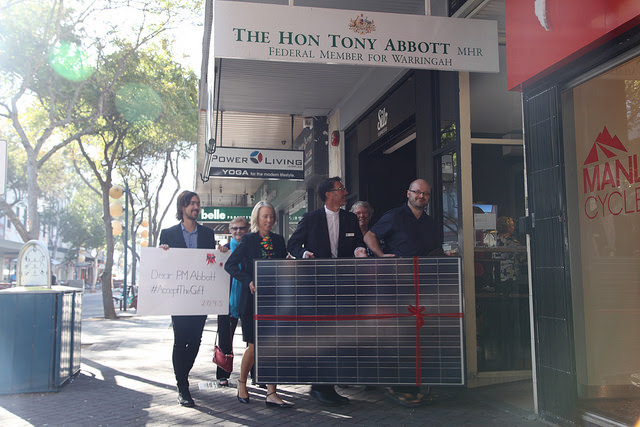
    This week has been wonderful. Our movement’s #acceptthegift action has been listed as a top five news story across several major media publications and shared on Facebook by over 10,000 people.

    Thank you for not giving up on Aussie renewables. Thanks for signing the open letter and sharing the images.

    deliveryshot.jpg

    As a daggy mob of Christians learning how not to be jerks, we’ve brought a new voice to the Renewable Energy Target (RET) debate.To build on this momentum, Common Grace is joining with Earth Hour next Saturday night. Christians across the country will be getting some mates together, enjoying a candlelit meal or BBQ, and having a chat about what following Jesus has to do with our ecological crisis. It’s simple and fun, and one of the most effective ways you can continue to inspire your friends not to give up on a sustainable world for our children and those most vulnerable around the world.

    Check out the Common Grace Earth Hour resources here

    Then, register your Earth Hour event here

    From Jody, Byron and the whole Common Grace team

    P.S. The devastating impact of violent weather in Vanuatu is a timely reminder of why we’re not giving up on renewables. Please keep the unfolding emergency in Vanuatu in your prayers. 

    P.P.S. Below are selected articles written about our #acceptthegift action and here is our media release. Well done to everyone on this – let’s keep the momentum going. Host an Earth Hour event 


    Common Grace
    http://www.commongrace.org.au/