Category: General news

Managing director of Ebono Institute and major sponsor of The Generator, Geoff Ebbs, is running against Kevin Rudd in the seat of Griffith at the next Federal election. By the expression on their faces in this candid shot it looks like a pretty dull campaign. Read on

  • China is the world’s largest contributor to annual growth in natural resource demand

    Ecological Footprint Image Green Footprint Network News
    March 12, 2015

    China is the world’s largest contributor to annual growth in natural resource demand

    China is the world’s largest contributor to annual growth in the demand for ecological resources and services, and has been for the last five years for which data is available, according to Global Footprint Network.

    The Ecological Footprint of the world – a measure of people’s demand on nature – has begun climbing again after experiencing a 2.1 percent decline in 2009 during the recession, according to Global Footprint Network’s 2015 Edition of the National Footprint Accounts, released today. The world’s Ecological Footprint increased nearly 4 percent in 2010 and nearly 1.7 percent in 2011 (the latest year data is available).

    However, excluding China, the world’s Ecological Footprint increased far less in 2011: 0.9 percent. The Ecological Footprint of China climbed 3.6% in 2010 and 5.2% in 2011.

    While the Ecological Footprints of many countries declined during the recession, including the United States and Germany, the Ecological Footprints of China and India, the world’s two most populous countries, continued to rise and now comprise about one quarter of the Ecological Footprint of the entire world.

    Still, the Ecological Footprints per person of both China and India remain far lower than that of many high-income countries. For example, the Ecological Footprint per person of the United States is more than seven times higher than that of India and nearly three times that of China.

    In the past six months, both China and India have announced steps to reduce dependence on fossil fuels, which would decrease their Ecological Footprints. China, in particular, has invested substantially in renewable energy, and its decades-long focus on reducing fertility has also helped preserve its biocapacity per person. But more recent news that China’s annual GDP growth should remain at 7 percent for the years to come suggests its Ecological Footprint will continue on an upward trajectory.

    “In addition to recognizing the importance of indicators like GDP, unemployment or inflation, we look forward to the day when national decision-makers around the world also track their resource dependence. I hope they recognize that natural resources are a fundamental asset for any economy. They should be measured and managed wisely,” says Global Footprint Network President Mathis Wackernagel. “We believe it is not only critical but also possible to live within the means of nature.-It can be achieved without sacrificing current human well-being.”

    “This is a particularly important year for looking more closely at the planet’s resource budget, first in September with the new Sustainable Development Goals and then in December in Paris for the climate talks,” Wackernagel adds. “What is becoming clear is that living within nature’s budget is vital for each and every nation’s economic strength and the well-being of its citizens. Working with, rather than against, nature’s budget is not only important for our planet as a whole but also for the health and resilience of each individual nation.”

    Double Challenge: Low Income, Biocapacity Deficit

    The 2015 National Footprint Accounts compare what people demand against what nature can provide. The accounts simply add together all of the human demands that compete for our planet’s biologically productive surface (Ecological Footprint). This demand then can be compared to all of the planet’s productive surfaces (biocapacity), including cropland, forests, pastures and fishing grounds. Using United Nations data sets, these accounts are calculated for approximately 200 nations.

    Overall, approximately 71 percent of the world’s population lives in nations with a double challenge: They earn below world-average income (based on Gross National Income) and are running a biocapacity deficit. This means that by 2011, they were using more resources and services from nature than the ecosystems within their respective borders regenerated, based on calculations from the 2015 National Footprint Accounts.

    Global Footprint Network’s annual update of the National Footprint Accounts shows that each country’s performance varies year to year, but over the last decades, global ecological overshoot – humanity living beyond the budget of nature – has climbed substantially.

    Ecological overshoot now stands at 54 percent above the planet’s biocapacity. This means humanity demands biocapacity 54 percent faster than what our planet can renew in one year. By contrast, our planet had 30 percent more biocapacity than what humanity used in 1961, the first year for which consistent data sets are available.

    Carbon Footprint

    The carbon Footprint continues to be the largest driver of today’s overall Ecological Footprint, and is also the leading driver of climate change. The world’s carbon Footprint increased almost 1.9 percent in 2011. That’s down slightly from an average annual growth of 2.5 percent from 1961 to 2011.

    When used in Ecological Footprint accounting, the carbon Footprint represents the land area required to sequester carbon dioxide emissions from fossil fuel use. This demand on nature competes for other land uses, including food, feed for animals, fiber for clothes and paper, and timber for construction. All those demands are tracked in the Footprint accounts.

    The 2015 National Footprint Accounts cover five decades of data. This year’s update is based on more than 6,000 data points per country per year, includes several methodological improvements and is being offered under a new, more open licensing program. More than 300 organizations and individuals around the world license Global Footprint Network’s National Footprint Accounts each year, including universities and financial institutions.

    “Notenstein’s methodology for rating sovereign bonds from a sustainability perspective makes heavy use of the National Footprint Accounts,” says Balazs Magyar, a sustainability analyst with Notenstein Privatbank AG in Switzerland. “During turmoils in the bond markets, especially the European sovereign debt crisis, our analysis using the National Footprint Accounts proved to be a valuable tool for selecting sovereign bonds.”

    New Licensing Structure

    This year, Global Footprint Network is offering the National Footprint Accounts under a more open licensing structure, with a new, improved “Public Data Package” available as a free download from our website. This free download includes the latest results for all countries, country graphics and the number of Earths required if the world’s population lived like the average citizen of each country. The free download also offers many new ways to sort data—by region, quality score, GDP, Human Development Index score, and other categories – and data quality scores for the results.

    Ecological Footprint and the Recession

    Since hitting a peak in 2004, the Ecological Footprint per person in the United States has dropped to nearly the same level it was in 1961 (the earliest year data is available). The recent Footprint contraction coincides with the recession. Similarly, several European countries, still struggling to pull out of the recession, continued to see a downward trend in their Ecological Footprints in 2011. That included the United Kingdom, France and Spain.

    Germany, widely viewed as the strongest economy in Europe, saw its per person Ecological Footprint remain virtually flat in 2011, in continuation of the last decade, which may be attributed in part to its investment in renewable energy. Sweden was an outlier, with its Ecological Footprint starting to creep up again to about 6.5 global hectares per person, though that was still substantially lower than its all-time high of more than 8 global hectares in 2004.

    “With more nations now moving closer toward economic recovery, Ecological Footprints will most likely begin creeping upward,” notes Susan Burns, CEO of Global Footprint Network. “However, these recoveries will be fragile and unsustainable in the long run unless we take a more proactive approach to managing our natural resource dependence.”

    Additional Resources

    Ecological Footprint and Biocapacity Data by Nation: See if your country is running a biocapacity reserve or deficit.

    Licensing Information for Commercial Data Use

    Footprint Methodology

    Case Stories on Footprint Applications: United Arab Emirates, Philippines, Calgary

    Personal Footprint Calculator

    About Global Footprint Network
    Our mission is to promote a sustainable economy by advancing the Ecological Footprint, a measurement tool that makes the reality of planetary limits relevant to decision-makers.
  • Daily update: Abbott government’s 10 biggest renewable energy whoppers

    1 of 18

    Web Clip
    Funny Quote of the DayPeter O’Toole – “When did I realize I was God? Well, I was praying and I suddenly realized I was talking to m…

    Daily update: Abbott government’s 10 biggest renewable energy whoppers

    Inbox
    x

    Renew Economy editor@reneweconomy.com.au via mail96.atl51.rsgsv.net 

    3:39 PM (17 minutes ago)

    to me
    Abbott’s 10 biggest renewable whoppers; Coal going ‘bust’; Abbott doesn’t believe in climate change; NSW now Australia’s biggest solar market; NSW Labor wants mandatory solar tariffs; Are solar homes getting paid properly for their solar exports?; Shell’s climate smack-down; The greening of China’s black electric power system; SolarCity to finance microgrids; Elon Musk to end range anxiety for EVs; Cities could be ideal place for utility scale solar plants; Global emissions trading scheme should be based on UN carbon budget; and 40% cut in UK oil imports from EVs?
    Is this email not displaying correctly?
    View it in your browser.
    RenewEconomy Daily News
    The Parkinson Report
    Despite protests that it is a supporter of renewables, the Abbott government has made an art of repeating utter nonsense about Australia’s renewable energy industry on radio, TV and at press conferences. Here are 10 of the worst of them. And more.
    US report calls end to global coal power boom, with two coal plants shelved or cancelled for every new plant built since 2010. In India, the ratio is 6:1.
    Tony Abbott’s exact position on climate change has been the source of some conjecture ever since his infamous “climate science is crap” comments.
    NSW overtakes Queensland as biggest solar market, as the overhang in small scale solar certificates looks about to disappear, meaning installer may finally get $40 for their STCs.
    NSW Labor wants mandatory tariffs for solar exports, opportunity for households to trade electricity, and a focus on decentralized generation.
    Tasmanian renewables groups warns solar households will quit grid if they keep getting shortchanged by problems like the TasNetwork meter glitch.
    Former top UK climate envoy delivers scathing assessment of fossil fuel industry’s global warming strategy as “narcissistic, paranoid, and psychopathic”.
    China’s electric power system is greening– with powerful implications for the future of the country’s energy profile.
    The company has already built a microgrid “at an undisclosed island location.”
    Tesla Motors is about to end range anxiety via an over-the-air (OTA) software update, according to founder and chairman Elon Musk.
    What if solar power plants could be built in developed areas between or atop buildings and homes without having to impact the desert?
    The Intergovernmental Panel on Climate Change’s (IPCC) carbon budget could provide the scientific basis for a global cap on emissions.
    New study says that if the U.K invests in electric vehicle infrastructure and supports its electric vehicle market, oil imports could be cut by 40% by 2030.
  • We’ve got the power Claire, Solar Citizens

    The conversation has been marked as important.
    More

    1 of 16
    Web Clip
    The Age National HeadlinesJobless rate drop adds small cheer2 hours ago

    We’ve got the power

    Inbox
    x

    Claire, Solar Citizens

    11:51 AM (56 minutes ago)

    to me
    Dear Neville —

    When it comes to the relationship between power companies and consumers, we’ve known for a while that things are out of whack. Power prices are through the roof and almost every solar owner I speak to has a story about connection delays, hidden costs and unfair fixed fees.

    But there’s a rule change on the horizon that could help all Australian energy consumers regain control of our power bills. It’s called the Demand Management Incentive Scheme Rule Change and it works by rewarding power companies for encouraging consumers to save energy. This provides incentives for power companies to support the installation of more solar with storage, helping to lower energy bills.

    Can you help make sure this rule change is accepted by making a submission to the AEMC using this easy form on our website?

    According to research from the Australian Energy Market Commission (AEMC), the body who makes the rules which govern power companies, this rule change would reduce household bills by an estimated $120 to $500 a year*.

    The fact is, the way our energy market operates currently goes against every notion of common sense. Why are companies investing in more and more network infrastructure – that’s the grid that delivers us power – even though electricity demand is falling? The same reason power prices have doubled since 2007. It’s in the rules. As things stand, the AEMC rules reward companies for investing in unnecessary infrastructure, and consumers are left to foot the bill.

    If accepted, this rule change will see common sense restored. It would mean that when consumers reduce their energy usage by going solar or using efficiency measures, their power bills would actually go down accordingly. 

    We’re at a turning point. If this rule change is accepted, our energy sector could finally be ready to embrace a sun-powered future. If it’s rejected, there will be fewer and fewer reasons for Australians to go solar; current solar owners will continue to be hit with discriminatory charges and all Australian energy consumers will face rising fixed costs.

    Right now we have an opportunity to win power back for energy consumers. Click here to to make a submission to the AEMC, urging them to accept this rule change. It will take you no longer than 10 minutes and -considering the time and money this rule change could save you in the long run – I’d say it’s worth it.

    Here’s to a fairer energy system,

    Claire O’Rourke, National Director

    Claire O'Rourke, National Director

    P.S.Submissions to the AEMC close on Thursday, so make sure you get yours in ASAP using our quick and easy form. Click here to make your submission today. 

    *http://theconversation.com/a-simple-rule-change-can-save-billions-for-power-networks-and-their-customers-38657

  • Crunch time for our uni’s – BILL SHORTEN

    Click here to enable desktop notifications for Gmail.   Learn more  Hide
    Something’s not right.
    We’re having trouble connecting to Google. We’ll keep trying…
    Errors: 101
    More

    1 of 15
    Web Clip
    Fool.com Headlines10 Great Stocks to Invest in for Your Retirement8 hours ago

    Crunch time for our uni’s

    Inbox
    x

    Bill Shorten via sendgrid.info 

    5:14 PM (5 minutes ago)

    to me
    .
    Neville,It’s crunch time.

    In just 24 hours, the Liberals will have another go at pushing their higher education bill through the Senate.

    That means that once again students are one step closer to the very real prospect of $100,000 degrees.  For most students, it will mean a lifetime of debt. For some of them, it means they simply won’t be able to afford to get a degree.

    I will not stand by and watch this happen.

    We stopped these bills passing last time, and we can stop them again. It’s vital our Senators understand that Australians won’t accept the Americanisation of our universities.

    So in the next 24 hours, let’s make it loud and clear.

    Can you change your cover photo on Facebook to the image below and make sure everyone understands Australians don’t want $100,000 degrees?

    Just right click to save this image and then upload it as your cover photo on Facebook. If you don’t use Facebook then you can forward this email to a friend.

    i_stand_fb_cover_1_.png

    It might not seem like much, but if thousands of us upload this picture in the next 24 hours, we can make our voices heard right up until the vote happens. Our research shows that changing your cover photo is one of the most effective ways of reaching thousands of Australians at once.

    So today and tomorrow, as students across the country brace themselves for $100,000 degrees, let’s make sure thousands of these pictures appear across social media in the lead up to this vote in the Senate.

    I will always fight to stop the Liberals’ $100,000 degrees and I hope you’ll join me too — it’s the only fair thing to do.

    Thanks for standing with me on this,

    Bill

  • COMMONWEALTH OF AUSTRALIA CONSTITUTION ACT – SECT 28

    This clause is vague. It implies the Governor General may dissolve the Parliament, but does not

    spellout the conditions underwhich he may do so.  It would cause a monumental Constitutional Crisis, Constutional Lawyers

    should examine this clause very carefully

    COMMONWEALTH OF AUSTRALIA CONSTITUTION ACT – SECT 28

    Duration of House of Representatives

                       Every House of Representatives shall continue for three years from the first meeting of the House, and no longer, but may be sooner dissolved by the Governor‑General.


    AustLII: Copyright Policy | Disclaimers | Privacy Policy | Feedback

  • Their secret… no longer a secret! TPP 350 org

    Click here to enable desktop notifications for Gmail.   Learn more  Hide
    1 of 17
    Web Clip
    Funny Quote of the DayClare Boothe Luce – “The politicians were talking themselves red, white and blue in the face.”

    Their secret… no longer a secret!

    Inbox
    x

    Charlie Wood – 350.org Australia <350@350.org> Unsubscribe

    4:33 PM (2 hours ago)

    to me

    Dear friends,

    When someone publicly insists on pushing a bad idea, we try to make them stop. But when that bad idea is a secret, free trade agreement that could affect millions of people around the world, this becomes an urgent matter that all of us need to make public and then stop.

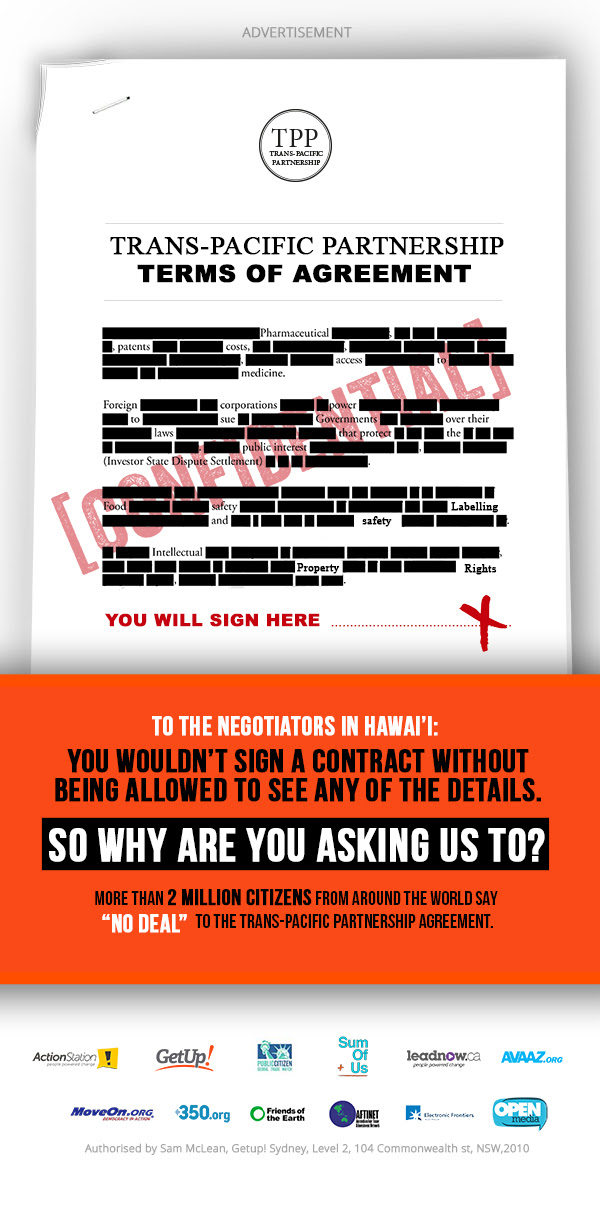
    The Trans Pacific Partnership (TPP) is one of those bad ideas. A really bad, secretive one, that threatens people’s sovereignty and environmental protections. Although negotiators are meeting right now in Honolulu to lock in an agreement on this disastrous deal, it’s all been kept secret — you can’t find much coverage in the news about what delegates are discussing because they are keeping quiet about it. So we thought we’d help put TPP in the media spotlight and send a message to delegates that people everywhere know what the TPP is and are standing against it:

    Together with our partners in the movement, we’re helping to run a full page advertisement in the largest newspaper in Hawaii, right where TPP negotiators are meeting. Check it out:

    Can you share this advertisement on Facebook and ask your friends to do the same?

    TPP is being negotiated by 12 countries and would enable fossil fuel companies to sue governments over laws and policies that they allege reduce their profits. So if an international oil giant thinks a local law designed to protect communities from fossil fuel exploration is hurting their profits, they won’t think twice before taking nations to court.

    But climate and environment is just one component of the deal. Thanks to leaked texts from Wikileaks, we know now that issues like online privacy, food standards and access to medicine would all become subject to corporate attacks. No wonder it’s all so secretive — this deal is only good for a few people, namely, the ones negotiating it.

    It’s time to show negotiators in Hawaii that the people know what’s going on behind the walls — and are not happy about it. When they check the newspaper before heading to the meeting room, they will see our messages. And they will know that there’s strong opposition to their “free” trade agreement.

    Can you tell your friends that civil society is against this massive corporate grab, and ask them to share the ad too?

    Let’s put TPP in the news for good, and send a global message to negotiators —  a secret deal at the expense of the people and democracy is a no deal.

    Onwards,

    Charlie

    *  Countries participating in negotiations on TPP: Australia, Brunei, Canada, Chile, Japan, Malaysia, Mexico, New Zealand, Peru, Singapore, the United States, and Vietnam.