Category: General news

Managing director of Ebono Institute and major sponsor of The Generator, Geoff Ebbs, is running against Kevin Rudd in the seat of Griffith at the next Federal election. By the expression on their faces in this candid shot it looks like a pretty dull campaign. Read on

  • [New post] QLD 2015 – what happened to the preferences? BEN RAUE

    to enable desktop notifications for Gmail.   Learn more  Hide
    1 of 25
    Web Clip

    [New post] QLD 2015 – what happened to the preferences?

    Inbox
    x

    The Tally Room <donotreply@wordpress.com>

    2:04 PM (7 minutes ago)

    to me

    New post on The Tally Room

    QLD 2015 – what happened to the preferences?

    by Ben Raue

    The final polls of the campaign all told the same story – the LNP leading with 52% of the two-party-preferred vote over Labor. This is certainly not what happened – in the seats where Labor and the LNP came in the top two, Labor has polled just over 52% of the two-party-preferred vote so far.

    But when you look at the primary votes, they aren’t far off. All three polls that produced a 52-48 figure had about 41% for the LNP and 37% for Labor, which was only off by 1% from the actual figures.

    The problems came in estimating preference flows. Most, if not all, pollsters rely on actual preferences from the previous election to estimate how minor party and independent votes will flow, rather than asking people how they will preference.

    Yet the pool of preferences in Queensland at this election was quite different. At the last election, Katter’s Australian Party polled over 11% of the vote, and made up a majority of the pool of minor party preferences. At this election, a majority of these votes belong to the Greens, thanks to KAP’s declining vote and focus on a small number of seats.

    Unlike in federal elections, the ECQ does not conduct a two-party-preferred (2PP) count in every seat. Indeed, the ECQ has now taken down the notional 2PP count for most seats, and we’ll have to wait for the final distribution of preferences to get the official seatwide figures, and the ECQ will not publish notional 2PP figures by polling place.

    You can only calculate a 2PP in a seat where the top two candidates are Labor and LNP. The AEC refers to these seats as “classic” electorates. At the moment, there are 77 seats where we have a Labor vs LNP count for most of the votes counted so far, with a 78th count being undertaken in Gaven. Out of the remaining eleven seats, there are four others where we will eventually get a Labor vs LNP count, but not until we get the final distribution of preferences, since the ECQ conducted a two-candidate-preferred count between other candidates on election night.

    So at the moment we can only compare preference flows in the 77 classic seats to the 71 classic seats in 2012 and the 83 from 2009.

    Year Classic seats Labor preferences LNP preferences Exhausted
    2009 83 32.01% 20.58% 47.40%
    2012 71 26.97% 22.08% 50.95%
    2015 77 46.59% 14.34% 39.07%

    What we’ve seen is a significant increase in Labor preferences, and a decline in LNP and exhausted preferences, even compared to the last Labor win in 2009.

    While part of this change is likely due to the decline of KAP, that doesn’t explain the whole picture. Even in strong Greens seats where KAP was a minor presence in 2012, you see a similar trend.

    In the inner-city seat of Mount Coot-tha, the preference flow from minor parties to Labor has increased from 45% in 2009, to 54% in 2012 and is now just under 75% in 2015. Most of these votes come from the Greens, and allowed Labor to win the seat despite being 10% behind on primary votes – normally such a feat is not possible under an optional preferential system.

    Ben Raue | February 3, 2015 at 1:00 pm | Tags: Queensland 2015 | Categories: Uncategorized | URL: http://wp.me/ppI95-6rT
  • Our Best Chance Yet !! Save the Reef 350 org

    More

    1 of 22

    Our best chance yet!

    Inbox
    x

    Moira Williams – 350.org Australia moira@350.org.au via list.350.org 

    1:04 PM (3 minutes ago)

    to me

    Dear friends,

    Right now we have one of the best opportunities we’ve ever had to stop the world’s largest coal port being built on the Great Barrier Reef. But we need to act fast.

    It looks almost certain that the ALP has won Government in Queensland, following Saturday’s historic election which swept coal-loving Premier Campbell Newman out of office after just one term.

    Click here to tell the ALP to say no to devastating coal projects on the Reef today!

    Under Newman, plans to build one of the world’s largest coal port at Abbot Point, in partnership with Indian mining giant Adani, were racing ahead. Abbot Point would provide a gateway for coal companies to unlock nine new mega coal mines in the Galilee Basin that would triple Australia’s carbon emissions and devastate the Great Barrier Reef.

    While the ALP have stopped short of saying they will cancel these projects all together, they have made some strong promises on the election campaign trail. These include:

    • Banning the environmentally-damaging dumping of dredge spoil in the Great Barrier Reef & internationally-significant Caley Valley wetlands
    • Cancelling taxpayer-funded subsidies to co-fund the billionaire-owned private rail line connecting the Galilee Basin to Abbot Point
    • Prohibiting dredging of the Reef unless Adani can demonstrate these projects stack-up financially (which we know they can’t).

    You can be certain that Adani and their cronies will be getting in the ears of the ALP right now so it’s crucial that we act immediately to make sure the incoming Government hears our voices over the money and power of the fossil fuel lobby.

    Call on the incoming Queensland government to say no to projects that would destroy the Reef and cook our climate.

    It’s hard to overstate the impact that these new mines will have on the climate. If the Galilee Basin were a country, the carbon dioxide produced from burning this coal would make it the seventh dirtiest fossil fuel burner on the planet. This is “make or break” for the climate.

    If the ALP lives up to its commitments, these projects could be delayed indefinitely — which would give us more time to convince global financiers that they are a bad deal. We have an opportunity to get a real commitment from this new Government and take a major leap forward in protecting the climate and our Reef for good.

    Send a message to the ALP today and tell them to put an end to these projects before it’s too late – the climate and our Reef depend upon it.

    For a brighter future,

    Moira for the 350.org Australia team

    PS: Spread the word on facebook here


    350.org is building a global climate movement.You can connect with us on Facebook, follow us on Twitter, and become a sustaining donor to keep this movement strong and growing.

  • New post] QLD 2015 – could Pauline Hanson win?

    1 of 24

    Web Clip
    101 CookbooksJanuary Cleanses & Detoxes5 days ago

    [New post] QLD 2015 – could Pauline Hanson win?

    Inbox
    x

    The Tally Room <donotreply@wordpress.com>

    7:12 PM (19 minutes ago)

    to me

    New post on The Tally Room

    QLD 2015 – could Pauline Hanson win?

    by Ben Raue

    TLDR – Yes, she could, but it’s going to be close.

    On Saturday night, it was a minor story that Pauline Hanson had polled quite highly in the south-east Queensland seat of Lockyer, winning 27.3% of the primary vote, ahead of Labor but 6% behind sitting Liberal National MP Ian Rickuss, who polled 33.7%.

    Because Hanson didn’t run in 2012, the ECQ on election night conducted an indicative two-party-preferred count between Labor and the LNP. This meant we didn’t have any idea how preferences would split between the LNP and Hanson, who is running again for One Nation.

    Late this afternoon the ECQ started posting results of a new two-candidate-preferred (2CP) count between Hanson and Rickuss, and it has Pauline Hanson leading in the count.

    There are 32 regular booths in Lockyer, in addition to a variety of prepoll centres, and postal and absentee votes. So far, 2CP results have only been released for five booths, which all are favourable to Hanson.

    While Hanson so far has polled 27.3% across Lockyer, she has polled 34.1% in the five booths where preferences have been distributed. The LNP’s vote is 2.2% lower in these five booths, and the Labor vote is 3.6% lower.

    In addition, there are large numbers of postal, pre-poll and absentee votes, which should favour the major parties. These votes are likely to strengthen the LNP position.

    But what would happen if you took the preference flows from these five booths and applied them to the remaining primary votes that have been counted so far?

    In short, the result would be extremely close. Preferences so far have flowed 26.5% LNP, 43% Hanson and 30.5% exhausted.

    This would result in Hanson polling 11,262 votes, and Rickuss polling 11,238 – a gap of 24 votes.

    Ben Raue | February 2, 2015 at 6:12 pm | Tags: Queensland 2015 | Categories: Uncategorized | URL: http://wp.me/ppI95-6rJ
  • Can Adani’s coal mine survive without Newman?

    Can Adani’s coal mine survive without Newman?

    The landmark Queensland state election on Saturday is likely to introduce a new Labor-led government elected with the key policy framework of “Saving the Great Barrier Reef”. The ALP has committed to remove state subsidies for the Galilee coal and associated rail projects, ban reef dumping and to ensure no dredging is undertaken at Abbot Point prior to financial close on any project.
    This election result will return the focus of Adani’s $15 billion Carmichael coal mine, plus associated rail and port infrastructure, proposal to the key questions of financial viability and strategic logic in the face of the structural decline of seaborne thermal coal markets.

    Central to its “Saving the Great Barrier Reef” policy, the Queensland Labor Party has committed to:

    – “Ban the sea dumping of capital dredge spoil within the Great Barrier Reef World Heritage Area”;

    – “Labor does not support … plan to dump dredge spoil from Abbot Point onto the Caley Valley Wetlands”;

    – “We will ensure that dredging does not go ahead until Adani has demonstrated its project has financial close”;

    – “The stewardship of the Great Barrier Reef necessitates that we have a comprehensive climate change policy”;

    – “Repeal the Newman Government’s water laws”; and

    – “Labor will not spend taxpayer money to build a private rail line for a private commercial project … Labor will not do any secret deals.”

    Labor’s policies will see the removal of numerous taxpayer funded subsidies as diverse as buying dredge spoil, co-funding a foreign billionaire-owned private rail line, allocating free water permits and funding a new single-purpose 200km water channel to the Carmichael proposal.

    The commercial viability of Adani’s Carmichael proposal without this government support is highly questionable. At the least the port project will not be allowed to commence until financial close, which is currently not scheduled until the end of 2015.

    The proposal to open up the Galilee coal basin for up to nine new mega-coal projects would see up to 300 million tonnes per annum of additional thermal coal exports. The 60 per cent decline in coal prices over the last four years reflects significant oversupply and weaker than expected demand. Flooding the seaborne coal market with a further 30 per cent increase in global supply is against Australia’s national interests.

    Opening the remote and lower quality Galilee Basin flies in the face of increasing global action on climate change by many of Australia’s major trading partners. Korea has just launched its national emissions trading scheme last month. In November 2014, India committed to a $US100 billion renewable energy program and $US50 billion electricity grid modernisation in the next five years. In the same month the China-US Climate Agreement committed both countries to expand on their significant, sustained efforts to systemically reduce emissions.

    There are now serious questions for the incoming executive in Queensland to examine how and why such lavish promises by way of enormous public subsidies were made to the Adani group in the face of conventional economics and our, and many others, continued analysis that showed this proposal was unbankable on commercial terms.

    Tim Buckley is the director of Energy Finance Studies, Australasia for the Institute for Energy Economics and Financial Analysis. He has 25 years of financial markets experience, including 17 years with Citigroup culminating in his role as managing director and head of Australasian equity research.

    Comments Policy »

    0 comments
    87 people listening
     
  • $85,000 from big tobacco George Wright LABOR

    1 of 22
    Web Clip

    $85,000 from big tobacco

    Inbox
    x

    George Wright via sendgrid.info 

    4:40 PM (0 minutes ago)

    to me
    .
    Neville,Tony Abbott just told the National Press Club his colleagues should be saying that “he’s a great person, doing a great job”, but what’s more disturbing than that is that there are corporate donors who seem to agree with him.

    While Queensland Labor edged closer to victory over the weekend, the Australian Electoral Commission released the details of political donations for last year, and it shows corporate donors gave to the Coalition at five times the rate they gave to Labor, including a handsome sum of $85,000 from big tobacco despite Tony Abbott promising in 2013 he’d join Labor in refusing tobacco donations.

    Despite the polls, there’s still a big risk that when big dollar donors pump money into election war chests, the top end of town get what they want and Australians get the short end of the stick.

    That’s how you get such an unfair Budget. That’s how big business get to draft Government policy. That’s how big tobacco try to bully their way out of plain packaging.

    But it’s not how we want to do things. Why don’t we start our own people-powered war chest?

    https://alp.org.au/davidvsgoliath

    The Coalition gets the big dollars and marginal electorates get saturated with their message.

    It means that despite the polls and unfair policies of the Government, the odds are still stacked against us, before election season even begins.

    That’s not how a democracy should function. What if instead we had a campaign driven by volunteers, funded by thousands of small donations? It’s the only way we can counter their ad buys and their massive campaign war chest.

    https://alp.org.au/davidvsgoliath

    It’s not a dream — if we start now, we can make it a reality. If you chip in just $5, and enough of us join you, we can make sure the Coalition can’t buy their way out of the trouble they’re in.

    Together we can give them a run for their money.

    George.

  • Queensland election result could be terminal for Galilee coal projects

    rss

    Queensland election result could be terminal for Galilee coal projects

    Print Friendly

    The landmark Queensland State election yesterday is likely to introduce a new Labor-led government elected with the key policy framework of “Saving the Great Barrier Reef”.

    The ALP has committed to remove state subsidies for the Galilee coal and associated rail projects, banning Reef dumping and to ensure no dredging is undertaken at Abbot Point prior to financial close on any project.

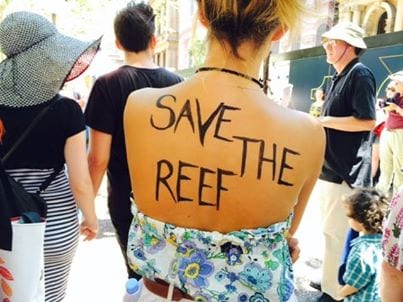
    Seen at the Sydney rally to save the GBR

    This election result will return the focus of Adani’s $15 billion Carmichael coal mine plus associated rail and port infrastructure proposal to the key questions of financial viability and strategic logic in the face of the structural decline of seaborne thermal coal markets.

    Central to its “Saving the Great Barrier Reef” policy, the Queensland Labor Party has committed to:

    • “Ban the sea dumping of capital dredge spoil within the Great Barrier Reef World Heritage Area”;
    • “Labor does not support … plan to dump dredge spoil from Abbot Point onto the Caley Valley Wetlands”;
    • “We will ensure that dredging does not go ahead until Adani has demonstrated its project has financial close”;
    • “The stewardship of the Great Barrier Reef necessitates that we have a comprehensive climate change policy”;
    • “Repeal the Newman Government’s water laws”; and
    • “Labor will not spend taxpayer money to build a private rail line for a private commercial project. …. Labor will not do any secret deals.”

    Labor’s policies will see the removal of numerous taxpayer funded subsidies as diverse as buying dredge spoil, co-funding a foreign billionaire owned private rail line, allocating free water permits and funding a new single purpose water channels for 200km to the Carmichael proposal.

    The commercial viability of Adani’s Carmichael proposal without this government support is highly questionable. At the least the port project will not be allowed to commence until financial close, currently not scheduled until the end of 2015.

    The proposal to open up the Galilee coal basin for up to nine new mega-coal projects would see up to 300 million tonnes per annum of additional thermal coal exports. The 60 per cent decline in coal prices over the last four years reflects significant oversupply and weaker than expected demand. Flooding the seaborne coal market with a further 30% increase in global supply is against Australia’s national interests.

    Opening the remote and lower quality Galilee Basin flies in the face of increasing global action on climate change by many of Australia’s major trading partners.

    Korea has just launched its national emission trading scheme in January 2015. In November 2014 India committed to a US$100 billion renewable energy program and US$50 billion electricity grid modernisation in the next five years. In the same month the China-US Climate Agreement committed both countries to expand on their significant, sustained efforts to systemically reduce emissions.

    There are serious questions for the incoming executive in Queensland to examine how and why such lavish promises by way of enormous public subsidies were made to the Adani group in the face of conventional economics and our, and many others, continued analysis that showed this proposal was unbankable on commercial terms.”

    Tim Buckley is the Director of Energy Finance Studies, Australasia for the Institute for Energy Economics and Financial Analysis. He has 25 years of financial markets experience, including 17 years with Citigroup culminating in his role as Managing Director and Head of Australasian Equity Research. His   detailed reports on Adani and GVK, global electricity markets plus the Indian electricity sector can be found here