Category: General news

Managing director of Ebono Institute and major sponsor of The Generator, Geoff Ebbs, is running against Kevin Rudd in the seat of Griffith at the next Federal election. By the expression on their faces in this candid shot it looks like a pretty dull campaign. Read on

  • Lima Talks; Oil Prices; Happy Planet Index; Christmas Footprint Global Footprint Network

    Click here to enable desktop notifications for Gmail.   Learn more  Hide
    More

    1 of 2
    Web Clip

    Lima Talks; Oil Prices; Happy Planet Index; Christmas Footprint

    Inbox
    x

    Global Footprint Network Unsubscribe

    7:12 PM (1 hour ago)

    to me
    Ecological Footprint Image LightGreen Footprint Network News
    Issue 38, December 18, 2014

    Fueling Footprint Conversations

    The Lima Accord reached at the conclusion of COP 20, the UN Framework Convention on Climate Change’s 20th meeting last week, marks the first time all nations have agreed to cut carbon emissions. Although non-binding, it is an encouraging development that sets the stage for more action on climate change in 2015 ahead of the Paris summit next December.

    The more than 10,000 representatives from 196 nations went home with plenty of work to do to uphold their promises to spell out their voluntary commitments on emission reductions by March 2015. The sooner countries prepare for the inevitable march of time towards a low-carbon future, the better.

     “Economies that are not planning their transition to a low-carbon future are vulnerable to unpredictable events such as consumers and investors turning against carbon-intensive products, the price of renewable energy becoming more competitive than that of fossil fuel-based energy, and technology advances,” said Sebastian Winkler, VP of Programs and Outreach at Global Footprint Network, upon returning from Lima.

    Global Footprint Network’s Finance for Change initiative is developing tools to evaluate the risks of stranded assets posed to nations’ economies and their sovereign debt.

    “Our analysis shows that countries are unequally exposed in terms of the scale and impact of reforms required to move to low-carbon economies. The longer countries wait, the more their carbon-intensive assets will lose value in a low-carbon future,” Global Footprint Network President Mathis Wackernagel pointed out in his commentary on the landmark U.S.-China climate deal announced last month, which created momentum heading into the Lima meetings. Read Wackernagel’s full statement on the U.S.-China agreement.

    What’s really behind the dramatic drop in oil prices? When and why might they go back up? Who are the winners and losers? Chris Nelder, Global Footprint Network’s policy officer, suggests a jump in U.S. oil production as a result of fracking is one major factor, but traders are now fueling the price decline. He forecasts that if prices remain at their current depressed levels for another three months or more, we should expect a slowdown in growth of U.S. oil production. “Some slowing is already indicated, as new drilling permits fell by 40 percent from October to November,” he notes. Read more of Nelder’s oil price analysis

    Click the interactive map below to see the multitude of locations where our team has been working to expand knowledge about the Footprint these past couple of months.


    Footprint in Action
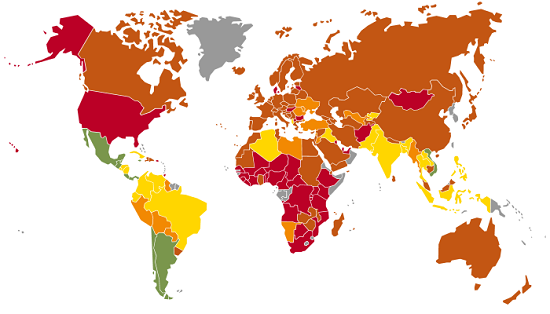
    Iraq – a “happier” country than … the United States?! The New Economics Foundation’s latest Happy Planet Index is out, demonstrating once again that the environmental cost of rich countries’ lifestyle fails to sustainably deliver long and happy lives. The overall index scores rank 151 countries based on life expectancy, experienced well-being and the Ecological Footprint. The resulting map is striking. Can you guess which is the happiest country of all?

    Montenegro appears to be the only country in the Mediterranean basin to have improved the proportion between biocapacity balance and production footprint between 1961 and 2007, according to the UN Development Programme’s latest National Human Development Report-Montenegro. Montenegro’s footprint comes close to its biocapacity, demonstrating that it is possible to achieve a high level of human development while maintaining a low level of environmental impact. At the same time, the local economy is about three times as energy-intensive as the EU economy. Across sectors, resource efficiency is indeed the main challenge facing the country going forward. Among five scenarios put forward in the report, “moderate reduction in the use of resources” emerges as optimal. It envisions an active and ambitious natural resource management policy that would increase resource productivity by 60 percent in 2020 compared to the 2005-2012 period average, and would achieve an absolute reduction of the use of resources of 20 percent compared to the same period average.

    News from the Network
    We were thrilled to learn that Professor Herman Daly, widely viewed as the father of ecological economics, was named a Laureate of the 2014 Blue Planet Prize (received by Global Footprint President Mathis Wackernagel in 2012). A formal acknowledgement of his contribution to economic theory was long overdue: He was one of the first to demonstrate that an economy has an optimal physical scale in the context of the natural ecosystems that support it.

    If too big, an economy starts yielding diminishing returns on investments, since the costs of operating become larger than the benefits that the system is able to generate. Consider the overuse of natural capital, for instance, where degradation of that capital is mistakenly considered “income” while, in fact, the long-term ability of that capital to keep yielding steady income is being compromised.

    By calling for an economic theory that is consistent with biophysical limits, Daly essentially laid the foundation for Global Footprint Network’s work. When asked whether his ideas about living within the regenerative capacity of the planet are unrealistic, he typically answers that he’d rather be unrealistic about socio-economic rules and behaviors than about physical conditions, since the economic rules can change but physical reality cannot. We could not agree more.

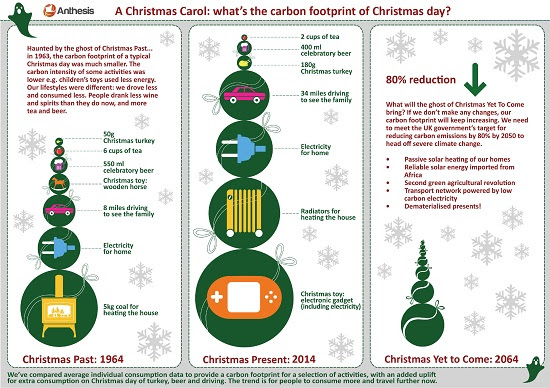
    The Carbon Footprint … of Christmas: Santa Claus has long been known for traveling sustainably on a reindeer-powered sleigh, snacking on milk and cookies, and delivering books, puzzles and board games with low-emissions life cycles to children around the world. Our 2014 Christmas, on the other hand, requires a lot more carbon than it did 50 years ago, according to an infographic from our partner organization Best Foot Forward (Anthesis Group). We drive around 34 km on fossil-fuel powered cars, eat meat galore and shower our loved ones with gifts of electronic gadgets. These devices have high carbon Footprints due to the large amount of energy required to produce the components and batteries, and to the power they consume when in use.

    Instead of a white Christmas, how about creating a green Holiday where the gift of experiences trumps the giving of things? Check out these suggestions from treehugger.com.

    From Our Blog
    Lead scientist David Lin traveled to the Indian state of Odisha to provide support to Pragyan Bharati, our India director, on our new pilot project there, Sustainable Development Return on Investment. In partnership with local organizations Gram Vikas and International Development Enterprises-India, we aim to empower local villagers to have a more informed voice in shaping development in their communities. Read Lin’s account of his eye-opening trip, in which he saw first-hand how seemingly small innovations can make an impact.

    Last month co-founders Susan Burns and Mathis Wackernagel were inducted into the Sustainability Hall of Fame. Susan made the trip to the International Society of Sustainability Professionals Conference in Denver, Colorado, to receive the award. She took that opportunity to pause and reflect on her journey as a sustainability pioneer. Read her candid interview.

  • 2014: best, worst and funniest ACF

    3 of 4
    Web Clip
    Forbes.com: Most popular storiesTechnical Glitch Hasn’t Stopped Best Buy’s Holiday Boom2 days ago

    2014: best, worst and funniest

    Inbox
    x

    Kelly O’Shanassy, ACF Unsubscribe

    7:01 PM (20 minutes ago)

    to me

    Dear NEVILLE

    I deeply appreciate you being part of ACF in 2014. Thank you.
    As a big believer in celebrating the wins, standing strong after the losses and keeping a sense of humour at all times, we’ve pulled together the highs, the lows and the hilarities of 2014. Enjoy!

    The Best

    Tasmanian World Heritage forests safe – When the federal government asked the UNESCO World Heritage Committee to tear up the listing for 74,000 ha of Tasmanian wilderness – you signed, called, faxed, delivered trees, rallied and donated. It took just seven minutes for the committee to throw out the government’s proposal. It made me dance among the trees!

    Radioactive waste dump dumped For seven years, the Muckaty mob fought a radioactive waste dump on their land. In June, the federal government formally withdrew its plan. They were the sixth remote community targeted and pressured by federal governments to be a dumping ground. They’re the sixth to say no.
    Environment laws protected – Pushing the big business agenda – to mine, dredge, and frack with no one watching – the government tried to water down the laws that protect the places we love. Against the odds, you and community leaders from all over Australia held them at bay, persuading crossbench Senators we need strong protections. There’s a long road ahead. Your support can help the push for a new generation of environment laws.
    Stolen country returned – “There’s a time to cry, there’s a time to laugh – now is the time to dance.” Olkola elder, Mike Ross, did exactly that last week when, after a century locked out, his people’s country on Cape York was returned to them. It’s an incredible story.
    The road ahead – I’m so excited to forge ACF’s new path with you and our President Geoff Cousins. If you missed our AGM, you can watch Geoff reveal how far he is prepared to go to make change. In my speech I talk about two of my favourite things: trees and people power.
    Sparking community change – ACF and the YMCA have doubled Spark’s reach. Kinder teachers, fitness instructors and chefs at YMCA centres saving energy and going solar. As part of the Climate Reality Project, we trained 415 new leaders. And we know many of you are taking action at home and in your communities. Your efforts matter.

    The Worst

    Where do I start?
    Polluters no longer pay – The government scrapped the law that made polluters pay for their carbon pollution. It was working. Pollution was going down. Now it’s going back up. This is what happened after you signed the petition. We lost that one……for now!
    Clean energy assaulted – In another inexplicable move, the government attacked the Renewable Energy Target with a hand-picked panel of climate denialists and former oil and gas executives, but you fought back with letters, phone calls, rallies, posters and by pressuring the ‘dirty three’ power companies. The RET is still alive.
    Nature not nurtured –  The Tasmanian government scrapped the Tasmanian Forest Agreement, the historic ‘peace deal’ between conservationists and the timber industry.
    The federal government approved the biggest coal mine in the world, dredging the reef, and opening a giant coal port.
    All this when we know nature is in trouble. A landmark survey of Australia’s environment by the Places You Love Alliance shows that we need to restore our rivers, climate, forests, soils, oceans and reefs, not make them worse — or we could lose them forever.
    Money madness – The federal government is handing out $47 billion in fossil fuel subsidies that promote pollution and only $1 billion to the Direct Action Plan to reduce pollution.

    The Funniest

    Good for humanity? – The Prime Minister, taking his cues from big coal, declared that “coal is good for humanity”. (Well it would be be funny if it weren’t so sad).
    It reminded me of the hilarious failed attempt the coal industry made to run a social media campaign called #Australiansforcoal. Hmmm, turns out Aussies prefer clean energy.
    G20 surprise – Our climate change campaign manager Victoria McKenzie-McHarg went above the call of duty with her crazy call to put climate change on the agenda of the G20. We can’t believe she did it in one take. And despite Mr Abbott’s best efforts, the G20 turned into a show of force for action to tackle climate change.
    The Emperor’s new clothes – Saffron, from our Canberra office, fielded some tricky questions from her six year old this year about her work in Parliament House. My favourites:
    • If people who don’t want to destroy the world become leaders one day, will you have to get a different job?
    • Is government just for boys?
    • Why don’t you have shoes that are pretty AND comfy?
    Meme me please – If you need more of a laugh, join ACF’s Facebook. You’ll find plenty of chuckles there. After all, how much can a koala bear?*
    Thank you so much for your continued financial support, interest and environmental action. With you on our team, 2015 could be the biggest year in ACFs history (and it’s our 50th!).
    Enjoy the great outdoors and the holiday season,
    Kelly
    Kelly O’Shanassy
    Chief Executive Officer
    Australian Conservation Foundation
    PS. You keep ACF fearless and independent – We are 94% funded by you, our members and supporters, and I’m so grateful for your support and to those who have remembered ACF in their wills. Our campaign for stronger, not weaker, environmental laws is at a crucial stage. Your contribution can make a difference
  • Season’s Greetings GEODYNAMICS

    1 of 2
    Web Clip
    CNN.com Recently Published/UpdatedOxfam digests lessons from 2004 Indian Ocean tsunami4 hours ago

    Season’s Greetings

    Inbox
    x

    Geodynamics info@geodynamics.com.au via mail28.wdc01.mcdlv.net 

    3:32 PM (5 minutes ago)

    to me

    #
    This is an auto-generated email alert. Please do not reply to this email. If you have any queries please contact us via info@geodynamics.com.au or click here to visit our website.

    We thank you for your interest in Geodynamics Limited.

      COPYRIGHT 2014
    GEODYNAMICS LIMITED

    Geodynamics Limited – Level 1 / 9 Gardner Close – Milton Queensland 4064

    www.geodynamics.com.au | Unsubscribe | Update Subscription Preferences | Privacy Policy


    Click here to Reply or Forward
    0 GB (0%) of 15 GB used
    ©2014 GoogleTermsPrivacy
    Last account activity: 1 hour ago

    Details

  • Love, actually.    World Wildlife Australia

    Click here to enable desktop notifications for Gmail.   Learn more  Hide
    1 of 2
    Web Clip
    NYT TravelHeads Up: Down the Hobbit Hole in Switzerland6 hours ago

    Love, actually.

    Inbox
    x

    Dermot O’Gorman, WWF-Australia noreply@act.wwf.org.au via server8839.e-activist.com 

    2:37 PM (28 minutes ago)

    to me
    Under water coral, Great Barrier Reef  © Troy Mayne

    Hi NEVILLE,

    It’s been a huge year for the Great Barrier Reef, and next year is going to be even bigger.  But as Christmas approaches, we (and Nemo) wanted to take a moment to say thanks for all that you’ve done for the Reef this year.

    We hope you like this little video message we’ve put togetherActually, we hope you love it:

    Nemo Christmas Video

    Merry Christmas!

    Dermot, Cristel, Gilly, Louise, Richard, Owen, Kate, Mark, Phil & the whole WWF-Australia team

    (P.S. If the video is a little perplexing – this might add some context: https://www.youtube.com/watch?v=00kjd-OekOA)

  • Click here to enable desktop notifications for Gmail.   Learn more  Hide
    1 of 15
    Web Clip
    CNN.com Recently Published/UpdatedNathaniel Kibby faces hundreds of charges in kidnapping2 hours ago

    RE: Pure desperation

    Inbox
    x

    Tanya Cross via Change.org

    1:30 PM (4 minutes ago)

    to me
    Change.org

    NEVILLE – Tanya Cross’ house was showered with asbestos in the fatal Tuncurry explosion – yet 18 months on, she and her son are still unable to return home as ANZ deny her home insurance claim.

    As ANZ hold their annual general meeting today, Tanya is making a plea for more support on her change.org petition to force ANZ to address her situation. Will you add your name today to help?

    Read on below for more information on her petition:

    ANZ Insurance: Pay our home insurance and allow us to move on with our lives

    Tanya Cross
    Forster, Australia
     Our home /property was damaged and contaminated with asbestos on 14/6/2013 by our neighbours fatal home explosion. His home was made of asbestos and the blast showered surrounding properties (including ours) with asbestos fragments making it unsafe to return home.

    As the explosion made national news you can find/verify information regarding the incident by googling ‘Tuncurry Explosion’.

    There were 4 residents/families including ours displaced on that day, 3 of which have been able to return to their homes at various times during that past 18 months. To date our home is the only property which has not been restored and we are the only residents insured with ANZ.

    My son and I have been forced to relocate several times and remain in temporary rental accomodation (currently we reside in the 3rd).

    The Short But Factual Version Of Our Ongoing Struggle:

    • We have held ANZ Home and Contents insurance for over a decade. ANZ insurance is currently underwritten by QBE.
    • We have never missed a payment, have always paid via direct debit and in fact still pay for our policies even though we haven’t been able to live there.
    • ANZ insurance ceased paying our temporary accomodation leaving us with mortgage payments and temporary accomodation rent. We can’t afford to continue paying both as I am a sole parent and therefore our sole bread winner.
    • ANZ have accepted our claims.
    • ANZ have paid part of our contents claim, we are unsure why this hasn’t been finalised however this is of little consequence when we don’t have a home. What they did pay however was useful and has now been exhausted into our mortgage/rent payments.
    • ANZ representatives advise that although my policy is ANZ Insurance, ANZ consider themselves unable to assist us?? I have asked numerous ANZ representatives (including their CEO) why they continue to choose to be underwritten by QBE when QBE are not providing the protection to their customers properties in accordance to their policies and product disclosure statements, I am yet to receive a response.
    • To date my property remains contaminated and therefore deemed ‘unsuitable for residential use’.
    • This fact was only proven after I fought for second opinion on the asbestos clean-up due to 2 failed attempts requiring Workcover intervention, by the insurers asbestos ‘experts’. This process took me from July 2013 – January 2014 at which time the new asbestos team confirmed the current dangerous contamination.
    • In February the insurer acknowledged this outcome and committed to paying the new asbestos company to complete the clean-up however to date this has not occurred. I have begged, pleaded and complained everywhere but still no progress.
    • ANZ has not apologised for the risk they placed my family in by insisting our property was safe up until I successfully proved their opinion inaccurate.
    • An ANZ Insurance appointed an engineer has attended my property twice, firstly in November 2013 and again in January 2014. The engineer wrote a report after both visits and there is currently 3 scopes of work as a result of these reports. The issue with these is none of them match. Some scopes have some details, some scopes have others and some reported damage is not in any of the scopes?? I escalated these obvious issues to the insurer and received a written committment that the builders would attend with all of the scopes when quoting. Disappointingly yet predictably this did not occur resulting in the builders attending in January/February 2014 and only being able to quote on the one scope they were issued.
    • The engineers report from January 2014 makes note of the fact that our home had deteriorated since his previous visit in November 2013 due to the home being unoccupied and remaining open to the elements via blown out windows not being fixed and therefore allowing in wind, water, squatters, animals, vermin etc.
    • Reported deterioration November 2013 – January 2014 yet we are now in December 2014 and the insurer has done NOTHING. Obviously and unfairly our home has continued its steady but predictable deterioration.

    We have resisted media contacts until recently when we agreed to tell our story as we sincerely hoped our claim would be settled fairly and privately, however we now accepted this will not be the case.

    It is very humbling to ask for help and I only speak up now out of pure desperation for our financial future and wellbeing.

    We know ANZ and QBE don’t care, we know we are nothing but a faceless insignificant number to them, but we hope Australians do care and will want to help us.

    We are not asking for anything unreasonable. We have paid for and held our ANZ polices in good faith for many years. We simply want ANZ Insurance to step up and live up to their promises.

    Thank you for taking the time to read our story. Should you choose to sign our petition that would be wonderful and we will be forever grateful.

  • The John James Newsletter No 36

    ktop notifications for Gmail.   Learn more  Hide


    More


    1 of 15


    Web Clip

    Gmail Blog – Use your cúpla focal on Gmail, now in Irish – 6 days ago

    The John James Newsletter 36 – URGENT – Provocation for WWIII at Cristmas

    Inbox x

    John James

    11:00 AM (14 minutes ago)
    to John

    The John James Newsletter 36

    18 December 2014. 

    Three Members of Congress Just Reignited the Cold War While No One Was Looking

    Pphoto of the chamber of the House of Representatives that shows H.R. 5859 passing by unanimous consent in the span of one second. (Photo: AP/J. Scott Applewhite)

    Late Thursday night, the House of Representatives unanimously passed a far-reaching Russia sanctions bill, a hydra-headed incubator of poisonous conflict. The second provocative anti-Russian legislation in a week, it further polarizes our relations with Russia, helping to cement a Russia-China alliance against Western hegemony, and undermines long-term America’s financial and physical security by handing the national treasury over to war profiteers.

    Here’s how the House’s touted “unanimity” was achieved: Under a parliamentary motion termed “unanimous consent,” legislative rules can be suspended and any bill can be called up. If any member of Congress objects, the motion is blocked and the bill dies.

    At 10:23:54 p.m. on Thursday, a member rose to ask “unanimous consent” for four committees to be relieved of a Russia sanctions bill. At this point the motion, and the legislation, could have been blocked by a single member who would say “I object.”  No one objected, because no one was watching for last-minute bills to be slipped through.

    Most of the House and the media had emptied out of the chambers after passage of the $1.1 trillion government spending package.


    The Congressional Record will show only three of 425 members were present on the floor to consider the sanctions bill. Two of the three feigned objection, creating the legislative equivalent of a ‘time out.’ They entered a few words of support, withdrew their “objections” and the clock resumed.

    According to the clerk’s records, once the bill was considered under unanimous consent, it was passed, at 10:23:55 p.m., without objection, in one recorded, time-stamped second, unanimously.

    Then the House adjourned.

    I discovered, in my 16 years in Congress, that many members seldom read the legislation on which they vote. On Oct. 24, 2001, House committees spent long hours debating the Patriot Act. At the last minute, the old bill was swapped out for a version with draconian provisions. I voted against that version of the Patriot Act, because I read it. The legislative process requires attention.

    Legislation brought before Congress under “unanimous consent” is not read by most members simply because copies of the bill are generally not available. During the closing sessions of Congress I would often camp out in the House chamber, near the clerk’s desk, prepared to say “I object” when something of consequence appeared out of the blue. Dec. 11, 2014, is one of the few times I regret not being in Congress to have the ability to oversee the process.

    The Russia Sanctions bill that passed “unanimously,” with no scheduled debate, at 10:23:55 p.m. on Dec. 11, 2014, includes:

    1. Sanctions of Russia’s energy industry, including Rosoboronexport and Gazprom.
    1. Sanctions of Russia’s defense industry, with respect to arms sales to Syria.
    1. Broad sanctions on Russians’ banking and investments.
    1. Provisions for privatization of Ukrainian infrastructure, electricity, oil, gas and renewables, with the help of the World Bank and USAID.
    1. Fifty million dollars to assist in a corporate takeover of Ukraine’s oil and gas sectors.
    1. Three hundred and fifty million dollars for military assistance to Ukraine, including anti-tank, anti-armor, optical, and guidance and control equipment, as well as drones.
    1. Thirty million dollars for an intensive radio, television and Internet propaganda campaign throughout the countries of the former Soviet Union.
    1. Twenty million dollars for “democratic organizing” in Ukraine.
    1. Sixty million dollars, spent through groups like the National Endowment for Democracy, “to improve democratic governance, and transparency, accountability [and] rule of law” in Russia. What brilliant hyperbole to pass such a provision the same week the Senate’s CIA torture report was released.
    1. An unverified declaration that Russia has violated the Intermediate-Range Nuclear Forces Treaty, is a nuclear “threat to the United States” and should be held “accountable.”
    1. A path for the U.S. withdrawal from the INF Treaty, which went into force in 1988. The implications of this are immense. An entire series of arms agreements are at risk of unraveling. It may not be long before NATO pushes its newest client state, Ukraine, to abrogate the Non-Proliferation Treaty, which Ukraine signed when it gave up its nuclear weapons, and establish a renewed nuclear missile capability, 300 miles from Moscow.
    1. A demand that Russia verifiably dismantle “any ground launched cruise missiles or ballistic missiles with a range of between 500 and 5,500 kilometers …”—i.e., 300 and 3,300 miles.

    Read the legislation, which Congress apparently didn’t.

    As reported on GlobalSecurity.org, earlier that same day in Kiev, the Ukrainian parliament approved a security plan that will:

    1. Declare that Ukraine should become a “military state.”
    1. Reallocate more of its approved 2014 budget for military purposes.
    1. Put all military operating units on alert.
    1. Mobilize military and national guard units.
    1. Increase military spending in Ukraine from 1 percent of GDP to 5 percent, increasing military spending by $3 billion over the next few years.
    1. Join NATO and switch to NATO military standards.

    Under the guise of democratizing, the West stripped Ukraine of its sovereignty with a U.S.-backed coup, employed it as a foil to advance NATO to the Russian border and reignited the Cold War, complete with another nuclear showdown.

    The people of Ukraine will be less free, as their country becomes a “military state,” goes into hock to international banks, faces structural readjustments, privatization of its public assets, decline of social services, higher prices and an even more severe decline in its standard of living.

    In its dealings with the European Union, Ukraine could not even get concessions for its citizens to find work throughout Europe. The West does not care about Ukraine, or its people, except for using them to seize a strategic advantage against Russia in the geopolitical game of nations.

    Once, with the help of the West, Ukraine fully weighs in as a “military state” and joins the NATO gun club, its annual defense budget will be around $3 billion, compared with the current defense budget of Russia, which is over $70 billion.

    Each Western incitement creates a Russian response, which is then given as further proof that the West must prepare for the very conflict it has created, war as a self-fulfilling prophecy.

    That the recent Russia sanctions bill was advanced, “unanimously,” without debate in the House, portends that our nation is sleepwalking through the graveyards of history, toward an abyss where controlling factors reside in the realm of chance, what Thomas Hardy termed “crass casualty.” Such are the perils of unanimity.

    http://www.commondreams.org/views/2014/12/16/three-members-congress-just-reignited-cold-war-while-no-one-was-looking