Managing director of Ebono Institute and major sponsor of The Generator, Geoff Ebbs, is running against Kevin Rudd in the seat of Griffith at the next Federal election. By the expression on their faces in this candid shot it looks like a pretty dull campaign. Read on
This week, I’ve seen two confronting sides of the coin that is climate change.
Last Friday, as thirty young Pacific Islanders arrived on our shores to stand up to the fossil fuel industry driving the destruction of their homes, I received an email from the President of The Marshall Islands College, asking for assistance in divesting his university from fossil fuels. Attached were thirteen photos of the frightening floods that have just hit the Islands and are evermore frequently scourging his home.
I sat, speechless. Here was a people suffering the worst impacts of climate change yet who had done nothing to cause the problem – offering to help, not just their country, but all countries, by standing up to the fossil fuel industry and divesting from climate disruption. This fighting, hopeful spirit of the Pacific brought tears to my eyes.
Meanwhile, back home, an announcement from Australia’s National University that they will divest* from two fossil fuel companies has prompted our Federal Treasurer to lambast ANU’s Vice Chancellor and our Financial Press to wage a condemnatory campaign, now into its eleventh day. It has even compelled our Prime Minister to exclaim, in his wisdom, that “Coal is Good for Humanity.” The contrast couldn’t be more stark.
But, albeit confronting, these events, I believe, are a major turning point for Australia.
They are laying bare the degree to which our politicians and our press are wedded to an industry whose activities will tank the planet. But more importantly, they’re highlighting the inexorable courage of our Pacific neighbours to tackle the heart of this problem and inspire all Australians to do the same.
And this gives me great hope as we move into times that will be more difficult and confronting than humanity has ever faced.
With the world’s largest coal port to blockade and millions more dollars to shift out of fossil fuels, the next fortnight will be 350.org Australia’s biggest and most challenging yet. We hope you will join us where and when you can by:
Working out the amount of carbon dioxide that lingers in the atmosphere is critical to estimating the future impacts of global warming on temperatures.
About half the CO2 that’s produced ends up in the oceans or is absorbed by living things.
But modelling the exact impacts on a global scale is a fiendishly complicated business.
In this new study, a team of scientists looked again at the way trees and plants absorb carbon.
By analysing how CO2 spreads slowly inside leaves, a process called mesophyll diffusion, the authors conclude that more of the gas is absorbed than previously thought.
Between 1901 and 2100 the researchers believe that their new work increases the amount of carbon taken up through fertilisation from 915 billion tonnes to 1,057 billion, a 16% increase.
“There is a time lag between scientists who study fundamental processes and modellers who model those processes in large scale model,” explained one of the authors, Dr Lianhong Gu at Oak Ridge National Laboratory in the US.
“It takes time for the the two groups to understand each other.”
Scientists monitor carbon dioxide levels near trees to work out how much is absorbed
The researchers believe that Earth systems models have over estimated the amount of carbon in the atmosphere by about 17%, and think their new evaluation of plant absorption explains the gap.
“The atmospheric CO2 concentration only started to accelerate rapidly after 1950,” said Dr Gu.
“So the 17% bias was achieved during a period of about 50 years. If we are going to predict future CO2 concentration increases for hundreds of years, how big would that bias be?”
Model revampOther researchers believe the new work could help clarify our models but it may not mean any great delay in global warming as a result of increased concentrations of the gas.
“The paper provides great new insights into how the very intricacies of leaf structure and function can have a planetary scale impact,” said Dr Pep Canadell from the Global Carbon Project at CSIRO Australia.
“It provides a potential explanation for why global earth system models cannot fully reproduce the observed atmospheric CO2 growth over the past 100 years and suggests that vegetation might be able to uptake more carbon dioxide in the future than is currently modelled.
“Having more carbon taken up by plants would slow down climate change but there are many other processes which lay in between this work and the ultimate capacity of terrestrial ecosystems to remove carbon dioxide and store it for long enough to make a difference to atmospheric CO2 trends.”
Many experts agree that the effect is interesting and may require a recalibration of models – but it doesn’t change the need for long-term emissions cuts to limit the impact of carbon dioxide.
“This new research implies it will be slightly easier to fulfil the target of keeping global warming below two degrees – but with a big emphasis on ‘slightly’,” said Dr Chris Huntingford, a climate modeller at the UK’s Centre for Ecology and Hydrology.
“Overall, the cuts in CO2 emissions over the next few decades will still have to be very large if we want to keep warming below two degrees.”
Rising sea levels of 1.8 meters in worst-case scenario
Sea level:
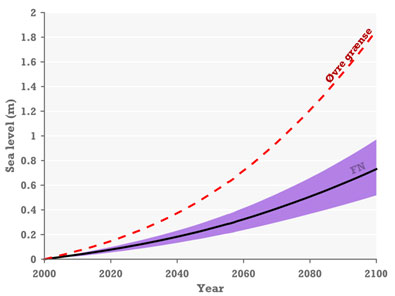
The climate is getting warmer, the ice sheets are melting and sea levels are rising – but how much? The report of the UN’s Intergovernmental Panel on Climate Change (IPCC) in 2013 was based on the best available estimates of future sea levels, but the panel was not able to come up with an upper limit for sea level rise within this century. Now researchers from the Niels Bohr Institute and their colleagues have calculated the risk for a worst-case scenario. The results indicate that at worst, the sea level would rise a maximum of 1.8 meters. The results are published in the scientific journal Environmental Research Letters.
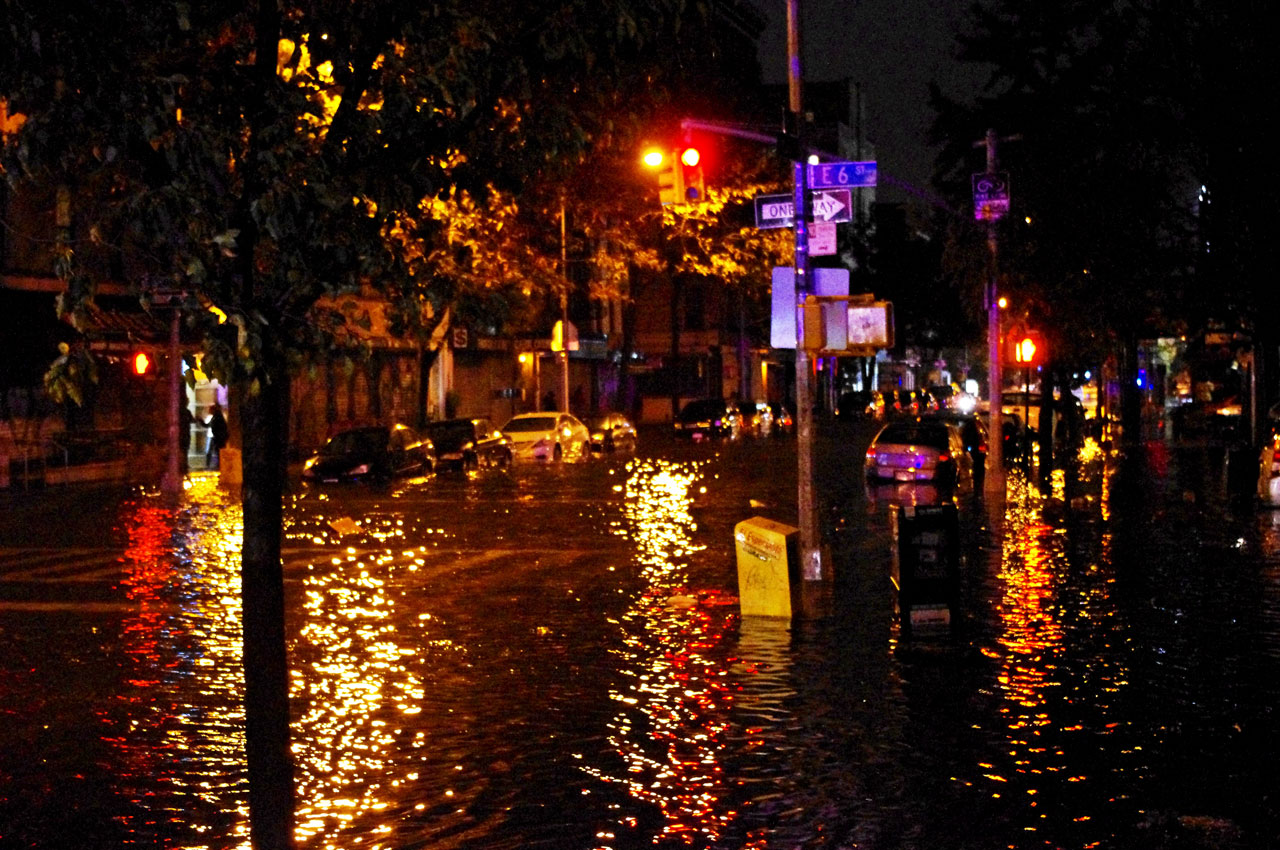
The storm surge of Hurricane Sandy reached 2.8 m above mean high tide in New York. In the future less severe storms will cause comparable surge levels due rising sea level. The unlikely worst case scenario for sea level rise this century is estimated to be 1.8 m, which would translate into approximately 20 times more frequent Sandy level surges. (Photo credit: David Shankbone, CC-BY-3.0)
What causes the sea to rise is when all the water that is now frozen as ice and lies on land melts and flows into the sea. It is first and foremost about the two large, kilometer-thick ice sheets on Greenland and Antarctica, but also mountain glaciers.
In addition, large amounts of groundwater is pumped for both drinking water and agricultural use in many parts of the world and more groundwater is pumped than seeps back down into the ground, so this water also ends up in the oceans.
Finally, what happens is that when the climate gets warmer, the oceans also get warmer and hot water expands and takes up more space. But how much do the experts expect the sea levels to rise during this century at the maximum?
Melting of the ice sheets
“We wanted to try to calculate an upper limit for the rise in sea level and the biggest question is the melting of the ice sheets and how quickly this will happen. The IPCC restricted their projektions to only using results based on models of each process that contributes to sea level. But the greatest uncertainty in assessing the evolution of sea levels is that ice sheet models have only a limited ability to capture the key driving forces in the dynamics of the ice sheets in relation to climatic impact,” Aslak Grinsted, Associate Professor at the Centre for Ice and Climate at the Niels Bohr Institute at the University of Copenhagen
The worst-case sea level projections is shown in red. There is 95% certainty that sea level will not rise faster than this upper-limit. Purple shows the likely range of sea level rise as projected in the IPCC fifth assessment report under a scenario with rising emissions throughout the 21st century (RCP8.5). (Credit: Aslak Grinsted, NBI)
Aslak Grinsted has therefore, in collaboration with researchers from England and China, worked out new calculations. The researchers have combined the IPCC numbers with published data about the expectations within the ice-sheet expert community for the evolution, including the risk for the collapse of parts of Antarctica and how quickly such a collapse would take place.
“We have created a picture of the propable limits for how much global sea levels will rise in this century. Our calculations show that the seas will likely rise around 80 cm. An increase of more than 180 cm has a likelihood of less than 5 percent. We find that a rise in sea levels of more than 2 meters is improbable,” Aslak Grinsted, but points that the results only concern this century and the sea levels will continue to rise for centuries to come
The recent announcement by the heirs to the Rockefeller oil fortune, philanthropists and other high net worth individuals that they will divest $50 billion from fossil fuel investments represents a significant behavioural shift, demonstrating that environmental sustainability is becoming increasingly important for investors when evaluating options and selecting where they will invest. Stanford, one of the world’s most well known and respected universities made a similar announcement that they would not invest any of their $18.7 billion endowment fund in coal mining companies in May this year, and the Australian National University (ANU), one of Australia’s most well known and highly ranked universities announced earlier this month that it will divest funds in seven resource and mining companies following an independent review.
On October 6, the Anglican Diocese of Perth announced that they will divest their fossil fuel investments and invest in renewables as part of their responsibility to act on climate change. During the announcement Father Evan Pederick from the Diocese stated that it was up to private enterprise and/or individuals to show the way in the absence of effective Government action. The Diocese of Perth’s action follows on from the Anglican Church in Australia’s announcement in August 2014. Several Anglican Dioceses in New Zealand have also made similar commitments, along with the cities of Dunedin and Brisbane and a number of foundations.
The divestment momentum is becoming harder and harder to ignore, however it would be naive to think that it is just about reallocating funds. Corporate social and environmental responsibility are now commonly front of mind in many organisations across a range of sectors globally. Company boards and management are now more cognisant of the reality that these responsibilities go beyond the mere reporting of performance in order to tick a regulator’s box or answer a query from a shareholder (of course this is still important). They realise that the positions they take will need to be justified as part of transactional negotiations, and that as National Governments begin to mandate environmental requirements more and more, their customers and trading partners who operate in jurisdictions under these mandates will also be subject to them. They are also aware of the reality that using social media and other platforms, individual shareholders can very quickly find others that are of a similar viewpoint to them, and form groups that give them far more of a say than they would have on their own.
Benefit From the Latest Energy Trends and Investment Opportunitiesbefore the mainstream media and investing public are aware they even exist. The Free Oilprice.com Energy Intelligence Report gives you this and much more. Click here to find out more.
The promise of generating energy with nuclear fusion is tantalizing because it would be free of toxic emissions and nuclear waste, and would have a virtually infinite fuel supply. On the downside, though, it is extremely costly compared with fossil fuels like natural gas and coal.
Now engineers at the University of Washington (UW) have developed a design for a fusion reactor that could be even less expensive than a coal-fired plant but boast similar generating capacity. The current design is for a reactor too small to generate much electricity, but the team is confident it can be scaled up to the size of a large power plant.
Select the reports you are interested in:
NO-SPAM: Under no circumstances will we EVER rent, sell or give away your email
“Right now, this design has the greatest potential of producing economical fusion power of any current concept,” Thomas Jarboe, professor of aeronautics and astronautics and an adjunct professor in physics, told the UW news department.
The engineers already have published the design, along with a cost-analysis study, in the journal Fusion Engineering and Design, and are scheduled present their findings at the International Atomic Energy Agency’s 25th Fusion Energy Conference in St. Petersburg, Russia, on Oct. 17.
The dynomak, as the reactor is called, began in 2012 as a mere student project for a class taught by Jarboe. Later Jarboe and a doctoral student, Derek Sutherland, worked to refine the concept.
Their plan was to create a magnetic field within a closed space to contain plasma – hydrogen gas rich in electrically-charged atoms – long enough to heat the plasma to the extreme temperatures needed to maintain thermonuclear conditions. This intense heat then would be transferred to a coolant fluid that would spin a turbine to generate electricity.
The UW power generator’s design, called a spheromak, also generates most of its magnetic fields by impelling electrical currents into the plasma itself, reducing the amounts of materials needed to generate and maintain thermonuclear fusion and thereby reducing the size of the reactor altogether.
Jarboe’s team says their reactor is an improvement on previous designs for fusion reactors, including one called Iter that’s now being built in Cadarache, France. Iter needs to be larger than the UW reactor because it needs superconducting conduits that coil around the exterior of the reactor to generate its magnetic field.
And because of the UW reactor’s size and its need for fewer ingredients to create fusion, it would cost one-tenth as much as the French reactor, yet produce five times more energy.
As for cost analysis, the UW team compared the amount of money needed to build a coal-fired plant and a fusion power plant based on their design, each capable of the same electrical output. The coal plant would cost $2.8 billion, and the fusion plant would cost a little less, $2.7 billion.
“If we do invest in this type of fusion, we could be rewarded because the commercial reactor unit already looks economical,” Sutherland said. “It’s very exciting.”
By Matthew Fraser, PhD Candidate in Marine Biology, University of Western Australia; Gary Kendrick, Winthrop professor, Oceans Institute at University of Western Australia; John Statton, Postdoctoral research Associate at University of Western Australia; Jordan Thomson, Postdoctoral researcher at Florida International University, and Michael Heithaus, Interim Dean, College of Arts and Sciences at Florida International University
In the summer of 2010-2011 Western Australia experienced an unprecedented heatwave — but not on land. Between December 2010 and April 2011, sea temperatures off the WA coast reached 3C above average, and for two weeks peaked at 5C above average — 28C compared to the normal 23C.
The effects were drastic. Corals bleached, and the makeup of the usually temperate south west marine ecosystems shifted to more tropical — both in fish, and algae.
The effects of such heatwaves on humans and land ecosystems are relatively well-established, and we have already seen mass deaths in animals resulting from abnormally high temperatures.
However, the risk of extreme heat events in our marine ecosystems is less known.
The 2011 heatwave has been dubbed the “Ningaloo Niña”. The Ningaloo Niña was an unprecedented warming event in waters off the coast of Western Australia, driven by intense Leeuwin Current flows, an extraordinary La Niña event, and multi-decadal trends in the Pacific Ocean.
These events overlapped to drive mean monthly sea surface temperatures up to 2-4C above normal in Shark Bay for a period of four months.
Too hot to handle
Survey areas where seagrass loss was observedGoogle Earth
The impact of this prolonged heatwave on the seagrass meadows in Shark Bay was drastic.
The main seagrass species of Shark Bay (Amphibolis antarctica) is a temperate species found only in Australia. In Shark Bay it lives near the limit of its temperature tolerance. The Ningaloo Niña pushed the grass past its limit — 90% dieback was recorded in some areas across the bay.
At the same time, the Wooramel River, which flows into Shark Bay, flooded three times in the summer of 2010/11. These floods delivered over 500 gigalitres of floodwater containing large amounts of sediment into Shark Bay. This reduced light availability resulted in meadows up to 15 kilometres from the River mouth being among the worst affected.
Loss of habitat will be greatest in areas where extreme events overlap with additional stressors, a pattern also noted in coral reef ecosystems.
The seagrass did recover a little over the next two years (measured in weight of leaves or “biomass”), but only to 7-20% of the historical averages for Shark Bay.
Belowground roots and rhizomes decreased over the same period. For large seagrasses, belowground reserves help them persist through unfavourable conditions like high temperatures or low light.
This lowered resistance could therefore increase vulnerability to future extreme events. As extreme climatic events are predicted to increase in frequency and intensity, this points to a worrying future for the seagrasses of Shark Bay.
Healthy Amphibolis antarctica with numerous green leaves (left) and defoliated A. antarctica meadow overgrown by algae in Shark Bay following 2011 marine heatwave (right).Matthew Fraser (left) and John Statton (right), Author provided
What does this mean for World Heritage?
Shark Bay was granted World Heritage Status in 1991 for its natural heritage values, and was the first marine World Heritage Site in Western Australia.
Shark Bay boasts one of the largest continuous seagrass meadows in the world, and the seagrasses of Shark Bay are central to its World Heritage Status.
The temperate seagrass Amphibolis antarctica – endemic to Australia – is undoubtedly the foundation species of Shark Bay. It covers approximately 3,700 square kilometres of Shark Bay (85% of the bay’s total seagrass cover), and its meadows are rich in biodiversity.
Shark Bay is home to globally significant populations of the endangered green turtle and the vulnerable dugong. Seagrasses provide important habitat and forage for these large animals, and loss of seagrass could impact these populations.
Indeed, Florida International University’s Shark Bay Ecosystem Research Project has noted a decline in the health of green turtles in Shark Bay in the two years following the heatwave and seagrass loss, showing the potential impact of seagrass loss on the megafauna of Shark Bay.
Seagrass forms important foraging habitat for green turtles, which declined in health after the 2011 heatwave.Pierre Pouliquin/Flickr, CC BY-NC
Such impacts could reach even the top predators in the system — tiger sharks — that forage for prey, including sea turtles, over seagrass meadows.
Important fisheries species can also rely on functioning seagrass meadows. Since the marine heatwave, the Shark Bay blue swimmer crab and scallop fisheries (the largest in WA) have been closed due to low abundances, presumably as an impact of the heatwave.
Seagrasses play other indirect roles in Shark Bay’s status as a World Heritage Site.
Seagrasses have contributed to the creation of large banks and sills across Shark Bay by increasing the buildup of sediment. These banks and sills have restricted circulation and led to a strong salinity gradient in the Bay — with salinities of 70 ppt found in Hamelin Pool.
This salinity gradient has allowed for the presence of one of the most diverse and abundant stromatolite populations in the world. Stromatolites are rocky structures created by blue-green algae. They represent living fossils, and are examples of some of the most ancient life on Earth — the oldest known stromatolite fossils date over 3.5 billion years.
Seagrass helps maintain salinity levels in Shark Bay, in turn vital for stromatolites, almost identical to 3.5 billion year old fossils.Robert Young/Flickr, CC BY
Seagrass loss will impact the long-term stability of these banks and sills, and may directly threaten these globally important organisms that attract many tourists to the region. Climate-driven loss of seagrass in Shark Bay will likely have severe implications for this iconic ecosystem.
Even in areas that are relatively free from human impacts like Shark Bay, these extreme climatic events will change our marine ecosystems.
This article also received input from Emeritus Professor Diana Walker at the University of Western Australia.
Matthew Fraser received funding from the National Heritage Trust – “Caring for our Country” program.
Gary Kendrick previously received funding for seagrass research in Shark Bay from the National Heritage Trust – Caring for our Country program and presently receives funding from the Australian Research Council to investigate seagrass recovery and restoration in Shark Bay.
Michael Heithaus receives funding from the National Science Foundation (USA).
John Statton and Jordan Thomson do not work for, consult to, own shares in or receive funding from any company or organisation that would benefit from this article. They also have no relevant affiliations.


 Leaves absorb significantly more CO2 that climate models have estimated
 Scientists monitor carbon dioxide levels near trees to work out how much is absorbed