Category: General news

Managing director of Ebono Institute and major sponsor of The Generator, Geoff Ebbs, is running against Kevin Rudd in the seat of Griffith at the next Federal election. By the expression on their faces in this candid shot it looks like a pretty dull campaign. Read on

  • O’Farrell sets aside $1.8b for new motorway

    O’Farrell sets aside $1.8b for new motorway

    Date
    October 3, 2012 – 3:21PM

    Jacob Saulwick

    Video settings

    Please Log in to update your video settings

    Video settings

    Please Log in to update your video settings

    The WestConnex motorway project

    WestConnex is a $10 billion motorway project aimed at connecting western Sydney with the CBD and the airport.

    Video will begin in 1 seconds.

    • 33km extension of M4 to airport
    • Buses in CBD to go underground
    • Light rail from Central to University of NSW
    • No light rail in city
    • No second rail crossing
    • Tale of two plans
    • Reaction to the plan

    The O’Farrell government said today it would set aside $1.8 billion for the WestConnex motorway to run from Parramatta to Sydney Airport.

    The 33-kilometre extension of the M4 in Sydney’s west, which will connect with another M5 East tunnel, were the major projects in a $30 billion infrastructure plan for the state released this morning.

    This afternoon, the NSW Premier, Barry O’Farrell, said he would back the project.

    “Even though times are tough, we recognise the need to invest in economic infrastructure to help boost productivity and create jobs,” Mr O’Farrell said.

    “We said we would start work on one of Sydney’s missing motorway links in this term of government and WestConnex is that project,” he said.

    “Today I can announce the next important phase in this project – the immediate establishment of the Sydney Motorways Project Office, within Roads and Maritime Services, which will be responsible for the detailed work required to make this road a reality.

    The Infrastructure NSW plan, called “First Things First”, also proposes a motorway connection between the F3 and M2 motorways in northern Sydney to be built in the next five years.

    The plan, released by Infrastructure NSW chairman Nick Greiner and chief executive Paul Broad at a press conference this morning, would require $20 billion in government funding in the next 20 years. Another $10 billion can be raised in tolls, the plan suggests.

    The combined M4 and M5 extensions, dubbed WestConnex, are said to cost $10 billion, with just $2.5 billion in government funding.

    The plan also proposes pushing buses underground in Sydney’s CBD to clear road space.

    This would hinge on new underground interchanges at Wynyard and Town Hall stations, to be built within five to 10 years.

    The plan rejects the idea of a second rail crossing for Sydney Harbour, as proposed in a separate plan developed by Transport for NSW.

    The report recommends light rail from Central to the University of NSW, but not in the city centre.

    It says the next train line to be built could be an extension of the eastern suburbs line to Randwick and Maroubra.

    The chairman of Infrastructure NSW said he hoped the community would regard the report as “independent of the politics of both sides, of the bureaucracy and of the various interest groups”.

    Mr Greiner said he hoped people would see the plan as “coherent” and “practical”.

    “The last thing the average person in NSW [wants] is another theoretical exercise that has no likelihood of being achieved.”

    He said that he hoped that “people see it as a step towards good things happening in infrastructure in NSW.”

    The Infrastructure NSW plan proposes that $10 billion of the estimated $30 billion cost of the projects be funded through user charges.

    The project proposes tolling on motorways but only on new and upgraded roads.

    It also supports the idea of “value capture” to impose new taxes on properties that will benefit by being close to newly built infrastructure.

    The report also proposes the government consider public private partnerships, including so-called “availability PPPs” where the risk is carried by the taxpayer, not the private sector.

    Tale of two plans

    The Infrastructure NSW report departs, in a number of respects, from a separate master plan released last month by Transport for NSW.

    The Infrastructure NSW report is meant to be independent advice, which the government is free to accept or reject.

    It remains unclear how the O’Farrell government will weigh the differences in the two reports.

    The major difference between the two documents is that the Transport for NSW report argues that a second rail crossing for Sydney Harbour is needed within the next 20 years to add capacity to the city’s train system.

    But the Infrastructure NSW report argues this project would deliver little benefit for great expense.

    Instead, it says Sydney’s train capacity could be increased by converting to single-deck trains.

    The two reports also depart on the question of light rail in the CBD. Transport for NSW is pushing the project, but today’s report warns against it.

    Mr Greiner said it could constipate the city and that light rail had a dubious record as a mass transport option.

    The report says: “A high capacity light rail service on George Street is likely to be incompatible with a high quality pedestration boulevard, and the negative impacts on bus passengers from inner suburbs may be considerable.”

    – with Sean Nicholls

    Read more: http://www.smh.com.au/nsw/ofarrell-sets-aside-18b-for-new-motorway-20121003-26yef.html#ixzz28DcvnR2W

  • Chatswood will cope with rail link passengers: minister

    This is a misguided comment from the minister concerned, From a railway working perspective, this will be an adminstrative nightmare. To tranship passengers onto services already at peak capacity is not a solution. Spare us from idiots not conversant with peak rail capacities.

    Chatswood will cope with rail link passengers: minister

    Date
    October 2, 2012 – 2:23PM

    Jacob Saulwick and Amanda Hoh

    Video settings

    Please Log in to update your video settings

    Video settings

    Please Log in to update your video settings

    Rail link flaw: What do you think?

    There are mixed opinions from commuters at Chatswood station over the government’s plan to build the north-west rail link as a shuttle between Epping and Chatswood, instead of a straight run to the city.

    Video will begin in 1 seconds.

    The Transport Minister, Gladys Berejiklian, has dismissed concerns raised by her own department that Chatswood station will not be able to cope with an influx of passengers transferring off the north-west rail link.

    The Herald this morning revealed analysis showing almost half of passengers in the morning peak hour would not fit on connecting services to the city because of the need to change off the north-west rail link at Chatswood.

    The analysis was conducted by consultants from the engineering firm Arup, at the request of the Transport Projects Division within Ms Berejiklian’s Transport for NSW.

    Crowd concern ... rail passengers at Chatswood station.

    Crowd concern … rail passengers at Chatswood station. Photo: James Brickwood

    But speaking on 702 ABC Sydney this morning, Ms Berejiklian said the analysis was based on incomplete information.

    “It did not take into consideration all the operational changes that will happen on the rail line between now and then,” the minister said.

    “It didn’t take into consideration that we will be increasing the number of services from the north shore to the city to 24 an hour; currently we are getting about 17 or 18 across, so that will increase substantially by the time the rail line is open.”

    However, Ms Berejiklian has not explained in detail how she will be able to add another six services an hour to the North Shore Line.

    She has said there will be a new, simpler timetable, and technology upgrades on the existing rail system.

    “I have every single confidence that, once the north-west rail line opens, commuters everywhere else in Sydney will be saying ‘Can I have that in my area because it will be world class.’ “

    The opposition transport spokeswoman, Penny Sharpe, said: “Commuters will come last under the Hills to Chatswood shuttle.”

    “[Premier] Barry O’Farrell promised a fully integrated direct rail link between the north-west and the CBD, but, instead, commuters will get a service slower than the bus and will be standing all the way to the city with no chance of a seat,” she said.

    The Greens transport spokeswoman, Cate Faehrmann, said the plans for the rail link would be a disaster.

    “The government’s obsession with building and privatising the link will come at the expense of improving services across the network,” Ms Faehrmann said.

    “A shuttle service to Chatswood simply won’t provide residents in the north-west with a genuine alternative to driving,” she said.

    “Apart from the fact that commuters will be forced to travel long distances standing, Sydney’s rail system needs a boost to capacity that can only be provided by integration with a heavy rail second harbour crossing.”

    At Chatswood station this morning, commuters were divided about whether the station could handle the impact of more interchange.

    “It’s already overcrowded; it doesn’t surprise me that it could become more overcrowded in the future,” one commuter, Caroline Bathje, said.

    Another, Kevin Adams, said: “I think this is a brilliant station. I can’t see any major issue with people disembarking … the station is big enough. Just as long as we get this new link done, that’s all that matters. I think the government are very, very proactive in finally getting things done.”

    Read more: http://www.smh.com.au/nsw/chatswood-will-cope-with-rail-link-passengers-minister-20121002-26wq3.html#ixzz288FFK57W

  • Woolworths: Profiting from poverty

    Woolworths: Profiting from poverty

    Inbox
    x

    GetUp!
    6:35 PM (38 minutes ago)

    to me

    Dear NEVILLE,

    This Sunday, GetUp members created one of the biggest news stories of the weekend. 

Well OK, it wasn’t quite as big as the grand finals. But because of the footy, this weekend’s newspapers were the most read of the year, and they carried a huge story – based on GetUp research – about the shocking impact of Woolworths’ poker machines.

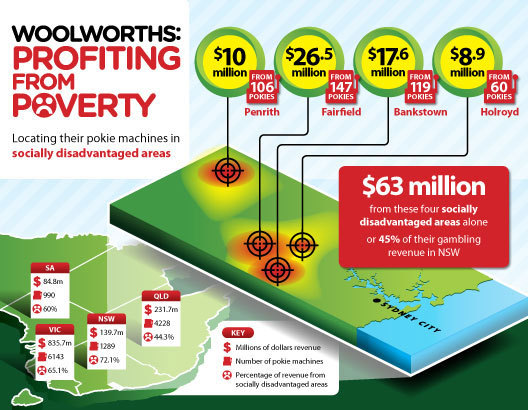
    It’s all explained in this new infographic. Check it out and help share it far and wide so the truth is inescapable:

    The research was commissioned by GetUp, and conducted by Dr Charles Livingstone of Monash University. It reveals for the first time that Woolworths poker machines are heavily concentrated in Australia’s most socially disadvantaged areas.

    Woolworths takes hundreds of millions of dollars a year out of communities that can least afford the destructive impact of poker machine gambling. It’s predatory. The more people know about Woolworths’ secret, the more pressure the company will feel to reform their pokies business.

    GetUp members have forced Woolworths into an Extraordinary General Meeting in November to discuss pokies. Let’s keep up the pressure until then.

    Will you take a minute to share this on Facebook or Twitter, and let the country know that Woolworths use poker machines to profit from poverty?

    http://www.getup.org.au/profiting-from-poverty

    The research shows that Woolworths operates a vast network of 12,650 poker machines in 277 venues across Australia. It is estimated that Woolworths poker machines generate $1.292 billion dollars of revenue a year for the company. In fact, 1 in 8 dollars made from poker machines goes to Woolworths.

    It will be difficult for Woolworths to hide behind its image as a family friendly supermarket brand if their customers know all about their huge investment in high loss poker machines that exploit the most disadvantaged communities in the country. 

    Thanks for all you do,
    the GetUp team.


    GetUp is an independent, not-for-profit community campaigning group. We use new technology to empower Australians to have their say on important national issues. We receive no political party or government funding, and every campaign we run is entirely supported by voluntary donations. If you’d like to contribute to help fund GetUp’s work, please donate now! If you have trouble with any links in this email, please go directly to www.getup.org.au. To unsubscribe from GetUp, please click here. Authorised by Sam Mclean, Level 2, 104 Commonwealth Street, Surry Hills NSW 2010.

  • Plutocracy’s Boot Boys MONBIOT

    Monbiot.com


    Plutocracy’s Boot Boys

    Posted: 01 Oct 2012 12:29 PM PDT

    We’re getting a better idea of how billionaires and corporations capture government policy.


    By George Monbiot, published in the Guardian 2nd October 2012

    To subvert means to turn from below. We need a new word, which means to turn from above. The primary threat to the democratic state and its functions comes not from mob rule or leftwing insurrection, but from the very rich and the corporations they run.

    These forces have refined their assault on democratic governance. There is no need – as Sir James Goldsmith, John Aspinall, Lord Lucan and others did in the 1970s – to discuss the possibility of launching a military coup against the British government(1): the plutocrats have other means of turning it.

    Over the past few years I have been trying better to understand how the demands of big business and the very rich are projected into policy-making, and I have come to see the neoliberal thinktanks as central to this process. These are the groups which claim to champion the free market, but whose proposals often look like a prescription for corporate power.

    David Frum, formerly a fellow of one of these thinktanks – the American Enterprise Institute – argues that they “increasingly function as public-relations agencies”(2). But in this case we don’t know who the clients are. As the corporate lobbyist Jeff Judson enthuses, they are “virtually immune to retribution … the identity of donors to think tanks is protected from involuntary disclosure.”(3) A consultant who worked for the billionaire Koch brothers claims that they see the funding of thinktanks “as a way to get things done without getting dirty themselves.”(4)

    This much I knew, but over the past few days I’ve learnt a lot more. In Think Tank: the story of the Adam Smith Institute, the institute’s founder, Madsen Pirie, provides an unintentional but invaluable guide to how power in this country really works(5).
    Soon after it was founded (in 1977), the institute approached “all the top companies”. About 20 of them responded by sending cheques(6). Its most enthusiastic supporter was the coup-plotter Sir James Goldsmith, one of the most unscrupulous asset strippers of that time. Before making one of his donations, Pirie writes, “he listened carefully as we outlined the project, his eyes twinkling at the audacity and scale of it. Then he had his secretary hand us a cheque for £12,000 as we left”(7).

    From the beginning, senior journalists on the Telegraph, Times and Daily Mail volunteered their services. Every Saturday, in a wine bar called the Cork and Bottle, Margaret Thatcher’s researchers and leader writers and columnists from the Times and Telegraph met staff from the Adam Smith Institute and the Institute of Economic Affairs. Over lunch, they “planned strategy for the week ahead.”(8) These meetings would “co-ordinate our activities to make us more effective collectively.” The journalists would then turn the institute’s proposals into leader columns while the researchers buttonholed shadow ministers.

    Soon, Pirie says, the Mail began running a supportive article on the leader page every time the Adam Smith Institute published something(9). The paper’s editor, David English, oversaw these articles himself, and helped the institute to refine its arguments(10).

    As Pirie’s history progresses, all references to funding cease. Apart from tickets donated by British Airways(11), no sponsors are named beyond the early 1980s. While the institute claims to campaign on behalf of “the open society”(12), it is secretive and unaccountable. Today it flatly refuses to say who funds it(13,14).

    Pirie describes how his group devised and refined many of the headline policies implemented by Margaret Thatcher and John Major. He claims (and produces plenty of evidence) either full or partial credit for the privatisation of the railways and other industries, for the contracting out of public services to private companies, for the poll tax, the sale of council houses, the internal markets in education and health, the establishment of private prisons, GP fund-holding and commissioning and, later, for George Osborne’s tax policies.

    Pirie also wrote the manifesto of the neoliberal wing of Mrs Thatcher’s government, No Turning Back(15). Officially, the authors of the document – which was published by the party – were MPs such as Michael Forsyth, Peter Lilley and Michael Portillo. “Nowhere was there any mention of, or connection to, myself or the Adam Smith Institute. They paid me my £1,000 and we were all happy.”(16) Pirie’s report became the central charter of the doctrine we now call Thatcherism, whose praetorian guard called itself the No Turning Back group.

    Today’s parliamentary equivalent is the Free Enterprise Group. Five of its members have just published a similar manifesto, Britannia Unchained(17). Echoing the narrative developed by the neoliberal thinktanks, they blame welfare payments and the mindset of the poor for the UK’s appalling record on social mobility, suggest the need for much greater cuts and hint that the answer is the comprehensive demolition of the welfare system. It is subtler than No Turning Back. There are fewer of the direct demands and terrifying plans: these movements have learnt something in the past 30 years.

    It is hard to think how their manifesto could have been better tailored to corporate interests. As if to reinforce the point, the front cover carries a quote from Sir Terry Leahy, until recently the chief executive of Tesco: “The path is clear. We have to be brave enough to take it.”

    Once more the press has taken up the call. In the approach to publication, the Telegraph commissioned a series of articles called Britain Unleashed, promoting the same dreary agenda of less tax for the rich, less help for the poor and less regulation for business(18). Another article in the same paper, published a fortnight ago by its head of personal finance Ian Cowie, proposes that there be no representation without taxation. People who don’t pay enough income tax shouldn’t be allowed to vote(19).

    I see these people as rightwing vanguardists, mobilising first to break and then to capture a political system that is meant to belong to all of us. Like Marxist insurrectionaries, they often talk about smashing things(20), about “creative destruction”, about the breaking of chains and the slipping of leashes. But in this case they appear to be trying to free the rich from the constraints of democracy. And at the moment they are winning.

    Twitter: @GeorgeMonbiot
    A fully referenced version of this article can be found at www.monbiot.com

    1. http://www.guardian.co.uk/uk/2005/jan/09/politics.past

    2. http://nymag.com/news/politics/conservatives-david-frum-2011-11/

    3. http://www.scribd.com/doc/30730535/Why-Think-Tanks-are-More-Effective

    4. http://www.newyorker.com/reporting/2010/08/30/100830fa_fact_mayer?currentPage=all

    5. Madsen Pirie, 2012. Think Tank: the story of the Adam Smith Institute. Biteback, London.

    6. page 37.

    7. page 95.

    8. page 18.

    9. page 44.

    10. page 52.

    11. page 212.

    12. page 19.

    13. http://www.monbiot.com/2011/09/12/think-of-a-tank/

    14. http://whofundsyou.org/

    15. page 106-116.

    16. page 111.

    17. Kwasi Kwarteng et al, 2012. Britannia Unchained: global lessons for growth and prosperity. Palgrave Macmillan, Basingstoke.

    18. http://www.telegraph.co.uk/comment/britain-unleashed-the-future-of/

    19. http://blogs.telegraph.co.uk/finance/ianmcowie/100020160/is-mitt-romney-right-to-question-representation-without-taxation/

    20. http://www.telegraph.co.uk/comment/britain-unleashed-the-future-of/9426472/Britain-Unleashed-David-Cameron-needs-a-change-of-heart-and-some-fire-in-his-belly.html

    You are subscribed to email updates from George Monbiot
    To stop receiving these emails, you may unsubscribe now.
    Email delivery powered by Google
    Google Inc., 20 West Kinzie, Chicago IL USA 60610
  • Crush hour: $9b rail link flaw

    Crush hour: $9b rail link flaw

    Date
    October 2, 2012

    EXCLUSIVE

    The NSW Transport Minister, Gladys Berejiklian, at Chatswood Train Station.

    Broken promises … Transport Minister Gladys Berejiklian at Chatswood train station, where thousands of disembarking commuters will be unable to get on city-bound trains already operating at capacity. Photo: Janie Barrett

    RUSH hour commuters will be forced to wait for at least two crowded trains to go through Chatswood station before being able to continue their journey to the city, under the O’Farrell government’s centrepiece $9 billion transport project.

    The government’s decision to build the north-west rail link as a shuttle between Epping and Chatswood, breaking its promise to allow trains to run all the way to the city, will lead to potential chaos for many north shore and Hills district commuters.

    Thousands of commuters disembarking at Chatswood will be unable to get on city-bound trains already operating at capacity. And passengers getting off the north-west trains may struggle to fit on the crowded platform at Chatswood.

    With an ”optimised” timetable for the north-west rail link, more than 40 per cent of peak-hour passengers transferring to the city at Chatswood will be unable to get on the next service because it will be too crowded, according to analysis commissioned by Transport for NSW and obtained by the Herald.

    Further, more than 15 per cent of them will be unable to fit on the next two citybound trains on the north shore line.

    The analysis was commissioned and done just before the Premier, Barry O’Farrell, and the Transport Minister, Gladys Berejiklian, announced the new model for the north-west rail link on June 20.

    Last night Ms Berejiklian said one of two environmental impact statements required for the link has received planning approval.

    Under the model, the line will be built and run by a private operator rather than RailCorp. Transport for NSW hired consultants from the engineering firm Arup to look at whether Chatswood Station could cope with the passengers transferring to citybound trains.

    Arup modelled what would happen if one peak-hour train on the north shore line was cancelled which, on RailCorp’s record, would happen about once a fortnight. In this case, 62 per cent of north-west rail link passengers would not fit on the first train to the city. Almost 40 per cent would not fit on the second train. More than 20 per cent of passengers – about 1900 people – would have to wait for a fourth, fifth or sixth train. In this scenario there would be ”extreme difficulties to alight and to enter the platform from stair”, a summary of the analysis says.

    ”Patrons entering the station have difficulty moving away from the stair and patrons coming off NWRL services … cannot exit carriages due to congestion,” the summary says.

    Even with a good running service, queueing levels would exceed good practice. ”Modelling doesn’t take into consideration the frustration and anxiety of missing trains,” it says.

    The modelling assumes 8880 people will get off the north-west rail link at Chatswood to transfer to the lower north shore or city.

    Using freedom-of-information laws, the Herald requested the analysis in July. The response from Transport for NSW redacted all substantial analysis, in part because it said releasing it could jeopardise procurement for the line. The department said the analysis was only preliminary because it was based on assumptions still being developed.

    The Herald obtained sections of the analysis independently.

    A spokesman for Transport for NSW said the modelling obtained by the Herald assumed 20 trains an hour on the north shore line in the morning peak.

    ”We are undertaking work to determine what improvements need to be made to the network to run 24 trains an hour,” he said.

    Ms Berejiklian said: ”The government is working to make this a world best-practice interchange and we are confident we will deliver that.

    “Everything that has been presented to me by Transport for NSW leaves me in no doubt that Sydney’s rail future has been well thought through.”

    The government’s infrastructure adviser, Infrastructure NSW, will release its plan for new tollroads through the inner west and south of Sydney tomorrow.

    It will also recommend building an airport at Badgerys Creek, a move that is not supported by the O’Farrell government.

    Read more: http://www.smh.com.au/nsw/crush-hour-9b-rail-link-flaw-20121001-26vkt.html#ixzz2862YF8ut

  • Labor MP to push for live exports ban

    Labor MP Kelvin Thomson has also appeared on Television stating objections as to how our livestock are treated in other countries. We can expect this to become a major issue. These reports are horrific and raise the whole issue of the beef and lamb export trade.

    Labor MP to push for live exports ban

    By Samantha Hawley, ABCUpdated September 29, 2012, 10:23 am

    A Labor MP has thrown her support behind calls for a ban on the export of live animals after the slaughter of thousands of Australian sheep in Pakistan.

    Almost half a shipment of 21,000 Australia sheep were brutally killed in the country before a court order was obtained by the owners halting the cull.

    The Agriculture Department is investigating claims some were buried alive.

    Janelle Saffin, the Member for the New South Wales electorate of Page, says she will push for a ban when the Labor partyroom meets the week after next.

    She believes she has the support of many of her colleagues.

    “It continues to be the issue that all members of Parliament get a lot of emails about and a lot of contact saying ‘please do something about this’,” she told Saturday AM.

    “Look the way I’ll say it is, it’s a debate that won’t go away.”

    The comments follow earlier calls from the Greens to halt the live export trade.

    But independent MP Bob Katter, who is a staunch supporter of the live export industry, has labelled the calls “extraordinarily arrogant”.Â

    “When you tell these people that you are inhumane, you have no love of animals, you are inferior people. You treat these animals terribly,” he said.

    “We’ve passed laws and I most certainly, you know, am in favour of laws saying that exporters have got to take some responsibilities there to protect government instrumentalities from the excesses of the greenie movement in Australia.

    “Now those laws have been passed. It would seem to me clearly, if the newspaper reports are true, they’ve been broken.

    “So someone should be and will be punished here if those laws have been broken.”

    ‘Sowing hatred’

    Mr Katter says the Government must be restrained in its response, unlike the ban on live exports after the Indonesian cattle controversy last year.

    “We’re provoking these people continuously and continuingly and I plead with the people in positions of responsibility to stop this,” he said.

    “Because you are sowing a harvest of hatred that your grandchildren will reap.”

    Liberal MP Arthur Sinodinos agrees the Government should tread carefully, and says a ban could send the wrong signal on the way Australia handles trade.

    “We can’t just be reacting every time we see what can be quite disturbing footage of something happening to our live cattle exports or live sheep exports abroad,” he told ABC News 24.

    “We have to make sure that we’ve put in place a series of measures with all of the relevant countries so that we can guarantee that the animals are looked after properly.

    “You know, animal welfare is important in its own right, it’s also important in terms of promoting the trade in a way that, you know, is credible from Australia’s point of view. I think we should be focused on that rather than on knee jerk reactions where we talk about potentially banning the trade completely.

    “And in the past when we’ve had that knee-jerk reaction, we’ve stranded plenty of animals and we’ve also sent businesses, potentially to the wall, particularly in northern Australia.”

    The Government argues the regulation of the live export sector is working.

    The 21,000 sheep were originally destined for Bahrain, but it rejected the shipment, claiming they were diseased – both the export company Wellard and the Federal Government argue the sheep were and are still healthy.

    An alternative market was found for them in Pakistan instead.

    The Sindh High Court has now ordered further tests be carried out on the sheep by an independent laboratory.

    The fate of the sheep is now likely to be decided by the court on October 17.