Managing director of Ebono Institute and major sponsor of The Generator, Geoff Ebbs, is running against Kevin Rudd in the seat of Griffith at the next Federal election. By the expression on their faces in this candid shot it looks like a pretty dull campaign. Read on
Northern Australia’s Pilbara coast is under warnings, alerts and watches as powerful Cyclone Lua nears for a landfall. NASA’s Aqua satellite has been providing infrared, visible and microwave data on Lua that have shown forecasters the storm is strengthening on its approach to land.
A fundamental shift in the Indian monsoon has occurred over the last few millennia, from a steady humid monsoon that favored lush vegetation to extended periods of drought, researchers report. Their study has implications for our understanding of the monsoon’s response to climate change.
Early snowmelt caused by climate change in the Colorado Rocky Mountains snowballs into two chains of events: a decrease in the number of flowers, which, in turn, decreases available nectar. The result is decline in a population of the Mormon Fritillary butterfly, Speyeria mormonia.
The northeastern US should prepare for a surge in Lyme disease this spring. And we can blame fluctuations in acorns and mouse populations, not the mild winter.
British Airways aims to turn Londoner’s garbage into jet-fuel. Photograph: Dan Kitwood/Getty Images
The aviation industry has often appeared to be in denial on the subject of climate change, lobbying relentlessly in the UK for a third runway at Heathrow and attacking the European Union’s gentle curbing of their emissions.
But British Airways is pushing ahead with a plant that aims to turn half a million tonnes of Londoner’s household rubbish into 50,000 tonnes a year of jet fuel. I’ll let you decide if this is greenwash or not: here’s some of the details.
The plant will based in east London and 80 lorries a day will pour garbage into a plasma chamber, which reaches 5,000C. The resulting gas is turned into jet fuel, Jonathon Counsell, BA’s head of environment, told me at the World Biofuels Markets conference in Rotterdam. The plant, due to being pumping fuel from 2015, will have enough energy left over to generate 33MW of electricity, he says.
The output is just 2% of BA’s current global fuel needs but Counsell says: “The first plant is always the hardest. If we can make the economics works, we will build two, three, four, five, very quickly.” He says London produces 20m tonnes of waste a year, and the UK 200m tonnes.
I asked Counsell why this should reassure those concerned about aviation’s rapidly growing contribution to climate change, when BA and others seem to have to be dragged to act. “We accept we are a significant source of emissions, and growing,” he says. “Taking action is about earning our right to grow.”
On biofuels, he says there are “no alternatives” to liquid fuels, if the industry is to meet its own goal of a 50% cut in emissions by 2050 (compared to 2005).
So why, I ask, is BA opposing the EU’s plan to make all airlines flying in and out of Europe buy some carbon pollution permits from 2013, especially when BA’s website states: “As part of our commitment to being environmental responsible [sic] we have been a long-standing supporter of emissions trading. This sits at the heart of our climate change policy as the most environmentally effective and economically efficient mechanism for addressing aviation’s CO2 emissions.”
Counsell told me: “We always said to the EU take a smaller step in the first instance, start with a smaller scheme, prove it and roll it out.” That can be translated, I would say, as “I wouldn’t start from here.” He added: “The risk of retaliation and non-compliance [from the US, Russia, China and elsewhere] is now playing out.” Which means “I told you so.”
What about where we actually are now, with the carbon trading scheme kicking in from 2013? Counsell says BA wants the EU to compromise and reduce the scope of the scheme, saying it currently risks collapsing totally and “setting us back 10 years.” That may make sense to you, or sound like “Lord make me chaste, but not yet.” But BA might be genuinely worried about a big setback, not least because non-compliance from other airlines might, at some point when the cost rises above a few Euros a flight, make a competitive difference.
Self-interest is often the best guide, and so that expressed very clearly to me by aircraft manufacturer Boeing was striking. They are backing biofuels with their own cash, despite not operating flights and therefore not being a purchaser of fuel.
“When we look out a few decades, the energy scenario for our industry does not look healthy,” Darrin Morgan, Boeing’s director of sustainable aviation, told me. “Fuel is now the number one cost for the industry, more than the aircraft, more than people. It used to be number three or four. That cost will diminish the ability of our customers to buy our aircraft.”
Morgan says the industry wants to get 1% biofuel into the global jet fuel supply by 2015, which equates to 600m US gallons a year. “That is not to say we only want 1%, we want as many percent as we can get sustainably.” He agues the bio-jet fuel industry only began in July 2011, when the international fuel standard body, ASTM international, approved it for use.
He agrees with Counsell that low-carbon biofuels are essential if the industry is to achieve the carbon-neutral growth goal it has set itself, as more efficient planes and air traffic cannot compensate for the fast growth: “That is unless developed world wants to tell the developing world you can’t fly – and good luck with that!”
So it’s biofuels or bust, according to the aviation industry. I’d be very interested in your thoughts.
This is a case of development versus conservation. When Darling Harbour Goods Yard was closed there were people lobbying to retain a rusty old goods shed on the new site, which would have ruined the visual concept of the new development.
Sydney’s buried history you’ll never get to see
Debra Jopson
March 17, 2012
”They will find it is under concrete” … Grace Karskens. Photo: Steven Siewert
THE historian Grace Karskens was incredulous. The Museum of Contemporary Art intended marking the nation’s oldest dockyard buried beneath the gallery’s $53 million extension with an arrow pointing to concrete. Admittedly, it was a 2.7 metre arrow, illuminated and by the artist Brook Andrew.
”Why? What’s that got to do with the dockyard?” said Associate Professor Karskens, who thinks it ”a bit mean” to mark the site with a few lines from the artist without explaining what lies below.
”People will have their appetite whetted and then they will find it is under concrete and they can’t see it. I’d like them to pull up the concrete and install some nice glass panels so people can see Sydney’s past embedded there,” said Professor Karskens, a winner of a Prime Minister’s Literary Award for The Colony: A History of Early Sydney.
Advertisement: Story continues below
A former City of Sydney historian, Shirley Fitzgerald, is also scathing about the museum’s handling of the colonial site, describing it as appallingly superficial. ”The MCA is trying to bury the history because they don’t see it as their brief. They see it as counter to being edgy and postmodern … I don’t think they quite get the importance of their site to the whole history of the city. It was the heartland of settlement,” she said.
The remains of the government dockyard, begun in 1797 under Governor John Hunter and enlarged by Governor Lachlan Macquarie, have stayed something of a secret, despite their rediscovery 15 years ago through site testing for an earlier plan to extend the museum.
The remains of the dockyard are listed on the State Heritage Register for their ”outstanding and unique historical significance” as part of the underground Sydney Cove West archaeological precinct.
Such early colonial archaeological remains are rare, according to the listing. Testing indicates substantial portions of two Macquarie-era docks remain.
In 2009, the then planning minister, Kristina Keneally, gave the museum redevelopment the go-ahead as a ”state-significant project”. She made only passing reference to the dockyard, even though the NSW Heritage Office said earlier: ”The nationally significant stone walls will be conserved and interpreted for the public”.
The MCA director, Elizabeth Ann Macgregor, who has seen the dockyard site, said it looked like ”a lot of rubble” and expert advice was to keep it covered.
”This is pretty much destroyed. You can see the outlines of a few bits of sandstone. You are not allowed to expose it. It’s a heritage no-no. It is absolutely wrong to expose it because it starts to deteriorate,” she said.
Plaques would be ineffective and the museum was going further than required in interpreting the site, she said.
Besides commissioning the artist, the museum acknowledges the dockyards in a lavish new book, Site, which includes a section by Professor Karskens. People with smartphones would be able to tap into information on the museum’s website, she said.
Andrew, a contemporary artist of Wiradjuri and Scottish descent, whose flashing arrow will be unveiled at the museum’s re-opening this month, said it would help to make the history visible.
Drawing on an indigenous shield design, the arrow’s zig-zag black and white pattern would be animated in LED lights, creating a hypnotic effect and drawing attention to the site from as far as the Opera House, he said.
”It’s a pretty significant reference … the LED is a strong light source, so you are going to be drawn to it,” he said.
His words, inspired by archaeological reports on the dockyard and by his heritage, will be laser cut into the ground below the arrow.
”In the loch, blood stricken, time hidden lay lost, under this place of birth, under your mind lies a tunnel, under this stone, salty darkness, forgotten place of docks and ships,” they say.
Andrew said he had envisaged a glass surface over the ruins but the realities of site management on foreshore land and architects’ plans led him to drop the idea
”We have monuments to Captain Cook but there are no statues of Aboriginal people and that’s more important than a glass to expose something,” he said.
Tony Lowe, a heritage consultant who has done extensive archaeological work on the site, said he was content for the remains to stay hidden because mould and other agents could damage them.
He said there were issues with rising salt at the Museum of Sydney, where windows allowed the public to see the brick and stone footings of the first Government House, and at the Conservatorium of Music, where early remains were uncovered.
It was ”possible that in another generation, portions of the [dockyard] remains may be exposed. It will just be an engineering solution that can do that,” he said.
The National Trust’s advocacy manager, Graham Quint, said the presence of crowds and salt water made exposing the remains difficult. But there should be far more extensive interpretation of the history, possibly in the paving outside, with headsets available for visitors.
”Given there won’t be an opportunity to access this for another 100 years, it’s important to indicate the history,” he said.
Professor Karskens said that in Wellington, New Zealand, shopping centre developers displayed the remains of a wrecked ship in the floor and in Sydney there were several precedents in revealing the rich history under our feet.
Ms Macgregor said another respected historian, Margaret Betteridge, had contributed a chapter to Site. Its title is the same as the message from the heritage consultants: ”Let sleeping docks lie”.
14 Dec 2009 – Deutsche Bank has designed a Carbon Counter widget to be downloaded to your desktop in order to allow you to have an accurate, real-time …
22 Jun 2009 – Will fast-moving numbers raise awareness or just frighten people? Deutsche Bank launched a carbon counter in the heart of Manhattan (Herald …
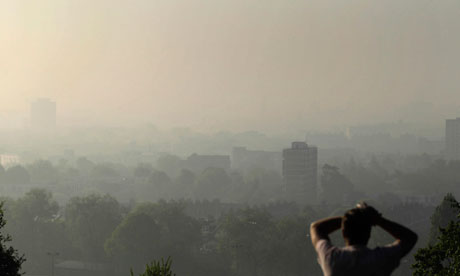
The view of smog covering central London from Hampstead Heath in April 2011. Photograph: Matt Dunham/AP
Air pollution in London hit record levels on Thursday due to a combination of traffic fumes, relatively still weather and an influx of dirty air from the north of England and northern France. Poor conditions are affecting a swath of the country as far north as Leeds and York.
Official monitoring stations in the capital show that particles, nitrogen dioxide, sulphur dioxide and other pollutants have reached levels not recorded since stringent new measurements were introduced in 2008. Pollution levels in London are even higher than last Easter, when the government was forced to issue a smog alert. The record high will worry officials preparing for the arrival of the world’s best athletes and hundreds of thousands of spectators for the Olympics in four months time.
Health advice from the Department for Environment, Food and Rural Affairs (Defra) says that adults and children with lung problems, adults with heart problems and all older people should not take any “strenuous physical activity” while pollution is at the recorded levels. The general population is advised to reduce exercise too.
Recirculated dirty air from Europe and the north of England is partly to blame, along with a lack of wind, said Gary Fuller, senior lecturer in air quality measurement at King’s College London. “Still conditions mean that the pollution from the cars and lorries on the roads today is simply not blowing away. On top of this, the air over England today was in northern France yesterday and in northern England on Tuesday where it picked up a lot of air pollution from coal burning industries, domestic heating and traffic.”
He added that poor air quality was affecting as far north as Leeds and York, and his forecasts suggested the high levels of pollution would continue into tomorrow.
The Met Office said that winds would be light on Friday morning but would be picking up by lunchtime with gusty winds of 25mph, followed by further winds on Saturday which should bring pollution levels down.
Simon Birkett, director of the Clean Air in London campaign, said: “The failure by the mayor to warn Londoners about five smog episodes in a row proves he is desperate to avoid the air pollution issue ahead of the mayoral election.
“It’s clear the mayor, who would rather suppress pollution in front of official air quality monitoring stations than save lives, is more concerned about getting re-elected than he is about those he represents. This may be the biggest public health fraud for a generation.”
This month, a report suggested that the 2012 Olympics would have no significant impact on air quality in London. Changes to road management during the Games are likely to have “broadly neutral impact on air quality”, Transport for London said.
Since December 2008, air quality stations in London have been monitoring smaller particles called PM2.5s, which are able to enter the bloodstream more easily and cause more respiratory damage than larger particles, such as PM10s. Fuller said the levels on Thursday were the highest since the new regime was introduced.
A Defra spokeswoman said: “We want to keep improving air quality and reduce the impact it can have on human health and the environment. Our air quality has improved significantly in recent decades and is now generally very good, and almost all of the UK meets EU air quality limits for all pollutants.
“There are some limited areas where air pollution remains an issue, but that’s being dealt with by the air quality plans, which set out all the important work being done at national, regional and local levels to make sure we meet EU limits as soon as we can.”
Last month, the environment secretary, Caroline Spelman, was criticised by an influential group of MPs for rejecting their recommendations to cut pollution on the grounds that it was too costly. Poor air quality has been linked to nearly one in five deaths a year in London. The capital’s poor air quality, caused largely by traffic, has seen the UK facing £300m in fines for breaching EU targets. The government has successfully lobbied Europe to push back the deadline for meeting the targets.
Climate scientists are concerned that Australia’s cool and wet summer could lead to confusion about whether climate change is real.
The last few months have seen floods in New South Wales, Queensland and Victoria, with river systems overflowing and dams filled to the brim, and temperatures in the 20s rather than the 30s in many parts of Australia’s south-east.
The weather conditions appear to contrast with the Climate Commission’s latest report, which says global average temperatures have continued to rise over the last decade.
The six-page report, written by Professor Matthew England from the University of New South Wales, Professor Will Steffen from the ANU and Professor David Karoly from the University of Melbourne, says 2011 was the warmest La Nina year on record, and warmer than all but one year of the 20th century.
Professor England, the co-director of UNSW’s Climate Change Research Centre and chair of the Science Advisory Panel for the Climate Commission, says there is a lot of misinformation about.
“There’s a lot of misinformation out there and a lot of commentary that climate change is over and this is just not the case,” he said.
“The long-term trend is still one of drying actually over south-eastern Australia, even taking into account the last couple of wet years.
“The fact that we have a couple of heavy rainfall events, that’s actually in line with our expectations under climate change of more extreme rainfall events when they do occur.”
Short memories
He says people have short memories when it comes to their experiences of weather conditions.
“You have a cold snap and you suddenly think, I want global warming to come now, not in 20 years or 10 years’ time,” he said.
“You have a heat wave and suddenly people are talking again about climate change.”
He says people cannot personally detect the kind of warming trend that comes with climate change.
“People can’t personally detect a long-term sensory scale warming trend; it’s just impossible,” he said.
“We know from the measurement records the planet is warming and that our climate is changing, it’s just that we have a very difficult job explaining that when day-to-day weather varies by such a large amount.”
But Professor England says he has not detected much change in the political will to tackle climate change.
“Great politicians like Malcolm Turnbull [are] forever good on this topic. He understands the science well, he’s been briefed well,” he said.
“In the Government there’s obviously a move towards putting in a carbon tax and putting in an incentive to business to go to low carbon technologies and so on.
“So the right moves are being made but I would agree that basically the response globally and also within Australia it’s way too slow [compared to what] we should be having given the scale of the problem we’re facing.”