Category: General news

Managing director of Ebono Institute and major sponsor of The Generator, Geoff Ebbs, is running against Kevin Rudd in the seat of Griffith at the next Federal election. By the expression on their faces in this candid shot it looks like a pretty dull campaign. Read on

  • Eighty hours and you’re licensed

    Eighty hours and you’re licensed

    0
    Jacob Bandur

    On the road … Jacob Bandur, 18, with driving instructor Christopher Lawford / Pic: Brad Hunter Source: The Daily Telegraph

    L-PLATERS would only have to clock up 80 hours behind the wheel to get their licence if they complete a safe driving course and take lessons with an instructor, under a proposal being considered by the state government.

    A day after The Daily Telegraph revealed the cabinet had approved cutting the number of hours from 120 to 100, there are now plans to reduce that by another 20 hours, further reducing the burden on learner drivers’ parents who have to log their child’s progress.

    An independent board of road safety and education experts will consider the proposal while they develop the safety course before reporting back to the government.

    The decision to cut the compulsory practice time to 100 hours was welcomed by instructors and young drivers yesterday.

    In 2011, police fined 12,093 L-platers – including 2341 for speeding, 3856 for not displaying their L-plates and 1134 for driving while suspended or disqualified.

    Roads Minister Duncan Gay said the safe driving course would go some way to reducing speeding offences in young people by teaching them new attitudes.

    “We are committed to reducing road crashes, injuries and fatalities among young people and this new initiative will help us to do that,” he said.

    Stephen O’Sullivan, manager of Trent Driving School, said the proposal was a good one, but didn’t go far enough: “At the moment, you can drive for 120 hours, but it doesn’t stipulate what should be done in those 120 hours,” he said.

    “It should be about driving skills and knowledge, not just the number of hours.”

    Jacob Bandur, 18, of Bexley, is 30 hours into his practice. He said he would do the safety course when it is offered.

    “100 hours is more realistic,” Jacob said.

    “I have training a couple of nights a week and I try to drive to and from training, and also with a driving instructor. It would definitely help my parents if I didn’t have to practise for 120 hours.”

    Jacob said he was happy the proposed safer drivers course would focus on the attitudes of young drivers.

    Jeff Mason, of Emu Plains, has taught his five children, aged 19 to 31, to drive.

    He believes changing the attitudes of young drivers will have the most influence on the frequency of fatal accidents.

    “They need the right skills, and attitude,” Mr Mason said.

    “And parents who are teaching their children need help to keep up with road rules.”


    14 comments on this story

  • 2010 Haiti quake possible start of new cycle of seismic activity

    ScienceDaily: Earthquakes News


    2010 Haiti quake possible start of new cycle of seismic activity

    Posted: 26 Jan 2012 12:21 PM PST

    The January 2010 quake that destroyed much of Port-au-Prince may have marked the start of a new cycle of active seismicity, putting Haiti and the Dominican Republic at high risk of future devastating earthquakes.
    You are subscribed to email updates from ScienceDaily: Earthquake News
    To stop receiving these emails, you may unsubscribe now.
    Email delivery powered by Google
    Google Inc., 20 West Kinzie, Chicago IL USA 60610
  • ‘Gravity is climate’: 10 years of climate research satellites GRACE

    ScienceDaily: Severe Weather News


    ‘Gravity is climate’: 10 years of climate research satellites GRACE

    Posted: 16 Mar 2012 04:53 PM PDT

    For the first time, the melting of glaciers in Greenland can now be measured with high accuracy from space. A new sharp image also renders the spatial distribution of the glacial melt more precisely.

    Better models needed to track atmospheric pollution’s impact on health, climate

    Posted: 19 Feb 2012 11:32 AM PST

    The past decade has witnessed a significant growth in Asian air pollution, causing a great concern for air quality and climate. If government policymakers hope to contain the problem, they will need increased research and better computer models of black carbon and other aerosol pollutants, also known as atmospheric brown cloud.

    Birds in uncertain climates are more likely to stray from their mates

    Posted: 16 Feb 2012 03:54 PM PST

    Married people may pledge to stay faithful through good times and bad, but birds sing a different tune — when weather is severe or uncertain, birds are more likely to stray from their mates, says a new study.
    You are subscribed to email updates from ScienceDaily: Severe Weather News
    To stop receiving these emails, you may unsubscribe now.
    Email delivery powered by Google
    Google Inc., 20 West Kinzie, Chicago IL USA 60610
  • Preparing for the flood: Visualisations help communities plan for sea level rise

    ScienceDaily: Oceanography News


    ‘Gravity is climate’: 10 years of climate research satellites GRACE

    Posted: 16 Mar 2012 04:53 PM PDT

    For the first time, the melting of glaciers in Greenland can now be measured with high accuracy from space. A new sharp image also renders the spatial distribution of the glacial melt more precisely.

    Overfishing leaves swaths of Mediterranean barren

    Posted: 01 Mar 2012 03:09 PM PST

    Centuries of overexploitation of fish and other marine resources — as well as invasion of fish from the Red Sea — have turned some formerly healthy ecosystems of the Mediterranean Sea into barren places, an unprecedented study of the Mediterranean concludes.

    Preparing for the flood: Visualizations help communities plan for sea-level rise

    Posted: 20 Feb 2012 06:08 AM PST

    Researchers have produced computer visualizations of rising sea levels in a low-lying coastal municipality, illustrating ways to adapt to climate change impacts such as flooding and storms surges.
    You are subscribed to email updates from ScienceDaily: Oceanography News
    To stop receiving these emails, you may unsubscribe now.
    Email delivery powered by Google
    Google Inc., 20 West Kinzie, Chicago IL USA 60610
  • Volcano Threats

    News 3 new results for volcanoes
    UK adds solar storms, volcanoes to national threat list
    CTV.ca
    AP In this photo, smoke plumes from the Grimsvotn volcano, which lies under the Vatnajokull glacier, about 120 miles, (200 kilometers) east of the capital, Rejkjavik, Iceland. (AP / Jon Gustafsson) LONDON — Britain has added volcanoes and solar storms
    See all stories on this topic »

    CTV.ca
    Britain adds volcanoes, solar storms to floods and terrorism on national risk
    Washington Post
    LONDON — Britain has added volcanoes and solar storms to floods, flu and terrorism on a list of threats to national security. The highest-priority risks to Britain are pandemic influenza, coastal flooding, terrorist attacks and — a new addition
    See all stories on this topic »
    Scientists find chain of islands more than 65 million years old
    Jamaica Observer
    She is currently said to reside in the craters of the Kilauea volcano on the big island; but that’s just the newest of the eight main islands in the chain. Though humans were not around to record her relocations, she must have previously lived on Maui,
    See all stories on this topic »


    Tip: Use site restrict in your query to search within a site (site:nytimes.com or site:.edu). Learn more.

    Delete this alert.
    Create another alert.

  • England faces wildlife tragedy as worst drought in 30 years hits habitats

    England faces wildlife tragedy as worst drought in 30 years hits habitats

    Wildlife trusts urge action to avoid loss of rare species and protect tadpole, wading bird and water vole populations

    • The Guardian, Monday 19 March 2012
    • Article history
    • Water vole

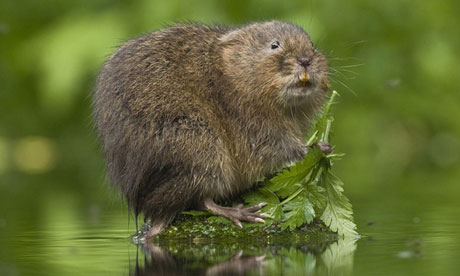
      Shrinking rivers and lower water levels in ditches and streams leave riverbank mammals, such as water voles, vulnerable to predators. Photograph: Terry Whittaker/PA/British Wildlife

      Tadpoles this spring will be facing more than the usual predatory threats of fish, birds and children with jam jars. Amid the worst drought in 30 years “a wildlife tragedy” is looming that could inflict a heavy toll on some of England’s best-loved species.

      As well as the risk of tadpoles of frogs, toads and rare species such as the great crested newt, dying if ponds dry out, pressure is growing on water voles and wading birds, and fish are already dying in numbers as habitats dry out, the Environment Agency warns.

      Agency staff have been removing fish from some ponds and rivers and placing them elsewhere, but this action is not feasible at every affected spot.

      Some once-common bird species, such as lapwings and curlews, whose populations have declined rapidly in recent years, could vanish altogether from smaller breeding sites, experts warn.

      Helen Perkins, of The Wildlife Trusts, said: “A wildlife tragedy is unfolding in parts of the country. After such a long period of low rainfall, some species may not recover and could be lost from some rivers and wetlands if we don’t act now.”

      Some areas of the country have suffered their driest 18 months since records began, and almost all of the east and south-east of England is now officially in a state of drought.

      At least seven water companies plan restrictions such as hosepipe bans, to come into force next month, and it is thought the drought could be felt as far north as Yorkshire and as far west as Wiltshire later in the spring. Water companies are looking at ways to share water, but transporting water over long distances is extremely difficult and costly.

      Only an extended period of much higher rainfall levels than normal could prevent a serious drought now, and the forecast is for a continuing dry spell.

      The soil is so dry in many parts of England that rainfall a fifth higher than normal would be needed to restore it. Many reservoirs are only half full after two dry winters. And rainfall from now on is less likely to recharge soils because more of the water will be lost to vegetation and less will stay in the ground.

      Caroline Spelman, the environment secretary, has called on households to save water. She said “The recent drought summit I held at my department highlighted the threats of a dry winter to various parts of the country, and it’s likely that more areas will follow Anglia into drought unless there is significant rainfall over the next few months.

      “We can all help reduce the effects of drought by being smarter about how we use water. Taking action now to reduce how much water we use will help us all in the future.”

      However, the picture is not uniform. Scotland, Wales and the far north of England, have still got good supplies of water, and South West Water, which serves Devon, Cornwall and parts of Dorset and Somerset, said it was “in a good position” with reservoir levels at 85% of normal.

      South West Water attributed its position to the upgrades made to the distribution network since the 1976 drought, the transformation of two china clay pits into reservoirs, and action on leakage.

      Other water companies, such as Thames Water, have come under fire for failing to fix leaking pipes.

      The Environment Agency said it was planning to help protect nationally important wildlife sites by altering the way it licensed organisations for the abstraction of water from rivers and underground sources – by allowing, for instance, higher pumping rates if any rainfall did occur.

      Some of the worst affected species will be water birds, which need wetland breeding sites and moist soils to probe for their food.

      Phil Burston, water policy officer at the RSPB, said: “Wading birds like lapwings, redshanks and avocets rely on shallow pools and boggy marshes. As we come into the breeding season, if these birds manage to breed at all, their chicks will need to feed on the insects that live close to the edge of pools. If [the ponds] dry up then the chicks will be forced to look elsewhere, putting them in danger.”

      He said snipe, redshank, lapwing, curlew and black-tailed godwit, were all species that had declined rapidly in numbers in recent years.

      Burston said that even the RSPB’s wetland reserves, which are carefully managed to preserve water and wildlife, would face difficulties. He predicted that outside the nature reserves the situation would become “desperate”.

      Dragonflies and other aquatic insects, on which birds and fish feed, are also among the likely victims, if streams, ponds and shallow lakes are dry before their larvae form. And shrinking rivers and lower water levels in ditches and streams expose the burrows of riverbank mammals, such as water voles, leaving these animals vulnerable to predators, such as stoats and weasels.

      Perkins blamed the loss of life on overuse of water. “We urgently need to change the way we use water at home and across businesses. Saving water now could save wildlife from an absolute disaster.”