Category: General news

Managing director of Ebono Institute and major sponsor of The Generator, Geoff Ebbs, is running against Kevin Rudd in the seat of Griffith at the next Federal election. By the expression on their faces in this candid shot it looks like a pretty dull campaign. Read on

  • O.E.C.D. warns of Ever-higher Greenhouse gas emissions

    My Alerts

    ADVERTISEMENT

    Alert Name: CLIMATE CHANGE NEWS
    March 16, 2012 Compiled: 1:07 AM

    By REUTERS (NYT)

    In its environmental outlook to 2050, the Organization for Economic Cooperation and Development said urgent action was needed to replace fossil fuels, which continue to dominate global energy.

    About This E-mail

    You received this e-mail because you signed up for NYTimes.com’s My Alerts tool. As a member of the TRUSTe privacy program, we are committed to protecting your privacy.

  • SEA LEVEL RISE IPCC 2007

    Should Hansen et al’s  research prove to be correct. The situation will be worse than shown

    in this article. If the Greenland ice melts, the sea level rise could be 5-7 metres.


    SEA LEVEL RISE
    Sea level rise can be defined as an increase in sea level caused by global warming through two main processes: the thermal expansion of sea water and the rapid melting of land ice.
    Sea level rise is also expected to make coastal cities more vulnerable to extreme weather (such as hurricanes) as well as to destroy important ecosystems such as wetlands and mangroves. Rising sea level inundates low-lying lands, erodes shorelines, exacerbates flooding, and increases the salinity of estuaries and aquifers. Islands are particularly exposed as many are gradually facing the loss of their fresh water supply due to salt-water intrusion. Low-lying coastal areas and deltas (the land where rivers feed into the ocean) house at least 300 million people and are particularly threatened by sea level rise.
    Some developing countries are especially exposed to sea level rise due to their low- lying nature and limited financial resources to respond. Among the most vulnerable are countries with large populations in deltaic coastal regions such as Bangladesh, Vietnam, China and Egypt.
    The Fourth Assessment Report of the Intergovernmental Panel on Climate Change (IPCC 2007) projects an increase of temperature ranging between 1.1 and 6.40 C over the next century, necessarily entailing a reduction of the amount of ice. As a result, sea levels could rise 10 to 23 inches by 2100.
    Two populous island nations, the Philippines and Indonesia, have millions who face displacement from their homes from sea level rise. Several small island state nations including the Maldives in the Indian Ocean and the Marshall Islands and Tuvalu in the Pacific could face extinction within this century if rates of sea level rise accelerate.

  • Air pollution ‘will become bigger global killer than dirty water’

    Air pollution ‘will become bigger global killer than dirty water’

    OECD report says pollution will become biggest cause of premature death, killing an estimated 3.6 million people a year by 2050

    • guardian.co.uk, Thursday 15 March 2012 17.44 GMT
    • Article history
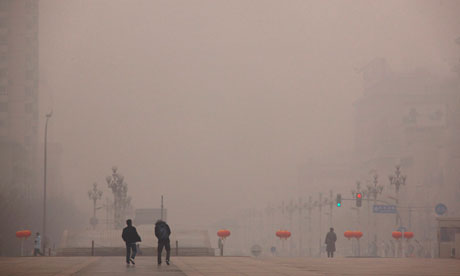
    • A hazy day in Beijing, China.

      Beijing, China, which is one of the countries likely to be worst hit by pollution-triggered deaths in coming decades. Photograph: David Gray/Reuters

      Urban air pollution is set to become the biggest environmental cause of premature death in the coming decades, overtaking even such mass killers as poor sanitation and a lack of clean drinking water, according to a new report.

      Both developed and developing countries will be hit, and by 2050, there could be 3.6 million premature deaths a year from exposure to particulate matter, most of them in China and India. But rich countries will suffer worse effects from exposure to ground-level ozone, because of their ageing populations – older people are more susceptible.

      The warning comes in a new report from the Organisation for Economic Cooperation and Development (OECD), which is a study of the global environmental outlook until 2050. The report found four key areas that are of most concern – climate change, loss of biodiversity, water and the health impacts of pollution.

      If current policies are allowed to carry on, the world will far exceed the levels of greenhouse gas emissions that scientists say are safe, the report found. “I call it the surrender scenario – where we would be if governments do nothing more than what they have pledged already?” said Simon Upton, environment director at the OECD. “But it could be even worse than that, we’ve found.”

      The report said that global greenhouse gas emissions could increase by as much as half, as energy demand rises strongly, if countries fail to use cleaner forms of energy. Water demand is also likely to rise by more than half, and by 2050 as much as 40% of the global population is likely to be living in areas under severe water stress. Groundwater depletion would become the biggest threat to agriculture and to urban water supplies, while pollution from sewage and waste water – including chemicals used in cleaning – will put further strain on supplies.

      However, the OECD study alsos said that there are some actions that governments can take quickly to tackle some of the key problems. For instance, many governments treat diesel fuel for vehicles differently than petrol for tax purposes, with tax breaks that encourage the take-up of diesel. But although diesel vehicle fuel produces lower greenhouse gas emissions than petrol, it is far worse for spewing out small particulate matter, which is bad for urban pollution. “In environmental terms, there is no reason to give diesel tax breaks over petrol,” said Upton.

      Governments could also remove other environmentally harmful subsidies, such as fossil fuel subsidies and subsidies for water that encourage irresponsible use of the resource. Biofuels are another potential danger area, because although they can emit less carbon than conventional fossil fuels, they also contribute to reducing biodiversity and put further strains on water use, so governments should consider carefully whether to go down the biofuels road, Upton warned.

      Upton said that if governments took action now, and developed long-term views of these environmental problems, it would give them a much greater chance of avoiding the worst outcomes. “The key thing is that these four biggest problems are interconnnected – biodiversity is affected by climate change and land use, water is linked to health problems, for instance. You can’t solve any one of these in isolation. So to be effective, governments have to focus on all of these four and look very closely at the connections between them,” he said.

  • Report finds 118.000 retail jobs to go

    Report finds 118,000 retail jobs to go

    Updated March 15, 2012 22:04:12

    The latest research into the retail sector reveals that 118,000 jobs will be lost across the sector in the next three years.

    ABC1’s 7.30 has obtained the figures from a six-month inquiry led by accounting giant Ernst and Young for the National Retail Association.

    The research shows many of the sales will be lost to online retailers and 33,000 of the job losses will come from the Federal Government’s refusal to close a GST loophole for imported goods bought online.

    Currently there is a tax-free threshold for imported goods bought online up to the value of $1,000.

    National Retail Association executive director Gary Black says the job losses will be far greater than those faced by the manufacturing sector.

    “There’s a jobs crisis unfolding in retail that dwarfs the predicament and dilemmas confronted by the Australian manufacturing sector,” he said.

    “All we want is to be able to compete on a level playing field.

    “We want the Government to move urgently, and if they don’t we’ll lose 33,000 jobs over the next few years.”

    Be it wholesalers or retailers great and small, the message is echoing across the sector.

    Clothing wholesaler Andrew Dalgliesh says the retail sector employs a huge number of Australians.

    “If all of those people we’re in one company and it went broke there’d be a national outcry,” he said.

    GST dilemma

    But there is disagreement over how to deal with the problem and whether or not closing the GST loophole for imported goods is the answer.

    The Howard government raised the threshold for imported goods from $250 to $1,000, claiming it would cost Customs too much to police piles and piles of incoming parcels bought online.

    Then late last year the Productivity Commission said though it might be costly, there is a strong case for closing the GST gap again.

    But the Gillard Government has dug in, claiming if the threshold was lowered to $100 it would cost customs $1.2 billion to collect just $500,000 in tax.

    It is an increasingly volatile issue for the Government, but surprisingly it has been thrown an unexpected lifeline from the biggest retailer of them all, Woolworths.

    Its chief executive Grant O’Brien says the GST threshold is not the biggest issue the retail sector is facing.

    “The thing we can’t afford to do as retailers is to be seen to be calling for additional taxes for our customers,” he said.

    “That’s not the issue here – the issue is to be providing for customers exactly what they require in terms of flexibility and to shop when they want and have the very best technology to assist them in that.”

    Woolworths is spending heavily to develop online service platforms for its various businesses, but its unexpected outburst has really seen the fur flying in retail.

    Myer chief executive Bernie Brooks disagrees with the food giant.

    “Woolworths have said retailers should just lower their prices to restore the trust of their customers. Do you think that’s fair?” he said.

    “It’s in their interests to say that because it doesn’t impact their business the way it impacts small business.”

    The Ernst and Young report will be released on Friday.

    Topics:retail, industry, business-economics-and-finance, work, internet-culture, australia

    First posted March 15, 2012 20:41:43

  • Shortage of skills slowing NSW economy

    Shortage of skills slowing NSW economy

    0

    SYDNEY is facing a new skills crisis, with NSW needing an extra 320,000 trade or diploma qualified workers by 2015 to avoid the economy grinding to a halt.

    Government modelling provided to The Daily Telegraph has revealed a critical shortage of qualified workers in Sydney and NSW regions.

    The stark modelling from Skills Australia warned NSW would need at least 180,000 workers with a trade qualification of certificate III or IV by 2015 to fill the jobs required by business and industry.

    It will also need an additional 144,000 people with diploma qualifications.

    The modelling also revealed about 1.3 million people in NSW are missing out on better paid jobs because of a lack of qualifications.

    Shortages are emerging among motor mechanics, plumbers, electricians, fitters, building and construction estimators, sheet metal workers, machinists and chefs.

    The research shows that, with increased skills, the average workers could earn $10,000 more a year, or $400,000 over a lifetime. This would add an extra $2 billion a year to the economy.

    Research to be released ahead of the next Council of Australian Governments meeting will show nearly 4.1 million Australians still do not have the minimum qualification for entry to the growth sectors of the economy.

    Prime Minister Julia Gillard is expected to announce a “sweeping overhaul” of the trade and training system in the coming weeks to try to fill the gaps being experienced by business and industry.

    At the forefront of the reforms will be putting vocational and trade students on an equal pegging with university students in receiving assistance and incentives to increase their skills.

    Writing exclusively in The Daily Telegraph today, Ms Gillard said: “Sydney businesses face shortages for all kinds of skilled work, from motor mechanics to plumbers (while) at the same time thousands of workers in Sydney are missing out on high-paid jobs because they don’t have the right skills.

    “We must make it easier and cheaper for our kids to go on to tertiary education or learn a trade.

    “I will be announcing a sweeping overhaul of the vocational training system in Australia later this month – because kids who do trades should get the same rights as those at university.”

    The skills statement is expected to show 70 per cent of new jobs created over the next five years will require at least a certificate III qualification, and out of these, four in every five will require a diploma level qualification or higher.

    Australian Bureau of Statistics figures show that employees with just a year 12 qualification earn $180 less a week than those holding a certificate III qualification.

    Ms Gillard said the government had scrapped upfront fees for training students in vital industries such as engineering, building, IT and computing. Other diploma students would get subsidies of up to $7800 a year.


    46 comments on this story

  • Global Sea Level Rise Map


    geology

    Global Sea Level Rise Map

    The map below can be used to show which areas would be under water if sea level rises a specific amount. You can select a value of sea level rise using the drop down box in the upper left corner of the map. Although this map is not a carefully surveyed and extremely accurate presentation, it does provide a visually striking view of what geographic areas might be flooded if global climate change continues unabated.

    Note: Some inland depressions, such as the Caspian Sea, show inundation on the map but would not be flooded. This is because the mapping algorithm is based upon elevation and can not distinguish areas that are separated from the oceans by a ridge or other high area. Be sure that you trace a connection with the ocean before assuming the area would be flooded.

    This sea level rise map was created by Alex Tingle of firetree.net using the Google Maps API, NASA data and lots of programming savvy. He explains how the map was created, the sea level data and issues about map accuracy here. We thank Alex for allowing us to share this map on Geology.com. Also thanks to Google and NASA for providing the resources needed to make this map.

    © 2005-2012 Geology.com. All Rights Reserved.
    Images, code and content of this website are property of Geology.com. Use without permission is prohibited. Pages on this site are protected by Copyscape.