Category: General news

Managing director of Ebono Institute and major sponsor of The Generator, Geoff Ebbs, is running against Kevin Rudd in the seat of Griffith at the next Federal election. By the expression on their faces in this candid shot it looks like a pretty dull campaign. Read on

  • Green energy firms fear new feed-in tariffs will be too low


    The DECC has been heavily lobbied by the big energy firms, and tomorrow’s announcement has been delayed several times. The Clean Energy Cashback, or feed-in tariff, will reward households, businesses or communities by paying above-market rates for the electricity they produce and feed into the grid.

    When the tariffs were unveiled last year, they were criticised for offering rates of return too low to encourage people to install micro-generation plants. Germany introduced feed-in tariffs a decade ago offering double-digit rates of return and sparked a green revolution.

    But Alan Simpson, special adviser to energy and climate change secretary Ed Miliband, fears the battle to get higher tariffs has been lost and believes the DECC will stick to its aim of getting just 2% of the UK’s electricity from smaller scale renewables by 2020. He says three times that would be easily achievable at an additional cost per household energy bill of £1.20 a year.

    “Germany needed starting rates that gave a 10% return on investment to kickstart their leap to the top of the renewables league. Britain needs to do the same,” he wrote in a letter to Gordon Brown last week. “At the moment, we don’t have a renewables industry. We have survivors; firms that exist despite government policy rather than because of it.

    “A coalition of groups – from farmers to the fuel-poor, environmental NGOs to eco-builders, ethical bankers to engineers and installers – has been lobbying DECC officials for all they are worth. But little seems to be working.”

    Andrew Melchior, head of the EIC Partnership, which is setting up the Horizon energy co-operative in Manchester, said his business was only viable because of an EU grant. The feed-in tariff would not be enough, he warned.

    “The Germans created an efficient industry that is able to provide solar installations at competitive prices. The UK does not have this industry, more a collection of enthusiasts experimenting with new technologies or proponents well versed in the pragmatics and dark arts of exploiting pots of grant funding.

    “We must provide a decent incentive so that the public begin to accept the concept of economically viable solar energy in the UK.”

  • Pentagon to rank global warming as destabilising force.


    “While climate change alone does not cause conflict, it may act as an accelerant of instability or conflict, placing a burden on civilian institutions and militaries around the world,” said a draft of the review seen by the Guardian.

    Heatwaves and freak storms could put increasing demand on the US military to respond to humanitarian crises or natural disaster. But troops could feel the effects of climate change even more directly, the draft says.

    More than 30 US bases are threatened by rising sea levels. It ordered the Pentagon to review the risks posed to installations, and to combat troops by a potential increase in severe heatwaves and fires.

    The review’s release coincides with a sharpening focus in the American defence establishment about global warming – even though polls last week showed the public increasingly less concerned.

    The CIA late last year established a centre to collect intelligence on climate change. Earlier this month, CIA officials sent emails to environmental experts in Washington seeking their views on climate change impacts around the world, and how the agency could keep tabs on what actions countries were taking to reduce greenhouse gas emissions.

    The CIA has also restarted a programme – scrapped by George Bush – that allowed scientists and spies to share satellite images of glaciers and Arctic sea ice.

    That suggests climate change is here to stay as a topic of concern for the Pentagon.

    The Pentagon, in acknowledging the threat of global warming, will now have to factor climate change into war game exercises and long-term security assessments of badly affected regions such as the Arctic, sub-Saharan Africa, and South Asia.

    Military planners will have to factor climate change into war game exercises and long-term security assessments of badly affected regions such as the Arctic, sub-Saharan Africa, and South Asia.

    “The leadership of the Pentagon has very strongly indicated that they do consider climate change to be a national security issue,” said Christine Parthemore, an analyst at the Centre for a New American Security, who has been studying the Pentagon’s evolving views on climate change. “They are considering climate change on a par with the political and economic factors as the key drivers that are shaping the world.”

    Awareness of climate change and its impact on threat levels and military capability had been slowly percolating through the ranks since 2008 when then Senators Hillary Clinton and John Warner pushed the Pentagon to look specifically at the impact of global warming in its next long-term review.

    But the navy was already alive to the potential threat, with melting sea ice in the Arctic opening up a new security province. The changing chemistry of the oceans, because of global warming, is also playing havoc with submarine sonar, a report last year from the CNAS warned.

    US soldiers and marines, meanwhile, were getting a hard lesson in the dangers of energy insecurity on the battlefield, where attacks on supply convoys in Afghanistan and Iraq inflicted heavy casualties.

    “Our dependence on fuel adds significant cost and puts US soldiers and contractors at risk,” said Dorothy Robyn, deputy undersecretary of defence for the environment. “Energy can be a matter of life and death and we have seen dramatically in Iraq and Afghanistan the cost of heavy reliance on fossil fuels.”

    She told a conference call on Friday the Pentagon would seek to cut greenhouse gas emissions from non-combat operations by 34% from 2008 levels by 2020, in line with similar cuts by the rest of the federal government.

    In addition to the threat of global warming, she said the Pentagon was concerned that US military bases in America were vulnerable because of their reliance on the electric grid to cyber attack and overload in case of a natural disaster.

    The US air force, in response, has built up America’s biggest solar battery array in Nevada, and is testing jet fighter engines on biofuels. The Marine Corps may soon start drilling its own wells to eliminate the need to truck in bottled water in response to recommendations from a taskforce on reducing energy use in a war zone.

    But not all defence department officials have got on board, and Parthemore said she believes it could take some time to truly change the military mindset.

    Parthemore writes of an exchange on a department of defence list-serv in December 2008 about whether global warming exists. It ends with one official writing: “This is increasingly shrill and pedantic. Moreover, it’s becoming boring.”
  • More flaws emerge in climate alarms


    This is the third time in as many weeks that serious doubts have been raised over the IPCC’s conclusions on climate change. Two weeks ago, after reports in London’s The Sunday Times and The Australian, the panel was forced to retract a warning that climate change was likely to melt the Himalayan glaciers by 2035. That warning was also based on claims in a WWF report.

    The IPCC has been put on the defensive as well over its claims that climate change may be increasing the severity and frequency of natural disasters such as hurricanes and floods.

    IPCC chairman Rajendra Pachauri was fighting to keep his job over the weekend after a barrage of criticism. Scientists fear the controversies will be used by climate change sceptics to sway public opinion to ignore global warming – even though the fundamental science, that greenhouse gases can heat the world, remains strong.

    The latest controversy originates in a report, A Global Review of Forest Fires, that WWF published in 2000. It was commissioned from Andrew Rowell, a freelance journalist and green campaigner who has worked for Greenpeace, Friends of the Earth and anti-smoking organisations. The second author was Peter Moore, a campaigner and policy analyst with WWF.

    In their report, they suggested that “up to 40 per cent of Brazilian rainforest was extremely sensitive to small reductions in the amount of rainfall” but made clear this was because drier forests were more likely to catch fire.

    The IPCC report picked up this reference but expanded it to cover the whole Amazon. It also suggested that a slight reduction in rainfall would kill many trees directly, not just by contributing to more fires. The IPCC said: “Up to 40 per cent of the Amazonian forests could react drastically to even a slight reduction in precipitation; this means the tropical vegetation, hydrology and climate system in South America could change very rapidly to another steady state.

    “It is more probable that forests will be replaced by ecosystems that have more resistance to multiple stresses caused by temperature increase, droughts and fires, such as tropical savannas.”

    Simon Lewis, a Royal Society research fellow at Leeds University who specialises in tropical forest ecology, described the section of the report by Rowell and Moore predicting the potential destruction of large swaths of the Amazon as “a mess”.

    “The Nature paper is about the interactions of logging damage, fire and periodic droughts, all extremely important in understanding the vulnerability of Amazon forest to drought, but is not related to the vulnerability of these forests to reductions in rainfall,” he said.

    He believes the IPCC should ban the use of reports from campaign groups.

    “In my opinion, the Rowell and Moore report should not have been cited; it isn’t sufficient evidence to back any claim at all, as it contains no primary research data,” Mr Lewis said. The WWF said it prided itself on the accuracy of its reports and was investigating the latest concern. “We have a team of people looking at this internationally,” said Keith Allott, its climate change campaigner.

    The Amazon constantly undergoes huge changes because of natural variability in the weather, aside from damage caused by human factors such as logging and agricultural clearance.

    Spotting the additional impact of global warming against such a changing background is difficult, especially when the world has so far warmed by about 0.7C since the 18th century.

    The Sunday Times

  • Climate change: Sceptics fiddle while the planet burns


    Kathy Maskell

    Walker Institute for Climate System Research

    University of Reading


    ■ Robin McKie’s article contains some sensible ideas – well, one at least: the abolition or serious rejigging of the IPCC. This latest blunder is not the only one to discredit the organisation. There is also evidence that the summaries for policy-makers do not always reflect the real scientific findings when these fail to support the widely held acceptance of manmade global warming.

    It would seem that the sceptics are charged with having to prove that the consensus is wrong. Surely it is for those who hypothesise – in this instance, that there is a direct link between anthropogenic greenhouse gas emissions and global warming – to demonstrate that it is true.

    Michael Robinson

    North Creake, Norfolk


    ■ It must be remembered that global warming is not an issue of opinion. It is solely about the quantum mechanical interactions between radiation and molecules in the atmosphere and the knock-on effects this has. Unlike questions such as the best policy for dealing with the recession, where two sides could in theory ague for all eternity, with climate change only one side can be correct. We just don’t yet know which side is correct. As climate change deniers have failed to produce a peer-reviewed body of evidence pointing to a mechanism that would negate the impact of our emissions, caution would seem to be sensible.

    David Coley

    Senior research fellow

    Centre for Energy and the Environment

    School of Physics, Exeter


    ■ A consequence of the intense public debate surrounding the Copenhagen conference has been a widening of the gap between those who accept that humans are affecting the climate system and those who do not. Yet the case that climate change is real and unwise is unchanged: greenhouse gases in the atmosphere warm the surface zone we inhabit. Measurements show that human industry and agriculture have increased the concentration of carbon dioxide in the air by nearly 40%.

    The cost of transforming world society to maintain prosperity and improve equity in a way that is sustainable and reduces the climate risk is a tough challenge. People are key to addressing this challenge, but to act, people must be convinced that there is a problem and that it is a priority.

    Professor Chris Rapley

    Director of the Science Museum and professor of climate science, University College London, London WC1


    ■ Despite the well co-ordinated political campaigns by “sceptics” against the IPCC, it remains the most authoritative source of information about the causes and consequences of climate change. Yet every error in its last report is now being portrayed as undermining the evidence that greenhouse gases are driving climate change. Perhaps it is time that the claims of the professional climate change “sceptics” are put to the same test.

    Bob Ward

    Policy and communications director, Grantham Research Institute on Climate Change and the Environment, LSE

    London WC2

  • Cost of UK flood protection doubles to 1bn pounds a year


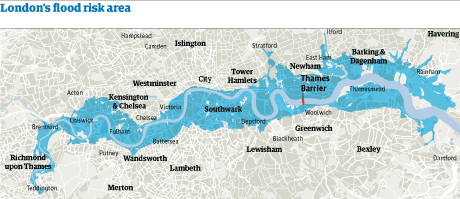
    The rising costs will be incurred from the impacts of climate change that will take effect in the coming decades, meaning the risks to homes and communities will increase unless defences are improved.

    FloodLondon

    The costs of dealing with floods can run into the billions – the devastating floods of summer 2007 cost a total of £3.2bn according to the EA, including more than £2bn in costs to homeowners and businesses as well as 400,000 of lost school days. The EA estimates that 5 million people live and work in the 2.4m properties in England that are at some risk of flooding and, at present, around £570m is spent every year building and maintaining the defences required for them. Half a million of those properties are in highest risk band, which means they are at risk of flooding due to extreme weather expected once every 75 years.

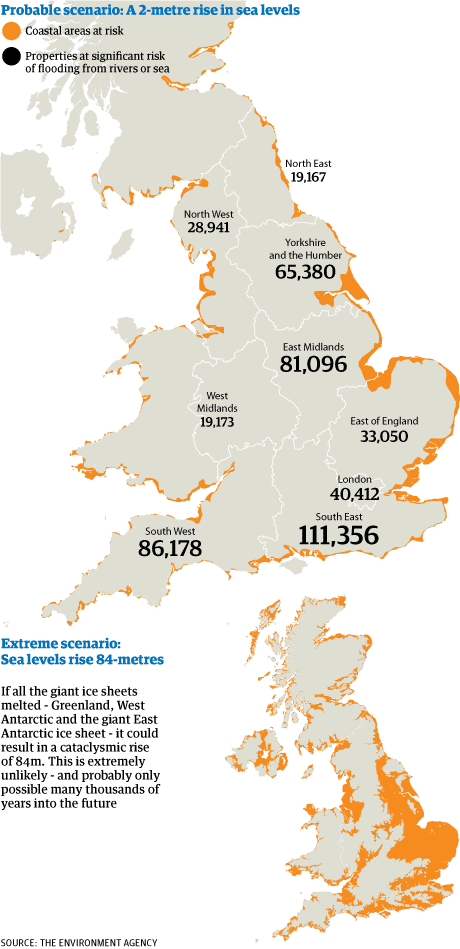
    Climate scientists predict that, by the 2080s, sea levels could be around 70cm higher around the southern parts of the UK, making serious storm surges and floods more frequent. Using predictions from the UK Climate Impacts Programme, the EA estimates that keeping all 2.4m at-risk homes at the existing level of flood risk for the next 25 years will cost £1bn per year by 2035. “Assuming that no new properties are adding to that risk, then that investment is to maintain the existing infrastructure and to invest to make sure it isn’t worsened, taking into account the uncertainties of climate change,” said Robert Runcie, the EA’s director of flood and coastal risk management.

    “What we know from the science of climate change is that weather patterns are going to become more extreme. The risk is going to get greater and we need to up our game in response to that,” said Chris Smith, the EA chairman, in an evidence session to the House of Commons environmental audit committee (EAC) last week.

    “The case for flood defence is very strong. The cost benefit of any flood defence work that we do, the benefit is at least five times the cost. The average cost to a home of being flooded is £20,000 to £30,000. The average cost to a home of being burgled is about £1000. So the damage that flooding does in terms of its impact on people’s livelihoods is huge.”

    But getting this money out of government has proved difficult. “The Treasury have crawled all over our figures and have agreed that our working is absolutely in order and have agreed with the conclusions that we have reached,” said Smith. “What they have not done, of course, is commit the actual figures and that is unlikely to happen this side of an election or, I suspect, the other.”

    An Treasury spokeswoman said:”The government will make decisions about the allocation of expenditure, including the allocation for flood risk management, at the next spending review.” She pointed out that spending on on flood and coastal erosion risk management had increased in recent years, from £394m in 2002-03 to £564m in 2005-06.

    Not spending the money could have even bigger consequences. The EA estimates that the annual cost of damage to residential and commercial property from flooding in England could rise from £2.5bn to £4bn by 2035 without the extra cash for flood defences. Investing the money would save England some £180bn over the next 100 years.

    “Even at a time of unprecedented financial pressure, this is something that has to be given a priority,” said EAC chair and Conservative MP Tim Yeo. “We could be more creative about getting private sector investment in as well. Where you’ve got new developments taking place, it’s quite legitimate in my view for the planning authority to say, look, although what we’re going to ask for [in flood defences] is not directly related to the houses or supermarket you’re putting up there, it is of concern to this community and we do need to accelerate investment in flood-prevention measures so we want to supplement what the taxpayer is being asked for with developer contributions.”

    Runcie said that flood management in future would depend on careful planning and preventing the construction of new buildings on flood plains. “One of the things that’s made a huge difference on that is a change to the planning laws where, only last year, we became a formal consultee. In the last 12 months, of the thousands of applications for major developments that have been proposed, only 4% went against our recommendations.”

    FloodUK


  • ‘Disastergate’ is an excuse tor IPCC critics to dig up old academic rows.


    The controversy centres on why the cost of repairs after hurricanes, floods and other natural disasters, has risen from $75.5bn (£46.7bn) in the 1960s to $659.9bn in the 1990s.

    Roger Pielke Junior, a professor of environmental studies at the University of Colorado, has attacked the IPCC for including in one of its reports a reference to an abstract in 2006 that indicated economic losses from disasters, even after “normalisation” to take account of inflation and growth in the number of buildings in high-risk areas, increased between 1970 and 2005. The authors of that study, led by Robert Muir-Wood (who works for my former employer, Risk Management Solutions), concluded that “we find evidence of an annual upward trend for normalised losses of 2% per year that corresponds with a period of rising global temperatures”.

    The authors offered many caveats about their results, not the least of which was the fact that the rising trend was strongly dependent on economic losses caused by hurricanes in the United States, particularly the nine that hit in 2004 and 2005.

    The six-page abstract, taken from a workshop presentation, was cited both in the review of the economics of climate change by Nicholas Stern in 2006 and in Chapter 1 of the volume by working group II in the IPCC Fourth Assessment Report in 2007, which stated: “Global losses reveal rapidly rising costs due to extreme weather-related events since the 1970s”. It pointed out “one study” found that an underlying rising trend in losses still remains, even after adjustments for inflation and increases in the numbers of exposed buildings.

    Pielke has several times on his blog since 2006 attacked both the Stern Review and the IPCC report for referring to the work by Muir-Wood. He argues that the abstract from the workshop, which Pielke organised with the company Munich Re (which also funds research at London School of Economics and Political Science on the implications of climate change for the insurance industry), was not peer-reviewed.

    Therefore, Pielke insists, the reports should have relied on other papers, such as those that he has written about hurricane losses, which conclude that the upward trend can be explained away completely by economic factors and that there is no evidence for the impact of climate change.

    The trouble with Pielke’s argument is that the work of Muir-Wood and his colleagues was eventually published as a peer-reviewed paper in 2008 (and included as chapter 12 of the book Climate Extremes of Society) and included the same conclusion. It remains the only paper to assess global economic losses from all types of extreme weather events, not just a single source of hazard in one region.

    Pielke is right that an increase in the number of valuable properties in high-risk areas is overwhelmingly the primary cause of increased financial losses from extreme weather events over the past few decades. That in itself is a worrying conclusion given that climate change is expected to lead to changes in the occurrence and severity of such events. Indeed, only last week a paper in the journal Science by researchers at the United States National Oceanic and Atmospheric Administration projected nearly a doubling in the frequency of the most severe hurricanes in the Atlantic by the end of this century.

    But it is difficult to tell to what extent, if any, climate change has also already affected past disaster losses around the world. Extreme weather events are rare, so identifying small trends is difficult when losses vary so much from year to year, creating a lot of “noise” in the dataset, and many competing factors contribute to the overall pattern.

    The absence of a “statistically significant” trend may indicate that no trend exists, or instead that a trend exists but cannot be definitively detected until a longer period of losses is available.

    What is clear is that it would be wrong to think of this as another mistake by climate researchers. In fact it looks more like a blatant attempt to dig up an old academic row in order to create the impression of an IPCC under siege.

    • Bob Ward is policy and communications director at the Grantham Research Institute on Climate Change and the Environment at London School of Economics and Political Science.