1 of 17
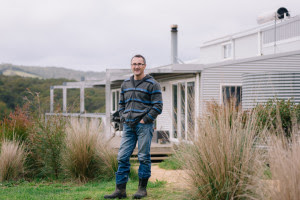
Our new consumer website: Richard Di Natale – the party leader living off the grid
|
Inbox
|
x |

|
1:56 PM (8 minutes ago)
 |
|
|||
|
Managing director of Ebono Institute and major sponsor of The Generator, Geoff Ebbs, is running against Kevin Rudd in the seat of Griffith at the next Federal election. By the expression on their faces in this candid shot it looks like a pretty dull campaign. Read on
|
Inbox
|
x |
|
1:56 PM (8 minutes ago)
|
|
|||
|
|
Inbox
|
x |

|
4:18 PM (19 minutes ago)
|
|
|||
|
|
Inbox
|
x |
|
12:52 PM (5 minutes ago)
|
|
|||
|
 |
|
|||||
| Australian Labor Party Authorised by G. Wright, Australian Labor, 5/9 Sydney Avenue, Barton 2600 ACT |
| Speaker of the House of Representatives | |
|---|---|
 Incumbent |
|
| Style | The Honourable (Diplomatic) Madam/Mister Speaker (within the House) |
| Appointer | Elected by the House of Representatives |
| Inaugural holder | Sir Frederick Holder, KCMG 9 May 1901 |
| Formation | Constitution of Australia 9 July 1900 |
 |
| This article is part of a series on the politics and government of Australia |
The Speaker of the House of Representatives is the presiding officer of the House of Representatives, the lower house of the Parliament of Australia. The presiding officer in the upper house is the President of the Senate. The office of Speaker was created by section 35 of the Constitution of Australia. The authors of the Constitution intended that the House of Representatives should as nearly as possible be modelled on the House of Commons of the United Kingdom.
The Speaker is the presiding officer of House of Representatives debates, determining which members may speak. The Speaker is also responsible for maintaining order during debate, and may punish members who break the rules of the House.
The current Speaker is the Hon Bronwyn Bishop (Liberal), elected 12 November 2013. The Deputy Speaker is Bruce Scott (National), who was elected Deputy Speaker on 9 October 2012 and has previously served as Second Deputy Speaker in the 42nd Parliament. If the Speaker is absent the Deputy Speaker becomes the Acting Speaker. The Second Deputy Speaker is Rob Mitchell (Labor).
The Speaker is elected by the House of Representatives in a secret ballot, with an election held whenever the Office of the Speaker is vacant, as set out in Chapter 3 of the House of Representatives Standing and Sessional Orders. The Clerk of the Australian House of Representatives conducts the election.
Unlike the Speaker of the House of Commons in Britain, the Speaker generally remains an active member of their party. If a party member, the Speaker will continue to attend party meetings, and at general elections will stand as a party candidate. There were two exceptions to this: the first Speaker, Frederick Holder (1901) and Peter Slipper (2010), who resigned from their respective parties upon election as Speaker, and sat as independents.
A Speaker ceases to hold that office if, for any reason, he or she ceases to be a member of the House. There is no convention in Australia that the Speaker should not be opposed in his or her seat, and three Speakers have been defeated at general elections: Littleton Groom (1929), Walter Nairn (1943) and William Aston (1972). Because the Speaker is always the nominee of the governing party, there is no expectation that a Speaker will continue in office following a change of government. While the Opposition sometimes nominates one of its own members for Speaker after a general election, this is understood to be a symbolic act, and party discipline is always followed in any ballot.
While in the Chair, a Speaker does not have a deliberative vote, but if there is a tie in votes, the Speaker has a tiebreaker vote.
There is no convention in Australia that Speakers should resign from Parliament at the end of their term: two Speakers become Cabinet ministers after having been Speaker: Norman Makin and Gordon Scholes.
Most Speakers have been senior backbenchers of the party holding office at the start of a new Parliament, or at the time of the death or resignation of an incumbent Speaker. Five Speakers have been former government ministers: William Watt, Groom, Archie Cameron, Ian Sinclair and the current Speaker, Bronwyn Bishop; one a former Parliamentary Secretary: Stephen Martin; and one both a former minister and a former Leader of the Opposition: Billy Snedden. Two were former state premiers: Holder and Watt.
Bronwyn Bishop was elected Speaker on 12 November 2013, as the Coalition’s first female Speaker of the House and the third female Speaker, after Labor’s Anna Burke (2012–13) and Joan Child (1986-89). The (43rd) Parliament (2010–13) was the first Australian federal parliament to have had three Speakers: Harry Jenkins (elected September 2010), Peter Slipper (November 2011), and Anna Burke (October 2012).
The name “Speaker” originates from olden times in the United Kingdom House of Commons. “Mr Speaker” was a description rather than a title, the speaker being the Member of Parliament chosen to speak for them to the king. The first recorded use of the term “Speaker” was in 1377. During earlier times when the king was very powerful, he would usually only call the Parliament together in order to get it to agree to levy taxes. The speaker would report parliament’s decisions to the king, which proved to be dangerous if it was not what the king wanted to hear. It was not uncommon for early speakers of parliament to be beheaded, with another being “murdered”. The traditional token reluctance shown by a member on being elected speaker dates from this time, when a member’s struggle not to be physically forced into the Chair could have been completely genuine. The practice in the House of Representatives that the newly elected speaker is escorted to the Chair by his supporters derives from this tradition.[1]
All male Speakers have been addressed by members as “Mister Speaker” while in the Chair. Joan Child chose to be addressed as “Madam Speaker”, as women Speakers are usually referred to in other parliaments. The former Speaker, Anna Burke, broke with this tradition and ruled that her official form of address is merely “Speaker.”

The Speaker’s principal duty is to preside over the House and maintain order in the House, uphold Standing Orders (rules of procedure), rule on points of order, and protect the rights of backbench members.
The Speaker is assisted by two deputies, both also elected by the House: the Deputy Speaker and Second Deputy Speaker, the latter of which must be elected from an opposition party. If the Speaker is absent, the Deputy Speaker would become the Acting Speaker and the Second Deputy Speaker the Acting Deputy Speaker. If both the Speaker and Deputy Speaker are absent the Second Deputy Speaker would become Acting Speaker.
Australian parliaments are notoriously rowdy, and the Speaker frequently exercises the disciplinary powers available under Standing Orders. The Speaker may summarily order a Member to excuse him or herself from the House for one hour. For more serious offences, the Speaker may “name” a Member, saying “I name the Honourable Member for X,” following the House’s convention that Members are always referred to by their electorate. The House then votes on a motion to suspend the Member for 24 hours. (The House also had the power to permanently expel a Member, but this happened only once, in 1920: the member was Hugh Mahon. The House no longer has the power to expel a member from membership of the House under Section 8 of the Parliamentary Privileges Act 1987.[2])
The Speaker, in conjunction with the President of the Senate, also administers Parliament House, Canberra, with the assistance of an administrative staff. The Speaker has accountability obligations to the Parliament for the Department of the House of Representatives.
A member of the House who wishes to resign would tender his or her resignation to the Speaker (but not to an Acting Speaker), or if there is no Speaker to the Governor-General. During the Joint Sitting of 1974 the Speaker of the Australian House of Representatives Jim Cope was the presiding officer.
While impartial, the Speaker does not usually quit the membership of his, or her, party – as is traditional Westminster convention. The only two speakers to have not been formally a member of a party were Sir Frederick Holder (Who resigned from the Free Trade Party upon taking the role) and Peter Slipper (Who resigned from the Liberal National party the day after his election to the chair).
On the other hand, the Speaker is not an active political figure like the Speaker of the United States House of Representatives. He or she does not take part in debates in the House, does not vote in the House except in the (rare) event of a tied vote, and does not speak in public on party-political issues (except at election time in his or her own constituency). He or she is expected to conduct the business of the House in an impartial manner, and generally does so.
There have been several memorable clashes between Speakers and the governments that caused them to be elected:
In addition, a notable occurrence in 2011, a Speaker survived being countermanded by the House. After a contentious debate on carbon pricing in which Speaker Harry Jenkins declared a “general warning” for all members, Liberal MP Bob Baldwin interjected and was named by the Speaker. The Government accordingly moved that he be suspended, but Baldwin was supported by the Coalition, independent MP Rob Oakeshott and WA Nationals MP Tony Crook. The resulting vote on suspending Baldwin for 24 hours failed 71–72. Convention would normally have required the Speaker to resign, but the House of Representatives immediately thereafter approved a motion of confidence in the Speaker, and as a consequence, Speaker Jenkins continued in office.[4][5][6][7]
Precedents for independent MP Speakers are former LNP member Peter Slipper who was the second speaker in the hung parliament resulting from the 2010 election; Frederick Holder who was initially elected for the Free Trade Party at the inaugural 1901 election, serving as an independent while speaker until his death in 1909; and in the Senate, Labor’s Mal Colston became an independent and Deputy President of the Senate following the 1996 election.
In the previous hung parliament elected at the 1940 election, the United Australia Party‘s Walter Nairn was speaker during the Curtin Labor government that was formed in 1941. Opposition MP Carty Salmon initially served as speaker for the first federal Australian majority government, the Andrew Fisher Labor government, resulting from the 1910 election. At the 1913 election, Labor’s Charles McDonald was offered retention of the Speakership by the incoming one-seat-majority Commonwealth Liberal Party, but declined – later however, after Labor’s return to government at the 1914 election, McDonald regained the Speakership until the subsequent election despite the mid-term change to a Nationalist Party government.[8][9]

A Member elected Speaker is entitled, while Speaker, to the title “The Honourable“, which, with the approval of the Sovereign, may be retained for life. This privilege is usually only given to those who have served as Speaker for at least three years. Speaker Harry Jenkins (2008–11) was the first Speaker to ask that “The Honourable” title not be used in reference to him, while also making clear that he was not attempting to set a precedent for future Speakers; he was simply not personally comfortable with the title.[citation needed]
Following the Westminster tradition inherited from the House of Commons of the United Kingdom, the traditional dress of the Speaker includes components of Court dress such as a black silk lay-type gown (similar to a Queen’s Counsel gown), a wing collar and a lace jabot or bands (another variation included a white bow tie with a lace jabot), bar jacket, and a full-bottomed wig. The wig available for use by the speaker was used by Herbert ‘Doc’ Evatt when he was a High Court Justice (1930–1940) and was donated to the Parliament by Evatt when he was elected to the House in 1951. The wig is currently on loan from the speaker’s office to the Museum of Australian Democracy.[10] Another addition, though only for the most formal occasions, includes court shoes and hose.
The dress of Speakers has often varied according to the party in power, but is determined on the personal choice of the Speaker. Most non-Labor Speakers have worn some variation of the traditional dress. All Labor Speakers have eschewed the traditional dress in favour of ordinary business suits, following the example set by their first Speaker, Charles McDonald.
Billy Snedden (1976–1983) was the last Speaker to wear the full traditional attire of the Speaker, complete with the wig. The Labor practice of wearing normal business attire resumed from 1983 until the election of the Howard Government in 1996. The new Speaker, Bob Halverson, chose to wear the traditional court dress of the Speaker upon his election in April 1996, but without the wig.[11] Speaker Ian Sinclair chose to wear an ordinary business suit during his brief term in 1998. Speaker Neil Andrew opted to wear a gown, albeit of a simpler academic style, a practice mirrored by his successor, David Hawker. Speaker Harry Jenkins resumed Labor practice from 2007 until the election of Peter Slipper in late 2011. Slipper went one step further to restoring the traditional dress by the gown and the QC’s bar jacket underneath his business attire. Slipper also took to wearing a white long tie or bow tie, in a variation from the lace jabot or bands.[10] For example, he wore a wing collar with white bow tie and bands on the occasion of his first formal procession into parliament.[12] Speaker Burke returned to the Labor practice of wearing normal business attire. Burke’s successor, Bronwyn Bishop, the first non-Labor woman to hold the post, continues wearing business attire with no gown.
|
Inbox
|
x |

|
11:59 AM (15 minutes ago)
|
|
|||
Dear NEVILLE,
This past week, over 7000 people have joined the campaign to introduce a ‘Buffett Rule’ – the tax reform as popular as puppies. Thousands more have emailed their Labor MP or Senator explaining how the Buffett Rule would help close tax loopholes for the wealthiest 1%.
But the best part? Labor Party insiders have told us that your simple and eye-catching messages are being read and talked about, and organisations have been reaching out to see how they can help get the word out in the lead up to the Labor National Conference.
You see, with over 2000 conference attendees there are many people that still won’t have heard about the Buffett Rule. So we’ve a plan to take it to their doorstep. A giant mobile Buffett Rule billboard is all set to drive round and round the Melbourne Convention Centre on 24 July, the very day the ALP will debate their tax policy.
Imagine it: every single Labor Party decision-maker in one place at one time, in one square city block – a captive audience for our eye-catching billboard. But before we can book it in, we need the funds to make it happen.
The Buffett Rule is simple. It makes sure the top 1% of income earners (who earn over $300K a year) pay at least 35% tax on their income. So no matter how many tax loopholes or deductions are used, the 1% pay at least the same rate of tax as your average income earner. At a time when the Tax Office has exposed rife tax dodging at the big end of town, no wonder this is such a popular tax reform with Australians!1
Whether we like it or not, politicians of today are poll-obsessed. Fortunately we can swing this in our favour, given that a massive 79% of Australians support the introduction of an Aussie Buffett Rule.2 What better way to get the Labor Party talking about the Buffett Rule than by highlighting this rockstar statistic with a mobile billboard, front and centre at next week’s ALP National Conference.
With all the Labor Party decision makers and policy setters in the one place, it’s the perfect opportunity to kick start the conversation about this insanely popular tax reform with an enormous Buffett Rule billboard.
Thanks for being a part of it,
Daney, Nat, Alycia and Mark, for the GetUp team
PS – Did you know 80% of Australians love their pets like a family member?3 This is about the same number of Australians who support the Buffett Rule. It’s tax reform that’s simple and fair, raises billions – and is as popular as puppies! Chip in to get the word out at the ALP Conference next week: https://www.getup.org.au/buffet-rule-billboard
References
[1] ‘Tax office statistics reveal the 55 millionaires who paid no tax’, Sydney Morning Herald, 30 April 2015
[2] Essential Media Communications poll held on 28 April 2015
[3] ‘Its raining cats and dogs’, Sydney Morning Herald, 22 September 2013
|
Inbox
|
x |

|
8:02 AM (1 hour ago)
|
|
|||
I’m thrilled to announce the beginning of the Solar Shindig – our nationwide week of action for a sun-powered future. Will you join in? Take a “selfie” to show you are standing up for solar.
Dear Neville —
The Solar Shindig week has begun and our timing is, ahem, impeccable. Just last week we heard news that the Abbott Government had banned the Clean Energy Finance Corporation from investing in rooftop solar*, a move that will make it harder for households and businesses to go solar. And let’s not forget the recent devastating cut to our Renewable Energy Target**. Solar in Australia is under attack and it’s time for us all to band together to defend it.
Our next big opportunity to influence Australia’s solar and clean energy future is at the end of next week at the Australian Labor Party’s National Conference. We need the ALP to show real leadership and adopt ambitious solar policy that sets a strong agenda before the next Federal election. That’s why we’re taking action in the lead up.
Over the next seven days Solar Citizens will be out in force, celebrating the potential of solar and clean energy and calling on our politicians to Stand Up For Solar. From Mackay to Margaret River, from Fremantle to Geelong, communities are coming together at local events to have some fun and show their support for a sun-powered future.
Now, I know many of you couldn’t host or attend a Solar Shindig event this week. But there is something you can do, wherever you are, to show your support. If you have a smartphone in your pocket, a camera on your computer or tablet or a digital camera, I’m asking you to take a “selfie” sometime over the next 7 days to show you’re standing up for solar. All you need to do is hold up a sign saying you’re standing up for solar and snap a photo – you can make the sign yourself or download one from our website. Click here to go to our website, download the sign and upload your selfie.
Here’s one I prepared earlier…
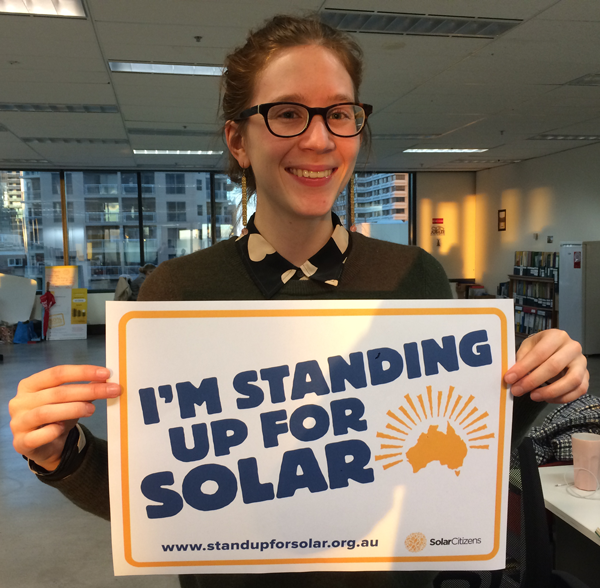
Over the coming week we want to see Solar Citizens across the country standing up for solar publicly and proudly. Will you take a selfie to show your support? Click here.
Let’s show our politicians what we’re made of!
For a sun-powered future,
Alex, Campaigns Coordinator
P.S. If you have some time on your hands this week, why not attend a Shindig event in your local area? Click here to see event listings and to RSVP.
* http://www.theguardian.com/environment/2015/jul/12/abbott-government-extends-ban-on-renewable-energy-to-solar-panels
** http://www.abc.net.au/news/2015-06-23/amendments-to-cut-renewable-energy-target-pass-parliament/6568642
Solar Citizens
http://www.solarcitizens.org.au/