In its State of the Environment Uganda 2008 report, published this month, NEMA attributes the acceleration of deforestation to expanding farmland, a population boom and increasing urbanisation. It says unless the situation is reversed, the knock-on effect will be catastrophic, contributing to and exacerbating soil degradation, declining food security, disease and conflict.
“In 41 years time, if the current rate of deforestation continues, the per capital forest cover will be zero because already we are tending towards desertification-type conditions,” Aryamanya Mugisha, executive director at NEMA, told the UN newswire IRIN today.
Annet Nakyeyune, an environmentalist at Makerere University, added that the poorest people living in rural areas, such as Katine, would be hardest hit.
Desertification due to deforestation is likely to “tamper with the country’s food security because rainfall will be erratic, floods rampant,” she said.
Nakyeyune also warned that water sources will disappear, water catchment areas will dwindle, agricultural productivity will be badly hit and livelihoods destroyed as a result. Disease will also inevitably increase.
The situation is being blamed partly on Uganda’s booming population, which is growing at a rate of 3.2% per annum. Areas around the capital, Kampala, have lost more than 78% of forest land since 1990.
NEMA also say that as only 10% of Uganda’s population has access to electricity and 89% of rural Ugandans use firewood to cook it will be an uphill struggle to reverse this alarming trend.
If NEMA is correct, then the people of Katine are likely to be among the first hit by the effects of deforestation and climate change.
Already farmers in Katine say they are struggling to adapt to what they perceive as rapidly changing and increasingly erratic weather patterns. Rain is not falling when it is supposed to and drought has left many farmers struggling to find enough food to feed their families.
On the Katine site today, Joseph Malinga reports on farmers’ fears of serious famine as a result of poor rains.
It is one of the greatest injustices that the world’s poorest will be the hardest hit by global climate change and the effects of deforestation and the destruction of the natural environment.
The introduction of new strains of drought-resistant cassava as part of the Katine project’s livelihoods programme is one way the project is trying to help farmers mitigate against more unpredictable weather, but are we doing enough?
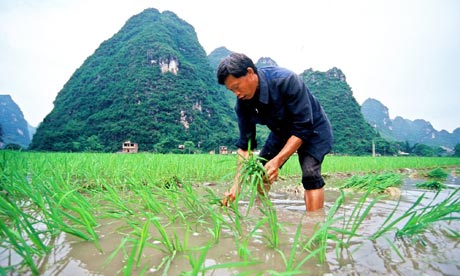 Chinese Minister for Land and Resources, Lu Xinshe, has announced that the regime is struggling to maintain the 120million hectares of arable land required to feed China’s population because of urban and industrial sprawl. “We will not plan any new large scale projects to return farmland to its natural state, beyond those that have already been planned,” he said. China has bought vast tracts of arable land in poor nations. There are now estimated to be one million Chinese farmers in Africa, alone.