Category: News

Add your news
You can add news from your networks or groups through the website by becoming an author. Simply register as a member of the Generator, and then email Giovanni asking to become an author. He will then work with you to integrate your content into the site as effectively as possible.
Listen to the Generator News online

 
The Generator news service publishes articles on sustainable development, agriculture and energy as well as observations on current affairs. The news service is used on the weekly radio show, The Generator, as well as by a number of monthly and quarterly magazines. A podcast of the Generator news is also available.
As well as Giovanni’s articles it picks up the most pertinent articles from a range of other news services. You can publish the news feed on your website using RSS, free of charge.
 

  • A new chapter for renewables BEN OQUIST The Australia Institute

    More

    3 of 24

    A new chapter for renewables

    Inbox
    x

    Ben Oquist <mail@tai.org.au>

    5:25 PM (1 hour ago)

    to me

    The Australia Institute

    Dear Neville —
    I’m getting in contact to let you know about some great news. Beginning today, The Australia Institute, in a new partnership with engineering consultants Pitt & Sherry, will now be publishing the highly regarded Carbon Emissions Index (CEDEX) report.

    The CEDEX is the benchmark indicator for Australia’s carbon emissions and an up to date snapshot of vital data from the energy sector.

    And now, for the first time, the new CEDEX report will produce accurate figures for total renewable energy produced in Australia, including all wind and solar.

    This month’s report shows that there has been a big increase in electricity demand in Queensland due to the controversial opening of gas export facilities in the state. As you know, The Australia Institute has released a range of research relating to gas expansion plans and the effects they will have on our electricity, emissions and gas prices.

    This report is a keenly sought after resource for industry and policy makers. The data from the CEDEX was also a crucial indicator which showed what a success Australia’s two years of carbon pricing was.

    Qld_gas_electricity_explosion.png

    Including solar into CEDEX comes at an exciting time and a turning point in how electricity is produced and consumed. There has been a rapid fall in the price of solar and battery storage, and there is an expectation that prices will continue to fall as the technology is massed produced and rolled out to consumers. Accurate and up to date data will track this energy transformation and help policy makers better understand the energy system and bring it into the 21st century.

    The Australia Institute has put the economic case of protecting the Renewable Energy Target in many reports, over many years. Earlier this year we hosted an industry roundtable to put the case for a higher 2030 target, a policy now adopted by the Labor opposition. Watch this space as The Australia Institute continues to be at the centre of the discussion on solar and storage as well as other renewable energy policy. For a discussion on the potential for storage to revolutionise the energy system listen to Simon Hackett and Fran Kelly on RN breakfast.

    This month’s new CEDEX is Now available online here

    Ben Oquist – Executive Director, & The Australia Institute Team

    PS. The Australia Institute’s research has long shown that the retention of the Clean Energy Finance Corporation and ARENA makes policy sense. Our research and arguments were central to the cross bench plan which kept them intact. Now, the new Turnbull Government is on the verge of overturning the Abbott policy to destroy these agencies. And congratulations to all those others who worked hard for the same result.

    Finally, looking forward, what an opportunity there now is for the Turnbull government to, in the spirit of bipartisanship, agree to match or beat Labor’s 50% renewable energy plan. Watch out for more critical Australia Institute research on this soon.

    Updates from The Australia Institute

    We aim to keep you updated according to your interests. As well as the regular update about the main work of the institute, we send those with a particular interest in certain parts of our research specialised updates on those areas. To adjust which emails you receive, head to our signup page.


  • A national disgrace Erica – Common Grace

    1 of 23

    A national disgrace

    Inbox
    x

    Erica – Common Grace <info@commongrace.org.au>

    2:50 PM (1 hour ago)

    to me

    Dear Neville,

    At Common Grace, we are devastated about the deaths of 53 women this year due to domestic violence. We agree with our new Prime Minister who has recently described domestic violence as a “national disgrace”. We are beginning to build a community that seeks to offer a distinctly Christian response. Our work is just beginning.

    Why a Christian campaign?

    Domestic violence has long been a private issue. When current statistics point towards one in six women having experienced domestic violence in Australia, we know that within churches there are both victims and perpetrators. How the church and Christians respond to them is crucial in seeing justice, healing and transformation. In some cases, churches have responded to domestic violence in wonderfully supportive ways for victims. However sadly there have been countless times when the church has let women and children down, and sometimes put them even more at risk through disbelief, minimising the victim’s experience, or staying silent.

    This inadequate response must not continue. We believe that the first instinct of Christians must be a genuine compassion for those who have been harmed in our communities. We at Common Grace hope that we can support churches and faith communities to be equipped to be safe and affirming places for women to disclose abuse. Where justice will be sought, action will be taken and real support offered. Victims need to have confidence that they will be heard and believed. That family violence will not be excused, that victims will not be blamed.

    Jesus always protects the vulnerable and exposes evil. We want to follow the example of Jesus: our model for equal, loving, and mutual human relationships.

    We recognise that gender inequality lies at the heart of domestic violence. That violent attitudes and behaviours have their root in the same place – the abuse of power and control of one person over another.

    In Australia one in three women experience physical violence in their lifetime. One in six Australian women experience physical or sexual violence from an intimate partner, and one in four experience emotional abuse from a partner. And these statistics are just the tip of the iceberg of the brutality and horror of this epidemic.

    Common Grace also believes that governments have a major role to play and we will be doing more in the coming months to call the Australian government to urgent, well-resourced action.

    But right now, we need your help –

    Common Grace wants the church in Australia to be supported to come up with strategies and practical solutions. So we want to know what churches and Christians are already doing to address violence against women and their children.

    Does your church have a proactive strategy to address instances of family violence? Do you know of faith leaders who confront male dominance and call out sexist attitudes? Have you heard of Christian communities that challenge perpetrators and tackle the hard work of change? Are you working to make change inside or outside of these communities? Finally, have you ever disclosed abuse and been genuinely helped by a community of faith?

    We want to hear from you. Please reply to info@commongrace.org.au with your stories.

    Sign our petition

    Enough.jpg
    Thank you if you have already signed our petition that calls on the federal government to restore funding to critical services such as crisis accommodation, legal services and affordable housing. For those who haven’t, here is the link. Please share this with your networks.

    We call on the Common Grace community to work together to make a difference to the thousands of women and children whose lives are in danger. We do not pretend to know all the answers. Please give us your ideas to help make this vision a reality.

    Grace & Peace,

    Erica, Nat, Cameron, Rachel, Deb, Bruce and all the Common Grace Team

    Common Grace
    http://www.commongrace.org.au/

    -=-=-
  • Uni Deregulation Delayed Erinn Swan LABOR

    More

    1 of 24

    Uni Deregulation Delayed

    Inbox
    x

    Erinn Swan Unsubscribe

    3:25 PM (43 minutes ago)

    to me

    The latest politics update from the Australian Labor Party | Unsubscribe
    .
    Neville —

    I wanted to let you know as soon as I could: after a huge campaign from Labor, the community and supporters like you, the Liberals have announced that they are not going to reintroduce $100,000 degrees to parliament this year.

    This is a great step, but it is only a delay – $100,000 degrees is still Liberal policy. They still want to make university more expensive – they’re just putting the policy on hold until after the next election. Hear from Tanya Plibersek below:

    Screen_Shot_2015-10-01_at_2.55.09_pm.png

    Thank you to everyone who has signed, emailed, posted, called, donated and stood up to say we don’t want university to be unaffordable. You have made a difference. Hundreds of you called Education Minister Simon Birmingham’s office recently to express your opposition to uni deregulation, tens of thousands of you have signed our petition, put posters up at campuses across the country, and talked to your family and friends.

    The Liberals have no plan right now, other than doing nothing for a while and introducing $100,000 degrees sometime in the future. On the other hand, Labor has a positive plan for our universities which you can read here.

    Our plan involves 20,000 more graduates, NOT $100,000 degrees. We have always been committed to opening access to higher education to more Australians because investing in education is the single most important thing we can do to maintain Australia’s prosperity and secure the jobs of the future.  We need your help to get the word out about Labor’s plan – will you forward this email to a friend so people know there is a better way?

    The only way we’re going to stop $100,000 degrees is to change the Government. Please help us spread the word about Labor’s positive plan for our unis. Universities are critical drivers of innovation across our economy – making sure they are affordable is not just the fair thing to do, our future prosperity depends on it.

    Thanks for all that you do,

    Erinn Swan
    Deputy Director Labor Digital

  • Shut out! Charlie Wood – 350.org Australia

    More

    3 of 23

    Shut out!

    Inbox
    x

    Charlie Wood – 350.org Australia <350@350.org> Unsubscribe

    4:26 PM (3 hours ago)

    to me

    Dear Neville,

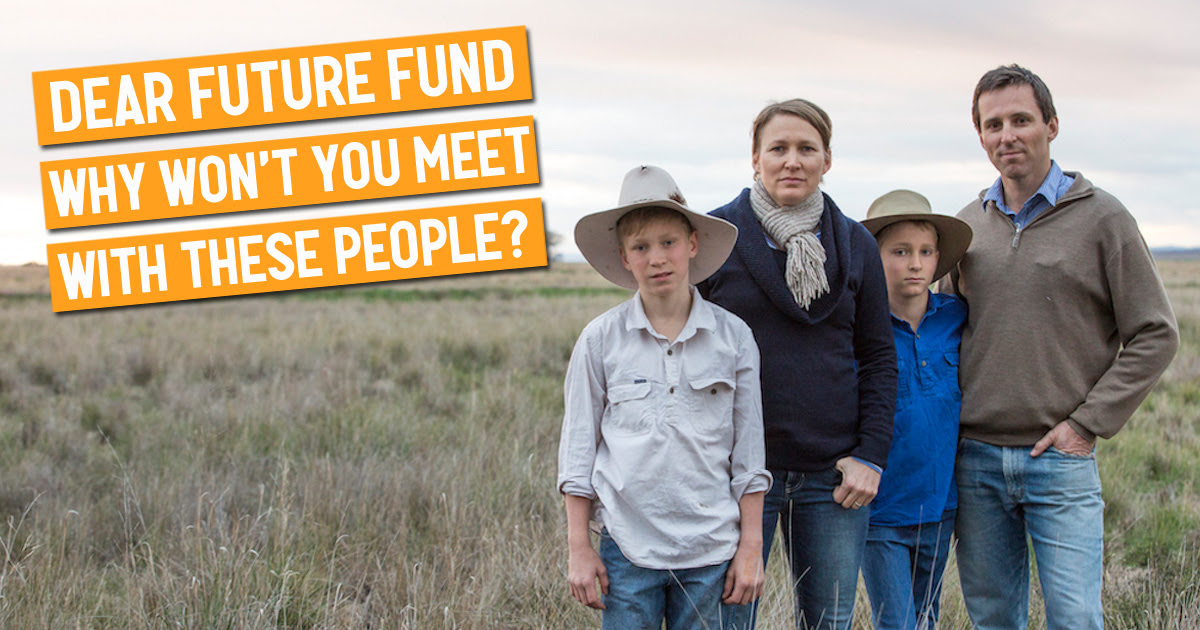
    Can you believe it? The Future Fund – our $117 billion sovereign wealth fund –  has refused to meet with farmers whose livelihoods are directly affected by the fossil fuel companies it invests in!

    Click here to tell the Future Fund to STOP shutting out the community and START shutting out fossil fuels.

    A few weeks ago, Liverpool Plains farmers Derek and Kirrily Blomfield asked you to join them in calling on the Future Fund to divest from fossil fuels. Their land is threatened by the massive proposed Caroona Coal mine, owned by BHP – a company that the Future Fund has almost $1 billion invested in.

    Since then, Derek and Kirrily, together with farmers and former fossil fuel workers, have asked to meet with the Future Fund and share their stories. The Fund responded by rejecting the request to meet.

    Click here to tell the Future Fund to stop ignoring the community and start divesting from fossil fuels.

    Meanwhile, within two days of the Future Fund divestment campaign launching, Future Fund chairman Peter Costello hit back in the Australian Financial Review – vowing that his Fund would never divest and stating that he would “not rule out fossil fuel companies on the grounds that we don’t like fossil fuels.”

    Costello went on to assure readers that the Fund was  “set up to invest for future generations.” Never mind that future generations are guaranteed a miserable future so long as the fund continues to invest in fossil fuels.

    This is about as backward as you get in the investment world. Typically, investors pride themselves on engaging with external stakeholders, even when they continue to invest in climate catastrophe. Investing in fossil fuels is bad enough. Refusing to engage with the community is a whole new level of ridiculous.

    Click here to tell the Future Fund to say YES to community and climate protection and NO to fossil fuels.

    In 2013, the Future Fund bowed to community pressure by divesting from tobacco companies. The case was clear – it was immoral to invest in companies wrecking people’s health. Fossil fuels are no different. They wreck people’s health, homes and livelihoods. And that’s why it’s time for the Future Fund to divest from them.

    And the first step towards that is talking to the communities who are affected most, people who face fossil fuel’s impacts on a daily basis.  Good, honest, hardworking people like Liverpool Plains farmers Derek and Kirrily. The Future Fund’s investments directly affect their future. The affect their two sons’ future. They affect all of our futures.

    Join us in telling the Future Fund to divest from fossil fuels and invest some time in listening to the communities who are bearing the brunt of their bad investment decisions.

    Yours for a brighter future,

    Charlie for the 350 team

    [1] Australian Financial ReviewPeter Costello says Future Fund won’t join fossil fuel divestment, 2nd Sept. 2015.

    PS: Help to amplify the campaign — like and share this graphic on social media: 


    350.org is building a global climate movement.You can connect with us on Facebook, follow us on Twitter, and become a Climate Defender and donate monthly to help 350.org keep Australia’s fossil fuels in the ground.

  • The big Labor Herald stories this week

    The conversation has been marked as not important.
    More

    1 of 20

    The big Labor Herald stories this week

    Inbox
    x

    Alex Brooks updates@laborherald.com.au via sendgrid.info 

    4:15 PM (3 minutes ago)

    to me

    .
    Neville,

    It’s been a week of more talk, but little difference when it comes to the new government. Here’s what’s been trending on the Labor Herald.

    The Top 5 Labor Herald stories this week:

    1. An open letter from Jenny Macklin
    2. 5 principles of Labor economic management
    3. Climate change: has it been subcontracted to the hard right?
    4. The “start-up year”: a plan to kickstart entrepreneurs
    5. The politics of spatial inequality

    Top 5 stories about Labor’s former PMs

    1. Julia proclaimed as fierce feminist in New York
    2. The age of impermanence
    3. Why I miss Paul Keating
    4. When Kevin Rudd became a TV presenter
    5. Whitlam: a tribute

    Policy, economy and the serious stuff

    1. 22 things Labor has to say about economic reform
    2. Reform and the bumps in the road
    3. Two futures

    Alex Brooks
    Editor, Labor Herald

    Ross Caldwell
    Assistant Editor, Labor Herald

  • 3.27°C warmer by 2030? NEVILLE GILLMORE

    8 of 24

    3.27°C warmer by 2030?

    Inbox
    x

    Neville Gillmore <nevilleg729@gmail.com>

    Sep 19 (11 days ago)

    to me
    3.27°C warmer by 2030?
    NOAA data show that the year-to-date land surface temperature was 1.47°C above the 20th century average on the Northern Hemisphere in 2015 compared to the 20th century average. The 20th century average was some 0.60°C higher than temperatures were at the start of the NOAA record in 1880. In other words, temperatures for most people on Earth are already 2.07°C higher than they were in 1880. 2015 is an El Niño year that is still strengthening, so 2016 could well be even warmer. A trendline that on this data points at yet another degree Celsius rise by 2030, on top of the current level that would make us 3.27°C warmer than in 1750.