Category: News

Add your news
You can add news from your networks or groups through the website by becoming an author. Simply register as a member of the Generator, and then email Giovanni asking to become an author. He will then work with you to integrate your content into the site as effectively as possible.
Listen to the Generator News online

 
The Generator news service publishes articles on sustainable development, agriculture and energy as well as observations on current affairs. The news service is used on the weekly radio show, The Generator, as well as by a number of monthly and quarterly magazines. A podcast of the Generator news is also available.
As well as Giovanni’s articles it picks up the most pertinent articles from a range of other news services. You can publish the news feed on your website using RSS, free of charge.
 

Mozambique’s food riots- the true face of global warming

admin /7 September, 2010

Mozambique’s food riots – the true face of global warming

The violence in Maputo is just the latest manifestation of the crippling shortcomings of the global economy.

It has been a summer of record temperatures – Japan had its hottest summer on record, as did South Florida and New York. Meanwhile, Pakistan and Niger are flooded and the eastern US is mopping up after hurricane Earl. None of these individual events can definitively be attributed to global warming. But to see how climate change will play out in the 21st century, you needn’t look to the Met Office. Look, instead, to the deaths and burning tyres in Mozambique‘s “food riots” to see what happens when extreme natural phenomena interact with our unjust economic systems.

A climate warning from the deep

admin /6 September, 2010

A climate warning from the deep

The dispersal of tiny sea creatures in Antarctica has alerted scientists to the vulnerability of Earth’s ice sheets


Bryozoans Bryozoans found in the Ross and Weddell seas were almost identical, meaning the ice sheet that separates them isn’t as ancient as once thought. Photograph: British Antarctic Survey

UN calls special meeting to address food shortages amid predictions of riots.

admin /6 September, 2010

UN calls special meeting to address food shortages amid predictions of riots

Poor harvests and demand from developing countries could push cost of weekly shop up by 10%


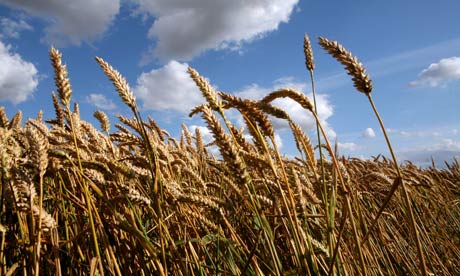
wheat and sky Global wheat harvest this year has been hit by droughts and floods. Photograph: Graham Turner for the Guardian

Two years after the last food crisis, when prices surged by nearly 15% in the UK, food inflation is back. Soaring global food prices have prompted City and food industry experts to warn that the cost of the weekly shop is set to rise by up to 10% in the coming months.

As in 2008, rocketing prices are the result of rising demand and supply shortages caused by freak weather and poor harvests. Moreover, these conditions are exacerbated by speculation on commodity markets and changing diets in fast-growing Asian countries.

Too fearful to publicise peak oil reality

admin /6 September, 2010

Too fearful to publicise peak oil reality

The economic establishment accepts the world soon won’t be able to meet energy demands, but wants to keep quiet about it.

It is very hard for the average person in the street to come to a sensible conclusion on peak oil. It’s a subject that prompts a passionate polarisation of views. The peak oilists sometimes sound like those extraordinary Christians with sandwich boards proclaiming that the end of the world is nigh. In contrast, the the international economic establishment – including the International Energy Agency (IEA) – has one very clear purpose in mind at all times: don’t panic. Their mission seems to be focused on keeping jittery markets calm.

Faced with these options the majority of people shrug their shoulders in confusion and ignore the trickle of whistleblowers, industry insiders and careful analysts who have been warning of the imminent decline in oil for over a decade now.

Remember the Queen’s question – that uncannily accurate and strikingly obvious question she put to economists at the London School of Economics a year ago after the financial crisis: did no one see it coming? Apply that question to peak oil and the answer is that many people did see it coming but they were marginalised, bullied into silence and the evidence was buried in the small print.

Take the 2008 edition of World Energy Outlook, the annual report on which the entire energy industry and governments depend. It included the table also published by the Guardian today, and the version I saw had shorter intervals on the horizontal axis. What it made blindingly clear was that peak oil was somewhere in 2008/9 and that production from currently producing fields was about to drop off a cliff. Fields yet to be developed and yet to be found enabled a plateau of production and it was only “non-conventional oil” which enabled a small rise. Think tar sands of Canada, think some of the most climate polluting oil extraction methods available. Think catastrophe.

Peak oil alarm revealed by secret official talks

admin /4 September, 2010

Peak oil alarm revealed by secret official talks

Behind government dismissals of ‘alarmist’ fears there is growing concern over critical future energy supplies

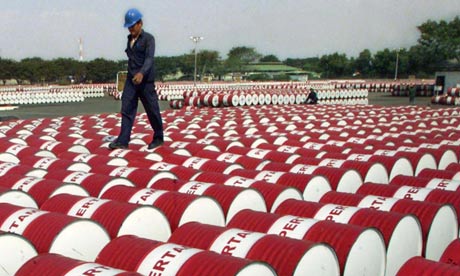
oil barrels Forecasts that crude oil production will reach 150m barrels a day by 2030 have been described as ‘unrealistic’. Photograph: Tatan Syuflana/AP

Speculation that government ministers are far more concerned about a future supply crunch than they have admitted has been fuelled by the revelation that they are canvassing views from industry and the scientific community about “peak oil“.

The Department of Energy and Climate Change (DECC) is also refusing to hand over policy documents about “peak oil” – the point at which oil production reaches its maximum and then declines – under the Freedom of Information (FoI) Act, despite releasing others in which it admits “secrecy around the topic is probably not good”.

Tibetan nomads struggle as grasslands disappear from the roof of the world

admin /4 September, 2010

Tibetan nomads struggle as grasslands disappear from the roof of the world

Scientists say desertification of the mountain grasslands of the Tibetan plateau is accelerating climate change.

  •  
    • guardian.co.uk, Thursday 2 September 2010 18.37 BST
    • Article his Like generations of Tibetan nomads before him, Phuntsok Dorje makes a living raising yaks and other livestock on the vast alpine grasslands that provide a thatch on the roof of the world.

But in recent years the vegetation around his home, the Tibetan plateau, has been destroyed by rising temperatures, excess livestock and plagues of insects and rodents.

The high-altitude meadows are rarely mentioned in discussions of global warming, but the changes to this ground have a profound impact on Tibetan politics and the world’s ecological security.

For Phuntsok Dorje, the issue is more down to earth. He is used to dramatically shifting cloudscapes above his head, but it is the changes below his feet that make him uneasy.

“The grass used to be up to here,” Phuntsok says, indicating a point on his leg a little below the knee. “Twenty years ago, we had to scythe it down. But now, well, you can see for yourself. It’s so short it looks like moss.”

The green prairie that used to surround his tent has become a brown desert. All that is left of the grasslands here are yellowing blotches on a stony surface riddled with rodent holes.

It is the same across much of this plateau, which encompasses an area a third of the size of the US.

Desertification

Scientists say the desertification of the mountain grasslands is accelerating climate change. Without its thatch the roof of the world is less able to absorb moisture and more likely to radiate heat.

Partly because of this the Tibetan mountains have warmed two to three times faster than the global average; the permafrost and glaciers of the “Third Pole” are melting.

To make matters worse, the towering Kunlun, Himalayan and Karakorum ranges that surround the plateau act as a chimney for water vapour – which has a stronger greenhouse gas effect than carbon dioxide – to be convected high into the stratosphere. Mixed with pollution, dust and black carbon (soot) from India and elsewhere, this spreads a brown cloud across swaths of the Eurasian landmass. When permafrost melts it can also release methane, another powerful greenhouse gas. Xiao Ziniu, the director general of the Beijing climate centre, says Tibet‘s climate is the most sensitive in Asia and influences the globe.