

Category: News

Add your news
You can add news from your networks or groups through the website by becoming an author. Simply register as a member of the Generator, and then email Giovanni asking to become an author. He will then work with you to integrate your content into the site as effectively as possible.
Listen to the Generator News online

 
The Generator news service publishes articles on sustainable development, agriculture and energy as well as observations on current affairs. The news service is used on the weekly radio show, The Generator, as well as by a number of monthly and quarterly magazines. A podcast of the Generator news is also available.
As well as Giovanni’s articles it picks up the most pertinent articles from a range of other news services. You can publish the news feed on your website using RSS, free of charge.
 

Climate scientists withdraw journal claims of rising sea levels.

admin /22 February, 2010

(NB. What is the true rise? – No one knows)

Climate scientists withdraw journal claims of rising sea levels

Study claimed in 2009 that sea levels would rise by up to 82cm by the end of century – but the report’s author now says true estimate is still unknown

• Read the full story of the hacked climate emails
• Jeffrey Sachs: Sceptics recycle anti-tobacco control arguments

sea level

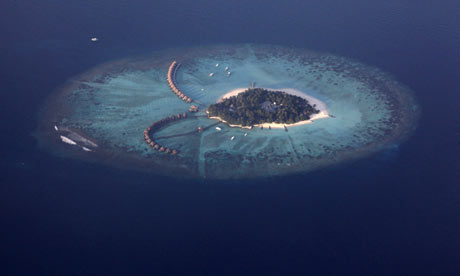
The Maldives is likely to become submerged if the current pace of climate change continues to raise sea levels. Photograph: Reinhard Krause/Reuters

Scientists have been forced to withdraw a study on projected sea level rise due to global warming after finding mistakes that undermined the findings.

The study, published in 2009 in Nature Geoscience, one of the top journals in its field, confirmed the conclusions of the 2007 report from the Intergovernmental Panel on Climate Change (IPCC). It used data over the last 22,000 years to predict that sea level would rise by between 7cm and 82cm by the end of the century.

At the time, Mark Siddall, from the Earth Sciences Department at the University of Bristol, said the study “strengthens the confidence with which one may interpret the IPCC results“. The IPCC said that sea level would probably rise by 18cm-59cm by 2100, though stressed this was based on incomplete information about ice sheet melting and that the true rise could be higher.

Many scientists criticised the IPCC approach as too conservative, and several papers since have suggested that sea level could rise more. Martin Vermeer of the Helsinki University of Technology, Finland and Stefan Rahmstorf of the Potsdam Institute for Climate Impact Research in Germany published a study in December that projected a rise of 0.75m to 1.9m by 2100.

Transport projects will happen: Keneally

admin /22 February, 2010

Transport projects will happen: Keneally AAP February 22, 2010, 2:48 pm      AAP © Enlarge photo   Premier Kristina Keneally says she’ll take personal responsibility for the implementation of NSW’s new transport plan, amid scepticism about whether some projects will see the light of day. Ms Keneally on Sunday announced her government’s $50.2 billion Continue Reading →

Future of food

admin /22 February, 2010

future of food      (Source New Matilda Com) 22 Feb 2010 Tofu-Gate By Anna Greer Shock: Last week’s headlines about vegetarians being bad for the planet turn out to be completely distorted. Anna Greer looks at how hard the media had to work to get it so deliberately wrong Conservative media around the world flipped a Continue Reading →

Gunns shares tumble in steep first-half profit fall

admin /22 February, 2010

Gunns shares tumble in steep first-half profit fall

FORESTRY company Gunns reported a sharp fall in first-half profit today in the face of tough trading conditions and uncertainty about the future of the proposed $2 billion Bell Bay pulp mill in Tasmania.

Net profit in the half ended December 31 plummeted to $420,000 from $33.6 million a year earlier. The result was well below analysts’ expectations, with RBS having forecast an $18.2m first-half profit.

Gunns indicated the first-half result would be the low point in the business cycle, and announced a restructuring of the business to better unlock unrealised value in the company’s assets and provide a sharper focus for investors, with dividend payments expected to resume in the second half.

Earnings before interest and tax in the first half slumped 93 per cent to $4.8m from $69.4m. The result was built on a 24 per cent tumble in revenue to $325.9m from $427.6m previously. No interim dividend was declared, compared with 2 cents previously.

How Rudd the dud dropped Australia in the alphabet soup

admin /22 February, 2010

How Rudd the dud dropped Australia in the alphabet soup

February 22, 2010

Comments 130

a

Illustration: Simon Bosch

Rarely has a government promised so much, spent so much, said so much, and launched so many nationwide programs, and delivered so little value for money and expectation. Two years of Kevin Rudd has produced 20 years of debt, and most of it cannot be blamed on the global financial crisis. This alphabet soup is self-inflicted.

Asylum seekers. Unless the government can show otherwise, it appears that about 98 per cent of asylum-seekers are getting Australian residency. In contrast, the latest figures from the United Nations refugee agency show most asylum applications worldwide are rejected. The bulging Christmas Island detention centre has become a grossly expensive sham and a mockery of a core election promise.

Beijing. Supposedly Rudd’s strong point, the relationship with China deteriorated badly last year after a series of serious missteps with Beijing.

Computers in schools. A million computers promised to schools, one for every student. This turned out to be much harder than it sounded.

Debt and deficit. The Rudd government inherited a massive $90 billion financial firewall when it came to office, via a federal budget surplus, the Future Fund and two infrastructure funds. In two years the budget has gone from $20 billion in surplus to $58 billion in deficit. Net federal debt has gone from zero to a projection of between $130 billion and $180 billion. It took the previous government 10 years to dismantle the $96 billion debt mountain that it inherited. It took Rudd one year to build it back up again.

ETS. The Copenhagen climate conference was a disaster. Rudd’s emissions trading scheme is abstract, complex, expensive and polls show about 80 per cent of Australians do not understand or trust it. A T-shirt produced by Newcastle steelworkers distils the political problem: “Rudd’s ETS: Higher Prices. Lost Jobs. 0.001 degrees cooler.”

Fuelwatch. Big promise, empty outcome.

Grocerywatch. Ditto.

Hospitals. Ditto.

Effects and dangers of methane gases

admin /21 February, 2010


18th February, 2010

Its short lifespan and greater potency means tackling methane emissions now could have a dramatic effect on atmospheric greenhouse gas concentrations

It’s the ‘other’ greenhouse gas, regularly left out of the public discourse on climate change -­ one usually dominated by discussions of carbon dioxide.

Few talk about our ‘methane footprint’; still fewer about the need to achieve a ‘low-methane economy’.

Methane makes up a small (1.77 parts per million/ppm) portion of the atmosphere compared to carbon dioxide (380 ppm), but is a significant component of the greenhouse effect.

Methane molecules absorb 20-30 times more infrared energy than carbon dioxide molecules in their respective lifetimes in the atmosphere, and their overall contribution to the greenhouse effect is estimated at 18 per cent compared to 63 per cent for CO2.

Add this potency to the fact that it has a short lifespan in the atmosphere of between 9-12 years (compared to 100 years for CO2), and you can start to see why cutting methane emissions now could make sense.