

UN to advise on climate change funding.
UN to advise on climate change funding
AFP
UN chief Ban Ki-moon has set up a high-level advisory panel to mobilise funding to help developing nations battle climate change.
The panel, to be led by Britain’s Prime Minister Gordon Brown and his Ethiopian counterpart Meles Zenawi, aimed “to mobilise the resources for climate change pledged at the recent climate change conference in Copenhagen”, Ban told reporters.
The group, evenly balanced between developed and developing nations, “will develop practical proposals to significantly scale up long-term (public and private) financing for mitigation and adaptation strategies in developing countries,” he added.
The UN boss said the group would specifically seek to marshal new and innovative resources to reach a $US100-billion ($A112.3 billion) target by 2020 to fund “adaptation, mitigation, technology development and transfer, and capacity building in developing countries, with priority for the most vulnerable.”
The panel was set to include heads of state and government, top officials from ministries and central banks as well as experts on public finance, development and related issues.
Crisis of climate change confidence
Crisis of climate-change confidence
MARIAN WILKINSON
February 13, 2010
Sceptics are undermining the credibility of fundamental scientific institutions and their research, writes Marian Wilkinson.
Amid the thousands of stolen emails from the University of East Anglia’s Climate Research Unit, posted on websites late last year, a telling exchange among the scientists has been largely overlooked.
It refers to reports that the US and Saudi Arabian governments had played a key role in picking a new candidate to chair the United Nation’s peak scientific body on climate change.
The emails, dating back to April 2002, noted reports of ”intense lobbying” by the US oil industry, specifically Exxon, to try to persuade officials in President George Bush’s White House to block the high-profile British atmospheric chemist, Dr Robert Watson, getting a second term as chairman of the Intergovernmental Panel on Climate Change (IPCC).
Financial crisis Paves the Way for Chinese Solar Giants
Financial Crisis Paves the Way for Chinese Solar Giants
Sales of Chinese solar modules, which accounted for nearly one third of the global market share, were shadowed in the wake of the financial crisis. However, what did not kill the Chinese companies made them stronger, especially in terms of product cost and market access.
Most of the top solar modules manufacturers in China had recovered as of the second half of 2009, according to Sean Tzou, the chief operating officer of Trina Solar Limited, a NYSE-listed Chinese solar photovoltaic company.
Along with sales recovery, the Chinese may have grabbed more market share from their international competitors. “Trina’s global market share is estimated to have reached 6 to 7 percent in 2009, up from 3.5 percent in 2008, ” said Tzou. “We also estimate that Chinese solar module manufacturers, including Taiwan, answered over half of the world’s demand in 2009.”
Chinese farms cause more pollution than factories, says official survey
Chinese farms cause more pollution than factories, says official survey
Groundbreaking government survey pinpoints fertilisers and pesticides as greater source of water contamination
- guardian.co.uk, Tuesday 9 February 2010 15.26 GMT
- Article history
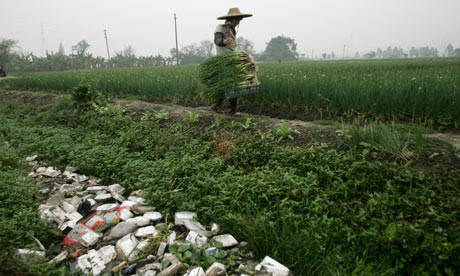
Overuse of fertilisers and pesticides has sent agricultural pollution through the roof. Photograph: Alex Hofford/EPA
Farmers’ fields are a bigger source of water contamination in China than factory effluent, the Chinese government revealed today in its first census on pollution.
Senior officials said the disclosure, after a two-year study involving 570,000 people, would require a partial realignment of environmental policy from smoke stacks to chicken coops, cow sheds and fruit orchards.
Scientists shed light on hydrogen fuel project
Scientists shed light on hydrogen fuel project ABC February 12, 2010, 9:00 am Researchers from the University of Wollongong, on the New South Wales south coast, are part of a group to have developed new technology with the potential to make hydrogen fuel from water. The process would occur using sunlight from solar panels Continue Reading →
Peak oil: the summit that dominates the horizon
Peak oil: the summit that dominates the horizon
Crude is still being discovered; existing fields are not being exploited to the full. So it’s hard to predict the exact point at which the world’s dwindling reserves will precipitate a crisis. But it’s coming
-
- The Observer, Sunday 29 November 2009
- Article history
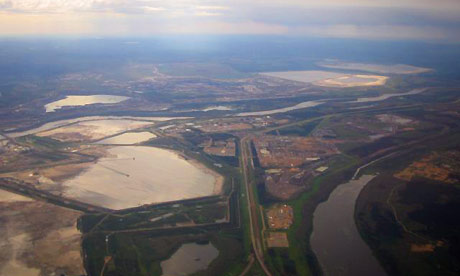
Aerial view of oil extraction at Alberta oil sands, northern Canada. Photograph: John Vidal
Massive new oil finds off the southern states of America and Brazil plus exciting discoveries in currently non-producing countries such as Ghana and Uganda sit uneasily with claims the world is running out of crude.
BP recently boasted about a “giant” strike on the Tiber field in the Gulf of Mexico and BG, the former exploration arm of British Gas, talked of its “supergiant” at the Guará prospect off South America, yet critics argue they cannot make up for the fast depletion of existing fields.