

United Nations’ blunder on glaciers exposed
United Nations’ blunder on glaciers exposed
- From: The Australian
- January 18, 2010
THE peak UN body on climate change has been dealt another humiliating blow to its credibility after it was revealed a central claim of one of its benchmark reports – that most of the Himalayan glaciers would melt by 2035 because of global warming – was based on a “speculative” claim by an obscure Indian scientist.
The 2007 report by the Intergovernmental Panel on Climate Change, which claimed to incorporate the latest and most detailed research into the impact of global warming, appears to have simply adopted the untested opinions of the Indian glaciologist from a magazine article published in 1999.
The IPCC report claimed that the world’s glaciers were melting so fast that those in the Himalayas could vanish inside 30 years.
But the scientists behind the warning have now admitted it was based on a news story in the New Scientist, a popular science journal, published eight years before the IPCC’s report.
Grinding poverty and tectonic volatility make a devastating combination.
Grinding poverty and tectonic volatility make a devastating combination
- guardian.co.uk, Wednesday 13 January 2010 23.43 GMT
- Article history
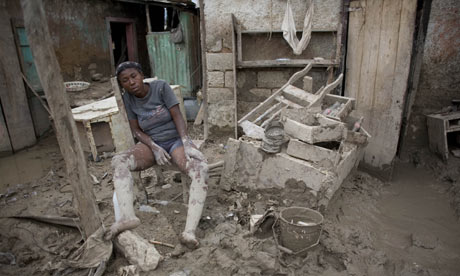
Chalin Sejour, 28, sits in front of her destroyed house with her belongs covered in mud in Gonaives. Aftermath of flood in Haiti in 2008. Photograph: Ariana Cubillos/AP
Haiti was a humanitarian disaster even before the earthquake hit. It is the poorest country in the western hemisphere; most of its buildings are badly constructed out of tin and cheap concrete with many slums perched on steep, bare hillsides which are particularly prone to landslides.
In addition, the population of 9 million has barely recovered from a series of devastating flash floods, hurricanes and mudslides in the last few years.
According to Oxfam, more than one in three people in the country were already short of food, and thousands had been made homeless after four hurricanes and tropical storms which struck the island in just a few months in 2008. The hurricanes alone caused damage valued at 15% of GDP, derailing economic growth.
British coastal cities threatened by rising sea ‘must transform themselves’
British coastal cities threatened by rising sea ‘must transform themselves’
Hull and Portsmouth could be dramatically remodelled, suggests report
- guardian.co.uk, Friday 15 January 2010
- Article history
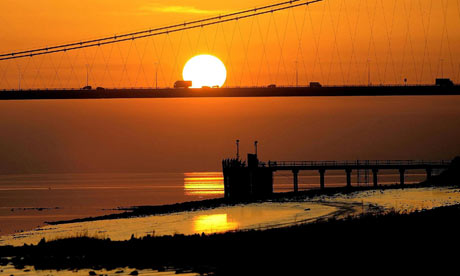
Hull: Venice of the North? A dramatic sunset over the nearby Humber bridge. Photograph: John Giles/PA
Hull could be transformed into a Venice-like waterworld and Portsmouth into a south coast version of Amalfi, engineers and architects have claimed in a study of options for developing Britain’s coastal cities in the face of rising sea levels.
The Institution of Civil Engineers and the Royal Institute of British Architects yesterday warned the future of cities including London, Bristol and Liverpool was at risk from seas which the Environment Agency predict could rise by as much as 1.9m by 2095 in the event of a dramatic melting of the Greenland ice sheet.
The report, Facing up to Rising Sea Levels. Retreat? Defence? Attack?, suggests swaths of Hull and Portsmouth’s city centres could be allowed to flood over the next 100 years and large parts of the populations moved out.
Get ready for seven-foot sea level rise as climate change melts ice sheets
Get ready for seven-foot sea level rise as climate change melts ice sheets
The IPCC’s 2007 report missed out the melting of the Greenland and West Antarctic ice sheets which would be the key drivers in dramatic sea level rises. From Yale Environment 360, part of the Guardian Environment Network
- guardian.co.uk, Friday 15 January 2010 11.57 GMT
- Article history
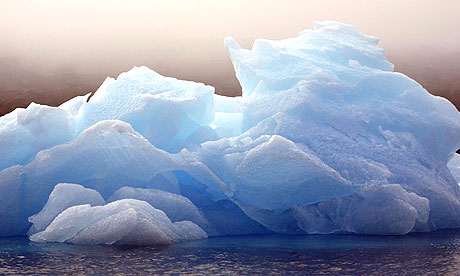
An iceberg off Ammassalik island, Greenland. Photograph: John McConnico/AP
The reports from the Intergovernmental Panel on Climate Change (IPCC) are balanced and comprehensive documents summarizing the impact of global warming on the planet. But they are not without imperfections, and one of the most notable was the analysis of future sea level rise contained in the latest report, issued in 2007.
Given the complexities of forecasting how much the melting of the Greenland and West Antarctic ice sheets will contribute to increases in global sea level, the IPCC chose not to include these giant ice masses in their calculations, thus ignoring what is likely to be the most important source of sea level rise in the 21st century. Arguing that too little was understood about ice sheet collapse to construct a mathematical model upon which even a rough estimate could be based, the IPCC came up with sea level predictions using thermal expansion of the oceans and melting of mountain glaciers outside the poles. Its results were predictably conservative — a maximum of a two-foot rise this century — and were even a foot lower than an earlier IPCC report that factored in some melting of Greenland’s ice sheet.
Climate scientists convene global geo-engineering summit
Climate scientists convene global geo-engineering summit
Meeting in California in March will discuss possible field trials of schemes that would tackle climate change by reflecting sunlight or fertilising the ocean with iro
- guardian.co.uk, Tuesday 12 January 2010 16.58 GMT
- Article history
Geo-engineering techniques, such as filling the sky with shiny dust to reflect sunlight, could curb such temperature rises without the need to restrict greenhouse gas emissions
Scientists are to hold a high-level summit to discuss how the world could take emergency measures such as blocking out the sun to slow dangerous global warming.
Experts from around the world have been invited to attend the meeting in March in California, which will examine possible field trials of so-called geo-engineering schemes, such as pumping chemicals into the air and oceans to combat climate change.
The move follows the failure of the recent Copenhagen climate talks to set meaningful carbon reduction targets, and comes amid mounting concern that such controversial techniques may be the only way to curb rising temperatures.
Arctic permafrost leaking methane at record levels, figures show
Arctic permafrost leaking methane at record levels, figures show
Experts say methane emissions from the Arctic have risen by almost one-third in just five years, and that sharply rising temperatures are to blame
- guardian.co.uk, Thursday 14 January 2010 19.00 GMT
- Article history
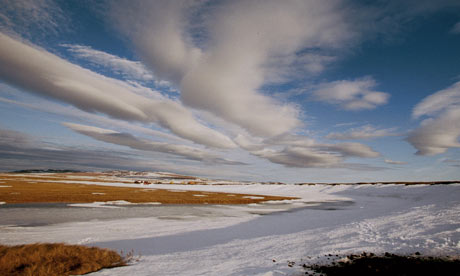
Permafrost in Siberia. Methane emissions from the Arctic permafrost increased by 31% from 2003-07, figures show. Photograph: Francis Latreille/Corbis
Scientists have recorded a massive spike in the amount of a powerful greenhouse gas seeping from Arctic permafrost, in a discovery that highlights the risks of a dangerous climate tipping point.
Experts say methane emissions from the Arctic have risen by almost one-third in just five years, and that sharply rising temperatures are to blame.