

Peru’s mountain people face fight for survival in a bitter winter
Peru’s mountain people face fight for survival in a bitter winter
Climate change is bringing freezing temperatures to poor villages where families have long existed on the margins of survival. Now some must choose whether to save the animals that give them a living, or their child
- The Observer, Sunday 3 January 2010
- Article history
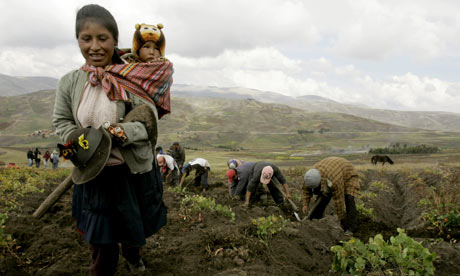
A farmer walks with her son during a potato harvest in Huancavelica, southern Peru. Photograph: Martin Mejia/AP
For alpaca farmer Ignacio Beneto Huamani and his young family, life in the Peruvian Andes, at almost 4,700m above sea level, has always been a struggle against the elements. His village of Pichccahuasi, in Peru‘s Huancavelica region, is little more than a collection of small thatched shelters and herds of alpaca surrounded by beautiful, yet bleakly inhospitable, mountain terrain.
The few hundred people who live here are hardened to poverty and months of sub-zero temperatures during the long winter. But, for the fourth year running, the cold came early. First their animals and now their children are dying and in such escalating numbers that many fear that life in the village may be rapidly approaching an end.
Climate has no time for delay or denial
Climate change has no time for delay or denial
Powerful vested interests and climate sceptics will work overtime to block legislation and discredit the science ahead of the next global climate summit in Mexic
-
- guardian.co.uk, Monday 4 January 2010 16.24 GMT
- Article history
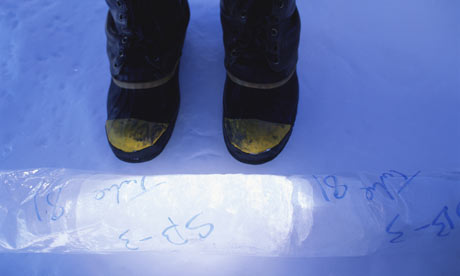
A team of glaciologists measure ice on Mount Sajama, Bolivia. Emails from the University of East Anglia were hacked last year by climate deniers in a bid to to discredit the science contained in a report by the Intergovernmental Panel on Climate Change (IPCC). Photograph: George Steinmetz/Corbis
It is often said by perceptive observers that a disconnect is in evidence in many countries between a public that want stringent action to tackle climate change and what governments are actually doing.
The United States, for example – which for many years has had no forward-looking policies in reducing emissions of greenhouse gases (GHGs) – is still encumbered with a large number of senators unwilling to act on account of partisanship or scepticism about the science of climate change.
Sea Rise Mapping
Here is an interesting site. http://flood.firetree.net/ It shows maps of the world which can be magnified in detail like Google maps. You set the extent of sea level rise from 1 metre to 14 metre rise in sea level and can check out the new shape of the new coastline. Check out Sydney for instance. Kind Continue Reading →
Australian bakes through warmest decade on record
Australia bakes through warmest decade on record
Posted
Updated
Heatwave: 2009 ended Australia’s warmest decade on record. (ABC TV: Chris Keane)
The Bureau of Meteorology says figures showing Australia has experienced its hottest decade since records began in 1910 are clear evidence of climate change.
The Bureau’s annual report has found the average temperature over the past 10 years was 0.48 degrees Celsius above average.
Climatologist David Jones says each decade since the 1940s has been warmer than the previous one.
And he has warned that this year is set to be even hotter, with temperatures likely to be between 0.5 and 1 degrees above average.
Afer this 60-year feeding frenzy, Earth itself has become disposable
After this 60-year feeding frenzy, Earth itself has become disposable
Consumerism has, as Huxley feared, changed all of us – we’d rather hop to a brave new world than rein in our spending
-
- guardian.co.uk, Monday 4 January 2010 20.30 GMT
- Article history
Who said this? “All the evidence shows that beyond the sort of standard of living which Britain has now achieved, extra growth does not automatically translate into human welfare and happiness.” Was it a) the boss of Greenpeace, b) the director of the New Economics Foundation, or c) an anarchist planning the next climate camp? None of the above: d) the former head of the Confederation of British Industry, who currently runs the Financial Services Authority. In an interview broadcast last Friday, Lord Turner brought the consumer society’s most subversive observation into the mainstream.
In our hearts most of us know it is true, but we live as if it were not. Progress is measured by the speed at which we destroy the conditions that sustain life. Governments are deemed to succeed or fail by how well they make money go round, regardless of whether it serves any useful purpose. They regard it as a sacred duty to encourage the country’s most revolting spectacle: the annual feeding frenzy in which shoppers queue all night, then stampede into the shops, elbow, trample and sometimes fight to be the first to carry off some designer junk which will go into landfill before the sales next year. The madder the orgy, the greater the triumph of economic management.
Africa’s apocalyptic mood
Africa’s apocalyptic mood
Religious fervour and the effects of climate change may combine with explosive effect over the coming months and years.
-
- guardian.co.uk, Thursday 31 December 2009 13.00 GMT
- Article history
The story is told of how two Ghanaian old ladies emerged from church one Sunday morning in June 1967. During the service, the minister had asked for prayers for the people of Israel, who were at war.
“Akosua”, one lady turned to the other, “what are we going to do?”
“Do about what?” the other asked, perplexed.
“Didn’t you hear the priest? Jerusalem is about to be destroyed!”
“Oh that … “
“Yes. You and I have been paying our church dues regularly. We have been coming to morning service without fail. But now that we are approaching the time when we shall leave this place of suffering and go to Jerusalem, our heavenly home of eternal peace, they say that that place, too, is going to be destroyed.”
“It’s not fair!” the other old lady assented. “All our good deeds have been done in vain!”
This story illustrates a phenomenon very common indeed in Africa: many Christians on the continent take what the Bible says about almost anything quite literally.
It is therefore extremely worrying that climate change is already changing the Africa’s environment irreversibly.