

Copenhagen: it’s time Europe started acting like it truly means what it says
Copenhagen: it’s time Europe started acting like it truly means what it says
The Copenhagen talks have ended in chaos and confusion with the multilateral process stretched to the point of collapse. It seems distrust and narrow self-interest have won the day. From Sandbag.org.uk, part of the Guardian Environment Network
- guardian.co.uk, Tuesday 22 December 2009 11.56 GMT
- Article history
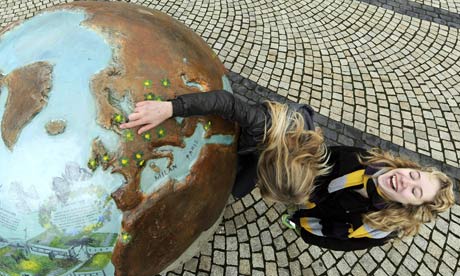
A girl stretches up to the top of a globe to point out Denmark while her friend giggles at an art installation entitled Cool Globes, an exhibition about combating global warming and climate change in Kongens Nytorv. Photograph: Adrian Dennis/AFP/Getty Images
The Copenhagen accord exists and has been heralded by some as a new beginning, involving a wider number of countries in a common effort to avert catastrophe. Despite its unclear legal status, countries who support it should now record nationally derived targets in an annex before the end of January 2010. This raises the question of what targets will countries enter and can they be increased?
Preparing for the inevitable
Preparing for the Inevitable
John James. www.planetextinction.com
The great party of the twentieth century is coming to an end.
Unless we start preparing our survival kit we will soon be just another species eking out an existence in the few habitable regions.
We should NOW be preparing for the rise of sea levels, spells of near-intolerable heat and storms of unprecedented severity. We need NOW to develop strategies to ensure reliable access to food and water, and how distribute food with minimal petrol. We need NOW crisis teams to prepare for unprecedented and massive migration, disease and epidemics? We need NOW to ensure our national security.
We cannot wait. Ten years from now could well be too late.
This never happens in peacetime – for it generally takes a generation or more for new concepts to become mainstream. Global warming is a national emergency. We need to plan it as a war in which everyone will be mobilised.
Since the world is too big and too divided to organise as one,
each individual nation will have to do it for themselves.
Plants and animals race for survival as climate change creeps across the globe
Plants and animals race for survival as climate change creeps across the globe
Lowland tropics, mangroves and deserts at greater risk than mountainous areas as global warming spreads, study finds
- guardian.co.uk, Wednesday 23 December 2009 18.20 GMT
- Article history
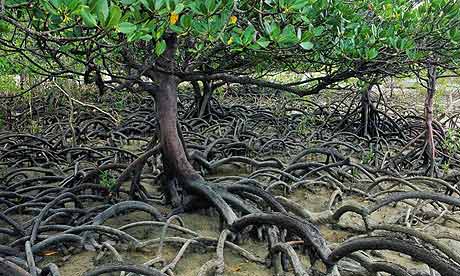
Mangroves are some of the areas most vulnerable to climate change, as a new study by the Carnegie Instuttion in California reveals the rapid movement of global warming across the world. Photograph: Corbis
Global warming creeps across the world at a speed of a quarter of a mile each year, according to a new study that highlights the problems that rising temperatures pose to plants and animals. Species that can tolerate only a narrow range of temperatures will need to move as quickly if they are to survive. Wildlife in lowland tropics, mangroves and desert areas are at greater risk than species in mountainous areas, the study suggests.
Marine mammals under threat from ocean noise pollution
Marine mammals under threat from ocean noise pollution
Ecologist
21st December, 2009
Oceans becoming noisier as sounds travel further in increasingly acidic water
Ocean noise pollution is getting worse and harming marine mammals because of the affects of carbon emissions and ocean acidification, according to a new study.
Rising carbon emissions are making the oceans more acidic as the CO2 combines with the seawater to produce carbonic acid.
In turn, ocean acidification and rises in seawater temperature make seas less able to absorb low-frequency sounds, so noise travels further. This is linked to deafness in dolphins, beachings and loss of habitat as marine mammals seek quieter surroundings.
Amazon Forest in Critical Danger
Amazon Forest in Critical Danger
Dr. John James. www.planetextinction.com
The vast Amazon rainforest is on the brink of being turned into desert, with catastrophic consequences for the world’s climate. And the process, which would be irreversible, could begin as early as next year. The cause comes from the permanence of the El Nino climate from the Pacific that is altering the precipitation in Amazonia.
Scientists were surprised to find that the forest is rapidly approaching a “tipping point” that would lead to its total destruction. Dr Nepstead covered an area of rainforest the size of a football pitch with plastic panels to see how it would cope without rain, and expected to record only minor changes.
The trees managed the first year of drought without difficulty. In the second year, they sunk their roots deeper to find moisture, but survived. But in year three, they started dying. Beginning with the tallest the trees started to come crashing down, exposing the forest floor to the drying sun.
Gulf Stream Collapse
Gulf Stream Collapse
Dr John James www.planetextinction.com
The Gulf Stream has slowed by 6 million tonnes of water per second over the past 30 years. Many scientists are worried that this portends a collapse and have applied computer models to work out the alternatives. These show there is a 50% chance the current will collapse totally when global temperatures rise by 3°C.
The waters that flow from the Antarctic to the north on the surface of the Atlantic are warm and lose water by evaporating, and therefore get saltier. Salt water is heavier than fresh water and when it reaches the north Atlantic it would sink were it not that the cold water from the arctic is denser still. The arctic water sinks under the warm and provides the force that drives the conveyor and creates the Gulf Stream.