

US climate agency declares CO2 public danger
US climate agency declares CO2 public danger
Environmental Protection Agency declaration allows it to impose emissions cuts without agreement of reluctant Senate
- guardian.co.uk, Monday 7 December 2009 20.24 GMT
- Article history
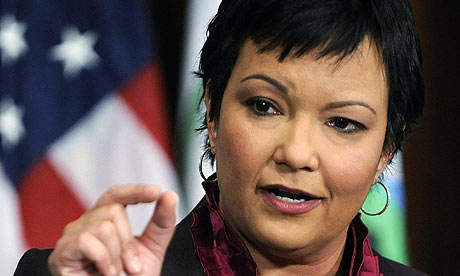
Lisa Jackson announcing the new US government position that greenhouse gases are a threat to public health. Photograph: Jonathan Ernst/Reuters
The Obama administration adopted its climate change plan B today, formally declaring carbon dioxide a public danger so that it can cut greenhouse gas emissions even without the agreement of a reluctant Senate.
The timing of the announcement – in the opening hours of the UN’s Copenhagen climate change summit – prevents Barack Obama from arriving at the talks without concrete evidence that America will do its bit to cut the emissions that cause global warming.
Tont Abbott’s scepticism will shock liberal voters
Tony Abbott’s scepticism will shock Liberal voters Australian Greens Leader Bob Brown has said that Tony Abbott’s statedscepticism on climate change today will shock many Liberal voters. “And in a world where both big and small business understand the scienceof climate change and the need for appropriate action, Abbott’s commentswill also dismay most business operators,” Continue Reading →
ETS will cost families ‘little or nothing’ promises Rudd
ETS will cost families ‘little or nothing’, promises Rudd
- From:
- December 08, 2009
FAMILIES will pay little or nothing for Labor’s emissions trading scheme, Prime Minister Kevin Rudd has pledged.
The Daily Telegraph reports full or partial compensation for rising costs would be available for couples with children on an income up to $160,000, as well as for singles on $30,000 a year or less.
Mr Rudd acknowledged that the Government’s defeated ETS legislation, which will be brought back to Parliament in February, would add to household costs.
Average electricity bills would rise $208 a year, gas costs would go up $83 a year and food expenses would increase by $68 a year, according to Treasury estimates prepared last month.
PM ‘ignoring’ plight of Australia’s sinking islands
PM ‘ignoring’ plight of Australia’s sinking islands
Posted
Updated
They are as numerous as they are picturesque. From the air, Australia’s Torres Strait islands are striking.
On the day I flew from Horn Island – just off the tip of Cape York – north toward the wilds of Papua New Guinea’s south-western coast, the sea was like aquamarine Venetian glass.
The cumulous clouds which hung above each of these varied islands were perfectly reflected, and the fine details of the scattered, shallow reefs were evident.
A single abandoned ship, marooned long ago on a reef in the centre of the strait, stood as evidence of just how treacherous these otherwise welcoming waters can be. That danger appears to be getting worse.
I was on my way to Boigu Island, which, unless I am mistaken, is Australia’s most northern frontier.
It, and nearby Saibai Island, are known as the mud islands – and for good reason.
Copenhagen deal taking world to 3.5 degree rise
Copenhagen deal taking world to 3.5 degree rise
Ecologist
7th December, 2009
Industrialised countries need to decrease their emissions to between 25-40 per cent on 1990 levels by 2020, according to IPCC
The ‘Climate Action Tracker‘, developed by renewable energy consultants Ecofys and the Potsdam Institute for Climate Impact Research (PIK), assesses the individual and combined emissions of every country taking into account their stated emission targets.
As it stands, world emissions growth would not stop before 2040 with CO2 emissions from aviation and marine transport likely to be nearly 4 times 1990 levels by 2050.
The Intergovernmental Panel on Climate Change (IPCC) says emissions growth needs to peak by 2015. Industrialised countries also need to reduce their emissions by 25-40 per cent on 1990 levels by 2020.
Emissions from industrialised countries, including the US and Russia, are currently projected to fall by 8-14 per cent on 1990 levels by 2020.
‘From these numbers, there is at least a one-in-four chance of exceeding a warming of 4 degrees,’ said Dr Bill Hare, from the Potsdam Institute for Climate Impact Research.
On current pledges, the most ambitious countries are the Maldives and Costa Rica, which have pledged to become carbon-neutral by 2020. Norway, Japan and Brazil have also announced significant emissions reductions.
Belarus, Russia and Ukraine are among the countries that have yet to propose substantial action beyond ‘business as usual’.
Copenhagen: all you need to know
Copenhagen in 60 secs: key facts and figures
Useful links
Climate Action Tracker
Potsdam Institute for Climate Impact Research (PIK)
Copenhagen must be a turning point. Our children won’t forgive us if we fail
Copenhagen must be a turning point. Our children won’t forgive us if we fail
We need to build a low carbon economy across the world, with a deal that helps developing nations and ensures trust
-
- guardian.co.uk, Sunday 6 December 2009 22.02 GMT
- Article history
Throughout history human progress has arisen from the dream of achieving far-reaching change even when people have said it was beyond our grasp, and from the struggle to overcome obstacles even when they seem insurmountable.
Today we face a global challenge whose solution, for decades until now, has appeared beyond our reach – impossible, unaffordable and unworkable.
But catastrophic climate change is no more a matter of untameable fate than slavery, women’s oppression, mass unemployment or nuclear war. And over the next two weeks we have the chance to come together, as a truly global community, to take the first decisive action needed to change its course.