

Wong boring everyone to tears with details of flawed CPRS/
Wong boring everyone to tears with details of flawed CPRS
Like most parliamentarians, Penny Wong, the Minister for Climate Change, is a climate sceptic. Of course she prefers to use that term to describe those who ignore the overwhelming science about the causes of climate change, but yet she ignores those same scientists when it comes to deciding what to do about climate change.
DEVELOPED COUNTRY EMISSIONS PLEDGES FALL SHORT, ANALYSIS SHOWS
Developed country emissions pledges fall short, analysis shows
From the World Resources Institute, part of the Guardian Environment Network
- From the World Resources Institute, part of the Guardian Environment Network
- guardian.co.uk, Friday 9 October 2009 13.35 BST
- Article history
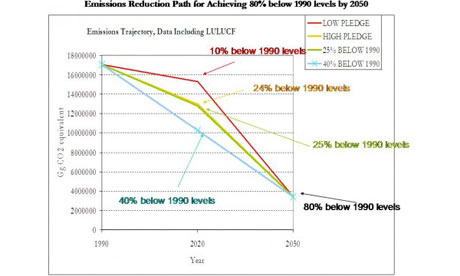 WRI analysis of greenhouse gas reduction pledges Photograph: WRI
Commitments made by developed countries to reduce greenhouse gas emissions, when added together, fall short of stabilizing global temperatures at a level that averts dangerous climate change.
A history of CO2 emissions
A history of CO2 emissions
How are ’emissions debts’ influencing the Copenhagen negotiations?

Old world order … should CO2 cuts incorporate the principle of historical responsibility? Photograph: HO/Reuters
Scanning through the amount of carbon dioxide that countries put into the atmosphere over the past century might seem even irrelevant to modern climate change debates.
ETS war heats up on costs as coalition set for talks
ETS war heats up on costs as Coalition set for talks
Lenore Taylor, National correspondent | October 13, 2009
HIP-POCKET concerns about the cost of emissions trading for households and small business have emerged as key battlegrounds between Labor and the Coalition as both sides prepare for high-stakes negotiations that could begin as early as next week.
Coalition frontbencher Ian Macfarlane says electricity price rises will be as high as 30 or 40 per cent by 2020, and the Coalition will demand amendments to the government’s proposed “inadequate and temporary” compensation.
But the government claims Mr Macfarlane has his figures wrong.
Monsoon threatens Sri Lankan refugees with ‘humanitarian disaster’, warns UN .
Monsoon threatens Sri Lankan refugees with ‘humanitarian disaster’, warns UN
Refugees held in internment camp said to be ‘at serious risk of flooding’ as monsoon season approaches
- The Observer, Sunday 11 October 2009
- Article history
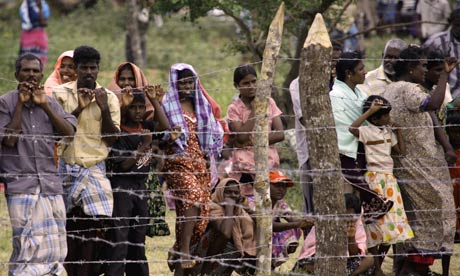
Civilians stand behind the barbed-wire perimeter fence of the Manik Farm refugee camp near Vavuniya, Sri Lanka. Photograph: David Gray / Reuters/REUTERS
Tens of thousands of detained refugees from the war in Sri Lanka are threatened by the imminent arrival of monsoon rains in the north of the country, according to an internal United Nations document.
The UN believes that about 66,000 people held in the vast Menik Farm internment camp since May face a humanitarian disaster when the rains start, bringing the spectre of disease. Officials have urged the government to move those whose tents are most likely to be flooded by a mixture of rain and sewage.
Food,famine & climate change: How we feed the world on 85p t
Food, famine & climate change: How we feed the world on 85p
As successive droughts and financial turmoil push a billion people worldwide to the brink of starvation, Plumpy’nut, a fast-food wonder snack, is quietly saving children’s lives
- The Observer, Sunday 11 October 2009
- Article history
Fatima Ibrahim was having two of her children weighed, measured and fussed over when we found her with 30 other mums and more than 50 hungry kids at an emergency feeding centre in northern Kenya. Barwaco came in at 12.8kg and her brother Mohamed at 8.1, and both were crying lustily as people crowded round Dida Jirma, a young community doctor.
Jirma noted the children’s weights and height and measured the circumference of their left upper arms. Some were ominously quiet and clearly ill, others playful. When it was Fatima’s turn, the doctor dived into a big cardboard box and counted out two dozen silver foil sachets of Plumpy’nut – one of the 21st century’s true superfoods.
Barwaco and Mohamed come from Nana, a small village way up on the stony Kenyan Ethiopian border. But like millions more children around the world, they owe their lives to this brand of food which is never advertised and is unknown outside disaster spots. The sweet paste, invented by a French scientist, is made under licence to UN children’s charity Unesco on an industrial estate outside Le Havre, and its mix of peanut butter, vegetable oils, powdered milk, sugar, vitamins and minerals is the equivalent of royal jelly, açaí berries and chocolate all wrapped into one for malnourished children. It’s cheap – a sachet costs about 85p – and because it needs no cooking or added water, children can safely feed themselves on it at home. In just a few years “ready-to-use therapeutic foods” (RUTF) like Plumpy’nut have revolutionised the treatment of severe malnutrition.