

Adelaide latest victim of global water shortages
Adelaide latest victim of global water shortages
Australia’s fifth-largest city could be reliant on bottled water as early as next week as overuse and drought stretch the Murray River to its limits
- guardian.co.uk, Monday 28 September 2009 17.58 BST
- Article history
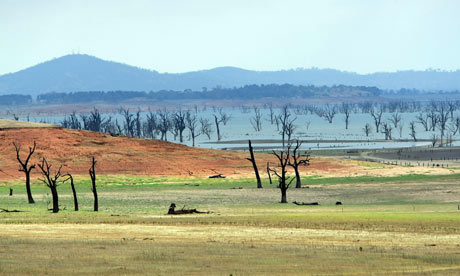
Lake Hume, part of the Murray River system in Australia, has been devastated by drought. Photograph: Torsten Blackwood/AFP/Getty Images
The water in Australia‘s biggest river is running so low and is so salty that the nation’s fifth-largest city, Adelaide, is at risk of having to ship water in to its residents, politicians have warned.
Adelaide’s water crisis follows similar problems in cities around the world, as the combination of growing population, increasing agricultural use and global warming stretches resources to the limit. Experts are warning of permanent drought in many regions.
Salinity levels in some stretches of the Murray River already exceed the World Health Organisation‘s recommendations for safe drinking, and South Australia’s water authority and 11 rural townships east of Adelaide have been told to prepare for the worst.
Dust storms spread deadly diseases worldwide
Dust storms spread deadly diseases worldwide
Dust storms like the one that plagued Sydney are blowing bacteria to all corners of the globe, with viruses that will attack the human body. Yet these scourges can also help mitigate climate change
- The Observer, Sunday 27 September 2009
- Article history
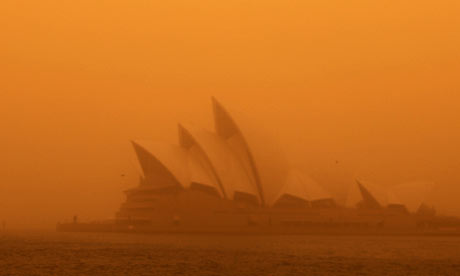
A dust storm blankets Sydney’s iconic Opera House at sunrise. Photograph: Tim Wimborne/Reuters
Huge dust storms, like the ones that blanketed Sydney twice last week, hit Queensland yesterday and turned the air red across much of eastern Australia, are spreading lethal epidemics around the world. However, they can also absorb climate change emissions, say researchers studying the little understood but growing phenomenon.
Saving our rail lines
Hello
The campaign in support of NSW rail and to stop the government’s so called
rail trail bill is hotting up.
If the Transport Administration Amendment (Rail Trails) Bill 2009 is passed
rail lines and train stations could be sold off at the Minister’s whim. The
public consultation set out in the bill is meaningless. It is a smoke screen
to try and justify a bad law.
The Thaw at the Roof of the World
The Thaw at the Roof of the World
- PrintBy ORVILLE SCHELL
SPEAKING this week at the United Nations, President Hu Jintao of China declared that his country “fully appreciates the importance and urgency of addressing climate change.” As well it should. China is beginning to realize that it has a lot to lose from the carbon dioxide that the world so blithely emits into the earth’s atmosphere.
Mr. Hu’s words made me think back to a day not long ago when I found myself on a platform 14,000 feet above sea level, surrounded by throngs of Chinese tourists in colorful parkas. A chairlift had brought us that much closer to the jagged peaks of Jade Dragon Snow Mountain and the glacier that cascades down its flank. People cheerfully snapped photos of the icy mass, seemingly unaware of the disaster unfolding before them.
Because of climate change, the roughly 1.7-mile-long Baishui Glacier No. 1 could well be one of the first major glacial systems on the Tibetan Plateau to disappear after thousands of years. The glacier, situated above the honky-tonk town of Lijiang in southwest China, has receded 830 feet over the last two decades and appears to be wasting away at an ever more rapid rate each year. It is the southernmost glacier on the plateau, so its decline is an early warning of what may ultimately befall the approximately 18,000 higher-altitude glaciers in the Greater Himalayas as the planet continues to warm.
Climate groups dimayed at G20
Climate groups dismayed at G20
September 26, 2009
CLIMATE change campaigners have expressed dismay after the leaders of the world’s most important economies failed to earmark funds to pay for a deal to cut carbon emissions.
States are due to hold a global summit – billed as the last chance to halt global warming – in Copenhagen in December in order to agree on ambitious new targets for cutting the production of greenhouse gases.
Emerging economies, led by a sceptical India, have insisted that they can not sign up to such a deal unless the rich-world nations whose industry caused the problem pay billions to finance their transfer to new clean technologies.
Campaigners had hoped that under the chairmanship of US President Barack Obama the Group of 20 summit might agree to set aside $US150 billion to pay for this work and convince emerging economies to sign the deal.
STOP CAPITALISM DEFINING HUMAN NATURE
Stop capitalism defining human nature
To solve global problems such as climate change, we need to escape our market-driven definition as greedy individuals
-
- guardian.co.uk, Thursday 24 September 2009 08.00 BST
- Article history
The global imagery of capitalist plenty has long ago been usurped, not only by other visions of an earthly paradise, but also other versions of prosperity. Capitalist ideology has ceased to be abstract theory and is made tangible in every object of desire set before us. At the same time, in this promiscuous spillage of commodities, a whole moral universe is implicit.
Puritans and moralists sometimes identify consumerism, the bonus culture, the acquisitive society, live-now-pay-later philosophy as “greed”. But these, like all other sins and vices, have been recast by the altered moral order. Many of what were regarded as human failings have been transformed into economic virtues. Covetousness has become ambition, envy now reappears as a manifestation of a healthy competitive spirit, gluttony is only a natural desire for more and lust a necessary expression of our deepest human reality. Temptation is no longer an impulse to be resisted: it is our duty to yield to it in the name of that most exalted of purposes, “consumer confidence“.